Rape Culture, Indian Edition

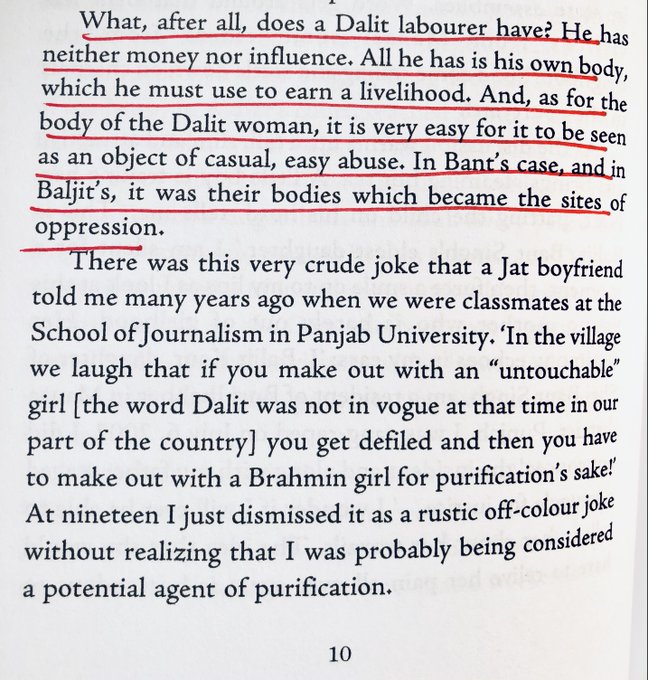
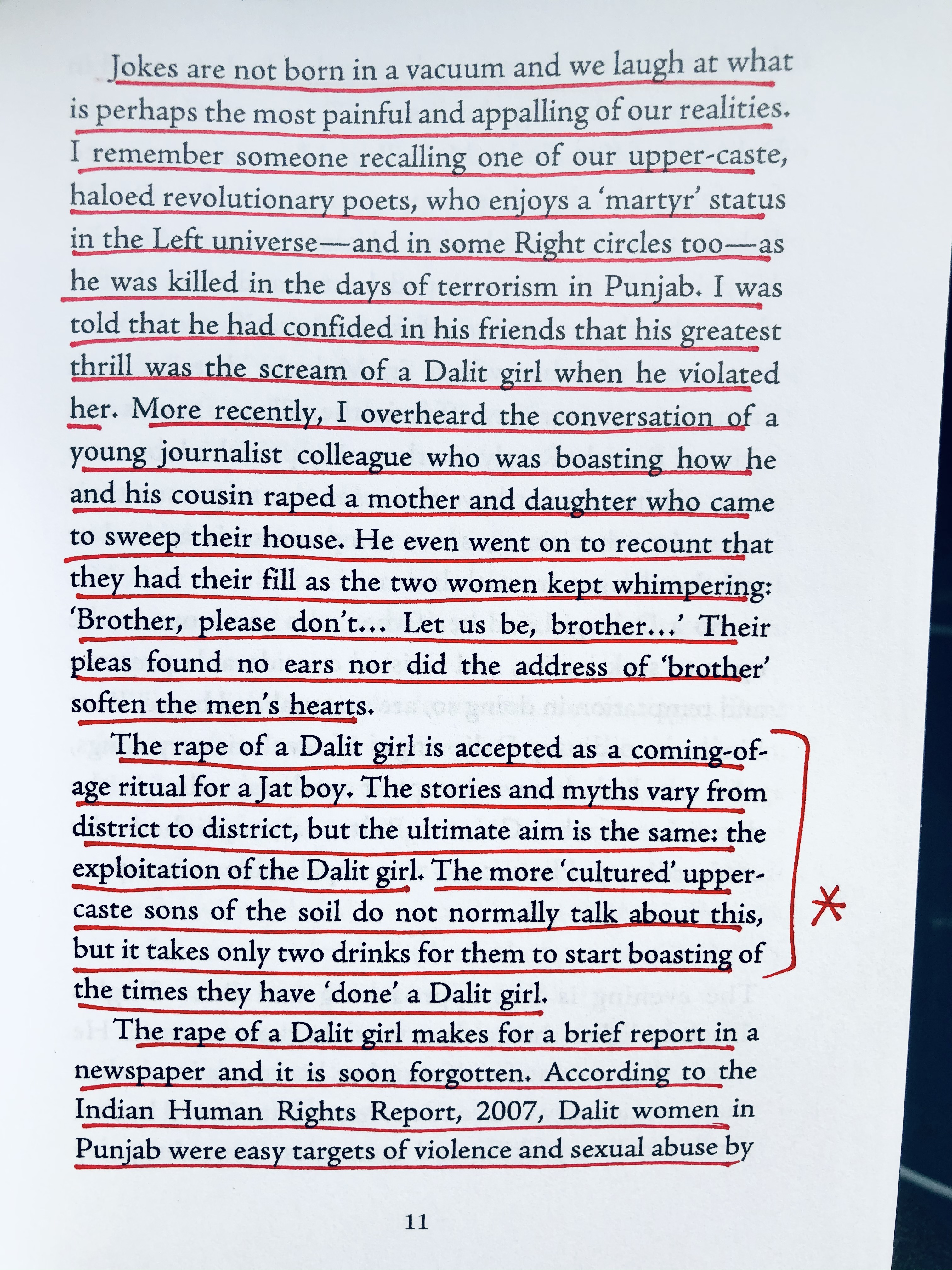
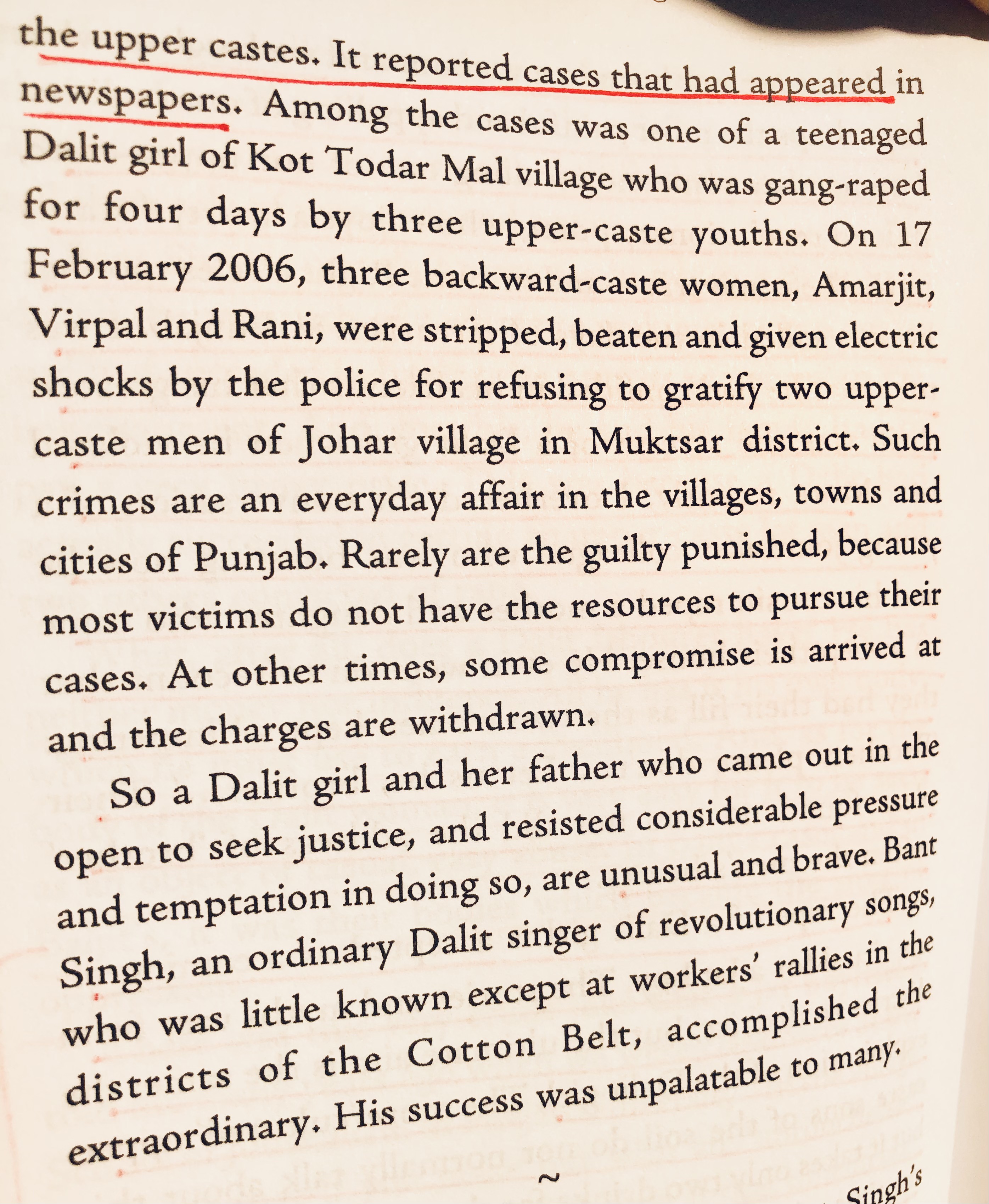
There is news about another rape case (alleged rape case?) making wavers in India and Twitter regular @conradkbarwa posted some excerpts from a book by poet and journalist Nirupama Dutta that you can see below:


Image

Image

Image

The anecdotes listed in these pages are obviously very disturbing and shocking, and I have no doubt that even if Nirupama moves in unusually nasty company, many such cases do occur across the Indian subcontinent and in most of them the police are yet another source of oppression (and sometimes even a second rape in the police station). The excerpts above are from East Punjab, so from a land that we are not entirely unfamiliar with (apart from whatever similarities exist across east and west Punjab, my in-laws are from villages near Ludhiana). It made me think about our own Punjab and the various anecdotes I have heard about rape of lower class women in villages as well as the use of sweepers and servants for sexual favors in urban areas. And of course, about the well publicized recent rape cases in Pakistani Punjab and about Razib Khan’s comment somewhere that “THIS is what a real rape culture looks like”. Which led to a tangential question in my mind: what are the similarities and differences between rape culture in Pakistani Punjab and Indian Punjab? 

  1. Differences in terms of actual prevalence and mechanics? Is such rape more common? less common? about the same? What figures do we have? How reliable are they? What is the trendline? How does this compare to other societies? 
  2. Differences in how it is framed: rapes in Pakistan tend to be framed as either class oppression (mostly by leftist/liberal commentators) or as “declining morals due to Indian movies, western influence, modernization, etc” (Islamist and/or traditional commentators). Rapes in India tend to be framed as class oppression too at times, but it seems that liberals and even traditional leftists in India (or about India, this is also true of most sympathetic Western commentators) seem very likely to blame “Brahminism” and the caste system as very specifically Indian forms of rape culture, not comparable to similar atrocities that happen to lower class populations in other countries (though I assume that population numbers being what they are, most actual rapists in East Punjab are  likely to be Jats or other local elites, Sikhs rather than Hindus, and rarely Brahmins). There is also a traditionalist view in India (that “lax morals, westernization, bollywood ” etc are to blame) and of course Hindutva types will add “love jihad” or “Muslim/Turkic colonization” to the list of putative causes. What are the most important causes in your view? 
  3. Which brings me to the real trigger for this post: Do you think the focus on caste in East Punjab (as in Nirupama Dutta’s book) and its relative absence in Western Punjab stories reflects a real difference in how easy it is to rape poor girls and get away with it? I know most Pakistanis will say this is exactly the case and that we are much better off since we are Muslims and any caste-ism that exists in us is a legacy of Hinduism, is less than it is in East Punjab, is fading fast and is the reason we have less rapes already, while Indian society will remain stuck in rape culture because of “Brahminism”.  Of course this is a question that in principle can be answered. What is the prevalence of the rape/sexual abuse of lower class women in Pakistani Punjab vs East Punjab? If it is really lower, then it needs an explanation. If it is not lower, then it may be that the focus on Brahminism is taking the public discussion (and possible solutions) into unhelpful areas? Or is it Pakistan that needs to talk more about caste rather than class to catch up to the reality? 
  4. I am not revealing any secrets by adding that this is connected to a personal feeling that left/liberal discourse is focused on political needs (defeating BJP/Hindu revivalism in this case)  and when you add that the usual human thing of finding a convenient narrative and beating it to death, it is possible that Pakistanis are actually a little better at analyzing their own society because they don’t have to carry this burden. But I am aware that this may be an extension of “grass is greener on the other side” on my part, and it is in fact the case that conversion to Islam (or “Indus man superiority”) has made Pakistanis less rapey than Indians. But if this is the case, why are Sikhs still rapey? does Brahminism work on them more than it does on Punjabi Muslims? (I am also aware that 6 out of ten readers will misunderstand what I am trying to ask here, but that is par for the course and I am more interested in the 4 who do get the question).

Fire away…
Dammed it you dont: The hydraulic origins of the divergence between the Raj, India and Pakistan

Historians have put forth the the idea that complex political states originated as ‘hydraulic empires’, a need for ancient societies to manage vast water systems. Governments have evolved from their ancient origins to do a lot more beyond managing water. However, we shall see in this post that attitudes towards water can lead to important differences in the evolution of spatially and temporally adjacent political entities.

In terms of hydrology and geology, there are striking contrasts between the Indo-Gangetic plain and peninsular India. The Indo-Gangetic plain is drained by perennial rivers, fed by both Himalayan glaciers and monsoonal precipitation. Peninsular India, on the other hand, is drained only by monsoon-fed seasonal rivers. Geologically, the Indo-Gangetic plain is blessed with alluvial soil which is both fertile and holds groundwater. Peninsular India is composed of harder rocks, which leads to more runoff and less groundwater retention. Water has always been a much harder challenge in peninsular India than the Gangetic plain.

The British Raj and its successor state of India, had vastly different attitudes towards the hydro problems of peninsular India. However, the Raj’s successor state of Pakistan never had to deal with the water challenges of peninsular India. Pakistan remained agriculturally more productive per worker than India till 2017. India had to construct 5264 medium and large dams (compared to Pakistan’s 150) to overtake Pakistan on that count. A side effect was an advanced industrial and technical base.

We first discuss the dam policy of the British Raj, which is known for its investments in railways and canals. A striking rarity in the Raj’s impressive portfolio of grand infrastructure projects are mega dams. It is not that the British did not build significant water-works in India, but these were overwhelmingly barrages and canal irrigation projects. And the absence of large dams was not due to a lack of technical expertise, indeed, elsewhere in the empire, (notably Canada and Australia), British engineers pioneered the techniques that underlie the construction of modern, large scale dams.

So what explains the Raj’s dam reluctance in their richest canvas ? It is likely that the politics of British India underlies the inhibition towards dams. The centre of gravity of the British Indian empire was the Indo-Gangetic plain. It was the most populated region, the region which produced the most recruits for the British Indian army and the region they really needed to manage. And this region did not need dams. The large dams the British built were mainly in deep South India, the largest dam there was a project conceived by the king of Mysore, Krishnaraja Wodeyar.

The modern day Republic of India found itself in a very different political situation. The elites of peninsular India were organized and had the numbers to match their Gangetic counterparts. Prime minister Nehru, although Gangetic, was deeply influenced by the economic philosophy of the Soviet Union. At the time, the Soviet Union was a master of building mega dams. A massive dam building project ensued, all across India. In the Gangetic plain, this meant increased agricultural yields, but in peninsular India, the dams were a game-changer. Vast tracts of land in Madhya Pradesh were brought under productive cultivation. Interior Maharastra developed a sugarcane belt. Gujarat has become a leader in cotton, tobacco and groundnuts.

Equally important, dams made large cities viable outside the Gangetic plain. Dams and their reservoirs are the only reason the nascent urban centres of peninsular India (Mumbai, Pune, Ahmedabad, Bengaluru and Hyderabad) could become the dynamic mega-cities they are today. In contrast, Gangetic plain cities continue to get their water from the perennial rivers that they are set on (Delhi-Yamuna, Lucknow-Gomti, Patna-Ganges, Kolkata-Hooghly and so on).

It is conceivable that the extreme importance of large dams and water management structures pushed India’s post-independent elites to invest heavily into engineering education. The public and private enterprises in charge of dam construction, irrigation boards, and hydroelectric machinery provided employment for the labour produced by these elite institutes. These projects thus serviced the needs and aspirations of both urban elites and the vast rural voting masses.

On the other hand, Pakistan’s situation was quite different. With the exception of Islamabad, Pakistan’s cities get their water in the same way Gangetic Indian cities do, surface water and ground water. Developing state-of-the-art water management technology was never an imperative for the Pakistani elite.

Pakistan and India: Why Did They Diverge?

@FrankBullit67 is a well-read Rajput from India, and an active presence on Twitter. He composed a thread on partition and his view of why India and Pakistan have diverged in many ways since independence. I tweeted it with the comment that it was interesting, but I may not agree with all of it. Which led to several people asking me “what do you disagree with?”. I had not really thought it through, but here is what I came up with; Frank’s tweets are combined into paragraphs and any comment I may have is under the tweet in red. (1. that India and Pakistan have not diverged as advertised here is another possible argument, I skipped that for now, and 2. everybody forgets Bangladesh, which fact was nicely summarized by @shivamsethi01 and i have attached a screenshot at the end of this post).

Frank: I was going to do a thread on Partition in the form of a historical chronology – I think that can wait. I’ve decided to do a thread which is more “philosophical” and on “principles” about Partition. So here goes. As we know, “partition” carved two countries out of one in 1947. One with a Hindu majority (~85% Hindu in 1947 but now 79%). The other with a Muslim majority (over 90% Muslim in 1947 – even more skewed now).

The process was extremely bloody resulting in over a million deaths (some think the figure could be two million).

For those who are unfamiliar with the scale of the carnage, it is worth Googling Margaret Burke-White’s pictures of partition for LIFE Magazine (see here).

Indians, Pakistanis and Brits can keep arguing for centuries about who was responsible for what but that’s another subject. The purpose of this thread is to concentrate on what I think is the key philosophical divergence between Hinduism and Islam which made violent conflict or a “partition” unavoidable. Although one can write an encyclopaedia on the theological differences between the two Faiths, the key difference to me is on the question of “Blasphemy”. Broadly, Hinduism has had atheists in the mix for millennia (or those with a weak adherence to faith or those who have created new sects). This was never punished. As a result, Hinduism, Jainism, Buddhism and later Sikhism lived next to each other for millennia or centuries despite enormous theological differences. Continue reading Pakistan and India: Why Did They Diverge?

Why do Pakistanis not want to be descended from Hindus?

First, I want to enter into the record that among Punjabis and Sindhis there is almost no West Asian ancestry in Pakistanis.* I qualify this with “almost” because there is some, particularly in Sindhis. You can tell because of African ancestry, which is distinctive in even small fractions, and which is found in some of the HGDP Sindhis. I haven’t checked the 1000 Genome samples from Lahore (which clearly includes Punjabis but also other ethnicities), but they seem “more Indian” than the HGDP Sindhis.

Most people with half a brain can see the above fact in the data. That being said there is some ideological battle between Pakistanis and Indians about the Hindu origins of Pakistanis. Or, should we say “Hindu”?

On both sides of my family, I have “caste Hindu” forebears within the last few centuries. My paternal grandmother’s father was born a Hindu. So I have no compunction in admitting that my ancestors were Hindu, and my genetics indicate a rather generic Bangladeshi ancestry except for the higher fraction of East Asian (my family is from what was Tippera). It helps I’m not Muslim or Muslim-identified.

From Hindu Nationalists there something of schizophrenia on the topic. On the one hand, they loudly proclaim the Hindu origins of South Asian Muslims (correct). Often, there is also an assertion that these are low caste converts (perhaps correct, but specious to the argument). But then, they flip to the assertion that South Asian Muslims are invaders, oppressors, etc.

It’s not totally coherent. Perhaps more coherent is the position of some Pakistanis: “we were never Hindus.” The argument is straightforward, and about ten years ago I was quite open to it. To be frank, I probably leaned toward the proposition that Hinduism as an identity makes no sense without a reaction to Islam and later the British-Christian experience. Though probably not as extreme as “real Hinduism didn’t exist in the 19th century”, I wouldn’t have laughed that assertion out of the house.

There are several reasons I reject or have evolved from my older views.

Continue reading Why do Pakistanis not want to be descended from Hindus?

Covid Lockdown. Some Questions

When the novel Coronavirus started its spread outside of China very little was known about it and it is no surprise that countries acted to slow or stop the pandemic by locking down their citizens to various extents. Some countries (most notably UK and Sweden) tried to “push through” to herd immunity but then had a LOT of cases and transitioned to various degrees of lockdown. Others like the US tried a “worst of both worlds” response, with the President being skeptical of lockdowns, but reluctantly going along with them for a while  before shifting back to passive-aggressive sabotage of whatever his science advisors were telling him (whether they were correct or not is a separate issue). Pakistan’s PM had Trump-like instincts in this matter and unlike the US, his lockdown did not last long and was never very effective. This led to an early surge of cases and deaths (after Ramadan, when lockdown first failed) but to the surprise of most observers (including me), this outbreak then seemed to slow down and now there are ongoing cases, but the health system is definitely NOT being overwhelmed and the worse seems behind us. Meanwhile India continues to have varying degrees of lockdown (and because Indian officialdom has relatively more ability to enforce such things, these  also seem to have been more real than any Pakistani lockdown ever was) and is seeing a major increase in cases. When people talk about this they frequently bring up the fact that testing and tracking are not necessarily at “first world” levels in either country, so real numbers may be very different from what is being reported. This is true, but we do see what is happening in hospitals, so the fact that the system has not been overwhelmed is still something we can say.  Beyond that, I have no special knowledge or data. So I thought I would put up a post and get some answers from the hive mind:

  1. Where can non-experts like us find the best data on Covid? There are many sites, which ones do commentators prefer and why?
  2. Why is Pakistan NOT experiencing a dramatic health emergency due to Covid in spite of having given up on lockdowns? Is there pre-existing immunity? something else? Or just fewer old people? is there more to come?
  3. IF Pakistan is not seeing a major increase in deaths, should India continue its current level of lockdown? Do we expect Indian immunity and spread characteristics to be very different from Pakistan?
  4. What is the expert consensus now on various details such as “doing X is cost-effective, but Y should be abandoned”.. I mean what is the best source (sources) for answering such questions? One assumes that the “authorities” spend a lot of time analyzing information to determine what worked and what was just a waste of effort? Are the detailed recommendations evidence-based? Should any of them be changed? (for example, why is my dentist open for cleanings, but my barber is not? things like that, are they evidence based? and what does the evidence say?)

I look forward to being enlightened. Meanwhile, stay safe and happy.

Browncast Episode 120: Gaurav Lele, Liberal from a soft Hindutva background

Another BP Podcast is up. You can listen on LibsynAppleSpotify,  and Stitcher (and a variety of other platforms). Probably the easiest way to keep up the podcast since we don’t have a regular schedule is to subscribe to one of the links above!

You can also support the podcast as a patron. The primary benefit now is that you get the podcasts considerably earlier than everyone else. This website isn’t about shaking the cup, but I have noticed that the number of patrons plateaued a long time ago.

in this episode we talk to Gaurav Lele. Gaurav is a software engineer in Pune who identifies as an liberal Indian from a family with some RSS connections, so he is able to see “both sides” to some extent. He is also an impressive human being in that he seems to be willing to change his mind based on evidence.. Gaurav also writes on Medium and Culture Trip , including a very interesting long post on Pakistan.  Gaurav Lele

Afghanistan, Next Round

From Dr Hamid Hussain

Some questions and then more questions came my way about recent events in Afghanistan. My two cents put together in the piece.

Afghanistan – Next Round Afghan Style

Hamid Hussain

“However tall the mountain is, there is a road to the top of it”.   Afghan Proverb

United States and Taliban signed an agreement in February 2020.  The agreement was to pave the way for withdrawal of US troops and integration of Taliban in Afghan political system. The next step was exchange of 5000 Taliban and 1000 Afghan government prisoners.  This also proved to be the first hurdle.  Afghan President Ashraf Ghani insisted on linking prisoner release with cease fire.  Taliban rejected it and under US pressure, Ghani released few hundred Taliban prisoners.

In the deal with US, Taliban agreed not to threaten “security of US and its allies’.  Taliban defined only Europeans as ‘US allies.  Off course they don’t consider Afghan government as US ally therefore they continued to attack government forces. On the start of the Muslim holy months of Ramazan, Ghani asked again for a ceasefire.  Taliban representative in his response called this call ‘illogical’.  Organization of Islamic Countries (OIC) also called for a ceasefire during negotiations between Taliban and Afghan government.  Taliban are not likely to agree to this.  They see attacks on Afghan security forces as a lever to extract more concessions. Taliban also want to calibrate its military operations to keep momentum of its cadres.  If they agree to a prolonged ceasefire and few months later need military operations, they may face difficulties in re-activating its own cadres.

Current violence in uneven geographically.  Violence has decreased in Taliban controlled areas in south and east and large cities.  In Taliban controlled areas, night raids by Afghan forces and air strikes by US forces and attacks by Taliban on government posts and convoys, Improvised Explosive Device (IED) attacks and target killings was the main engine of violence.  Afghan forces have stopped operations in Taliban controlled areas resulting in marked reduction of violence.  In government controlled large cities, Taliban were attacking government and civilian targets.  They have markedly reduced these attacks that resulted in reduction of violence in large cities. In some parts of eastern Afghanistan, Daesh was responsible for most attacks.  An unlikely alliance of US, Afghan forces, Taliban and local militias confronted Daesh from all sides eliminating most pockets of Daesh that contributed to marked reduction of violence. In all these areas, with reduction of violence, general public feels somewhat secure with economic activity picking up in towns and rural areas. Continue reading Afghanistan, Next Round

Why did so many BAME (Black, Asian and Minority Ethnic) voted Tory? (a)

This is a follow up to:

Why did so many BAME (Black, Asian and Minority Ethnic) voted Tory?

It appears that Jews, Indian and African Britons abandoned Labour in droves and voted for other political parties. Would be curious to learn who they voted for. Suspect many voted for the Liberal Democrats.

As described by Veedu Vidz in the above previous Brown Pundit post, moderate muslims also appear to have abandoned Labour en mass. Who did moderate muslims vote for?

Are there any English exit polls? [Updated with this exit poll hat trip Ali Choudhury.] Do we know how Pakistani Britons, Bangladeshi Britons, Indian musiim Britons, muslim Britons in general voted?

In the above conversation it was implied that minorities and people of color in USA vote Democrat. My response is that in America Asian Americans and Latino Americans are “swing voters” not wedded to either party. Black African Americans vote overwhelmingly Democrat. However, I think President Trump will likely do a lot better with the Black African American vote in 2020 than he did in 2016.

From page 26 of the exit poll provided by Ali Choudhury, we can see the following:

  • Labour lost only nine percentage points of the BAME vote
  • Conservative Tories gained only one percentage point in additional BAME voters
  • Liberal Democrats gained only six percentage point in additional BAME voters
  • Other political parties gained two percentage points of additional BAME voters

Labour–if these exit polls are not contradicted by other exit polls–did FAR better in 2019 among BAME voters than I thought (and that many political commentators thought). To my surprise the Liberal Democrats only gained six percentage points of BAME voters (for 12% total) and the Conservative Tories only gained one percentage point in additional BAME voters.

My new question is why did the overwhelming vast majority of BAME Britons vote for Jeremy Corbyn? Why did so few BAME Britons vote Liberal Democrat?

Did the moderate muslim Britons almost universally vote for Jeremy Corbyn? If so, why? Would love to hear from Veedu Vidz and Rakib Ehsan.

National Register of Citizens (NRC) and Citizenship Amendment Act(CAA)

Brown Pundits favorite Kushal Mehra explains the National Register of Citizens (NRC) and Citizenship Amendment Act (CAA).

I don’t understand why the NRC and CAA are controversial among some. Can anyone explain this to me?

Why did so many BAME (Black, Asian and Minority Ethnic) voted Tory?

https://www.youtube.com/watch?v=hmz97E0z8Sc&t=785s

Another amazing podcast from Veedu Vidz–heartthrob of England. {Sisters, he is already owned by Mimzy and unavailable. Sorry.}

Start watching from 25 minutes in. Some take-aways:

  • Chinese earn the most per hour of any group in Britain.
  • Indians earn the second most of any group in Britain. {Chinese continue to economically outperform Indians globally and in Britain.}
    • Do Chinese and Indians really earn more per hour than English Jews? I am skeptical. What is beyond all doubt is that British caucasians are massively academically and socio-economically under performing Jews, Chinese and Indians.
  • The sample sizes for Chinese and Indian Britons is too small to know how they voted for certain. But it is possible that Chinese, Indian, Sikh Buddhist Hindu and moderate muslim Indians voted against Jeremy Corbyn in part because of Corbyn’s close alliance with conservative Sunni and Islamist groups.
  • Before 2019, Pakistani and Bangladeshi Britons  use to heavily vote for Jeremy Corbyn and Labour.
    • Brown Pundit favorite Sajid Javid has received a lot of abuse for being a muslim Tory.
  • Tory Priti Patel (who I just heard about for the first time) has also received a lot of abuse.
    • (Is part of the English anger at Priti Patel jealousy over the socio-economic success of Indians? Given how many Indian Britons vote Tory, how can it be because of that?)
    • Priti Patel wants a point based (merit based) immigration system. (Why is this controversial among caucasian English people?)
  • There is a great deal of diversity among the British muslim population
  • Veedu Vidz says that Boris Johnson is anti everyone who is not Boris Johnson.
  • 38 minutes in discusses deep anti Jewish bigotry on the part of English caucasians, the Labour party and Jeremy Corbyn.
    • comes from the far left
    • comes from the far right
    • need to focus a lot more on muslim anti Jewish bigotry
  • 43 minutes in, many working class caucasian and BAME voters probably are voting Tory in part because they are so scared of being accused of racism by their representatives for asking questions.
  • 46 minutes in, Labour has lost its moral legitimacy on racism, bigotry and sectarianism. Labour and the BMP are the only two parties in English history to be investigated by the Equality and Human Rights commission for misconduct.
  • 58 minutes in, many poor and working class caucasian britons have suffered from globalization and have no privilege at all. Labour should stop accusing them of having non-existent privilege.
  • 60 minutes, many Labour try to blame the world’s social ills on Britain. (I am stunned that this still happens. England has been falling apart for generations and is in many ways more backwards than many of her former colonies. Talk about delusions of grandeur.)
  • 63 minutes in Veedu asks if Hindus have an advantage over muslims in Britain.

My questions:

  • I get why many Britons felt they could not vote for Corbyn and Labour. Why didn’t more vote Liberal Democrat?
  • Can anyone send me an exit poll with granular detail on 2019 UK voting patterns?

++++++++++++++++++++++++++++++++++++++++++++++++++++++++++++

Update 1:

Maajid Nawaz Gob-smacks Corbyn and says Corbyn beat Corbyn.

https://www.youtube.com/watch?v=eeni-2J_fYs

+++++++++++++++++++

Update 2:

Katie Hopkins is a Member of the Tory party and is trying hard to create an alliance between the UK and India (and presumably the Dharmic world more generally). The alliance would focus on resisting:

  • Globalism (which she mostly defines as post modernist wokeness, perhaps combined with pro business free markets to a lesser degree)
  • Islamism
  • Feminism (by which I think she means third wave woke post modernist intersectional femnism)

To simplify, I think she mostly means post modernism and Islamism. She appears to think the Europe will divide into Islamist hamlets and non Islamist hamlets. And that Europe and the world as a whole needs India’s and America’s help to survive.

Could the UK government pursue an alliance with India focused on post modernism and Islamism? Could this end any remaining Indian sensitivity about being colonized by the UK? Is this being facilitated by Indian Britons and perhaps muslim Indian Britons leaving the Labour party?

Sham Sharma has speculated that Indian Americans could wholesale flip to the Republican Party similar to the flip of Indian Britons between 2017 and 2019? Could this really happen?

+++++++++++++++++++++++++++++++++++++++++++++++++++++++++++++++++

Update 3:

https://www.youtube.com/watch?v=YkpnSU6ceg8

It is possible that British Asian, African, ethnic minority, poor and lower middle class European ancestry voters were scared about anti Jewish bigotry:

https://www.youtube.com/watch?v=ZSmUU7t2zgc

As a side note, the UK has very different issues than the USA. For example UK students perform far better in math than Americans. 13% scored 5 or higher in the 2018 OECD PISA test, compared to 8% of Americans.  Immigrants appear to slightly academically underperform non-immigrant Brits across reading, science and math, although mathematical performance  was not provided. The definition of “disadvantaged students” in the report was unclear.  Between 2009 and 2018 the number of immigrant students has risen from 11% to 20%. One third of immigrant students are “disadvantaged students.” Math results for England have been rising over time and girls sharply outscored boys in mathematics, science and reading.

+++++++++++++++++++

Update 4:

According to Nimco Ali (patriotic Briton who happens to have Somali muslim ancestry) most African Britons vote Tory. She is a leading campaigner against female genetic mutilation and says that Tory leaders, Tory moderate muslims and Tory Indians (Priti Patel ) are backing her. Nimco also fights for muslim woman to have the right not to wear the hijab, and again says that she gets support from many Tory leaders, Tory moderate muslims and Tory Indians (Priti Patel ). She is very aspirational. She says that in Britain the aspirational BAME are African Britons and Indian Britons. Both back the Tories. The less aspirational Britons are Pakistanis and they tend to support Labour and Jeremy Corbyn. I am guessing that Bangladeshis are in the middle.

I wonder why more African Britons don’t vote Liberal Democrat. My main man Maajid Nawaz is Liberal Democrat. I get why African Britons don’t like Jeremy Corbyn.

Nimco Ali says that Briton has recently prosecuted several muslim Britons for female genetic mutilation of children. Until recently no Briton was prosecuted for female genetic mutilation. About a tenth of mothers giving birth to children in many British hospitals have had FGM. Kudos to Boris Johnson, Brown Pundit favorite Sajid Javid, Priti Patel and other Britons for trying to end FGM!

Brown Pundits