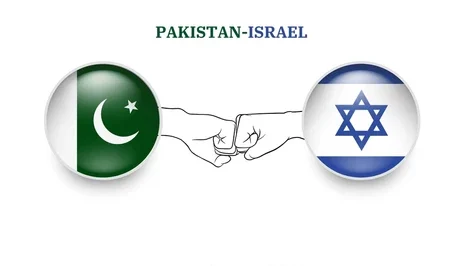
Pakistan is the Israel of the Subcontinent

A Brown Pundits Precedent Post

I. The Ideology Before the Nation

Pakistan has a birth certificate: a 1933 pamphlet by Choudhry Rahmat Ali. Israel has the Basel Programme of 1897. Both nations emerged not from an ancient territorial consciousness but from an ideological project; one that required, as its sustaining premise, the claim that a religious minority could not coexist within a pluralist polity. This is not a slur; it is the historical record.

What makes both nations structurally similar is that their nationalism is grievance-generative by design. Israel requires the Palestinian question; Pakistan requires Kashmir. Without the wound, the ideology loses its cohering force. This is why, as Kabir inadvertently demonstrates in thread after thread, Kashmir is not merely a territorial dispute for Pakistan; it is an existential necessity. Indian nationalism has no equivalent. India does not need Kashmir to know what it is. Pakistan does.

II. Organic vs. Constructed Nationalism

Omar has made the point that durable nationalism must be organic; rooted in geography, language, ethnicity, or long civilisational memory. Bangladesh is a useful comparison: Bengali Muslim nationalism is at least tethered to a linguistic and territorial reality. The Bengalis of East Pakistan had a mother tongue, a delta, a literary tradition. When Pakistan tried to impose Urdu on them, they revolted; because Bengali identity had roots.

Pakistan’s tragedy is that Urdu itself is borrowed. It is a prestige creole, Persianised, Arabicised North Indian court language, that is the mother tongue of perhaps 7% of Pakistan’s population (the Muhajir elite but Urdu had admittedly very deep roots in Lahore). It was imposed as a national language precisely because it belonged to no one’s soil, and could therefore function as a neutral imperial medium. The irony is that Urdu is a derivative of Persian, and Persian, the language Pakistan’s nationalism effectively displaced, was the actual civilisational glue of the entire region from Kabul to Lucknow. In the Golestan framework, Persian would resume its natural role as the prestige link language. Pakistan’s nationalism requires its absence.

III. A Core-Periphery Imperial Topology Continue reading Pakistan is the Israel of the Subcontinent
Not All Our Ancestors Were “Just Hindu”

Pakistanis never HinduIslam destroyed everything? |Pakistanis were Hindu

Aslan Pahari’s videos are linked to the top where he essentially argues that the Indus region, before Islam, was a seamless Hindu civilisational block. It makes for neat storytelling. It is also historically careless.

Sun Temple of Multan

The subcontinent before the 8th century was not a flat religious plain. It was layered, regional, and politically fragmented. Yes, there was a broad Brahmanical tradition stretching across north India. Yes, temples like the great Sun temple at Multan testify to the strength of that religious order in what is now South Punjab. But to move from that to “all ancestors were Hindu” is to mistake dominance for uniformity.

Sindh

Take Sindh. When Muhammad bin Qasim entered the region in the early 8th century, he did not conquer a purely Brahmanical kingdom. The ruling Brahmin elite he defeated, had previously overthrown a Buddhist polity, and the religious landscape of Sindh included Buddhists, various Hindu sects, and local traditions. The frontier between Indic religions was not rigid. It was porous, competitive, and regionally specific.

It goes without saying that Buddhists emerged from a broader Brahmanical milieu, but I am referring specifically to the religious landscape immediately preceding the arrival of Islam.

Punjab Continue reading Not All Our Ancestors Were “Just Hindu”

Pakistan Is Not About to Break Apart

There is a persistent habit, especially among our soi-disant commentators, of predicting Pakistan’s imminent disintegration. The arguments are familiar: Baloch insurgency, Pashtun irredentism, low Kashmiri fertility, economic weakness, and analogies to 1971. They are also, taken together, wrong.

To begin with, most people discussing Pakistan do not understand its internal sociology. They begin with a conclusion, “Pakistan is artificial and unstable”, and then select facts to confirm it. This is confirmation bias dressed up as analysis.

Consider the Pashtuns. The claim that they are natural irredentists misunderstands who they are and how they live. Pashtuns in Pakistan are not a marginal population looking across the border for salvation. They are deeply integrated into the Pakistani state, economy, and military. They dominate transport, logistics, security, and large parts of urban informal commerce. Large numbers have moved permanently into Karachi, Lahore, and Islamabad. Assimilation is not failing; it is proceeding at scale. Continue reading Pakistan Is Not About to Break Apart

Brown Pundits