
An Eye transplant and a Pound of Flesh

An article from a Sri Lanka newspaper.

By Bhante Dhammika of Australia

Sibi is a small rural town in Pakistan’s Balochistan Province and like many such places it has little to recommend it. It is occasionally the scene of terrorist attacks by Balochi separatists, it has no forts, palaces or ancient ruins that might attract tourists from outside, and it often records the highest temperatures in Pakistan. But as unlikely as it may seems this woebegone, dusty town was once the setting for one of Buddhism’s most enduring and beautiful legends.
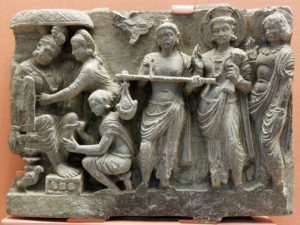
Depiction of the  Sivi Jataka from Gandhara, 5th century CE


In ancient times it was the capital of the small city state of Aritthapura and at one time was ruled by a king named Sivi or sometimes Sibi or Shibi. This king gets a mention in the Mahabharata and the Cholas of south India claimed to be descendants of him, a claim that had no basis in fact.

The earliest mention of King Sivi however is from the Jataka, in the Sivi Jataka, number 499 of the collection. According to this story the Bodhisattva was once reborn as King Sivi and he had made a vow to give anything if anyone asked it of him. Aware of this vow, Sakra decided to test the king to see how genuine his vow was. He manifest himself as a blind man and approached the king pleading; “Give me sight. Will no one give me sight?” Hearing this, filled with compassion, and determined to fulfil his vow, the king led the blind man to a surgeon and asked that his own eyes be taken out and transplanted into the sunken sockets of the blind man. At this point the Jataka increases the tension of the story by having the surgeon ask the king; “Are you sure this is what you want to do?” But the king is adamant and requests that the operation proceeds. What follows is a fairly explicit description of how the eyeballs were squeezed from their sockets, how the optic nerve (or is it the extraocular muscles?) is severed, and the pain this caused. Before the surgeon severs the optic nerve for good he again asks; “Are you sure you want me to do this? Once I cut it there is no turning back.” The king, now in terrible pain, begs the surgeon to hurry up and do the needful. The scene is so vivid that one is tempted to think that the ancient Indians may have actually tried to perform such an operation. As happens in most such Jatakas, the drama ends well with the king’s sight being restored.

In later Buddhist Sanskrit text there is another version of this story. Here King Sibi makes a vow that he will do whatever he can to save a life should the need ever arise. Saka manifests himself as a hawk who catches a dove within view of the king. Seeing this the king pleads with the hawk to release its prey but the bird retorts: “Then how am I to feed myself and my young?” The king thinks for a moment and then says; “I will cut some flesh from my thigh and give it to you if you let the dove go.” Driving a hard bargain the hawk agrees but says it wants the same amount of flesh as would have been provided by the dove. The king agrees, a pair of scales are produced and the process of slicing off a dove’s-worth of flesh is about to begin when Sakka reveals himself and expresses his satisfaction that King Sibi has had the courage to go through with his vow.

Although the imagery of cutting eyes balls out of their sockets or slicing flesh off a living person are disconcerting, even shocking, the purpose of both versions of this Jataka story is clear. A true hero will be prepared to sacrifice much of himself or herself for others. Jesus said pretty much the same thing in the Gospel of John: “Greater love has no one than this: to lay down one’s life for one’s friends.”
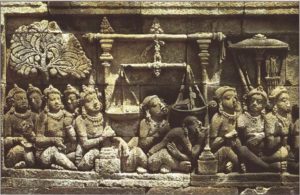
Depiction of the Sivi Jataka from the Borobudur temple, 11th century CE.

The Sivi version of the story is depicted in a relief from Sarnath and Nagajunakonda in Andhra Pradesh, in a mural on the walls of the Mulkirigala temple in Sri Lanka and elsewhere.

This version has had an unexpected consequence. Sri Lanka has the highest number of people willing to donate their corneas after death to be used to help restore sight to the blind. This is due to campaigning starting in 1964 by the Sri Lanka Eye Donation Society and also because Buddhists in the country  are familiar with the story of King Sivi’s gift. The society has 450 branches in the country and every year is able to provide thousands of corneas to be used in eye surgery around the world.

The alternative Sibi version of the story is depicted in the art of numerous Buddhist countries. Perhaps the most well-known of these is the depiction on one of the panels of the great Buddhist temple of Borobudur in Java. In the middle of the panel a pair of large and impressive scales can be seen and in the right hand dish of the scales the dove is waiting to be weighed against the king’s flesh. This version of the story has had an influence too, although in literature rather than medicine.

In around 1597 William Shakespeare wrote his famous play The Merchant of Venice. In the play a young merchant promises to guarantee a loan his friend plans to take out in order to woo his sweetheart. The agreement is that if the loan, which is given without interest, cannot be repaid by a set date the moneylender will be repaid not in cash but with a pound (about 450 grams) of the guarantor’s flesh. The moneylender has made this stipulation because he secretly hates the guarantor and hopes that he will not be able to repay the money. The date passes without the loan being repaid and the moneylender demands his pound of flesh. The lender is soon able to repay the loan and even offers to double the amount rather have his flesh cut off, but the moneylender demands that the original agreement be kept. He does not want the money, he wants the pound of flesh. They go to court and the judges uphold the original agreement but they also decide that moneylender can have his pound of flesh but without shedding a drop of blood, which would be a criminal offence under the law.

This is one of Shakespeare’s most dramatic plays and the origin of the ideas in it have been explored in great detail. Its chief source was Giovanni Fiorentino’s llPecorone written in 1378. But where did Fiorentino get the idea of cutting off flesh of a certain weight to repay a loan? The simple answer is that no one knows. But the idea is so gripping, so iconic, so unusual, that one cannot help thinking that at some time before the 14th century, probably many centuries earlier, it may have travelled from India, through the Middle East and eventually filtered into Europe. If this is correct, it may be a small contribution Buddhist literature made to the works of Shakespeare.

The story of King Sibi endured for centuries despite the disappearance of Buddhism in India. In 1907 M. Longworth Dames published his Popular Poetry of the Baloches, containing English translations of verses, songs and poetry he had transcribed in the Balochi tongue during the previous decades. One of the poems he recorded in 1884 is immediately recognizable as the Jataka story, only the king is a Muslim named Ali.

But to return to the town of Sibi. In a semi-desert area to the south of the town is a collection of ruins. One of these looks suspiciously like it was once a stupa. We know that there was such a monument somewhere in or near the town because the Chinese pilgrim Xuanzang mentioned one in his travelogue, erected “where King Sivika sliced his body to ransom a dove from a hawk, in order to acquire Buddhahood.” No archaeological examination has ever been done to determine the date and purpose of this monument, and probably never will be. But it is quite likely that it is what remains of the stupa erected to commemorate King Sivi’s noble deed.
BrownCast Podcast episode 16: Native Americans and a globalized world

Another BP Podcast is up. You can listen on Libsyn, iTunes and Stitcher. Probably the easiest way to keep up the podcast since we don’t have a regular schedule is to subscribe at one of the links above. You can also support the podcast as a patron (the primary benefit now is that you get the podcasts considerably earlier than everyone else…). Would appreciate more positive reviews.

This week we’re doing something different…but also something you are going to have to expect. The “BrownCast” and “Brown Pundits” are labeled “brown” because the founders of this weblog are brown. We are obviously interested in Indian/South Asian/Desi topics…but that’s not all we are. In fact, the three original founders, myself, Zach, and Omar, are confirmed dilettantes.

One of the “privileges” of being white is that you are interested in whatever you want to be interested in. You don’t just opine on “white” topics, you opine on the world because the world is your canvas. In the year 2019, my own opinion is that more nonwhites need to decolonize their minds, get over white people and their fraught relationship with a race which dictated the terms of the 19th and 20th centuries and grasp the chaotic, polycentric, and globalized 21st century with two hands.

Cross the threshold. Step into the future. It’s interesting…if sometimes a bit too interesting.

The conversation in this podcast starts out with specific concerns and questions about how Native Americans in the USA are reacting to the candidacy of Elizabeth Warren. Brett Chapman lays out the concerns of his own people rather well. He is a lawyer, so that is to be expected! But, the conversation moves to issues relating to Catalan and Scottish independence, and reconsiderations of the sacrosanct nature of the Eurocentric Westphalian system.

Native American experiences are not just particular, they’re universal, and global.

This is 2019 and the 21st century. Two Americans, one a brown 1.5 generation semi-immigrant, one a Native American, and a brown Briton, get together and have a discussion about continental European politics. It’s our business. The world is our business. And our business is the world.

Coloniser mansplaining beautiful Indian girl

https://twitter.com/fatfemmfatale/status/1096921912863870977

The guy is simply obnoxious; he epitomises the Coloniser complex that I write against.

She is obviously far above his league and he tries to defuse his insecurity by talking over her at every instance.

It’s strange that Netflix finds nothing wrong with this video when the level of aggression towards this lady is off the charts. You never walk out on a lady EVER but it’s only because she outright rejected him (she can do much better) that his ego couldn’t handle it.

As an aside I had no idea that she was Indian until he mentioned it and then only got more riled up.

Humble Address to his Majesty-

Pakistanis are great at winging it; I was just talking to a friend of mine who claimed that Pakistan couldn’t have been behind the attack in Kashmir since it has so many other issues to deal with. Furthermore when I bemoaned the lack of a large market such as India he simply held up that Pakistan had access to China.

This ability to constantly Jugaad it is admirable if foolhardy. For a nation allegedly so obsessed with Izzat, the Pak PM (who is notoriously arrogant) is essentially deferring the Saudi Crown Prince, who is less than half Imran’s age, as the new Caliph.

Well I guess beggars can’t be choosers!

Can India and Pakistan Make Peace?

Major Amin sent in an old article of his from 2013 (posted below).
I think Indian and Pakistan CAN make peace, but not yet… Anyway, you can read Major Amin’s more pessimistic take here.. 
Can India and Pakistan make Peace – Agha.H.Amin , Major (r)
(from 2013)
The recent sudden angelic desire on part of the Pakistani establishment to make peace with India has nothing to do with any major shift in Pakistan’s foreign policy written in the Pakistani military headquarters popularly known as the GHQ.
The Pakistani apparent shift is merely a tactical response to extreme confrontation with the US over perceived US view that Pakistan is playing a double game in Afghanistan.
This is similar to Musharrafs flirtation with India from 2000 to 2007 which in reality was a gambit to prevent a two front war with Afghanistan occupied by the USA and a hostile India in the east.
The real picture of true intentions of the Pakistani military will emerge when the US withdraws from Afghanistan.
This will be the time when the Russians ,Iranians and Indians will have no choice but to support the Northern Alliance against Pakistan sponsored Taliban who regard all Shias, Ismailis,Non Pashtuns,moderate Pashtuns as infidels who deserve to be massacred.
The Pakistani politicians are a compromised manipulated lot who are under firm control of the Pakistani military thanks to the politicians own massive financial corruption. They will do what the Pakistani generals tell them whether it is the PPP, PML or any new party like Imran Khans Tehrik i Insaaf.
Pakistan will remain the same state run by an army rather than a state with an army.The Pakistani generals will control Pakistan’s politics and foreign policy and Pakistan India relations will remain a mix of an uneasy and an unpredictable peace.

Continue reading Can India and Pakistan Make Peace?

Pakistan’s #1 in newborn mortality rates!?!?!


Sometimes you read things you need to double check on. World is failing newborn babies:

1. Pakistan: 1 in 22
2. Central African Republic: 1 in 24
3. Afghanistan: 1 in 25
4. Somalia: 1 in 26
5. Lesotho: 1 in 26
6. Guinea-Bissau: 1 in 26
7. South Sudan: 1 in 26
8. CĂŽte d’Ivoire: 1 in 27
9. Mali: 1 in 28
10. Chad: 1 in 28

Let’s let that sink in. Pakistan has worst mortality rate for newborns than Afghanistan, South Sudan, and the Central African Republic. Nations riven by conflict, warfare, and general underdevelopment.

I wouldn’t mind if someone pointed out how there is an artifactual bias in the above analysis. The numbers are horrifying, especially in light of the fact that Pakistan is more prosperous than most of those countries.

You shall judge a nation by how it treats the least amongst us.

Why do South Asians have heart disease?


Why Do South Asians Have Such High Rates of Heart Disease?:

Some of the most striking findings to come out of Masala relate to body composition. Using CT scans, Dr. Kanaya and her colleagues found that South Asians have a greater tendency to store body fat in places where it shouldn’t be, like the liver, abdomen and muscles. Fat that accumulates in these areas, known as visceral or ectopic fat, causes greater metabolic damage than fat that is stored just underneath the skin, known as subcutaneous fat.

…. Cardiovascular risks tended to be highest in two groups: those who maintained very strong ties to traditional South Asian religious, cultural and dietary customs, and those who vigorously — embraced a Western lifestyle. Those with lower risk are what the researchers call bicultural, maintaining some aspects of traditional South Asian culture while also adopting some healthy Western habits.

This discrepancy plays out in their dietary behaviors. Almost 40 percent of Masala participants are vegetarian, a common practice in India that is widely regarded in the West as heart healthy. But vegetarians who eat traditional South Asian foods like fried snacks, sweetened beverages and high-fat dairy products were found to have worse cardiovascular health than those who eat what the researchers call a “prudent” diet with more fruits, vegetables, nuts, beans and whole grains (and, for nonvegetarians, fish and chicken). People who eat a Western style diet with red and processed meat, alcohol, refined carbohydrates and few fruits and vegetables were also found to have more metabolic risk factors.

I think one of the issues with the “traditional” lifestyle combined with modern affluence is that they aren’t actually eating like their (our) ancestors would eat. Though fried snacks and sweetened beverages are acceptable in vegetarian diets, I doubt that this was on the menu for many Indians who lived on vegetarian diets in the past. The two “bad” dietary options are really converging on modern processed/high cal diets from different pathways.

Never forget – Comments of the Day

Scorpion Eater:

Numinous:

This may be related to a phenomenon Razib and Omar and their guests observed in the last couple of podcasts: of academics and others on the left in western countries having (and expressing) a really dim view of Hinduism and Hindu civilization, even vis a vis Islam and Islamic civilization.

My guess is that whenever a colonial atrocity is pointed out, even with sufficient evidence, people automatically think of the caste system, untouchability, Sati, etc. at the back of their minds, and that makes them come up with excuses for the coloniser. (Almost no other religion or civilization seems to have so many negatives associated with it in the Western mind, Yoga and stuff notwithstanding.)

What India must do to Kashmir-

Very sad news emerging out of Kashmir.

Vidhi was saying that India should retaliate whereas I think it should be a more subtle response along the Israeli lines in the West Bank.

(1.) Everytime there are protests in the Valley, India should randomly select a sample of the protestors (maybe a third or so), strip them of their citizenship and bus them to the border so they can join Pakistan. Continue ad nauseam which will help demographics and instil enough fear to dampen potential rioters.

(2.) Abolish Section 377 and bring only the Valley under Central Rule (keep Jammu & Ladakh as it is). India should actively encourage Hindu (not just KP) immigration into Srinagir. Encourage KPs (who are India’s most endangered minority not the Parsis) to breed like rabbits (or like Muslims) and make them agents of the Indian state. Both the tepid tweets by Mehbooba Mufti & Omar Abdullah show the huge disconnect Muslim Kashmiris have with the rest of the Indian State.

(3.) India should begin to demilitarise in Kashmir and retreat to defensible borders on the LOC. With an effective and ongoing occupying force it can keep the Valley sedated with only a fifth of its standing army instead of the current million strong component. The geographic trade of Pakistan conquering Srinagir is losing half of Sindh so Pak won’t engage in conventional warfare.

(4.) BJP’s shameful backtracking on the Citizenship amendment shows the bankruptcy of democracy. The BJP should simply not allow the “new citizens” to settle in NE states, which understandably want to opt out. The “new citizens” should be redirected towards Kashmir & other sensitive regions of India, one million Bangladeshi Hindus in Srinagir will help sort things out.

No one will cry for the Muslim Kashmiris; their cause isn’t as emotive as the Palestinian one. I personally can’t understand the Kashmiri Muslim problem; they are one of the few people in India lucky enough to have Urdu as the official language of their state. They have the unique position of being cultural Pakistanis who have access to the Indian economy so they should buckle down and stop making a fuss.

It is obvious that it’s the Cult of the Holy Pedophile, also known as Muslim menace, behind it all and why it’s so important that Bharat use sickle & all to castrate Islam & its sick ideology once & for all.

The immense success Israel has had in the past two decades demonstrates that tough actions bear fruit and it’s time for the Muslim Kashmiris to step up. The Palestinian cause is far more secular (much less Muslim) than the Kashmiri one and therefore much more worthy.

Blame Bengal Famine on anyone but the British

I was flirting with a lot of topics on what to write but I’m just going to leave these tweets out here. We continued the exchange but my blood is now boiling; Vidhi always like to say “calm is a super-power” but I dislike the presumptuousness and arrogance when dispensing on the evil doings of colonialism in South Asia.

I notice many Indian commentators decry UP/Bihar backwardness but it has to do with British policy of bleeding India through her port cities.

British Development in the Subcontinent wasn’t centred in the most populous areas but rather the most productive. Say what you will about the Mughals (and John makes an uncharitable dig at them in a following tweet) but their development focus remained the UP-Bihar.

They may have been a rentier state par excellence but at the very least at least their wealth flowed back into the geographical territories that comprises modern day India

Brown Pundits