
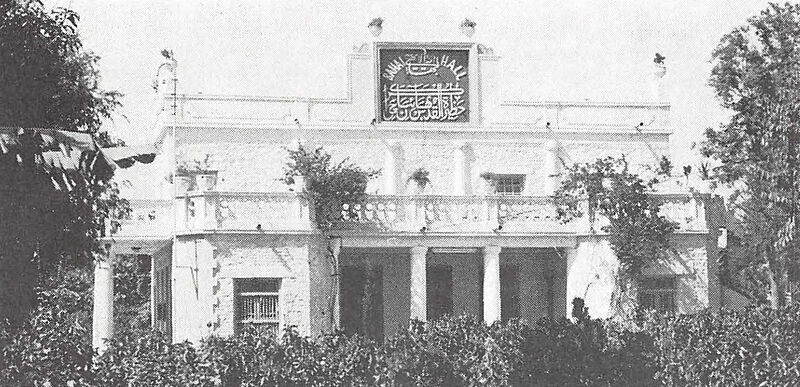
UP’s very long shadow:
As I board my flight back to the UK after a brief but productive trip, I find myself reflecting on a language that continues to haunt and inspire me: Urdu.
It is a tongue caught between paradoxes. The language of courtesans and qawwals, of sacred supplication and sly seduction. It carries within it the scent of jasmine and blood, of Delhi’s dusk and Lahore’s lingering grief.
The Beloved Guardian of the Baha’i Faith once noted that while most Baha’i texts should be translated from English, Urdu alone is trusted for direct translation from Persian and Arabic. That proximity, that spiritual siblinghood with Persian, the language of kings, and Arabic, the language of God, renders Urdu magical.
Sanskrit, of course, is the language of gods, but Urdu, its stepdaughter of sorts, captures the longing of poet to partisan.
There’s a reason the Bahá’í prayer I share below is so piercing in Urdu. So here, before I cross back into another timezone, I offer this prayer—without commentary, without translation. Just Urdu, as it was meant to be heard.
And I wonder: perhaps this is what Pakistan truly is—a project in transcending the local. Not rooted in soil, but in sentiment. A place where Punjabis, Pathans, and Muhajirs are asked to shed skin and commune in Urdu. Where Pakistaniyat, for all its fractures, has succeeded in producing a common idiom: of piety, pride, and pain.
Addendum: On Language, Identity, and the Idea of Pakistan
Punjabi and Sindhi, to me, feel like the earthy languages of the water—fluid, rooted, and elemental. They evoke a visceral sense of place. French (the other language I’m familiar with), by contrast, once aspired to the status of la langue commune—the common tongue. It became, ironically, the very origin of the phrase Lingua Franca—a Romance-based pidgin used across the Mediterranean. That term still makes me smile.
These reflections tie into a broader never-ending question: what, really, is Pakistan? There’s a tendency to caricature it as a South Asian North Korea. But that’s inaccurate. Pakistan is a feudal-aristocratic state with a remarkably successful ideological project. While Partition may or may not have been good for the totality of the Muslims of the Indian Subcontinent, for those who truly buy into the idea of Pakistanis, the state has succeeded beyond expectation.
It has managed to forge a new identity—not by rooting itself in local ethnicities like Punjabi, Sindhi, or Pashtun, but by transcending them. The exception, perhaps, is Balochistan, where the state’s integrative force remains weaker. But among Punjabis in particular, the internalisation of Pakistaniyat is real. Lahore, Karachi, Peshawar, Pindi, Quetta & Islamabad form that super-quadrant of a tranplanted UPite language naturalised.
And central to that success is the Muhajir. In many ways, becoming Pakistani means absorbing the Muhajir psyche—a pathology of exile, pride, and constructed belonging. My own lineage (the patri-half that hails from the Indian Subcontinent) bears this duality: Grandmama, a Muhajir Shia Syeda from Uttar Pradesh; Grandpapa, a Punjabi Sunni of Qaqazai Pathan extraction (all Bahá’ís of course, GPapa served on the National Spiritual Assembly of Pakistan for decades). A heady blend, to be sure. But one that reflects what elite Pakistani culture became: Urdu-speaking, English-literate, ideologically committed, and unrooted from any one soil.
From Qasim to the Quaid—it was never really about geography. It was about narrative.
Beautiful prayer!
I don’t want to rehash the arguments from the Partition thread so I’ll just make one point. Most Pakistanis are happy that we have our own sovereign nation-state and that we are governed from Islamabad instead of from Delhi. I don’t understand why this seems to threaten some Indian nationalists. Pakistan is not going to succeed in conquering Delhi and India is not going to succeed in conquering Islamabad. Like it or not, both states are nuclear-armed and nuclear states cannot be dismantled. We must accept our current borders– yes, they are arbitrary as most borders are arbitrary–and learn to live with them.
As a liberal Pakistani, I believe that Pakistan is a multi-ethnic state. So I disagree with X.T.M that the state needs to “transcend” local identities. One of the wrong lessons that the Pakistani state learned from the events of 1971 was to fear ethnic nationalism and to double down on Islam and Urdu. This is perhaps changing now. For example, Coke Studio at some point used the slogan “Sound of the Nation”. A typical season used to have songs in each of the regional languages as well as Urdu.
“Pakistaniat” is still a contested notion and it is sometimes used by the establishment to push a very specific vision that suits the central government. This usually involves denying or at least underplaying one’s ethnic identity in favor of the Pakistani one.
One thing that India has managed to do well is to reconcile people’s ethnic identities with the “Indian” identity. The linguistic reorganization of states is part of this. It is possible to be both Tamil and Indian or Maharastrian and Indian.
Perhaps Kashmir is the exception (for various reasons that I’m not going to get into here). In that case, there is perhaps a substantial section of the population that does not feel both Kashmiri and Indian. However, certainly the political leaders of National Conference for example have no issues balancing those two identities.
Thank you – in the air now