F*ck Your Algorithm, My People Are Still Colonised

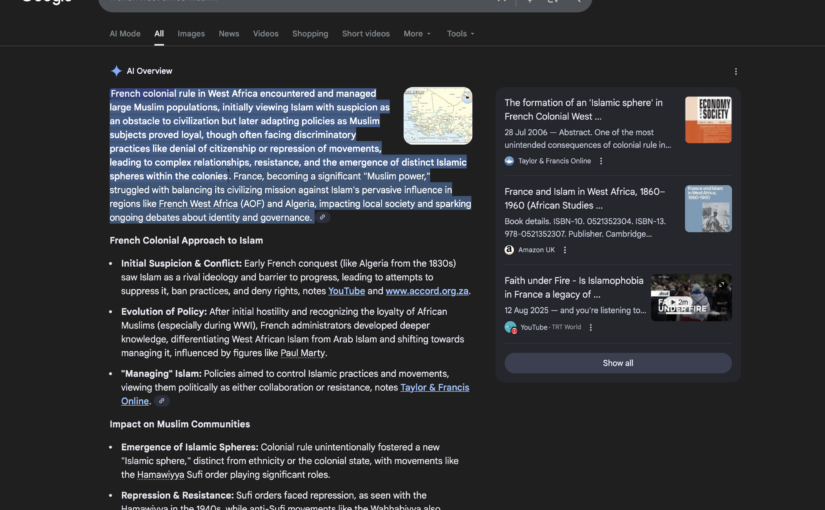
I was not browsing an archive or reading a colonial memoir. I was looking at an AI summary produced by Google’s Gemini system. What stopped me cold was not the history. It was the voice.

Islam was described as an “obstacle to civilisation.” French colonialism was reframed as a “civilising mission.” Muslim societies appeared as a “pervasive influence” to be managed. Colonial domination was softened into administration. Dispossession was translated into balance. This is not neutral language. It is the vocabulary of empire.

“French colonial rule in West Africa encountered and managed large Muslim populations, initially viewing Islam with suspicion as an obstacle to civilization but later adapting policies as Muslim subjects proved loyal, though often facing discriminatory practices like denial of citizenship or repression of movements, leading to complex relationships, resistance, and the emergence of distinct Islamic spheres within the colonies. France, becoming a significant “Muslim power,” struggled with balancing its civilizing mission against Islam’s pervasive influence in regions like French West Africa (AOF) and Algeria, impacting local society and sparking ongoing debates about identity and governance.”

Islam is fundamental to West Africa

Continue reading F*ck Your Algorithm, My People Are Still Colonised
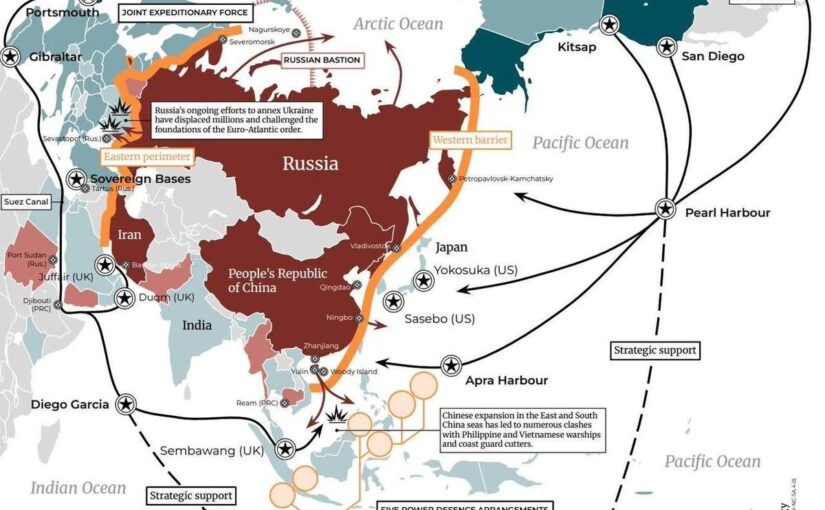
Pakistan, the deciding hinge between the West & CRINK

Pakistan does not announce itself as a great power. That is precisely why it works.

Prussia, built on Position, not Pretension

In a world that is reorganising around blocs, chokepoints, and undersea cables, Pakistan has emerged as one of the most dextrous middle powers on the planet. Not because it dominates geography, but because it understands it. Not because it leads alliances, but because it survives them. Most states are trapped by their alignments. Pakistan is not. It sits at the hinge of the Eurasian landmass: between the Gulf and Central Asia, between China and the Muslim world, between the Indo-Pacific and the Middle East. This position is dangerous for weak states. For competent ones, it is leverage. Pakistan has learned how to convert constraint into flexibility.

Dexterity & Diplomacy as Strategy Continue reading Pakistan, the deciding hinge between the West & CRINK

Lord Zoroaster’s Fire Still Burns

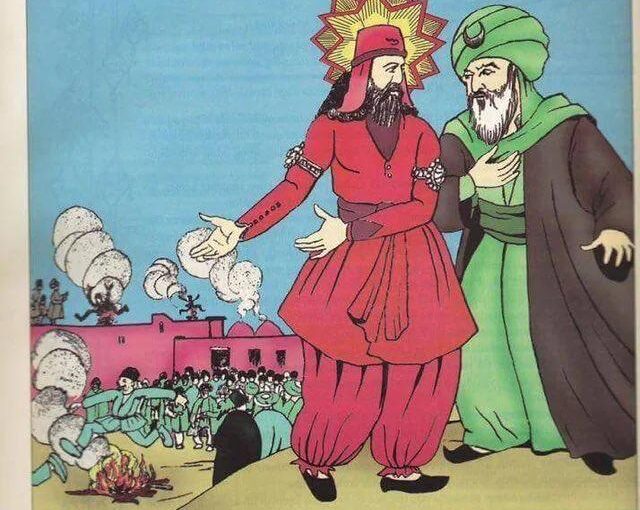
In the 1920s, Soviet Azerbaijan produced a remarkable satirical magazine called Molla Nasreddin. It mocked clerics, superstition, empire, and authority with a sharpness that would soon be extinguished by Stalinist conformity. One cartoon from that period shows two figures standing side by side: Lord Zoroaster in red, radiant and amused; Prophet Muhammad in green, solemn and slightly defensive. Below them, a crowd leaps over a fire.

Lord Zoroaster turns and says: “You claimed to bring them a new religion, but they still jump over my fire.”

The joke is simple. The implication is not. It is a jab at how ancient Persian customs; Nowruz, fire-jumping, seasonal rites, survived Islamic conversion not as relics, but as living practice. Islam arrived. The civilisation did not leave. The fire stayed lit.

Iran Is Not a Regime Problem Continue reading Lord Zoroaster’s Fire Still Burns

A Pakistani Wedding That Refused Not to Be Indian

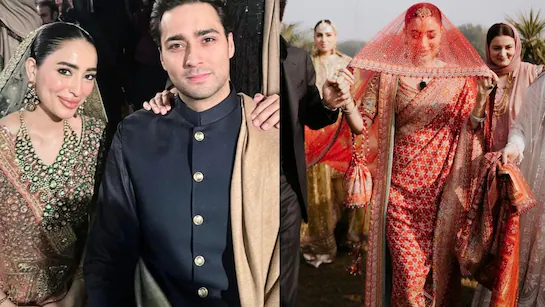
There is a tweet circulating of Nawaz Sharif’s grandson’s wedding. It is meant to be ordinary; the bride wore Indian designers, Sabyasachi and Tarun Tahiliani. Instead, it is revealing, the extent of Indic soft power. The colours are unmistakably Indian: red, gold, marigold. The symmetry is ritualistic rather than theological. The staging is ceremonial, not Quranic. The aesthetics are not Arab, Persian, or Turkic. They are Hindu-Indian; not in belief, but in form.

This is not a criticism. It is an observation. For seventy-five years, Pakistan has insisted that it is not India. That it broke away not only as a state but as a civilisation. That Islam did not merely replace Hinduism but erased it. Yet when Pakistan’s most powerful family marries its children, what appears is not a purified Islamic aesthetic but a recognisably Indic one.

Civilisation does not obey ideology.

Islam in Jambudvīpa did not enter an empty space. It arrived in a world already shaped by colour,  hierarchy, procession, music, and spectacle. It adapted to that world. It did not abolish ceremony; it repurposed it. Nikah replaced vivah, but the social grammar remained. Weddings stayed long, public, ornate, and familial. They did not become austere. They became Muslim in name and Indian in structure.

Continue reading A Pakistani Wedding That Refused Not to Be Indian

How will the Iranian Regime Survive? By Becoming Persian & Crowning a Pahlavi Queen

Iran After Ideology

The Iranian Revolution survived because it fused two forces that had long resisted foreign domination: Shi‘i Islam and Persian historical memory. It endures today because it still commands the machinery of the state. But endurance is not the same as viability. The revolution has reached a point where its original ideological heft, once an asset, has become its primary liability.

The Iranian Revolution must become Iranian. Not rhetorically, but structurally. Islam can no longer function as an export ideology or as a permanent mobilisation doctrine. It must become a civilisational substrate: Islam with Persian characteristics, not Persian life bent permanently around Islamic revolution. The clerical class has to accept a hard truth that other revolutionary elites eventually learn; that ideology is a ladder, not a house. Nuclear ambition, permanent resistance, and theological maximalism were once instruments of leverage. Today they are liabilities. Iran is not losing legitimacy because it is insufficiently Islamic; it is losing legitimacy because it insists on remaining revolutionary long after the revolution has exhausted its social utility.

The English Example Continue reading How will the Iranian Regime Survive? By Becoming Persian & Crowning a Pahlavi Queen

India’s Eastern Face: Where Civilisation Dissolves Instead of Ending

Hard Edges and Soft Ones

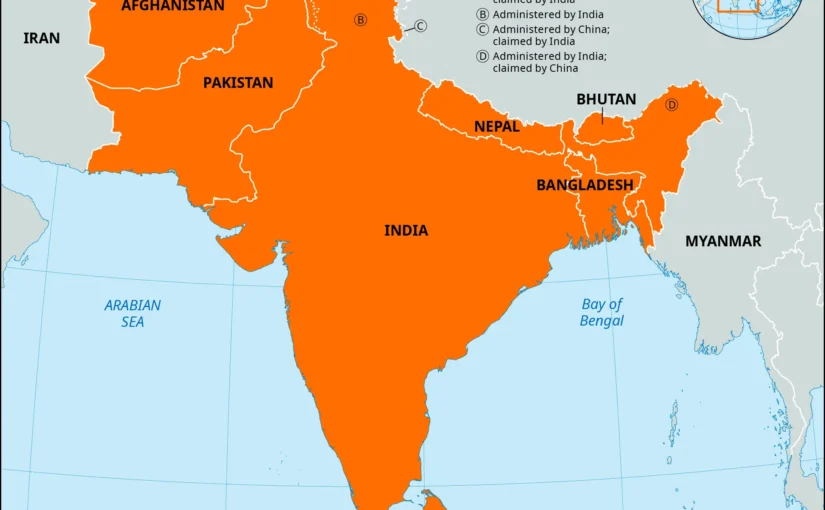
India is unusual among civilisations in that most of its edges are real. They can be pointed to on a map and felt underfoot. The northwest is closed by the Hindu Kush, a wall that both protected and punctured India through invasion. The north is sealed by the Himalayas, which turned the subcontinent inward for millennia. The south ends cleanly in the Indian Ocean, a hard geographic edge that also became India’s great outward highway. These are faces with sharp contours.

India is bounded in the northwest by mountains, in the north by ice, in the south by water, and in the east by diffusion.

The east is different. It does not end. It thins.

A Boundary That Does Not Behave Like One

Geographically, there is a boundary. The Indo-Burman ranges run from Arunachal through Nagaland, Manipur, Mizoram, and down into Burma. They are real mountains, thick with forest, rain, and disease. But they are not high enough, cold enough, or empty enough to function like the Himalayas. They slow movement without stopping it. They divide ecologies more than peoples.

This matters because civilisation follows ecology before it follows flags.

Where India Becomes Something Else, Gradually

Continue reading India’s Eastern Face: Where Civilisation Dissolves Instead of Ending

South Asia Is an Ugly Postcolonial Euphemism

There is something faintly ridiculous about how often educated people insist on using the term South Asia as if it were a neutral, hygienic improvement on an older and supposedly “problematic” word. It is neither neutral nor an improvement. It is a bureaucratic euphemism invented to manage post-Partition discomfort, and it collapses the civilizational reality of the region rather than clarifying it.

The Indian subcontinent has had a name for millennia. It was called India because it lay beyond the Indus. Greeks used it. Persians used it. Arabs used it. Medieval Muslims, early modern Europeans, and the British all used it. The word survived because it described a geographic and civilizational unit, not because it flattered any modern state. The fact that the Republic of India later adopted the name does not retroactively invalidate its older meaning. Belgium did not abolish the word “Europe,” and Serbia’s existence does not make “European” offensive.

South Asia, by contrast, is not an ancient term misused by a nation-state. It is a late–Cold War academic construction, popularised by American area studies departments that were uncomfortable saying “India” once India no longer meant a single polity. It is a word designed to avoid an argument, not to resolve one. Like “Middle East,” it describes nothing from within the region itself. No one historically lived in “South Asia.” No one spoke “South Asian.” No one cooked “South Asian food.” Continue reading South Asia Is an Ugly Postcolonial Euphemism

Greenland, Trump, and the Comfort of White Intermediaries

What people are missing in the Greenland debate is not a technicality of citizenship or electoral legality. It is the structure of power that keeps repeating itself across the settler-colonial West.

This is not really about whether the Greenlandic Prime Minister, Jens-Frederik Nielsen, can lawfully hold office.

Of course he can. He has a Danish father and a mother born and raised in Greenland, and he meets every formal requirement. That point is trivial, and focusing on it is a way of dodging the real issue. The real question is why, across every settler-colonial society; Indigenous welfare and political destiny are so reliably mediated by white-presenting figures, even when those societies are overwhelmingly Indigenous in population.

Greenland is 90 percent Inuit. Yet when power reaches its most visible, internationally legible form, it is once again carried by someone who presents as Danish, speaks the language of European governance fluently, and is immediately readable to Western capitals as “safe.” This is not accidental. It is structural. Continue reading Greenland, Trump, and the Comfort of White Intermediaries

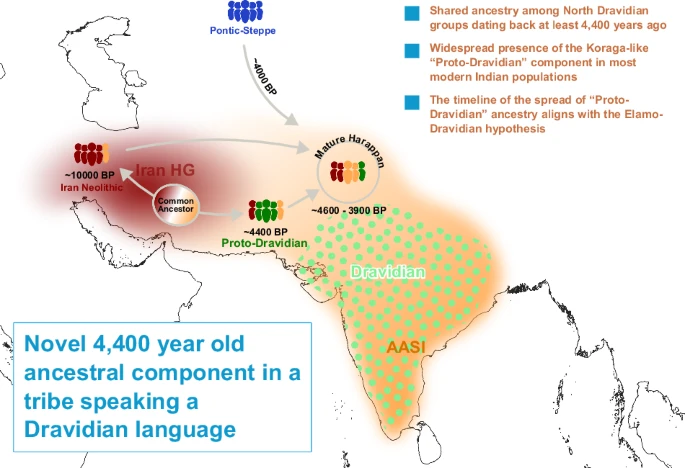
New DNA research paper sheds light on proto-Dravidian and Indus Valley Civilization genetics.

Disclaimer

Please note I am a dentist — not a geneticist — and I do not claim formal expertise in this field. I have a long-standing interest in history and look to archaeogenetics as one of the best tools available for addressing some of the most enduring questions about South Asian origins and identity.

Credit is due to the many researchers, bloggers, and science communicators who have made this field accessible — including Razib Khan (whom I haven’t met, though he happens to be a fellow Bengali), who’s writing first inspired me to engage deeply with these questions.
Continue reading New DNA research paper sheds light on proto-Dravidian and Indus Valley Civilization genetics.

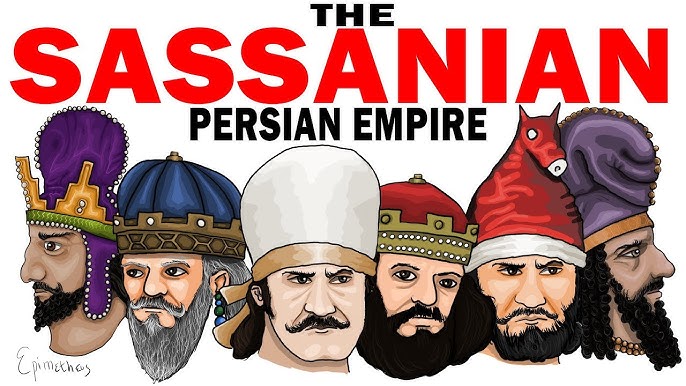
Between Arab Conquest and Persian Conversion: The Sasanian Inheritance

The Clip That Explained a Civilisation

A short video of an Iranian woman is circulating on X. In it, she says Islam is not Iran’s native religion and was imposed on Zoroastrian Persians through torture, massacre, rape, and enslavement. The clip is amplified by familiar accelerants, including Tommy Robinson, and is now being treated as a one-line explanation for a fourteen-century transformation.

Almost immediately, a counter-narrative appears. It insists there is “not a single piece of evidence” for forced conversion in Persia; that Islamisation was slow; and that many Persians, especially Sasanian elites, moved toward the new order for political, fiscal, and social reasons. A further layer is added: nostalgia for the Sasanians is misplaced because late Sasanian society was rigid, unequal, and harsh, and early Muslim rule improved conditions for ordinary people. These are two different claims. They are routinely fused. History does not require that fusion.

Conquest Is Not Conversion Continue reading Between Arab Conquest and Persian Conversion: The Sasanian Inheritance

Brown Pundits