
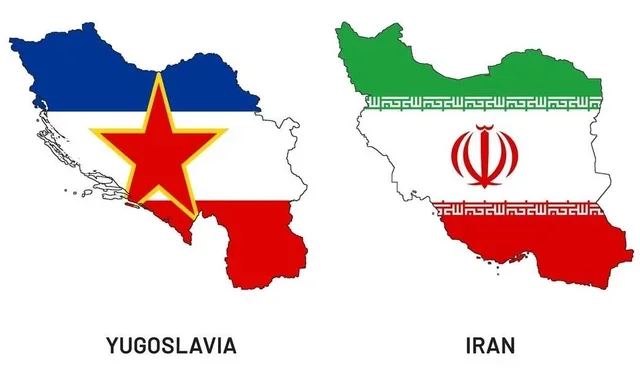
There is a recurring Saffroniate habit, when it comes to Pakistan, that deserves to be named plainly. It assumes collapse. It treats Pakistan as a Yugoslavia-in-waiting, a state held together only by force and denial. This is not analysis. It is projection, reinforced by confirmation bias.
Pakistan is not Yugoslavia. It is, in many ways, the opposite.
Yugoslavia fractured once the external logic binding it disappeared. Pakistan was born under siege and continues to organise itself around that fact. Whatever one thinks of this psychology, it has consequences. States that internalise permanent vulnerability do not casually dissolve. They centralise, harden, and adapt. That is not a moral defence. It is an empirical observation.
This is why fantasies of Pakistan’s inevitable breakup consistently miss the mark. No serious actor inside Pakistan believes fragmentation would lead to peace, prosperity, or benevolent external management. The lesson of 1971 was not weakness; it was that disintegration invites catastrophe. That understanding is widely shared, across elites and institutions alike.
Where the Commentariat becomes especially sloppy is on culture.
Cultural borrowing is routinely misread as insecurity or fraud. When Pakistani weddings feature aesthetics recognisably Indian, or when Basant reappears in Lahore, it is framed as denial, appropriation, or embarrassment. This misunderstands how culture actually works.
Basant is a Punjabi seasonal festival. Its roots lie in agrarian cycles, the coming of spring, and the shared folk culture of the Punjab region. Over centuries, it accumulated different meanings in different places. In parts of North India it acquired Hindu associations. In Pakistan today, it carries no religious significance at all. It is simply an excuse to celebrate, fly kites, and mark the end of winter.
That does not make it Hindu property, nor does it make its practice in Pakistan a contradiction. It makes it regional culture doing what regional culture has always done: surviving political rupture.
What unsettles critics is not Basant itself, but the fact that Pakistan retains a cultural life that does not fit neatly into the categories they prefer. There is an assumption, often unspoken, that Pakistan must either reject the Indian inheritance entirely or admit civilisational fraud. This is a false choice.
Civilisations do not vanish at borders. They refract. Pakistan did not exit Punjabi culture in 1947. It reinterpreted it. That process is sometimes awkward, sometimes defensive, but it is not incoherent.
The same applies to deeper historical questions. Asking what religious and cultural layers existed in Punjab, Sindh, or Bengal before Islam is not “washing” or erasure. Buddhism mattered. Local cults mattered. Heterodox traditions mattered. None of this threatens Hindu history, nor does it diminish Islam. It simply acknowledges that the Indian Subcontinent was never civilisationally flat.
This is where bias enters the discourse. Every overlap becomes evidence of bad faith. Every shared practice is treated as theft. Every attempt at cultural synthesis is read as denial. That is not scholarship. It is resentment masquerading as critique.
None of this is to deny Pakistan’s internal problems. Discrimination against minorities exists and deserves serious scrutiny. But seriousness requires proportion. Throwing around words like “genocide” outside their proper context is not moral clarity; it is rhetorical inflation. Gaza looks and feels like genocide. Pakistan’s contradictions, however real, are not that.
Pakistan’s identity is shaped by siege, but it is not stupid. Its elites may be arrogant and misguided but they are not naïve. They defend borders fiercely because history taught them the cost of weakness. They borrow culturally because borrowing is how civilisations survive. These instincts coexist. They already do.
The real danger is not Pakistan’s collapse, but the collapse of analytical discipline among those who keep predicting it. When every fact is filtered through a desire for failure, analysis stops. You are no longer observing reality. You are narrating a wish.
Pakistan does not need to be Yugoslavia for its critics to feel satisfied. It only needs to exist; imperfectly, stubbornly, and recognisably itself.
>>>Over centuries, it accumulated different meanings in different places. In parts of North India it acquired Hindu associations. In Pakistan today, it carries no religious significance at all. It is simply an excuse to celebrate, fly kites, and mark the end of winter.
There are plenty of folks who are not Christian, who happily celebrate Christmas. Absolutely nothing wrong with that. Just that they don’t harbor delusions about it ‘not being a Christian holiday’.
what comes next now? Do Pakistanis start celebrating Holi as yet another ‘non hindu festival’? why not? How about Diwali? Heck its an “autumn” festival that is celebrated with lights and fire crackers.
What is all this mental gymnastics for? What is the big f deal about simply being honest about the fact that Basant is Basant Panchami?
The answer directly goes to the heart of the matter – the internal……….balkanisation that a Pakistan constantly struggles with.
As far as conflating the fantasies and speculation regarding insurgencies in Pakistan and their future prospects – one can’t help but wonder whether its an intentional conflation – tie 2 theories together that really aren’t connected, simply because you can knock them both down by virtue of attacking the one that is more…questionable.
Given the shared history and culture in the Indian subcontinent, the Punjabi Muslims in and around Lahore also celebrate kite flying as a sport in Pakistan from home rooftops during the Basant season.[18] In 2007, the Supreme Court of Pakistan imposed a ban on the manufacture, trade, and flying of kites in Lahore on the basis of fatal incidents due to glass-coated stray strings used in the kites in Lahore.[36] Plans to restore the festival in 2013 were cancelled after Jamaat-ud-Dawa threatened attacks on the celebrations, claiming the festival had “Hindu origins” and describing it as “un-Islamic.”[37] In 2017, the ban on Basant was briefly lifted and reimposed.[38]The ban was lifted in 2026 after 19 years.[39]
Obviously there are people who claim Basant is “un-Islamic” but they are a fringe element. Jamaat-ud-Dawa is not taken particularly seriously.
The real issue with Basant was the deaths and injuries associated with the celebration. I’m not really aware of all the technicalities, but the type of string used was apparently lethal in many cases–especially to motorcyclists.
Even this year, Maryam Nawaz allowed celebrations only under strict SOPs. The celebration was restricted to Lahore and not allowed in other parts of Punjab province.
There were still some injuries and deaths but overall the SOPs seem to have worked.
Basant did emerge in Hindu space; the history is fairly clear on that.
Basant is basically Norouz; u can strip the religious dimensions but not the origin.
Why are Pakistanis so ashamed of their Hindu origins; Persians take pride in our Zoroastrian heritage ..
I really don’t have any issues with Basant originally being “Hindu”. But it is now basically a spring time celebration.
I don’t think it’s really about being “ashamed” of “Hindu origins”. Pakistanis have an antipathy to the Indian nation-state. Being Muslim is central to our identity.
I guess Iranians are much more secure about their Islamic identity than Pakistanis are.
I just resent the implication that Pakistanis are really “Hindu” or “Indian”. You addressed that well in your original post. I’m going to leave it here.
this is true; Pakistanis can define themselves as they like.
u do always go on about secularism
India is a constitutionally secular state. It is free to change its constitution whenever it wants. I will not judge a Hindu Rashtra by the standards of a secular state.
It is up to Indians to define their own identity. They want to be “Hindi, Hindu, Hindustan”, go for it.
Similarly, it is for Pakistanis to define our own identity. Non-Pakistanis have no locus standi.
So in the same way you go on about India’s secularism ad nauseam; the Saffroniate will harp on about Pakistan’s Hinduness.
What is good for the goose is good for the gander no?
They are far more obsessed with Pakistan than I am with India.
You’re free to do what you like. I have no control over that.
But any honest person will see the level of anti-Pakistan posting that is happening around here.
BB gets away with calling for the “dissolution of Pakistan”. He has said this repeatedly. Similar comments about the “dissolution of India” would probably meet with a much harsher response no?
Personal disrespect from RNJ and BB is a red line. I do not appreciate being trolled.
BB does need to calm down though
No need to engage Kabir.
Is there any point to constantly calling it out; side step Kabir and his antics; & ur signal will raise up.
But both of u enjoy the mutual obsession alas
I am happy to ignore him going forward.
But I will not tolerate Pak Fauj being compared to Nazis.
Nor will I tolerate disrespect towards me personally.
Kabir stop as well
No I’m simply going to remove low signal comments arbitrarily- enough is enough
You live in India. Calm down.
Do you not understand the concept of citizenship? I can move to New York tomorrow.
.
.
Stop
Stop
we write on many topic; the Commentariat gravitates to Pak..
Yes, they enjoy trolling Pakistan and Pakistanis. But you don’t need to encourage them.
If I were writing over and over again about India, someone would call me out on it.
Of course, it’s your blog. You’re free to post about whatever. But it’s becoming a hostile environment for Pakistanis.
Iran is much more secure about its identity period.
Basant did emerge in Hindu space; the history is fairly clear on that.
i dont think you can give Kite Flying a religious origin. Plenty of Kite Flying contest all over thee world, Including China and SE Asia.
Recall the novel Kite Runner located in Afghanistan
Basant did emerge in Hindu space; the history is fairly clear on that.
Kite flying gained prominence during the Mughal era as part of springtime court and popular festivities, with Basant patronized by Mughal emperors and officials and celebrated at the Lahore Fort.
During the early 19th century, Basant received significant patronage under the Sikh Empire, particularly during the reign of Maharaja Ranjit Singh. Contemporary travel accounts describe state-sponsored celebrations in Lahore, where members of the court and military wore yellow clothing and participated in public festivities, effectively institutionalising the festival at an imperial level.
Under British colonial rule, Basant continued as a popular seasonal festival in northern India, though it gradually shifted from elite patronage to civic and recreational celebration, particularly in urban centres
Basant is basically Norouz; u can strip the religious dimensions but not the origin.
No one has linked Norouz to Basant. Noruz is basically the New Year Celebrations of Iranian Peoples (19 March and 22 March) . If any link of Nourouz to Basant it was thru the Persianized Muslim Mugals
South Asian and SE Asian New year is around April when the Sun Enters Aries
https://en.wikipedia.org/wiki/Nowruz
However, the Hindu calendar year was based on the Nirayana or sidereal year (i.e. the movement of the sun relative to the stars), while the Western Gregorian calendar is based on the tropical year (the cycle of seasons).
Anyone who has played around with Astrological Software will be familiar with these words sidereal and tropical calendars.
For those interested there is is wiki Sidereal_and_tropical_astrology (I am no longer interested)
https://en.wikipedia.org/wiki/South_and_Southeast_Asian_solar_New_Year
Non Christians don’t really celebrate Christmas in Pakistan. I don’t know what Pakistanis you have been interacting with.
The orthodox Islamic view is that Christians consider Christ to be God. This is shirk according to strict Islamic monotheism.
When my dad was Dean of the School of Humanities and Social Sciences at LUMS, he introduced a Christmas party on campus–mainly for the janitorial staff since they are mostly Christian. The people at the mosque told students that if they participated, they would have to reaffirm their faith in Islam.
He identifies as Pakistani-American?
Exactly. I was raised entirely in the US.
Calm pls
Mocking about the Pakistani Army’s “need” for coffins is disgraceful. Stop now otherwise it will be a mass deletion of all your comments.
Take a break, pause and calm.
it depends on which class of Pakistan; Elitestanis are super-liberal and Westernised.
it’s the middle classes that are uber-Islamic
on the line mate. on the line
paste the links?
https://kabiraltaf.substack.com/p/what-being-a-centre-left-pakistani
What do you mean exactly?
Alas Pakistan is a decade away from celebrating festivals like Valentines Day & Christmas but it will happen
It is fun to celebrate everyone’s festivals
There is no compulsion in celebrating festivals.
Most Muslims would not participate in Christmas because believing Christ is God or the son of God is clearly shirk in Islam.
Valentine’s Day has its own problems. People associate it with immorality.
Dating etc is not considered permissible in Islam. Especially not by the orthodox.
I don’t know that people are predicting the fracturing of Pakistan as much as rooting for it to happen.
Good distinction!
Thank you for writing this.
Yugoslavia fell apart because Slovenia, Croatia and Bosnia wanted independence. They did not want to be ruled by Serbia. In many ways Yugoslavia was an artificial entity like the USSR.
Pakistan is not comparable to this. There is no serious desire for independence in any of the provinces. One can argue about the extent of the desire for independence in Balochistan– though I think it is more about wanting greater fairness from the Pakistani state– but certainly Sindh and KPK do not want independence from Punjab. Whether anti-Pakistan people like it or not, most Pakistanis have a distinct feeling of being Pakistani. The country is not being held together at gunpoint.
As for culture: I am on record as arguing that Pakistan is a South Asian country and there is nothing wrong with that. Basant, for example, predates the Indian and Pakistani nation-states. It’s not owned by India or by Hindus. It’s part of Punjab’s culture.
Effectively, it’s a secular occasion in Lahore. If Lahoris believed it was a “Hindu” celebration, they would stop celebrating it. Maryam Nawaz Sharif would not be caught dead promoting anything un-Islamic.
Linking Basant to Holi and Diwali is a bad argument. Diwali is specifically about Ram’s victory over Ravana. There is no way it can be interpreted as a secular occasion. It is clearly Hindu. Basant is about flying kites and celebrating the arrival of spring. There is nothing inherently un-Islamic about it.
It is as rooted in Hinduism as Norouz is in pre-Islamic Persia..
Tbf Christmas is extremely secularised
sure, but does anybody demand pretending that its not a Christian holiday?
Basant in all its forms all over India is pretty secularized as well. And there is absolutely no issue with Pakistanis celebrating it without the religious connotations. But why the dishonesty?
And why is said dishonesty supposedly empowered and supposedly shoved down people’s throats as the ‘truth’?
Tbf Christmas is extremely secularised
I think you know only European and North East Liberal Americans who for the most part are secular Christians.
In Sri Lanka, Philippines it is primarily a Religious (Midnight Mass)and secondarily festive (food, partying)
Roman Catholics the largest Christian Denomination in the World take Christmas quite seriously.
Christmas is specifically about celebrating the birth of Christ. Of course, it’s a Christian religious celebration.
That doesn’t mean that non-Christians cannot participate in the gift-giving etc without at all for a moment believing that Christ is God or the Son of God.
Comparing Christmas to a kite-flying festival is disingenuous.
Vasant Panchami, also rendered Basant Panchami[3][4] and Saraswati Puja in honour of the Hindu goddess Saraswati, is a Hindu festival that marks the preparation for the arrival of spring. The festival is celebrated in different ways depending on the region and by different Indian religions.
Vasant Panchami also marks the start of preparation for Holika and Holi, which take place forty days later.[5] The Vasant Utsava (festival) on Panchami is celebrated forty days before spring, because any season’s transition period is 40 days, and after that, the season comes into full bloom.
Sure, I have no issues with any of that.
In Pakistan, Basant has no specific religious connotations.
The more people insist that Basant is Hindu, the more opposition there will be to it in Pakistan.
yes but that is foolish. Persians take pride in Zoroastrianism, Pakistanis are ashamed of Hinduism, which is probably the most sophisticated Theo-philosophical system on the planet
Pakistan’s experience of being Partitioned from British India and continuing to dispute territory with the Indian nation-state doesn’t really have an analogy with Iran.
Perhaps one could say that India is to Pakistan what Israel is to Iran?
I’m not going to dispute Hinduism with you. You clearly are an admirer. Most Pakistanis are not. For one thing, it is commonly perceived as polytheism and idol worship. Idol worship is shirk in Islam and we are very clear about Allah being the only God.
India is becoming increasingly anti-Muslim. Pakistan is increasingly anti-Hindu. It goes both ways.
eye for an eye makes the whole world..
this is rather droll.
Your comment is directly contradicting your own parent post. I’m…not quite sure what to make of that.
I think it’s a dual edge – there is no need for outsiders to constantly remind Pakistanis of their Hindu origins but it is an internal dialectic.
Kabir
Christmas is specifically about celebrating the birth of Christ. Of course, it’s a Christian religious celebration.
Not quite Christian, originated in Germany
Specially Christmas Trees and Santa Claus is Pagan.
My Parents did not have Christmas Trees.
Of course there are many Christians yho dont read the Bible who Chink Christmas is written in the Bible.
I have no idea if Pakistan will ever break up, but if it will, it won’t be like Yugoslavia. Maybe I’m missing out on a popular meme, but I never heard such a comparison being made before reading this article.
Yugoslavia’s breakup was a consequence of its time, place, and geopolitics. It broke up for similar reasons to why the Soviet Union broke up at the same time. Both mega-states were identified with revolutionary communism, which was a spent force at the end of the Cold War. There was no particular reason for the constituent parts of Yugoslavia to hold together in the absence of that unifying ideology, just like there was no reason for the Baltic states to show any fidelity to Mother Russia (The Slovenes and Croats had long been in a completely different sphere than the Serbs and Macedonians had, the former under German/Hungarian influence and the latter under Ottoman.)
Why was there an edge to the Yugoslav break up that was absent from the USSR (which was entirely and surprisingly amicable)? Perhaps religious differences were felt more keenly in the former (definitely true for Orthodox Serbs vis-a-vis Bosnian Muslims, perhaps also with Catholic Croats). Also, Serbs probably felt more insecure and truncated as a nation as compared to Russia (which still remained a vast empire after the secession of the former Soviet republics) and weren’t willing to let go without a fight.
Did Yugoslavia have nuclear weapons? No.
The Islamic Republic of Pakistan does. Our territorial integrity is an absolute red line. The rest is all wishful thinking from Indians.
Slovenia, Croatia and Bosnia clearly didn’t want to be ruled by Serbia. Kosovo didn’t want to be ruled by Serbia. The same situation doesn’t apply to the provinces of Pakistan.
These fantasies about the breakup of the Islamic Republic of Pakistan are incredibly offensive.
But the Soviet Union did have nuclear weapons, concentrated in 3 republics (Russia, Ukraine, Kazakhstan) AFAIK. It still broke up.
I’m not sure what you were responding to, but I’ll reiterate what I wrote in my earlier comment: I have no interest in, or expectation of, Pakistan’s break up. I was simply analyzing Yugoslavia’s break up and the conditions that made such a break up conducive. Since that was the topic of XTM’s post.
Yes no need for Kabir to be hyperbolic; Kabir cannot control the discourse.
Is fantasizing about the dissolution of India acceptable?
If not, then fantasizing about the dissolution of Pakistan should not be acceptable either.
I wasn’t responding to you specifically.
In general, I think fantasizing about the dissolution of Pakistan is in bad taste.
I don’t fantasize about the dissolution of India proper. Of course, I want the Disputed Territory of Occupied Kashmir to be freed from India but that is the official Pakistani position. Indian nationalists obviously don’t agree.
The USSR was an “atami takaat”.