
Start with the uncomfortable question nobody in Washington wants to ask directly: how is this not a defeat for Israel?
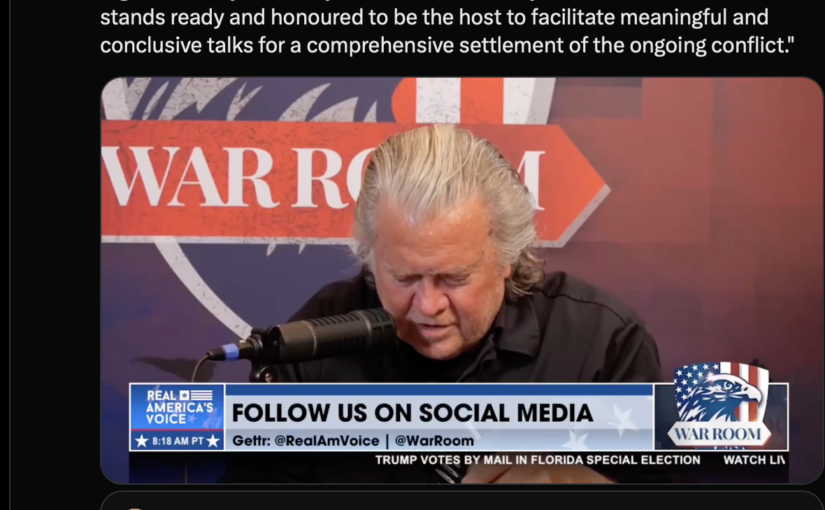
Trump reposted Shehbaz Sharif’s offer to host US-Iran peace talks, and Bannon’s WarRoom picked it up within the hour. That’s the tell. When Pakistan’s diplomatic positioning lands on the most watched MAGA platform in America, amplified by the President himself, the “Second Act” isn’t a thesis anymore. It’s the news.
In 1956, Britain and France attacked Egypt alongside Israel. Militarily, they won. The Egyptian army collapsed. The canal was taken. Then Washington intervened, sterling cracked, and within weeks they withdrew — humiliated, permanently diminished, never again operating as independent great powers in the Middle East. They won the battle and lost the century. (As an aside, PM Modi made his allegiances clear from the very start of this conflict; the bombing was reportedly postponed for his visit to Washington. India, like Britain and France in 1956, has picked its side. The question is whether it has picked the winning one.)
That is the template. Now run the present war through it. Israel spent two years engineering this confrontation. Then, at the exact moment diplomacy began to work, the bombs fell. Oman’s Foreign Minister Badr bin Hamad Al Busaidi, a cautious, establishment figure from a cautious, establishment country, said it plainly: nuclear negotiations were making progress, Iran had agreed to no enriched uranium stockpiling and full IAEA verification, peace was within reach. Talks were due to resume on 2 March.
The strikes began on 28 February.
That is not coincidence. That is a choice: war over settlement. Now look at the structure that follows. Iran has not won militarily. Its air force is degraded. Its infrastructure is hit. Its Supreme Leader is dead, replaced by his son; a harder man, not a softer one, which is itself a signal about how decapitation strategies tend to end. But Iran has achieved the one thing that matters strategically: leverage over the Strait of Hormuz. Analysts are already describing any exit that leaves Iran as the effective gatekeeper of the Strait as a colossal strategic failure for the United States. That is the centre of gravity. The US can bomb, seize assets, escalate. But it cannot reopen the Strait on its own terms if Iran is willing to absorb damage and impose cost. Geography is doing the work. Patience is doing the rest.
Now watch Washington move.
A $200 billion supplemental request is already in play. Oil prices are moving. Trump has begun the political separation, “I might have forced their hand”, while his own Secretary of State had already said Israel led the way. That asymmetry matters. Trump wants a deal he can sell to American families at the petrol pump. Israel wants Iran broken. Those are incompatible war aims, and they are visibly diverging: Trump rebuked Israel over the South Pars gasfield strike; Israel assassinated Ali Larijani, seen by some as a key potential negotiating figure, just as back-channel possibilities were opening.
The same negotiations torpedoed in February are now the only viable exit. Trump says Iran wants a deal. Iran denies it. Neither side is behaving like a defeated power. This is not surrender. This is endurance; and endurance, historically, beats air supremacy.
That is Suez. It does not require retreat under fire. It requires something subtler: the moment when the patron begins calculating its costs independently from the client, and reaches a different conclusion. When that happens, the war ends regardless of battlefield position. Britain and France didn’t lose in 1956 because they ran out of soldiers. They lost because Washington ran out of patience.
The American public will eventually ask whose war this was. That question is already forming. And it is precisely here, in the gap opened by Washington’s growing ambivalence and Israel’s strategic overreach, that the second story begins.
While the US and Israel have been consumed by a war that is proving harder to exit than to enter, one country has quietly stepped into the resulting vacuum. Not China. Not Russia. Not Turkey, though Ankara is watching closely.
Pakistan.
The country written off as a chronic failure, IMF supplicant, political circus, army behind the curtain, is sitting at the intersection of every active fault line simultaneously: Iran, Afghanistan, the Gulf, China, the United States. Geography always gave Pakistan this position. What has changed is the environment around it, which has been upended so completely that Islamabad’s chronic flexibility looks, for once, like an asset.
Pakistan is currently fighting its own war.
Operation Ghazab Lil Haq has struck Kabul, Kandahar, Khost, Jalalabad, and Paktika. Dozens of posts taken. Hundreds of Taliban fighters reportedly killed. Sustained air and ground operations across a sovereign border; and almost no international reaction. No UN emergency sessions. No sustained outrage cycle. No sanctions architecture. The reason is straightforward: nobody wants to defend the Taliban. That absence of sympathy functions as operational permission. Pakistan is, in effect, conducting unrestricted combined-arms warfare with minimal external constraint, building ISR capacity, strike tempo, and cross-border coordination in real conditions, against a real adversary.
This is not the Pakistan of Kargil.
But the military dimension is only part of it. Diplomatically, Pakistan has turned Trump 2.0 into a strategic opening; expanding cooperation into minerals, energy, and trade, securing the lowest tariffs in South Asia, signing a defence pact with Saudi Arabia. It is quietly exploring a Turkey-Saudi-Pakistan alignment. It maintains, uniquely, and valuably, working relationships with both Washington and Beijing simultaneously.
And now this: Pakistan has publicly offered to host negotiations to end the Iran war. The state associated with nuclear proliferation in 2004 is offering itself as the venue for ending the most consequential war in the world in 2026. That is not reputational drift. That is repositioning; made possible, directly, by the vacuum that Israel’s war has created. This is Pakistan’s second act, and it is happening because Israel’s war has reshuffled the board.
In the 1980s, Pakistan was a conduit: American arms in, Afghan fighters out, rents collected, bomb built. The bill came due later; a destabilised region, a heroin epidemic, a Kalashnikov culture, and decades of blowback. Pakistan has done this before: accumulated leverage during crisis and squandered it in peacetime. That remains the central question. Can it convert this moment into durable structural position, or will it, as so many times before, mistake tactical relevance for strategic depth?
Because right now, in the middle of a war that may yet become Israel’s Suez, Pakistan is back where it always believed it belonged; at the table where outcomes are decided. Three years ago, that would have been implausible. Today, it is simply the situation.
As the saying goes, “quantity has a quality all its own”. With regard to Pakistan, how many other demographically robust states with pedigreed military institutions are there really? The annual birth cohort is almost on par with China (many will find hard to believe, but check the trend 5.8m vs 7.5m). For as long as manpower isn’t completely obsolete in warfare, Pakistan is the ideal mercenary state. The same could be said for India, and it was in my view the only real use the US had for them. Once a nation crosses an HDI threshold, they will try and outsource the casualties. Whether Pakistan executes this option is secondary to it having a differentiating value to the rest of the countries in the broader region. The other thing that is becoming clear is that the most advanced military in the world has natural constraints in power projection. It should be obvious that much like Iran, a regime-change military op on Pakistan wouldn’t be realistic even for the US, without internal sabotage. The ability of the “empire” to challenge the sovereignty of regional powers is in question, which means you broaden your assessment of credible interlocutors.
+10
“A regime-change military op in Pakistan wouldn’t be realistic even for the US”–
Pakistan is a nuclear weapon state. No one is going to be able to do a “regime-change military op”.
Sadly, nuclear weapons are a necessity. They are the only guarantee that a country’s sovereignty will not be violated. After all, no one attacks North Korea.
If Iran had had nukes, none of this would be happening.
You don’t need a military op for a regime change in Pakistan since you can just do it by phone call.
is that so?
I guess he’s referring to the no confidence vote against Imran Khan in 2022.
That’s not “regime change”. Pak Fauj is the regime and Pak Fauj decided that IK had become a liability.
They brought him into power in 2018 and they removed him in 2022.
Unfortunately, the ruling class of India – Judiciary and Bureaucrats don’t understand this simple fact about Pakistan. It has been a military junta and any facade of democracy is a lie.
Indians will never learn their lesson – “Na jayein aap bahar ki chiknayi pe, Vark chandi ka chadha rakha hai gobar ki mithai pe.”
That’s not true – Pakiatan is a hybrid regime and there is significant buy in by tbe population (North Punjab, South Punjab, KPK, Sindh even) into the “Pakistan project.”
No. You are wrong.
Erm with what exactly?
Ballistics seem to be the new deterrent.
Pakistani Army is one of the best trained armies right now, next only to American. If you include motivation, they are perhaps even better than the Americans.
US and Saudi are doing the right thing to use Pakistani army for their goals. India should watch closely what’s the bargain here. Does it stop at bodies for money or does it go further than that?
yes Pakistan is both indispensable and disposable; it’s like Pakistan and India have gone back to the 80’s paradigm.
They have except that this is still a Unipolar moment and India has no friends in the world unlike the 80s. US, China and Russia – all three benefit from weakening India. Interesting times.
Agreed wrt the US and China, but what’s your reasoning with Russia? I would think their best case scenario is multipolarity, and a rising India clinches that. The combined economic and political coercion of the west might be sufficient to contain China from butting into their own zones of influence, but Russia and India as “swing states” changes everything.
Russia has rebuilt their economy to be as anti-sanction. They will sell weapons, fuel, nuclear materials and chemicals to India and others. But a strong/secure India will not buy weapons from Russia.
think Monday the 23rd March (79th Pakistan Day) is when unipolarity came to a screeching halt
Apparently, it was Washington that asked Pakistan to host the US-Iran negotiations.
https://www.dawn.com/news/1985071/islamabad-offers-to-host-us-iran-climbdown-effort
so murky; Trump is keen not to disrupt the markets. Iran can win a lot of concessions
” ‘Everything After This Will Be Harder’: General Stanley McChrystal on Iran”
https://www.youtube.com/watch?v=jKkpCnZs_Xc
Iran has turned back vessel Selen 🇵🇰 bound for Karachi, Pakistan since it did not have approval to pass Hormuz.
https://x.com/alirezatangsiri/status/2036453053553877056?s=46
Geopoltical mediators lol
https://x.com/Jvnior/status/2036764582492926144?s=20
I realised no one understands Persian culture and its subtlety.
Am on vacation in Kerala. Will reply after I come back along with some posts.
oh wow.- amazing. do share pictures! u live such a full life. India really is the best..
XTM _ have a comment in response to you above that seems to have gone to spam?
Sorry spam filters are reacting to heavy commenting and more mix of commenting. R u in WhatsApp group
I had no idea there is a WhatsApp group!
https://chat.whatsapp.com/ECG7yRZwbFcHusqGoXz8aP?mode=gi_t
Ah! The age old town square doing its job. Here is the full interview. The Iranian spokesperson never said what that Islamist handle you said quoted in the tweet. Of course, Islamists, especially paid actors like this handle are always going to equate India with Israel and Hindu self respect with Zionism.
https://www.youtube.com/watch?v=t8ohByQ9OSg
Saudis Bypass Hormuz As Oil Exports From Yanbu Surge Toward 5 Million Target
I guess Trump can try to force open Hormuz and then Iran or Houthis will bomb this Yanbu too.
Even at target levels, Yanbu exports would still leave Saudi Arabia’s crude exports roughly 2 million barrels per day below pre-war levels, which however is a far cry from some of the worst case scenarios contemplated just days ago.
https://www.zerohedge.com/markets/saudis-bypass-hormuz-oil-exports-yanbu-surge-toward-5-million-target
Pakistan going places
This turned out to be correct. There had only been a third party which had delivered a U.S. request for talks:
https://www.moonofalabama.org/2026/03/war-on-iran-u-s-iranian-non-talks-the-battle-continues-bad-u-s-options-proxy-war-escalation.html
The US out of Iraq too
The PMF is an official part of the Iraqi army. The attack is likely to lead to the final expulsion of all U.S. forces from Iraq:
The U.S. base in Erbil, in the Iraqi Kurdistan region, is the last one holding out. It will now be removed.
https://www.moonofalabama.org/2026/03/war-on-iran-u-s-iranian-non-talks-the-battle-continues-bad-u-s-options-proxy-war-escalation.html
“Donald Trump Can Declare Victory With the Iranian Regime Surviving but How Long Can It Last?”
https://www.youtube.com/watch?v=HbFssUIdCTw
“It will not be the same Hormuz ever again”
By Ezgi Basaran
https://www.angleanchorvoice.co.uk/p/it-will-not-be-the-same-hormuz-ever
https://thewire.in/world/why-india-misread-iran-a-civilisation-it-knew-quite-well
could not open.
in any case, this iran civilisational connect with india has to be debated. persian was the high language of ruler’s court and of the muslim elites, many of whom came from iran. including the plunderer ghaznavi mahmood,who spoke persian/dari.
the gangetic hindu elites learned this language for their survival.
almost 180 years later ( 1856-2026), the ordinary hindu and muslim know almost nothing of iran, so much so that the persian names and phrases are pronounced fairly differently.
what remains is the urdu script, sherwani and the deep bow !!
indian muslims are becoming ‘arabic’ !!! allah hafeez has replaced the persian khuda hafeez
it’s difficult to Arabicise so each; saying Ramadan, Salat and Alláh-u-Abhá Hafiz does not make an Arab..
“Western media is deceiving public about what is happening: Writer and researcher on Iran”
https://www.youtube.com/watch?v=8tk4ycZ0sGY
Off topic but the temporary pause in Operation Ghazab lil-Haq (for Eid) has now concluded. The operation will continue until Afghanistan decides not to support terror proxies.
There was some discussion here about Pak Fauj bowing to public pressure. That seems to not have been the case. Afghanistan is a clear national security threat to Pakistan.
https://www.dawn.com/news/1985608/temporary-pause-in-operation-ghazab-lil-haq-has-concluded-fo-says
Pakistan must not and cannot bomb civilian sites or infrastructure under any circumstance. Otherwise it is doing an Israel to Gaza.
Of course, civilian sites should not be bombed.
If India is allowed to violate Pakistan’s sovereignty in response to terrorism–Pahalgam has still not been proven in front of the international community– than Pakistan is certainly allowed to deal with national security threats from Afghanistan.
The difference is that Afghanistan is not a nuclear power. They should have kept that in mind before daring to antagonize Pakistan.
Nothing and no one trumps Pakistan’s national security.
https://www.youtube.com/watch?v=yZwDv5GEfqM
this the latest on pgurus, where 3 generals discuss.
the consensus are as follows:
i) significant usa boots on ground will take at least 30 days.
ii) US will keep the air bombardment on the islands and the coast.
iii) kharg and qeshm being bigger islands will be bombed but will not be occupied.
iv) U S can ‘easily’ take abu musa, tnub islands, larak and hold it, thus making the straits contested.
v) it will also hold the hills in the oman coast/ peninsula..
this the latest on pgurus, where 3 generals discuss
Missing: 3 Indian Generals
?
formerly_browns 3 general were Indians.
They have no clue as to the constraints for Trump
a) Cant have Americans die
b) Cant have Stock Markets fall
c) Cant have fuel prices rise.
India has no such constraints. eg Plenty of cannon fodder yobs who can be sent to die.
the US will invade Oman?
US has bases in Oman. you are probably mistaking for Yemen.
’13 US Bases Uninhabitable’: Pentagon Admits Much Of Iran War Overseen By Personnel ‘Working Remotely
Trump on the way to achieving his goal of getting the US out of Gulf and Mid East
The New York Times really buried the lede in a fresh report entitled “Iran’s Attacks Force US Troops to Work Remotely.” With the report noting that before the Iran war started the Pentagon had some 40,000 troops in the region, we are told that many have been widely dispersed due to the Iranian retaliatory bombing campaign on the Gulf, even as far as Europe, and must ‘work remotely’.
“Many of the 13 military bases in the region used by American troops are all but uninhabitable, with the ones in Kuwait, which is next door to Iran, suffering perhaps the most damage.”
https://www.zerohedge.com/military/13-us-bases-uninhabitable-pentagon-admits-much-iran-war-overseen-personnel-working
yes shocking
Pakistan on the stage
“Israel wanted to assassinate Iran’s Foreign Minister Aragchi and speaker Ghalibaf. It had coordinates of their movements.
Pakistan intelligence got the information about Israeli plans. Pakistan informed US that if Israel kills Abbas Aragchi and Ghalibaf, there will be no one left in Iran to talk to. Iran will be taken over by the hardcore IRGC commanders.
At this, US intervened and stopped Israel from carrying out strikes to eliminate Aragchi and Ghalibaf. ”
– Pakistani official to Reuters
https://youtube.com/shorts/JU8oOdWjFeg?si=SmOAhcH_n4zOgY_h
M j Akbar’s view.intetesting