
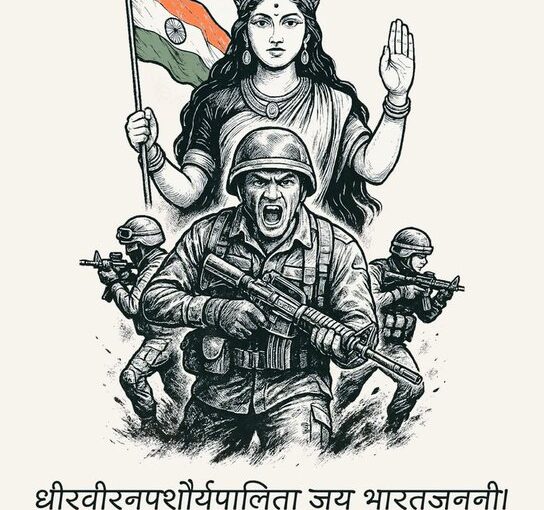
The review of Dhurandhar 2 has now been posted. Read it if you haven’t. The comment thread on the Ikkis post, which ran in parallel, illustrated the review’s central argument more vividly than any film still could.
A film that educates audiences to hate will eventually produce hateful audiences.
We have been moderating this site long enough to know that comment threads are a pressure gauge, not a debating society. What happened over the last 48 hours was not debate. It was escalation; predictable, cyclical, and ultimately ending where it always ends when people get sufficiently worked up: in the language of violence.
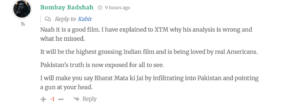
BB was on a Dhurandhar high. We understand this. There is something in the film’s rhythm, the josh of it, as he put it himself, that makes a certain kind of Punjabi Muslim-hating Bollywood patriot feel ten feet tall. We are not without understanding. He had just watched a four-hour film designed specifically to produce this effect. But understanding the cause does not excuse the consequence.
The line was crossed when he repeated, almost verbatim, dialogue from the film, the “ghar mein ghusega bhi, marega bhi” register, and directed it as a personal threat at Kair. Saying one will infiltrate Pakistan and hold a gun to someone’s head to make them chant a slogan is not josh. It is a threat. That it is practically unenforceable is beside the point. The language normalises exactly what we argued Dhurandhar 2 normalises: the idea that the other must be humiliated into submission, not merely defeated.
BB’s commentating rights are suspended until Thursday, 2nd April. Every comment he attempts in that period will be deleted. When the suspension ends, reinstatement of authorship will depend on whether the Saffroniate faction of our commentariat, can reason with him collectively that certain red lines exist even in the heat of subcontinental rivalry. Those lines are not about Pakistan. They are about the difference between argument and menace.
Kabir and Sbarrkum retain their authorship. Kabir was asked to stop and did not, and we say so plainly. But nothing in his conduct approached the violent register BB eventually reached. We are also honest about the asymmetry here: Brown Pundits tilts toward Bharat, that is India; everyone who reads this site regularly knows this. That soft tilt means Kabir, Sbarrkum and Qureshi operate in a forum that is structurally not neutral. The least we owe them is consistent application of the rules.
We want to say something about the Punjabi dimension behind all of this, because it is analytically interesting and not merely polemical.
The specific psychosis on display was not generically South Asian. It was Punjabi Muslim. Sindhis, for reasons rooted in their extraordinarily deep relationship with their language and soil, do not typically present this way. The Urdu-speaking Muhajir community has its own compound psychology; one that is genuinely rooted in a Persianate-subcontinental synthesis, an organic cultural memory with its own coherence. One can understand the Urdu speaker’s claim to a syncretic civilisational elsewhere.
But the Punjabi Muslim who denies his Hindu heritage, who treats Partition as a founding rather than a fracture, has bought into a psychosis that makes him a stranger to his own soil. Punjab is not merely an Islamic land. It is a land of Jats, Rajputs, Gujjars, Sikhs, Hindus, and Muslims who share the same genes, the same rivers, the same agricultural calendar, and the same emotional register. The denial of this, the insistence that one is Arab by faith and therefore by civilisation, is a psychological dissonance.
We are all, in some atavistic sense, Hindu. Not Hindu in the BJP sense. Hindu in the original sense: people of the Indus, rooted in a particular soil, shaped by a particular civilisation that precedes all the conversions and all the partitions. Kabir could, if he chose, say “Bharat Mata Ki Jai” and mean something true by it; not a Hindu supremacist slogan but an acknowledgment of the soil that made him. That is not the egregious part of BB’s comment. The egregious part was the gun.
We restored the full comment thread and will keep it visible until Thursday. We did this deliberately. The thread is the evidence. Anyone who wants to understand why we moderated the way we did; firmly on both sides, without ideological favouritism, need only read it.
Brown Pundits exists because the subcontinent deserves analysis that is neither exclusively Saffron nor Crescent. That standard is not always met. But it remains the standard. Fairness, balanced by wisdom. That is all.
You have completely missed the mark about Punjabi Muslims.
I am not Punjabi Muslim and I don’t think Kabir is either.
Taking pot shots at Punjabis seem to be a very Indian repsonse, it projects envy due to Punjabi cultural dominance on both sides of the border post 1947.
There was no Hindu religion before the British grouped all the pagan traditions together under a geographical moniker and named it Hinduism, so nobody is denying ”Hindu roots” here. We celebrate our native cultures with much fanfare, to the shock and horror of a neighbouring country.
We had pagan ancestors, so did the Arabs, Persians and Turks.. and all converetd to Islam over the centuries and contributed to it. We don’t have any qualms about accepting our pagan history, infact it sometimes is more fascinating. However as an Indian or Pakistani Muslim, you cannot own it openly because our pagan traditions havent gone extinct like those other places, and these pagan followers see it as an opportunity to try to label us as traitors to the land.
This is why Indian Muslims felt the need to create Pakistan, as Shuddhi movement amongst the pagans, fed by false British narratives, tried to rid itself of Islam and Islamic influences in the region.
The best thing that can be hoped for is an uneasy co-existence, but that appears to not be possible because our pagans want revenge for turning 1/3rd of the land to Islam.
Movies that promote hate, are promoted there, and thsoe that shun hate -even if true – are labelled propaganda. Dehumanizing the other is in full force via media, which is just a leadup to war. With the weapons we now have, we are hurtling towards ruin.
There’s also something generational happening here. The 4chan, “bakchodi”, “edgelord” gamer culture is a big part of the indian youth lacking civility. Brainrot is a real independent variable to structural political differences between Indian nationalists and Pakistan counterparts. Actual kinetic military confrontation is more rare now that in the 1948-1971 period. Despite the past having actual risks, the borders were much more open. Now, Pakistan, excluding nuclear blackmail, has never been less threatening, but the urban middle class is peaking in its mania. I would be cautious to extrapolate too much from this cultural moment we are living in.
Qureshi’s rendition of Hinduism as an equivalent form of paganism is fairly problematic.
I agree, but its hard to persuade otherwise. There’s genuine tension between the actual diversity of indic folk religious practices and seeing them as fragmented vs seeing a coherent “dharmic” superstructure. Cultural history can be interrogated like genetics in a way, we can choose the temporal framing, and find a way to lean towards one or the other. That said, I think its a bit politically convenient to imagine Indus dwellers as qualitatively alien to and outside the ambit of the classical prakritic/sanskrtic ecumene. One can make a much stronger argument for the distinctiveness of Assam or Kerala.
but even then I imagine they are variants on a theme?
Maybe the respective elite cultural vocabularies are variants? Take Sangam era Tamil Nadu for example, despite its maturity in classical antiquity, my understanding is that their literate culture was still a by product of the encounter with Indo-aryans,not an in situ development. And yet their poetry shows a radically distinct sensibility. Reading it in translation, I would not know that this culture was any closer to the Ganges than to the Nile. So i think there are deeper substrates that aren’t derivative of the indo-aryan culture, and were not necessarily exported and fused with the folk cultures of other regions. Southern kinship systems, totemic lineages, our shrine culture, our pastoral oral epics, the unique marine cultural landscape.ect
oh that’s fascinating.. I know nothing about this
If interested a compilation of verse, writing and reference by the Barr-Kumarakulasinghe family of Tellipalai, Jaffna
https://wilpattuhouse.com/MiscStuff/GennealogyStuff/Tamil%20Hymns%20Poetry-%20Barr-Kumarakulasinghe.pdf
My grandfather was a Tamil Poet (while a Admin to Brits)
I cant read write Tamil so asked Vijayvans opinion of granfathers Tamil
VijayVan
Excellent craftsman of traditional Tamil poem with it’s rules of prosody, meters, and phonics. This is what literati used to write till Modern Poetry took over. Even now there are many versifiers in traditional meters. In fact, some themes especially the last verse in page 8 directly trace their roots to Sangam Tamil. Their ragas and talas are set to Carnatic music. These verses are ditto from Bhakti poetry. On a side note , Chritsian Tamil is an interesting phenomenon. It usually eschews pure Tamil and incorporates many Sanskritised words which people know. Your document is peppered with such sansritised Tamil
It’s not problematic, since I donot use it in a deregatory fashion. Greek, Roman and Norse religions were pagan, and neo-pagans today identify as such in Europe. It follows that Indian religions were also pagan, since the term is used to define polytheistic traditions that are very loosely connected.
This is not some new opinion or a revisionist history, infact historians like Romilla Thapar and several others had held these exact same views.
I think “pagan” just sounds too much like “kafir”.
I don’t think you mean it that way but it would come off as offensive to many Hindus.
People raised Muslim have a visceral antipathy towards any form of idol worship. But this is our issue.
Unfortunately, I’m going to have to disagree. This isn’t strictly a generational difference, such animosity towards Pakistanis has been going on for well over a decade. BB’s language and sentiments towards Pakistan has been a staple among Indian posters on any Pakistani forum, blog, comment section etc. I’ve observed this since the late 2000s and many of these posters tend to be of the older gen – 70s, 80s, early 90s born.The younger generation just learned from the older ones.
ha, I am sort of clubbing anyone under 35 as young and digital-native in the indian context. I try to test my generalizations against people I interact with offline. The online world makes really fringe things seem mainstream. The vast majority of people don’t comment online. I think BP is such a great space, but in general, pathological online commentors are often (not always!) cranks. Its very easy to fall into confirmation bias. I could go into a pakistani forum and stay long enough to hear some dehumanizing remarks, and feel comfortable in strident political stances. Offline is the test for me. I know plenty of pakistanis, and have been to the country (as a hindu). I also have thousands of interactions with Indians of all types and I mix freely with hindu nationalist types. I have plenty of extended family in the Indian armed forces. I know how people talk 5 drinks down. The online discourse is so distant from real life. What our parents considered slighting remarks to muslims was so incredibly tame compared to what we observe in the online hate bubble
I think that this kind of language towards Pakistanis has been normalized since 2014.
Indians talk about Pakistanis the way Israelis talk about Palestinians.
It seems like the basic criteria of Indian nationalism is to hate Pakistan and Muslims.
From my observation, this has been going on longer than that. Yes, 2014 was a flashpoint for the RSS/BJP base the way Trump’s election was for the alt right in America but these sentiments have always existed and on both sides of the aisle in the political system. I’ve come across similar comments as his since like 2010 across multiple platforms. Pakistani forums, social media spaces and comment sections have been getting brigaded with such vitriol for a very long time. When I speak to older people such as my father and uncles who have worked in tech and even managed websites/forums as a hobby, they’ve dealt with this kind since the 90s. The indoctrination and hatred towards Pakistanis and Muslims goes a very long way back. 2014 was just the mask off moment.
Agreed that anti-Pakistani and anti-Muslim sentiment has always existed. But I don’t think people felt free to be as hateful as they are now. “Ghar me ghuske marangay” etc is a post-Modi phenomenon.
A movie such as “Dhurandhar” would not have been made pre-Modi.
I grew up in the US with many Indian friends. My family has always been heavily involved with Hindustani music. Our Indian acquaintances and friends probably had political differences with Pakistanis but no one was ever hateful on an individual level.
2014 certainly changed things.
For my own part, I used to be much more pro-India. I come from a family that deeply admires Nehruvian secularism. But the events of recent years (particularly “Sindoor”) have made me much more of a Pakistani nationalist.
When one sees how Muslims are treated in India, one feels incredible gratitude that a sovereign Pakistan exists and at least 250 million of us don’t have put up with that kind of second-class treatment.
These new Hindutva guys actually think that we celebrate events like Pahalgahm or Mumbai attacks. Even the most rabid Islamist on this side didn’t justify these two events. I have heard more about 26/11 in the last 5 years than in the first 10 proceeding and vowing revenge for it..
Excluding Kashmir (due to reasons discussed) Pakistan honestly does not have any designs on taking over India or fighting some war of conquest. Maybe the first generation after 1947 may have some yearning to unite through conquest but second generation onwards are fine with the national boundaries and look more towards the Middle East.
I also used to buy the theory that Pak Mil wants to continue enmity with India to justify their hold over the country, but this theory doesnt make sense anymore.. an entity as entrenched as the Pak Military does not need any oustide reason to rule now since they have absored or quashed almost all opposition.
However Indian politicians needs to stoke enmity towards Pakistan for domestic optics, and the Hindutva need to do this against Muslims due to internal demographic and political issues. It only harms India in the long term.. something they think more money will fix (but it won’t)
I agree about Pakistan not having ambitions of conquest outside of a very limited theater in Kashmir. Most hindu nationalists/chauvinists understand this. You are picking up on a dramatically amplified signal of online trolling (and perhaps mentally imbalanced people). In the same vein, even the most ardent fanatics on this side don’t take akhand bharat seriously.
From the outside its easy to underestimate how integrated muslims are in India and how varied the muslim poltical situation is in each and every region of the country. The idea that I, or even a locally influential person, could bully a muslim to say “bharat mata ki jai” is ridiculous. *Some* of the middle class angst against muslims is probably based on the fact they punch way above their weight in street politics, in contrast to the suppressed influence nationally. So while the mood amongst muslims here is that , yes, it sucks that the ruling party accommodates voices that disrespect us brazenly, and yes that’s demoralizing to a muslim wed to the liberal , civic nationalist “idea of india” , there is no demoralization of being a karnataka muslim or a kerala muslim. My own friends laugh at the concern of liberals for them under “the regime”, because if the last 12 years have proved anything, its that the most chauvinist central administration means squat on their local autonomy.
It’s not just the massive online troll farms/Indian nationalist bot armies but Akhand Bharat and the balkanization of Pakistan has been promoted as the ultimate goal by several Indian podcasters, talking heads, pundits, defense analysts, politicians, current and former diplomats, active and retired military and intel officers. People like Gaurav Arya, Sushant Sareen, Ranveer Allahbadia, are not exceptions, they are sadly the norm and are just the propaganda wing of the Modi government.
I don’t know about Karnataka and Kerala but there have been documented cases in other states (maybe mostly North India) of Muslims being lynched for supposedly eating beef or for not chanting “Jai Shree Ram” or whatever.
The demonization of Muslims in North India is incredibly worrying.
I keep saying that India is a secular state (on paper) but it is turning into a Hindu majoritarian state.
for the benefit of all, ‘ girmit’ is a snack made primarily from puffed rice and spices, onions etc,etc..some thing in the ‘jhal muri’family.
This is essentially a middle karnataka to northern karnataka snack.
On the side: a midterm election to the state assembly is to take place in davangere south constituency, (middle karnataka) which has a significant Muslim presence. a section of the Muslim leadership of Congress mooted a Muslim candidate. this was brushed aside by the high command and state leadership of the party and handed the ticket to the 25year old grandson, whose grandfather held the seat. This is a rich lingayet family who are ruling this area for last 40 years.
does girmit have a say on this?
All this to show that at the core congress and BJP are similar. so to say that, India is different after 2014 is a stretch.
Modi reflects what a Hindu on street feels.
Hemanta Biswa Sarma, the current CM of Assam, who was a congressman all his life, and now in BJP takes stances which even hardcore RSS guys feel shy. There is an election there too.
I have yet to get the direct scoop on the Davangere situation, so I don’t know how much to view it as a fiefdom passing to a successor vs actual succession. But on the theme of “all politics is local”, the lingayats of Gulbarga have a totally different relationship with muslims than those of Davangere. Another good example of long term community polarization is the Dharwad south seat (now Haveri), which was a bastion of the muslim Sanadi family several decades ago, but now entertains a BJP candidate regularly. My broader point is not that muslims and non-muslims (for reasons I prefer not to say hindus because the tension is with all others) don’t polarize. In fact they might be polarizing for understandable reasons, it’s more a comment on the extreme hate rhetoric which to me is quite different. Regarding Assam, they are a unique outlier in terms of how culturally different they are from the hindutva leadership, but their concerns are the most understandable. The changing demographics of their state, and it’s implications are real, and this is going to get ugly. It’s worth looking into how Assamese muslims view Bengali muslims.
ಗಿರ್ಮಿಟ್ ಅಣ್ಣನಿಗೆ ಒಂದು ಪ್ಲೇಟ್ ಮಿರ್ಚಿ ಬಜ್ಜಿ, ಒಂದು ಖಡಕ್ ಛಾಯ್.
(one plate mirchi bhajji and one khadak chai to girmit Bhai!!
Pak Fauj definitely needs India as the external enemy. Pakistani nationalism is based on being anti-India. TNT is our official ideology
But the irony is that India itself is strengthening the hold of Pak Fauj. The best way to weaken TNT is increased people to people contact etc. We are essentially the same people.
But when Pakistanis see how Muslims are treated in India and when India violates our sovereignty, we become more grateful to Pak Fauj for being the only institution able to deter Indian hegemony.
I keep saying this on BP but there is hatred on both sides. My own feeling is that Indians hate Pakistan much more than Pakistanis hate India.
No offense but I don’t buy the “same people” narrative. All humans are the same if you really get down to it. I’m not exactly sure why Pakistan needs a special relationship with India. Pakistan and India are separate countries, separate nations, 3 – almost 4 generations removed from the partition with each of our own unique experiences as nations and different ambitions and trajectories. We are nearly 4 generations deep into azaadi so no, people to people contact would not weaken our sense of nationhood or erase our desire to remain a separate sovereign country. One of the biggest testaments to this is the relations between the diasporas outside the subcontinent, especially here in the US, you see the Pakistani community get absorbed into the American Muslim melting pot while Indians end up creating their own spaces (due to mass immigration) or some assimilate into White America (same holds true for non-religious South Asian Muslims). The only way Pakistaniyat is extinguished is through some 1492-style Hindutva inquisition of Pakistan but that’s a pipedream for the RSS.
I didn’t mean to imply that people to people contact would “erase our desire to remain a separate sovereign country”. It would certainly weaken the hard version of TNT.
Bangladesh and India have a lot of people to people contact–or at least, they had until recently. And those two countries have a much more normal relationship than India and Pakistan.
I don’t think Pakistan needs a “special” relationship with India. But it would be nice if we can move towards a more normalized relationship with our neighbor. After all, geography can’t be wished away.
As for “same people”, I don’t know if you are Punjabi. Punjabis on both sides are certainly the same people. The creation of a man-made border certainly doesn’t change our genetics or our history. As I’ve mentioned my own nana was from Amritsar. Many Pakistani Punjabi families have roots in East Punjab.
Our experiences of the US diaspora must be different. My family was always part of a South Asian community rather than the “American Muslim melting pot”. Perhaps because we were not particularly religious. Also, we were heavily involved in Hindustani music which of course tends to be an Indian activity.
To give you a better idea of where I’m coming from you, you can read this:
https://kabiraltaf.substack.com/p/what-being-a-centre-left-pakistani
I don’t know about weaken, I just don’t think we need any justification or theory to justify our existence or purpose. People to people contact hasn’t really made any Pakistanis change their faith or convictions, in any meaningful numbers. The average person isn’t thinking about political ideology or history. Pakistaniyat is now a philosophy, a phenomenon, in its own right much like Kashmiriyat. As years go by, every unique experience Pakistan goes through as a nation, whether it was the Gwot or political instability/national tragedies, natural disasters or even positives like winning a world cup or an olympic gold medal or a diplomatic victory, whatever it be, further cements the identity.
I don’t think Bangladesh-India are a good example of people to people contact improving relations; Bangladeshis are some of the most anti-Indian people currently, like I’ve met way more Bangladeshis critical and even borderline resentful of India more than many Pakistanis especially your average left of center dawn-reading Pakistani urban dweller. Bangladeshis are more anti India than us but they do depend on them a lot more, the closeness with India is due to necessity, Bangladesh is geographically surrounded by India and economically they can only thrive by having good relations with them, sort of like the USA and Mexico, the latter has no choice but to try and have good relations or they’re committing economic kamikaze. As for Pakistan, I think we can have reasonable relationships but more like China-Japan, Japan-S. Korea or China-Vietnam – great trade ties and people to people contact but not too chummy – still bit of a friction and consanguineous rivalry, enough to encourage healthy competition. Maybe I’m too Americanized but I think we can’t achieve successes as a state unless we stay in constant competition to motivate ourselves to get better, the desire to one-up your neighbor is necessary to move the nation and human race forward.
I don’t really agree with how ethnic or ethno-linguistic identities are defined especially in South Asia and I do believe identity isn’t strictly defined by language or provincial boundaries. Who you consider your people varies person to person based on what you prioritize, so yeah, you’re free to feel kinship with East Punjabis over a Baloch from Jacobabad or a Memon from Karachi but not everyone has to share that rubric.
Personally I don’t know where I’d place myself in Pakistan’s cultural mosaic due to my mixed (Pakistani) background, I just feel very Pakistani because of that. I do have a lot of Kashmiri relatives settled in Punjab, so I respect Punjabis but don’t necessarily identify with it and even on that side of my family, people identify differently depending on several factors like where they grew up, language proficiency, social class, religiosity levels, political leanings etc
On the topic about Indian-Pakistanis relations in America, I think there’s a growing wedge between the two communities and yes, like you said perhaps your family being not very religious could be a reason for why you gelled better but I think it also depends on where you lived and the particular Indian and Pakistani communities found there. My state has had a huge influx of Indians due to the h1b program so it’s changed the social fabric and complexion of society, it’s very different from the older waves of Punjabi and Gujarati immigrants who settled in the Northeast and California. The massive waves of southern Indian immigration in the past 20 years has made a lot of younger whitewashed Pakistani-Americans think that we don’t share much at all with Indians, quite a contrast from the kinship South Asians feel in the UK and Canada and that’s to do with kind of immigration we’ve been getting.
My mom’s family is Kashmiri-Punjabi. My nana actually had “Khawaja” in his name.
My point with respect to Bangladesh-India was that people in West Bengal and East Bengal share a certain ethnic kinship– just as people in West Punjab and East Punjab share a certain ethnic kinship. The Punjabi identity long predates either the “Indian” or “Pakistani” identity.
Even before 1971, one of the issues was that the East Pakistani leadership wanted to trade with Calcutta. The Kashmir cause didn’t mean very much to them–unlike what it meant to West Pakistanis.
I think the current Bangladeshi antipathy to India has to do with the fact that Hasina has been given refuge in Delhi. But I’m not a Bangladeshi so I could be wrong.
I agree with you that Pakistan doesn’t need an ideology to justify its existence. Pakistan is a reality. It’s a nuclear power. The country will continue to exist.
However, The “Two Nation Theory” is the official ideology of the country. If you had grown up in Pakistan, you would have been made to take “Pakistan Studies” from primary school until you completed your undergraduate degree. “Pak Studies” is basically state propaganda.
I ideally want to see a Pakistan which moves away from the hard version of TNT and normalizes with India. This doesn’t seem likely since India is now increasingly committed to its own version of TNT– that India is a Hindu nation just as Pakistan is a Muslim one.
On the diaspora: I grew up in the DC area. My dad was with the World Bank. My mom is a doctor. So that was our particular social circle of Indians and Pakistanis
.
Interesting perspectives. Regarding one of them, an Indian Punjabi or Gujarati person would probably also see a huge wave of Telugu H1B immigrant and feel they have not much in common and hard to socialize. Id venture that even Keralites would feel the Telugus culturally distant. I feel closer to Sri Lanka culturally than many parts of India.
You used the example of South Asian kinship in the UK, which is a tad ironic to me because the brawling and bad blood between Sikhs and Pakistanis was legendary in the 80s/90s , of which we had nothing of the sort in the US. A harsh truth is that the south indian h1bs never genocided their muslims and our goddess shrines share compound walls next to dargahs and no one blinks. In Punjab, where you feel kinship, it was the Sikhs who sent the trains full of dead bodies to west Punjab, not RSS. Don’t mean to make too many assumptions about your views in particular, but I’ve noticed a broader Punjabi cognitive dissonance that goes unacknowledged, it was your cultural kin who committed these crimes against you , not the inscrutable distant hindu. It was for the sake of these same Punjabis that Congress rejected the cabinet mission plan, and it’s mainly in the imagination of them that kashmir was in their political ambit. The rest of india is pragmatically doing damage control on the stupid situation they created, because losing a province could create anarchy.
Don’t forget that it was Punjab and Bengal that were divided. The only provinces to be cut in half.
You are correct that there was more Partition-related trauma in Punjab than in other parts of India or Pakistan.
Punjab looms large in the Pakistani cultural space given that the majority of the population is Punjabi and it’s the most powerful province.
While there was violence in the Punjab, there is also more cultural bonhomie between Punjabis on both sides. We share a language, a culture etc. A Pakistani from Lahore can relate to an Indian from Delhi far more than he or she can to an Indian from let’s say Chennai.
“more partition related trauma” is an understatement. Down here there is *zero* partition related trauma. The Punjabi bonhomie you mention is the whole point, people confuse that for trust. Healing the trauma has almost nothing to do with the rest of us. The best partition plan would have seen the entirety of Punjab province in Pakistan, with the latter as a de facto Muslim state and not de jure.
A very civil discourse, very unlike other discussions on this topic.
A pleasure to read
Yes, it’s amazing how civil discussion can be when the usual suspects are absent.
There will obviously be more trauma in the provinces that were divided.
But there was trauma in UP. Qurrutulain Hyder has written about this.
Wouldn’t you say that there was trauma in Hyderabad related to the “police action”?
If the entirety of Punjab had gone to Pakistan, the holiest sites of the Sikhs would all have been in Pakistan. I don’t think they would have taken kindly to that.
Also had all of Punjab gone to Pakistan, Kashmir would have had to go to Pakistan. There would have been no land route from India.
I think my response got flagged for spam.
I think that 12 years of the Modi regime has allowed people to express certain views that they may have been hesitant about expressing in the past.
The Indians on here may not agree with me but Modi’s politics is largely based on demonizing Pakistan. Pakistan is used as a proxy for Indian Muslims whom the party sees as the enemy within.
Movies like “Dhurandhar” would not have seen the light in Congress days.
While there were certainly India-Pakistan tensions (and wars) during the Congress era, Congress is generally able to separate the Pakistani government/military from the Pakistani people. We largely saw dialogue and people to people contact continue.
I also think Pakistanis are generally less hateful towards India than Indians are towards Pakistan. We may not like India (I think most of us don’t) but we don’t have fantasies of the absolute destruction of the country. Far too many Indians salivate at the thought of Balochistan seceeding.
The rise of cable news allowed (actually outrageous) events like 26/11 to persist in the news cycle indefinitely. The process that allowed for Modi started much earlier. I’m not even sure that his government even gave the fanatics a fillip, if anything , the country is building immunity to their main narrative. Many people actually believed that he was going to turn the country into Singapore in one term, and that the only thing preventing it previously was Congress corruption , enabled by (among other things) appeasement politics. Such naive thinking is fairly rare in 2026
I do realize that 26/11 fundamentally changed many Indians’ thinking on Pakistan.
I do feel–and I know many Indians will disagree with me– that electing a man whose followers call him “Hindu Hriday Samrat” and who has Muslim blood on his hands (Gujarat 2002) as PM three times reveals a certain level of Muslim hatred in India that is very troubling.
As a Pakistani, this is not really a worry for me. If India violates our sovereignty, we are a nuclear power and can defend ourselves. But I would hate to be an Indian Muslim right now. Basically, they are second class citizens.
Hindus fundamentally dislike Muslims (and vice versa). It’s sad but true. It doesn’t bode well for co-existence in India.
modi became chief minister of gujarat even before be was an MLA. To believe and say that he engineered riots is stupid.
Even leading advocates of this theory such as rajdeep sardesai, Barkha Dutt have moved away from this point.
Even congress doesn’t speak this language any more.
More Hindus than Muslims were killed and arrested in riot control. At best he can be accused of inaction in the initial stages.
Gujarat always had Hindu Muslim clashes.
Events leading to riots were horrific. A full bogie of woman, children and everybody were burned alive. This was not an accident.
This was the tipping point.
First of all, I believe the appropriate word is pogrom and not riot.
The responsibility for action or inaction rests with the Chief Minister of the state.
The fact that such a man has thrice been elected Prime Minister speaks volumes about India.
For the record, the maternal side of my family is Punjabi (well Kashmiri-Punjabi) but settled in Punjab for generations. My maternal grandfather’s relatives fled Amritsar at Partition.
Agreed that the concept of “Hinduism” was a British invention. When it came to the census, anyone who couldn’t state that they were Muslim or Christian was labelled “Hindu”. That’s not necessarily how the natives referred to their beliefs.
I wouldn’t use the word “pagan” as it just seems offensive.
I was at the Lahore Museum recently and the galleries are full of pre-Islamic art on display. There are paintings of Radha Krishna, statues of Buddha (from the Gandhara civilization) etc. No one seemed particularly bothered by it.
Of course, the identity of Pakistan is based on being a Muslim nation. And there are Pakistanis who want to pretend that their ancestors were Arabs and Persians.
The “Ertrugul” phenomenon was a thing. But I think India also has a role to play in this. The more they define being “Indian” as being “Hindu”, the more Pakistanis will go in search of an alternative history and culture.
I’ve been reading this blog for a few months now. This poster has always had a negative presence. Knew he was a reprobate when his first post was a very explicit, profane piece sexualizing and fetishizing Pakistani women – which is a patholigical fixation of Hindu fundamentalist types. I’m surprised he was ever given authorship, I always thought the blog admins would have higher moral rectitude and discernment. Giving a platform to such shady characters reflects poorly on what has otherwise been a well run and pedigreed blog. I appreciate the admins for establishing decorum and protecting the integrity of brownpundits.
Yes. I have never experienced such Islamophobia, homophobia etc than I have from “BB”.
I was always against his being given authorship here. That post on “haraam bits” was absolutely disgusting. It’s not just about Pakistani women. He’s also made comments about “settling” in the Kashmir Valley and by implication conquering Kashmiri Muslim women.
He’s basically your worst example of an Indian man. His only agenda here is to insult Pakistan.
I don’t think he’s particularly a “Hindu fundamentalist” though he does seem to support BJP etc. He seems like a young guy who treats cricket victories against Pakistan as victories on the battlefield and Bollywood propaganda as real life.
I was willing to just deal with him as a troll but the threats of violence have crossed all lines.
A small point: I would never say “Bharat Mata ki Jai”.
Primarily because as a Muslim it is against my religion to believe in any kind of god except for Allah. “Bharat Mata” is a mother goddess. This slogan is not a generically Indian nationalist one but specifically a Hindu one.
If we cannot ask Pakistani minorities to chant “Allah ho Akbar” or “Nara-e-Takbeer”, we certainly cannot ask Indian Muslims to chant specifically Hindu slogans.
I could say “Jai Hind” or “Hindustan Zindabad”. But I’m not an Indian so I have no need to say either of these things.
I don’t expect Indian citizens to say “Pakistan Zindabad”. Indians shouldn’t expect Pakistanis to chant Indian patriotic slogans.
Bharat Mata isn’t a deity, it was invented by Bollywood or something. So in the common understanding it is just “mother India” which is not unlike the personification of the motherland used by other muslim cultures from Turkey to Indonesia. The same protocols of solemnity that would be expected in discussing a goddess people believe in are not followed with Bharat Mata.
“Bharat Mata” was not invented by Bollywood. The concept dates to late 19th century Bengali literature. According to Wiki:
https://en.wikipedia.org/wiki/Bharat_Mata
I can’t speak for Indian Muslims. But Orthodox Islam takes the concept of shirk very seriously. We cannot bow to any gods other than Allah. So I will never chant a slogan that mentions some version of Durga or Kali. This is the same problem India’s Muslims have with “Vande Mataram”. “Mother goddesses” are anathema to Islam.
I wrote a long response to this but for some reason it’s in moderation.
The short version is that “Bharat Mata” wasn’t invented by Bollywood but goes back to late 19th century Bengali Literature. She was painted by Abanindranath Tagore in 1904 as a four-armed goddess.
https://en.wikipedia.org/wiki/Bharat_Mata
Indian Muslims may make their own accommodations but Orthodox Islam takes shirk very seriously. There is no God but Allah. So you can understand that “mother goddesses” are absolute anathema for Muslims.
On Indian cinema:
“Smoker’s Corner: Ghosts on the Screen”
By Nadeem F. Paracha
https://www.dawn.com/news/1986163/smokers-corner-ghosts-on-the-screen