
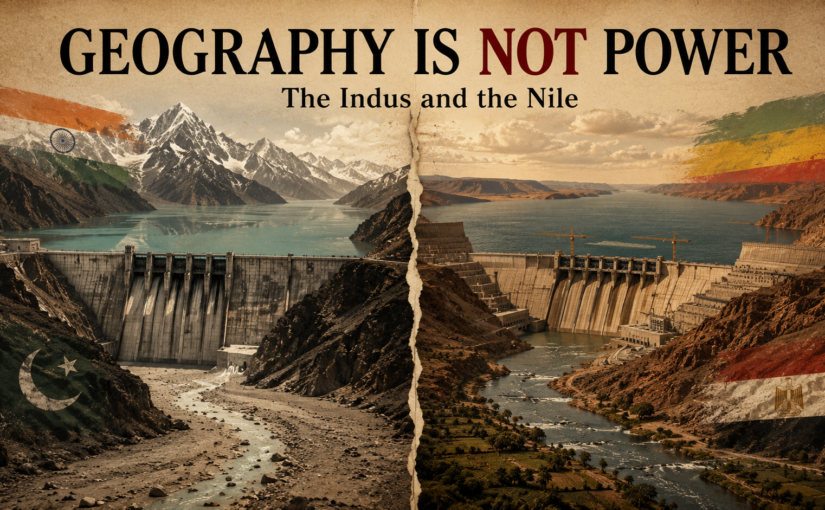
The Indus Waters Treaty and the Nile
While the previous thread argues about whether Panini held a Pakistani passport, a more useful quarrel is flowing past us. In April 2025, after the Pahalgam massacre, India held the Indus Waters Treaty in abeyance. It did this the day after the attack, a fortnight before the missiles of Operation Sindoor. The water came first. That order tells us something: New Delhi reached for the river before it reached for the air force, because it believes the river is the better weapon. We think it is wrong about that, and the reason why takes us a long way from the subcontinent, to the Blue Nile.
The instinct underneath India’s move, and underneath most of the commentary on it, is that the country upstream holds the whip. Sit at the top of the river and you control the tap. It is a tidy idea and it is false. Whether the upstream state is master or supplicant depends not on the map but on which side can make the other bleed.
India is running a bluff it cannot yet call. The treaty India suspended was built to survive exactly this. Signed in 1960 under World Bank mediation, it gave Pakistan the three western rivers and India the three eastern ones, and it contains no exit door. A party cannot lawfully walk away or hold it in abeyance; it stays in force until both sides agree to change it. India knows this, which is why, when it asked twice, in 2023 and 2024, to renegotiate, and Pakistan refused to come to the table, India was left with grievance and no remedy. The Court of Arbitration has since ruled, more than once, that the suspension has no standing and that the limits on India’s water control still bind. India calls the court illegal and presses on.



“And who knows, in the distant future we can prop up Afghanistan like China does Pakistan.”
We are going to watch this in a few hours?