
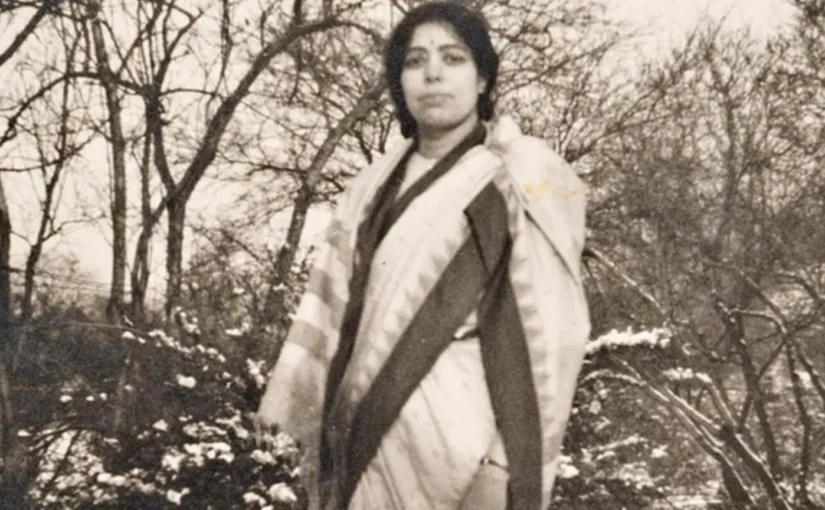
The Untold Story of E.K. Janaki Ammal
via X
She was born in 1897 in Tellicherry, Kerala, the daughter of a high court sub-judge and one of nineteen children in a large, liberal household called Edam. Her family belonged to the Thiyya community, considered “socially backward” under the Hindu caste system. But within Edam, caste meant little. There was music, a sprawling library, a cultivated garden, and a quiet expectation of excellence.
Her sisters married. She did not. Instead, Janaki Ammal chose plants.
She trained first at Queen Mary’s and Presidency Colleges in Madras, then left colonial India in 1924 on a Barbour Scholarship to the University of Michigan, where she would become the first Indian woman to earn a doctorate in botanical science. She lived in an all-women’s dorm, smuggled a squirrel in her sari for company, and worked under renowned botanist Harley Harris Bartlett.
She returned to India and joined the Sugarcane Breeding Station in Coimbatore, where she changed the course of Indian agriculture. The country’s native sugarcane was hardy but lacked sweetness; imported varieties were sweeter but weak. Janaki crossbred both into something stronger, higher-yielding, and perfectly suited for Indian soil.
The sugar in Indian chai owes its taste to her.
She was also the first to cross sugarcane with maize, helping decode the plant’s evolutionary history. But her work, though pioneering, was not credited. A British biologist dismissed her research. Her male colleagues at the institute refused to support her publication. Her note to Nature was stalled. She nearly resigned.
But she stayed. And she worked.
In 1940, as bombs fell over London, she relocated to Britain, joining the John Innes Horticultural Institution and, later, the Royal Horticultural Society at Wisley, becoming the first woman scientist ever employed there. She lived through the Blitz. When the air raids began, she slept under tables. When food was rationed, she kept working.
At Wisley, she created new varieties of magnolia, studied colchicine-induced polyploidy in woody plants, and collected plant specimens from Nepal, returning with rare rhododendrons and roses. One of the magnolias she bred was later named after her: Magnolia kobus ‘Janaki Ammal’. It still flowers in Surrey.

She co-authored the Chromosome Atlas of Cultivated Plants; a landmark of modern botany. Her studies on polyploidy, species distribution, and chromosome morphology spanned everything from magnolias to mentha, solanum, cymbopogon, and orchids. She saw the Himalayas not as a singular ecological belt but as a frontier of hybridization between Chinese, Malayan, and native Indian flora; decades before biodiversity was a buzzword.
But India had not forgotten her.
In 1951, Prime Minister Nehru invited her home to reorganize the Botanical Survey of India. Inspired by Gandhi and independence, she returned. But male colleagues refused to take orders from a woman. Her reforms were blocked. She was isolated again. And so she did what she had always done: she moved on.
She became a plant explorer, traveling across India, identifying species, collecting data, protecting forests. In her 80s, she helped lead the campaign to save Silent Valley, a rainforest in Kerala threatened by a hydroelectric project. She died in 1984, nine months before the valley was declared a national park.
In her last years, she lived in the Field Laboratory at Maduravoyal, tending to medicinal plants, refusing retirement, still working. Her brinjals still grow in fields. Her magnolias still flower in Wisley. Her sugarcane still sweetens the tea of 1.4 billion people.
She received a Padma Shri at age 80—belated, insufficient, and largely unnoticed.
She never married. Had no children. Claimed no title. Asked for no monument.
“My work will survive,” she told her family once.
And it did.
Postscript
Janaki Ammal was not just a botanist. She was a cytogeneticist, plant geographer, experimental breeder, and one of the first Indian scientists to speak of biodiversity—in the 1930s.
She was dismissed for her caste. Blocked for her gender. Ignored in her lifetime.
But she bred sweetness out of bitterness. She turned silence into survival.
And the country she loved, though too slow to honour her, now lives inside her legacy.
Her name is E.K. Janaki Ammal.
Remember it. Share it. Teach it.
This post isn’t just history. It’s a recovery.
Quite wonderful. And a welcome change in tone.
thank you
Yes I was going to write in 1971; then saw this on Twitter was going to WhatsApp share it, then it dawned on me great BP article
I think slightly stricter moderation will be required.
It cannot be endless Indo-Pak foray; also I find the idea that every Pakistan comment has to be answered by Kabir to be tiresome
The commentariat have a right to their views but it gets tendentious
I think BP also has to be more confident; we are what we are..
Great article! Kerala has consistently been a standout destination in the subcontinent. I’m planning to visit Kochi next year for the biennale, along with some surfing in Varkala.
I have only been once- I do 3/4 Metros.
Chennai – Mumbai – Delhi
Beautiful!!!
Yes Bharat the Beautiful
I found the Thivya also very interesting
**Thivya Caste (also known as Ezhava)
from Wiki
According to some Malayalam folk songs like Vadakkan Pattukal [which?] and legend, the Ezhavas were the progeny of four bachelors that the king of Ceylon (Sri Lanka) sent to what is now Kerala at the request of the Chera king Bhaskara Ravi Varma, in the 1st century CE. These men were sent, ostensibly, to set up coconut farming in the region Another version of the story says that the king sent eight martial families at the request of a Chera king to quell a civil war that had erupted against him.
Yes I saw that !
@sbarrkum This myth of Bhaskara Ravi Varman inviting Ezhavas into Kerala does not seem to be historically accurate. The Tarisappalli Copper Plates (circa 856 CE) issued during the rule of the earliest recorded Perumal Sthanu Ravi Varman mentions Ezhava families being assigned to the Church being built by Persian Merchant Sapir Iso. However, the broader point of Ezhavas being immigrants to Kerala from Eezham (Sri Lanka) seems to be true.
There is also a distinction usually drawn between Ezhavas and Thiyyas. Thiyyas are from Northern Kerala and Ezhavas from South. Thiyyas had a much higher social status and were a martial caste. Almost all of the warrior heroes and heroines of North Kerala are Thiyyas, and their social status was similar to that of Nayars.
yes for some reason the wiki entry for Thiyyas went to Ezhava/ I remember Ezhava from God of Small Things?
There seems to have been an understanding that both groups share common origins. After the time of Sree Narayana Guru in the early 20th century, there was a spiritual and political consolidation of the Ezhava-Thiyya groups. I need to read up more on this.
By the way, I read up a bit more on EK Janaki Ammal. Her father was a Diwan Peshkar in Colonial India. Her mother is of Thiyya-British parentage. So, she definitely was a woman from a privileged background.
Anglo-Indian? on her mother’s side?
Yes! The following are the wiki pages of Janaki Ammal, her brother, and her father, in that order.
https://en.wikipedia.org/wiki/Janaki_Ammal
https://en.wikipedia.org/wiki/E._K._Govindan
https://en.wikipedia.org/wiki/E._K._Krishnan
love it. TIL.
Thank you – I notice Kabir is busy defending on the Hinduphobia thread but has not had the courtesy to write on this board
Nice and refreshing post! 🙂
thank you