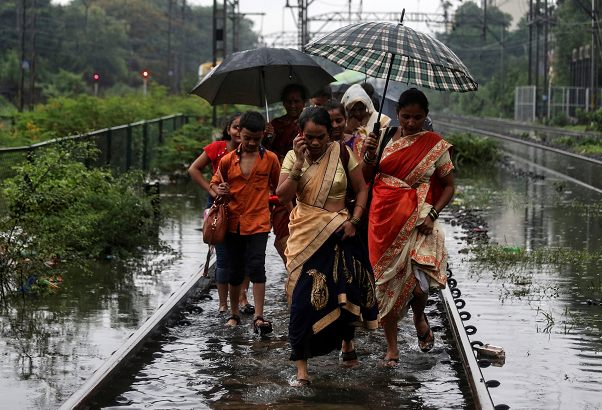
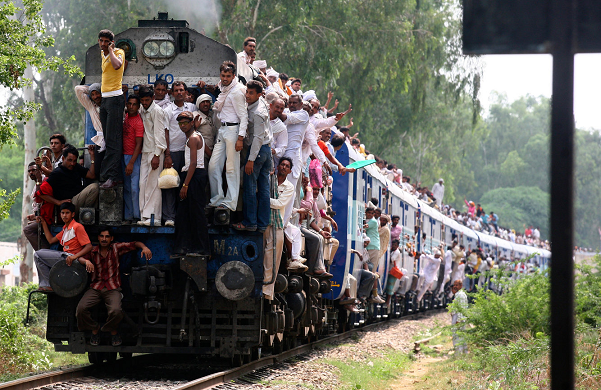
Metaphors for full, empty, void, overflowing — Indian trains

You already know the way things are —

so this DoubleQuote will show you the familiar, hopefully with a new slant —

— the abstract intuition that sees these two images taken together as a binary, a pairing of extremes — something the brain finds very reassuring —

— and a metaphor for duality and as such, non-dual.

**

The lower of the two photographs, with the ladies walking along the railway tracks with no train in sight, is taken from an article on the oncoming monsoon that might interest you:

Waiting for the Monsoon, Discovering a Brain Tumor Instead

A brain tumor — what kind of strong weather in mind and heart is that? We live in an alien, often beautiful, sometimes unbearably human world.

A couple of instances of Christianity in the world around us

I saw Omar Ali yesterday — terrific conversation — and when I asked what topics I should discuss here, he suggested I post whatever interests me — so here’s the anointing of Brazilian strong-man Bolsonaro, and hymn singing in Hong Kong.

Religious behavior in general fascinates me — but when it affects politics, people often don’t realize what powerful motivation it can provide.

**

Religion can be coercive, as in the anointing of Bolsonaro

see video

— Remember the laying on of hands over Donald Trump? The overarching authority of religion has Trump bow his head, but sets Bolsonaro on his knees! —

— and religion can be liberating —

see video

— That’s a crowd of protesters in Hong Kong singing “Sing Hallelujah to the Lord”.

Remarkable.

**

From Reuters in June:

Sing Hallelujah to the Lord’ an unlikely anthem of Hong Kong protests

For the past week, the hymn has been heard almost non-stop at the main protest site, in front of the city’s Legislative Council, and at marches and even at tense stand-offs with the police.

It started with a group of Christian students who sang several religious songs at the main protest site, with “Sing Hallelujah to the Lord” catching on among the crowd, even though only about 10 percent of Hong Kong people are Christian.

“This was the one people picked up, as it is easy for people to follow, with a simple message and easy melody,” said Edwin Chow, 19, acting president of the Hong Kong Federation of Catholic Students.

The hymn is simple, optimistic yet adds a touch of solemnity and calm to the proceedings, and also affords some legal protection to the protesters —

The students sang the songs in the hope of providing a cover of legitimacy for the protest. Religious gatherings can be held without a permit in the financial hub.

“As religious assemblies were exempt, it could protect the protesters. It also shows that it is a peaceful protest,” Chow said.

The hymn was composed in 1974 by Linda Stassen-Benjamin in the United States for Easter. Its five words are repeated over four stanzas in a minor key, which gives it an air of meditative solemnity.

**

Between the anointing of a dictator and the hymn singing of a crowd of protesters demanding democratic freedoms from the Chinese state, we have quite an instructive confluence of ways in which religion can enter the public square.

No doubt there are others. In Nepal, there’s the tantric cultus of the goddess Kubjikaa. What’s religion up to in your neck of the woods?

Invisibility, Jeff Sharlet’s The Family, and the goddess Kubjikaa

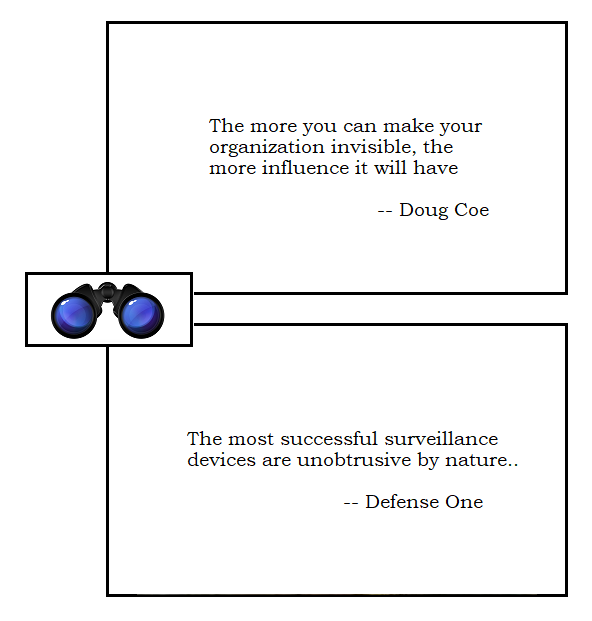
It’s like a waterfall: you stumble on an idea that comes from the mouth of Doug Coe, describing the principle behind the influence of The Family, of which he was the long-time leader —

— and it turns out the same principle is referenced in an article on surveillance in Defense One

— only to re-emerge in Dr Mark SG Dyczkowski‘s work on the tradition, philosophy and practice of the goddess Kubjikaa.

**

There’s clearly a principle at work here that could find application in many fields, contexts, silos — and the concatenation of such instances is itself a demonstration of the value of silo-breaking thinking.

FWIW, I wouldn’t have so much as heard of the Goddess Kubjikaa were it not for my half-century friendship with Mark Dyczkowski, to whom I owe so much, and into the waters of whose scholarship so deep I have dipped no more than a toe.

Climate change: impact on the Hajj


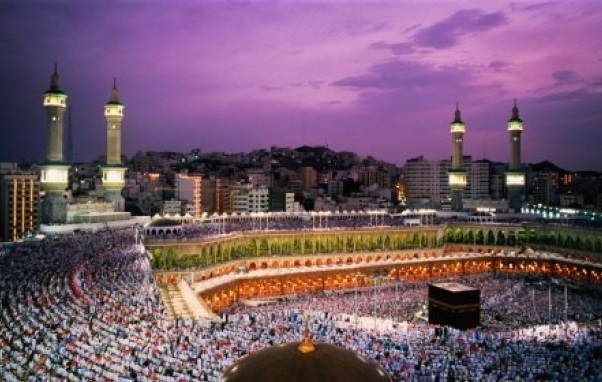
The Hajj, Mecca

**

Since I posted my poem Mourning the lost Kaaba in late November 2017 — though not, I imagine, because of my poem — a report on the likely impact of climate change on the annual Hajj pilgrimage has come out from scientists at MIT and Loyola Marymount:

Kang, Pal, & Eltahir, Future Heat Stress During Muslim Pilgrimage (Hajj) Projected to Exceed “Extreme Danger” Levels

Here’s the abstract:

The Muslim pilgrimage or Hajj, which is one of the five pillars of Muslim faith, takes place outdoors in and surrounding Mecca in the Saudi Arabian desert. The U.S. National Weather Service defines an extreme danger heat stress threshold which is approximately equivalent to a wet?bulb temperature of about 29.1 °C—a combined measure of temperature and humidity. Here, based on results of simulations using an ensemble of coupled atmosphere/ocean global climate models, we project that future climate change with and without mitigation will elevate heat stress to levels that exceed this extreme danger threshold through 2020 and during the periods of 2047 to 2052 and 2079 to 2086, with increasing frequency and intensity as the century progresses. If climate change proceeds on the current trajectory or even on a trajectory with considerable mitigation, aggressive adaptation measures will be required during years of high heat stress risk.

**

That’s the science — and while Saudi Crown Prince Mohammed bin Salman told the G20 in June that the Saudis are committed to “reducing greenhouse gas emissions and adapting to the negative effects of climate change,” beliefs concerning the Prophet’s institution of the Hajj in 632 CE following on earlier Abrahamic practice may well clash with scientific claims that the Hajj may become impossible for future devout Muslims to observe.

What happens, then, when this divine command intersects with increasing temperatures that eventually render Mecca uninhabitable? How do the climate change scientists fare when they sit across the table from the ulema, the scholar-clergy of Islam?

From a Muslim point of view, we’d better climate-correct, and do so fast:

Shahin Ashraf, We must stop climate change before it makes Hajj impossible

**

The issue I’ve raised above is tightly focused on one sanctuary, one religion, one pilgrimage. Below are some other major pilgrimage sites to consider in light of climate change:

I would be interested in the cross-disciplinary exploration of the impact of climate change as understood by the scientific consensus, global migration patterns now and as expected in the coming years, and the devotional rituals and ceremonials of the various religions involved.

Large pilgrimages and religious ceremonials

This list draws text from Wikipedia and other online information sites.

Kumbh Mela:

Allahabad, India, 120 million devotees, every 12 years. The Prayag Kumbh Mela is a mela held every 12 years at Allahabad, India. The fair involves ritual bathing at Triveni Sangam, the meeting points of three rivers: the Ganga, the Yamuna and the mythical Sarasvati. The Kumbh Mela in 2013 became the largest religious gathering in the world with almost 120 million visitors.

Arba’een:

Karbala, Iraq, 30 million pilgrims annually. The Arba’een Pilgrimage is the world’s largest annual public gathering, held every year in Karbala, Iraq at the end of the 40-day mourning period following Ashura, the religious ritual for the commemoration of martyrdom of the grandson of Prophet Mohammad and the third Shia Imam, Husayn ibn Ali’s in 680. Anticipating Arba’een, or the fortieth day of the martyrdom, the pilgrims make their journey to Karbala on foot,where Husayn and his companions were martyred and beheaded by the army of Yazid I in the Battle of Karbala. The number of participants in the annual pilgrimage reached 30 million or more by 2016.

Papal Mass

Philippines, 7 million adherents, occasional. Pope Francis’ apostolic and state visit to the Philippines garnered a record breaking crowd of 7 million people. The mass conducted by the pope was the largest gathering in papal history.

Makara Jyothi

India, 5 million pilgrims annually. This pilgrim center and temple is located amidst a dense forest in the southern region of India. It was visited by over 5 million pilgrims in 2007 for a festival known as ‘Makara Jyothi,’ occurring annually on the 14 of January. Although the Sabarimala Temple, site of the Makara Jyothi celebration) draws a crowd of 50 million visitors annually, the specific day of the miraculous celestial lighting observation gathered 5 million pilgrims in 2007.

Bishwa Ijtema:

Near Dhaka, Bangladesh, 5 million pilgrims annually. The Bishwa Ijtema, meaning Global Congregation, is an annual gathering of Muslims in Tongi, by the banks of the River Turag, in the outskirts of Dhaka, Bangladesh. It is one of the largest peaceful gatherings in the world. The Ijtema is a prayer meeting spread over three days, during which attending devotees perform daily prayers while listening to scholars reciting and explaining verses from the Quran. It culminates in the Akheri Munajat, or the Final Prayer, in which millions of devotees raise their hands in front of Allah (God) and pray for world peace.The Ijtema is non-political and therefore it draws people of all persuasion. It is attended by devotees from 150 countries. Bishwa Ijtema is now the second largest Islamic gatherings with 5 million adherents

[ this is where the Hajj, with 2.3 million pilgrims annually, fits in ]

Umrah:

Mecca, size unknown, year round. The ?Umrah is an Islamic pilgrimage to Mecca, Hijaz, Saudi Arabia, performed by Muslims that can be undertaken at any time of the year, in contrast to the ?ajj which has specific dates according to the Islamic lunar calendar. It is sometimes called the ‘minor pilgrimage’ or ‘lesser pilgrimage’, the Hajj being the ‘major’ pilgrimage which is compulsory for every Muslim who can afford it. The Umrah is not compulsory but highly recommended.

Kalachakra,:

Various locations, 500,000 participants, variously. The Kalachakra is a term used in Vajrayana Buddhism that means “wheel(s) of time”. “K?lacakra” is one of many tantric teachings and esoteric practices in Tibetan Buddhism. It is an active Vajrayana tradition, and has been offered to large public audiences. The tradition combines myth and history, whereby actual historical events become an allegory for the spiritual drama within a person, drawing symbolic or allegorical lessons for inner transformation towards realizing buddha-nature. The Dalai Lama’s 33rd Kalachakra ceremony was held in Leh, Jammu and Kashmir, India from July 3 to July 12, 2014. About 150,000 devotees and 350,000 tourists were expected to participate in the festival. The Kalachakra has also been performed, eg, by Grand Master Lu Sheng-yen of the True Buddhs School, a Chinese Vajrayana group.

**

The impacts of climate change will need to be studied as they apply not only to these sites of pilgrimage, but also to holy sites in general, notably including Jerusalem, Rome, Varanasi, and Kyoto.

An observation for David Ronfeldt

[ cross-posted at Zenpundit — suggesting that the “how do we know when a radicalized thinker shifts into violent action mode?” question is frankly a koan ]
.


stern task-master image borrowed from The Zen Priest’s Koan

**

We’d been discussing on FB The Right Way to Understand White Nationalist Terrorism, and in particular this observation:

This movement is often called white nationalist, but too many people misunderstand that moniker as simply overzealous patriotism, or as promoting whiteness within the nation. But the nation at the heart of white nationalism is not the United States. It is the Aryan nation, imagined as a transnational white polity with interests fundamentally opposed to the United States and, for many activists, bent on the overthrow of the federal government.

and an idea occurred to me that seemed interesting enough for me to re-post it here on Zenpundit and Brownpundits:

We’re seeing a lot of discussion of how to foresee the switch from a terror-propensity thought into a terrorist act. Even in retrospect this is very difficult to manage, although lots of people elide the difference or feel constrained to separate the two, and managing an effective strategy to accomplish forewarning seems close to impossible.

I’d like to observe that the great leap between thought and act is in fact a leap across the mind > brain distinction, ie the “hard problem in consciousness”. > It’ds called the “hard problem” because it’s a question so basic that our best reaches of thought can’t stretch across the inherent paradox, a koan in effect.

Perhaps if we started with that koan, we could at least understand the “size” of the problem that predicting terrorist violence poses.

**

I think that’s, technically, an audacious idea.

What the hell do I mean by that? It doesn’t threaten my physical well-being, nor, I’d suspect, national security. It’s “just a thought” — so what’s the big deal?

Well, it concerns a matter of immediate strategic and tactical concern, for one thing. And for another, it takes that strategic and tactical issue way past its present discursive parameters, and analyzes it to a level of fundamental abstraction — so much so that it invokes one of the few most basic unresolved issues in scientific thought, a veritable western koan.

That’s quite a reach, but I believe it’s a reach that illuminates the difficulty of the “strategic and tactical issue” from a fresh point of view that’s frustratingly so deep as to be virtually impenetrable.

**

In Chalmers‘ words, the “hard” problem is:

how physical processes in the brain give rise to subjective experience … the way things feel for the subject. When we see for example, we experience visual sensations, such as that of vivid blue. Or think of the ineffable sound of a distant oboe, the agony of an intense pain, the sparkle of happiness or the meditative quality of a moment lost in thought

You remember the kids’ mathematical saying, “three into two won’t go”? Well here’s a case of “mind into brain won’t go” in the sense of Chalmers‘ hard problem.

**


Leonard koan, yes, yes — from Leonard Cohen (1934-2016)

Chuang-tzu or Zhuangzi, it’s a laughing matter [review]

[ cross-posted at Zenpundit — Zhuangzi, a light-hearted philosopher dancing to his own laughter, illuminated by CC Tsai ]
.

Zhuangzi: The Way of Nature
translated by Brian Bruya, illustrated by CC Tsai
Princeton University Press, 2019
US $ 22.95

__________________________________________________________________________________________________

You may be acquainted with the yin-yang symbol — or as it’s more properly called, the Tai-chih or Taiji — but here’s CC Tsai‘s version, with dragon:

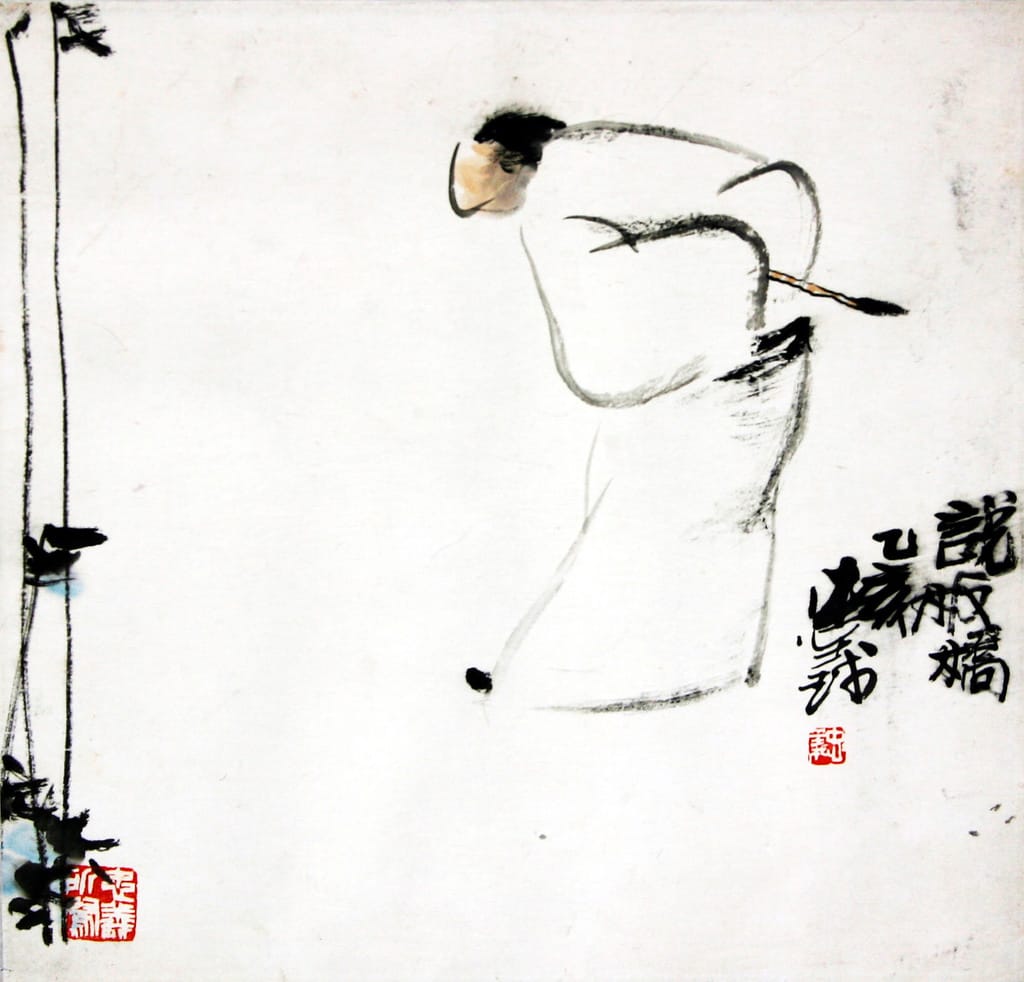
That’s the style of CC Tsai‘s illustrations, which — rather than Brian Bruya‘s translations — are the featured aspect of this version of the Zhuangzi: it also encapsulates the essence of Zhuangzi‘s thought.

Here’s the comic book version of a very comic work of profound, non-invasive philosophy.

**

Zhuangzi is a Taoist, one who would allow the arising and fading away of things in their natural order, with as little thought-commentyary, let alone intervention, as piossible — given the human tendency to go round and round in circles even while sitting still — Laozi‘s Tao Te Ching is the simple and direct exposition of this way of approaching and appreciating life, while Zhuangzi presents the same appreciation in the formm of quizzical tales and (naturally, absent) morals..

Ah. Thus the seagull, Laozi tells Confucius, who came to discuss benevolence and righteousness, doesn’t get white by soaping yup and washing itself, nor does the crow get black by dipping itself in ink: benevolence, similarly, is not a matter of soap and water — it simply arises where it arises.

You get the feeling Laozi wouldn’t mind having left it at the seagulls doing what they do, and likewise with the crows — but Confucius dropped by and asked about benevolence and righteousness, and Laozi responded as was only benevolent and polite..

**

My favorite story in all of Chuang Tzu / Zhuangzi is the story of Lord Wen-hui’s cook Ting, who taught him the natural way of things while cutting up an ox. In Burton Watson‘s translation:

Cook Ting was cutting up an ox for Lord Wen-hui. At every touch of his hand, every heave of his shoulder, every move of his feet, every thrust of his knee – zip! zoop! He slithered the knife along with a zing, and all was in perfect rhythm, as though he were performing the dance of the Mulberry Grove or keeping time to the Ching-shou music.

“Ah, this is marvelous!” said Lord Wen-hui. “Imagine skill reaching such heights!”

Cook Ting laid down his knife and replied, “What I care about is the Way, which goes beyond skill. When I first began cutting up oxen, all I could see was the ox itself. After three years I no longer saw the whole ox. And now – now I go at it by spirit and don’t look with my eyes. Perception and understanding have come to a stop and spirit moves where it wants. I go along with the natural makeup, strike in the big hollows, guide the knife through the big openings, and follow things as they are. So I never touch the smallest ligament or tendon, much less a main joint.

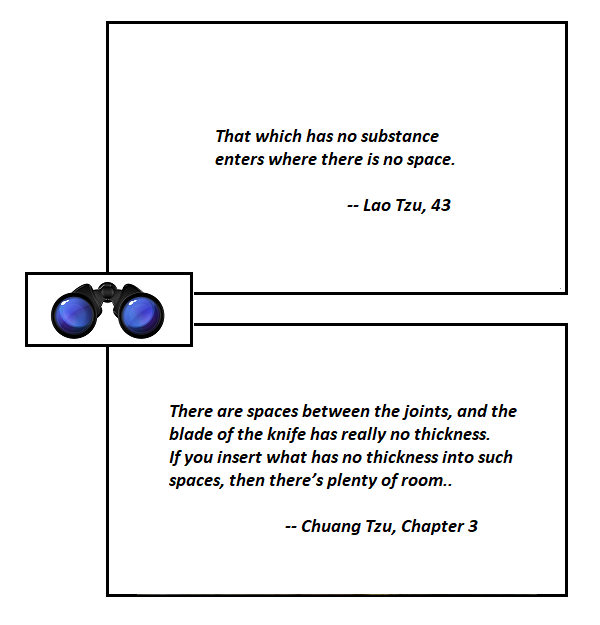
“A good cook changes his knife once a year-because he cuts. A mediocre cook changes his knife once a month-because he hacks. I’ve had this knife of mine for nineteen years and I’ve cut up thousands of oxen with it, and yet the blade is as good as though it had just come from the grindstone. There are spaces between the joints, and the blade of the knife has really no thickness. If you insert what has no thickness into such spaces, then there’s plenty of room – more than enough for the blade to play about it. That’s why after nineteen years the blade of my knife is still as good as when it first came from the grindstone.

“However, whenever I come to a complicated place, I size up the difficulties, tell myself to watch out and be careful, keep my eyes on what I’m doing, work very slowly, and move the knife with the greatest subtlety, until – flop! the whole thing comes apart like a clod of earth crumbling to the ground. I stand there holding the knife and look all around me, completely satisfied and reluctant to move on, and then I wipe off the knife and put it away.”

“Excellent!” said Lord Wen-hui. “I have heard the words of Cook Ting and learned how to care for life!”

**

That’s a long-ish quote, but its rollicking good humor will have carried you through it, and I wanted to give you a sense of the Zhuangzi as I have known and loved it — to taste it in comparison with CC Tsai‘s vision / version of the same tale, as represented in a couple of frames from his telling:

**

So now we have Burton Watson‘s “the blade of the knife has really no thickness. If you insert what has no thickness into such spaces, then there’s plenty of room” and Brian Bruya‘s “my knife glides in and out between the bone joints, moving as it pleases: the cow suffers no pain and, in the end, doesn’t even know it’s dead.”

Pretty remarkable, either way — but that’s in English, and who knows what contortions a translator must make to move from Chinese into English? Watson‘s Chuang-tsu is closer to Lao-tsu, if you compare the statement of principle to its embodiment in an anecdote:

Ursula Le Guin‘s translation of the Tao Te Ching is even more succinct:

The immaterial enters the impenetrable..

No wonder cook Ting’s vorpal blade went snicker-snack, to borrow a phrase from Lewis Carroll‘s poem, Jabberwocky. And come to think of it, Lewis Carroll, aka Charles Lutwidge Dodgson, the Christ Church, Oxford logician, may indeed be the English language’s native equivalent of the Chinese Zhuangzi.

**

As I hope I have indicated, Chuang Tzu / Zhuangzi, even in translation, is a writer of enormous charm and insight, and CC Tsai‘s presentation marries the conventions of the comic book with classical Chinese artistry to provide an exemplary introduction to one of the world’s great philosopher-humorists.

Delightful. Warmly recommended.

The Ideal and the Practical — the Practice

I’d written a response to @AnAn and included a quote from the Chuang Tzu’s chapter on Lord Wen-hui and what he learned from his Cook Ting, and wanted to throw in the following DoubleQuote — but graphics seem to be discouraged in the Comment sections here, so I’ve opened this post for the purpose:

The thing is, Lao Tzu offers us the ideal statement, formulated in terms of an impenetrable absence of space, and an absence of substance to the point of non-existence — while Chuang Tzu, peering over Lord Wen-hui’s shoulder right there in Cook Ting’s kitchen, offers us the same insight, couched in terms of there being “spaces between the joints” and his knife having “really no thickness” — Chuang Tzu’s measureless insight penetrates Lao Tzu’s impenetrable absolutes to show us there’s room for play there — “room — more than enough for the blade to play about in”.

If we bear these two versions of the same idea — formulated ideally and in practical terms by the two principle philosopher-poets of the Taoist school — in mind when our thoughts run up against the impracticality of an ideal, we may find, like Cook Ting, that we too have room enough room to play in.

I’m fond of saying “two is the first number”

I was senior analyst in a small and wonderfully eccentric DC Beltway think tank a while back, and my boss kept asking me for what he called “early indicators” of upcoming troubles. The trouble was, I never saw an “indicator” as such — I only ever saw “indicators” plural. It takes two to tango, they say, and from my POV it takes two to make a pattern.

My HipBone Games began as an attempt to make Hermann Hesse’s Glass Bead Game playable, preferably on a paper napkin in a sidewalk cafe, so I began with boards like my WaterBird —
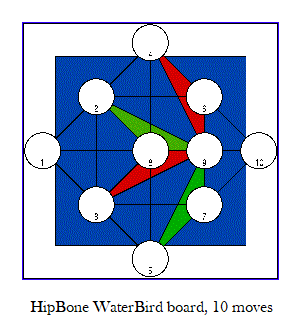
— with ten moves, ten concepts arrayed in such a way that players or later readers could see ten richly interconnected concepts in one place — concepts that might be textual, musical, mathematical, visual, filmic — if we’d known how to convey smells via the internet, I’d have included those, too..

And over time, I discovered the obvious — that the fundamental game move involved two concepts, with one bridging link between them. So that’s the fundamental way to learn to play the HipBone Games. Over time, I’ve come to rely more and more on this simplest of HipBone Games, the DoubleQuote:
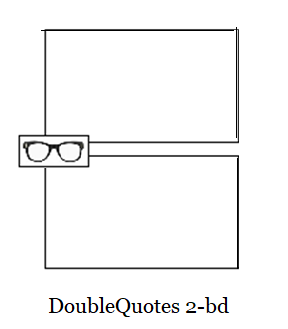
— leaving the larger HipBone Gameboards — the 8-move Dart board on up to the 120-odd Said Symphony board, dedicated to, you may have guessed it, Edward Said, and available for possible competition games and solo symphonies.

**

What’s a concept, you might ask — what constitutes a move?

I might use a different definition if I were taking about anything other than the Bead Game, but in this context, a concept is a rich idea — an idea with rich possibilities for association. Let me take a paragraph from a New Yorker piece as an example:

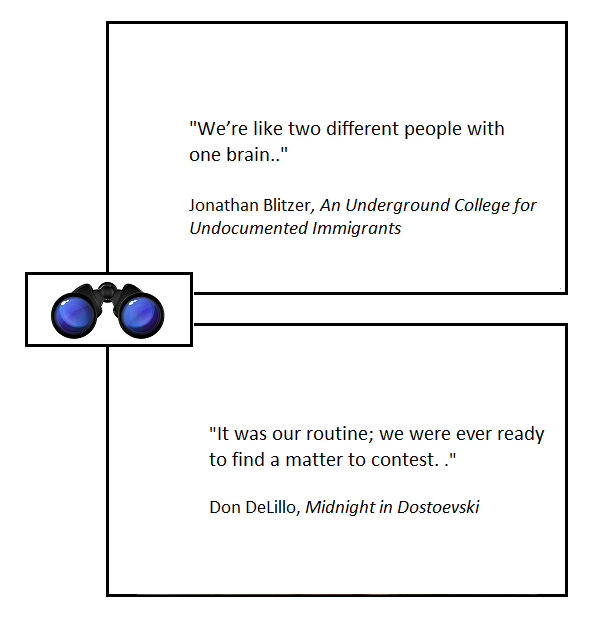
Melissa and Ashley, identical twins from Georgia, shared a bedroom while growing up. They had the same best friend, took classes together in high school, and dreamed of becoming artists in their own collective. “We’re like two different people with one brain,” Melissa liked to say.

The article in question is titled An Underground College for Undocumented Immigrants — so there’s room associations with the underground railroad perhaps, another situation where the official system repressed a minority, and that minority found ways to circumvent the system.

I’ve chosen this example, in fact, because it offers numerous associative possibilities — to other ideas, narratives, or statistical finds about twins, to other New Yorker articles, to underground movie theaters or catacombs, to those who dream of becoming artists — and in particular for my purposes here, because it’s about two people who think, almost as if they are one.

In fact, to emphasis this notion of unity and harmony, I might simply chose this statement for the first position in my DoubleQuote::

We’re like two different people with one brain

**

Let’s use a musical analogy, and say the two of them think in close harmony, or, since there are two of them, that thinking together, they constitute a duet..

The opposite of harmony,in which many notes played simultaneously form a chord, is counterpoint, in which differing melodic lines move between discord and resolution — harmony a “vertical” matter, synchronic, while counterpoint is “horizontal” and diachronic —
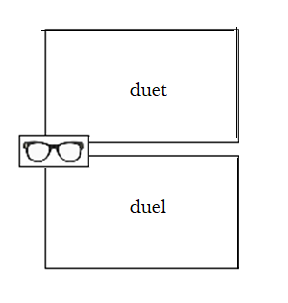
— and the opposite of a duet is a duel.

**

The two friends in Don DeLillo’s New Yorker piece, Midnight in Dostoevsky like to keep their minds at opposite poles from each other. As one of the two reports:

He liked to test himself on what he knew. He liked to stop walking to emphasize a point as I walked on. This was my counterpoint, to let him stand there talking to a tree. The shallower our arguments, the more intense we became.

I wanted to keep this one going, to stay in control, to press him hard. Did it matter what I said?

The actual phrase I’d place in juxtaposition to the first paragraph above might come from a discussion of whether the old man walking in front of them that day was wearing an anorak or a parka —

It was our routine; we were ever ready to find a matter to contest.

Again, the context — the article itself — is rich in associative potentials, with parkas, anoraks, Inuits, linguistics, life in the arctic circle, the whole idea of North — on which the pianist Glenn Gould wrote an entire radio opera

— and note that Gould is himself a master of counterpoint, specializing in the work of JS Bach, and called his radio opera technique “contrapuntal radio” —

So:

“This was counterpoint” — the opposite of harmony, and full of both conflict and resolution, with phrases isolated and overlapping, paused and repeated, denial and occasional agreement and renewed denial — a duel, not by any means a duet.

And yet each of our two excerpts describes the conversations of two close friends, the one emphasizing unity, the other diversity. And it is in the similarities and differences between the two conversation — between duel and duet — that the two concepts link to become a single move.
**

Having given that extended example, let me present a few more DoubleQuotes, in their positions on the board — with minimal explanations:

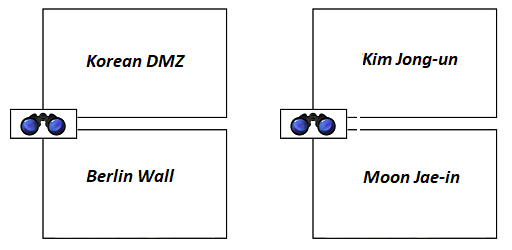
Some of them are made of names or phrases so simple, they fit on a mini-version of the board:
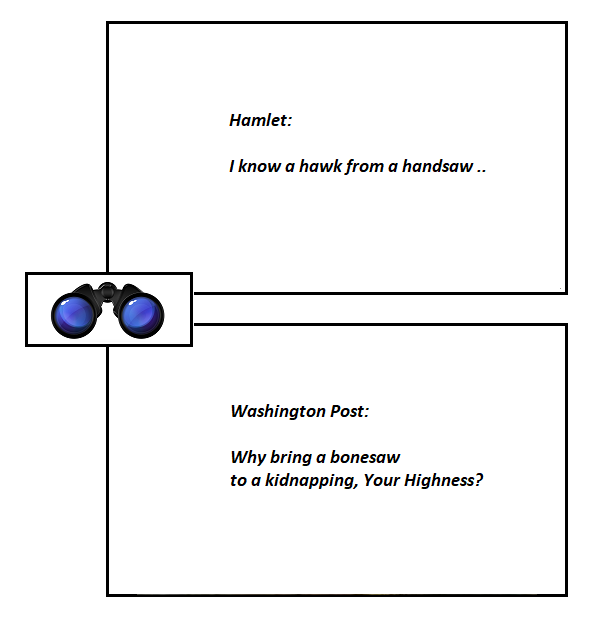
Some bring Shakespeare to bear on current events — in this case, Saudi Crown Prince MBS and the Khashoggi murder:
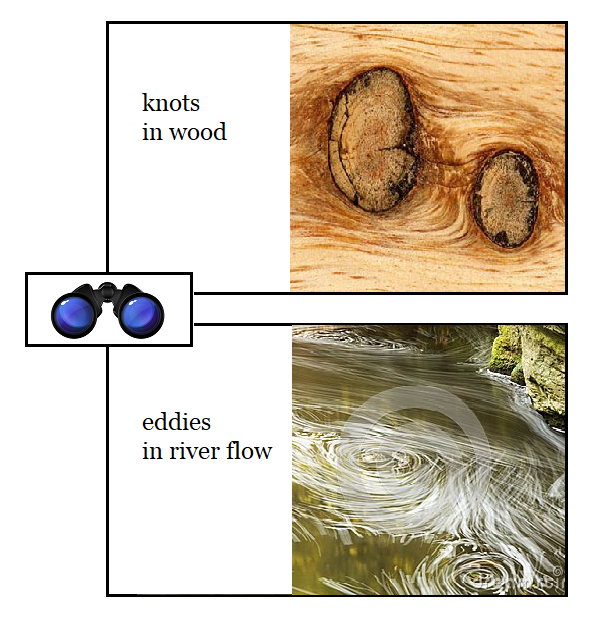
Some showing similarities in different materials:
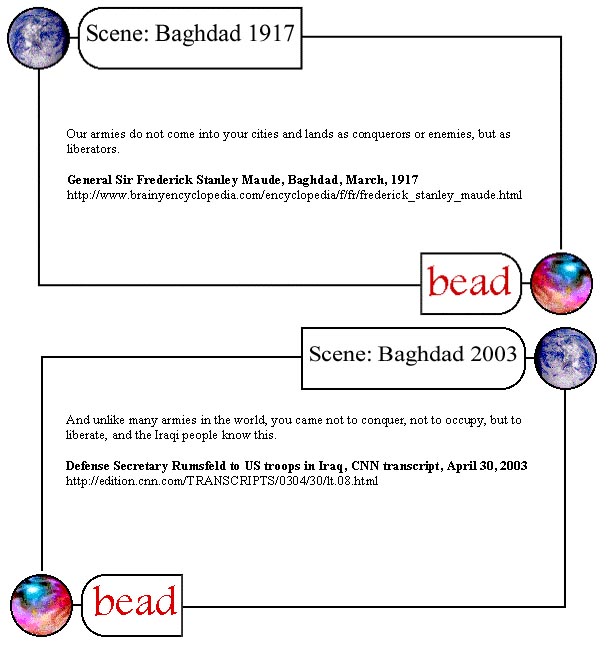
Some making historical comparisons — this one’s in an earlier version of the same board —
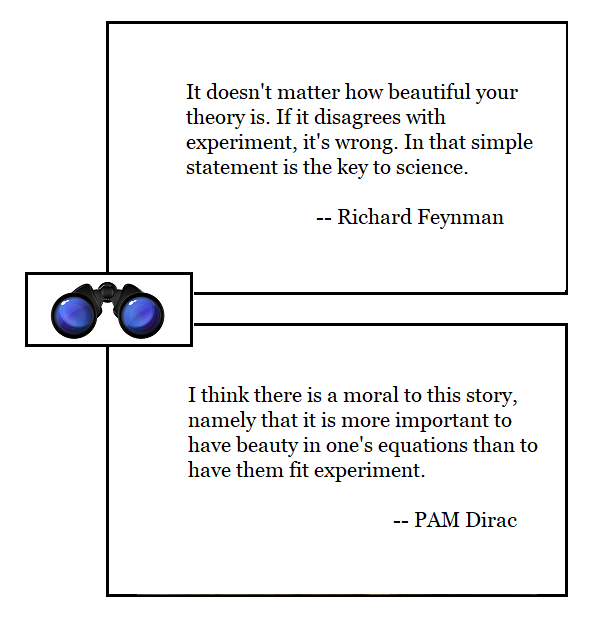
or opposite opinions and creative practices of two of the world’s most distinguished physicists:
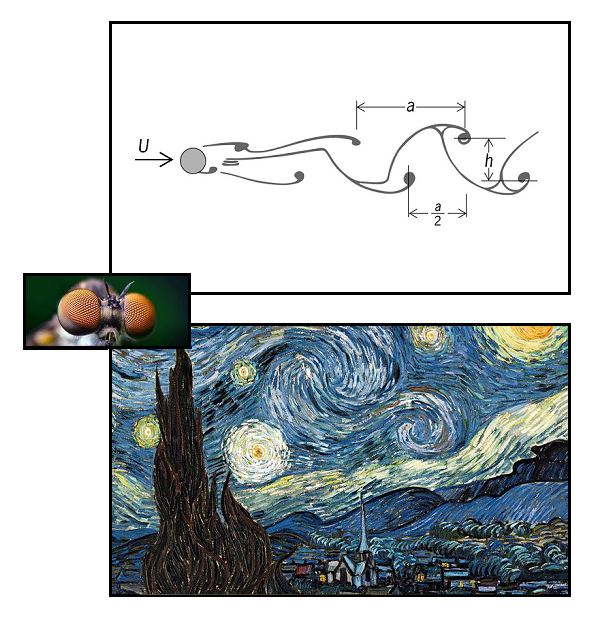
or — and this is my personal favorite, crossing as it does the great disciplinary boundary — between CP Snow’s Two Cultures — between art and science:
**

But either I’ve been very unclear, or you get the idea.

Here’s the blank DoubleQuotes board again, for you to download and drop your own examples into.

At gmail I’m hipbonegamer — feel free to send me your own, with any explanation you feel like making, and in a later post I’ll put them up here.

By request — the ouroboros game

Callum Flack saw my recent post here and wanted to see examples of the Ouroboros board in use — so this post is for him, and Ali Minai too if self-reference interests him — I’m guessing it does, unless computer science has moved so far ahead since Hofstadter wrote Godel Escher Bach that it no longer applies..

**

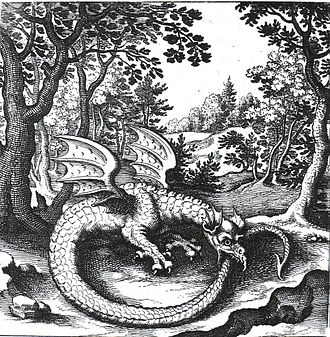
How to explain the ouroboros? It’s the ancient and ubiquitous symbol, found earliest, perhaps, in Pharaonic Egypt, of a serpent biting its own tail:

More recently, it’s a popular image in alchemy

Self bites itself. And that’s a pattern worth watching.

**

Wikipedia tells us, quoting a Harvard study by Michael Witzel:

in the Aitareya Brahmana, a Vedic text of the early 1st millennium BCE, the nature of the Vedic rituals is compared to “a snake biting its own tail.”

Then there’s this example from a medieval Indian scripture, the Yoga-Kundalini Upanishad:

The divine power, Kundalini, shines like the stem of a young lotus; like a snake, coiled round upon herself she holds her tail in her mouth and lies resting half asleep as the base of the body

That’s ouroboros.

There’s a marvelous moment in the film Silence of the Lambs when the young FBI trainee, Clarice Starling, asks the psychiatrist and serial killed Hannibal Lecter:

You see a lot, Doctor. But are you strong enough to point that high-powered perception at yourself? What about it? Why don’t you – why don’t you look at yourself and write down what you see? Or maybe you’re afraid to.

That’s ouroboros.

The paradox of Epimenideas, the Cretan philosopher who declared “all Cretans are always liars” which St Paul mentions in his Epistle to Titus, is ouroboric.

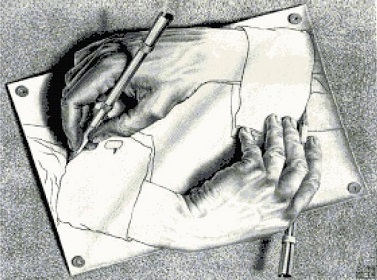
Artists, too, can take an interest in such things as hands that are drawing hands drawing hands — a double ouroboros (MC Escher)..

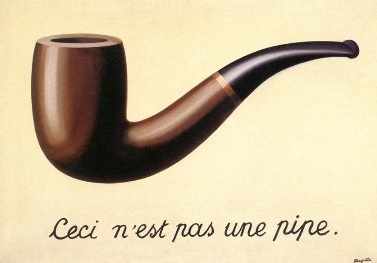
or pipes that are not pipes (Magritte):

**

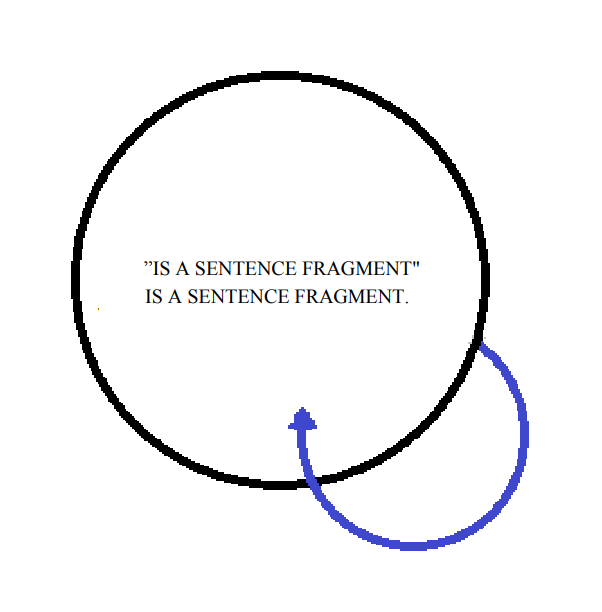
Anyway, here for any who are interested, are some instances of the one-move self-referential Ouroboros board in use:

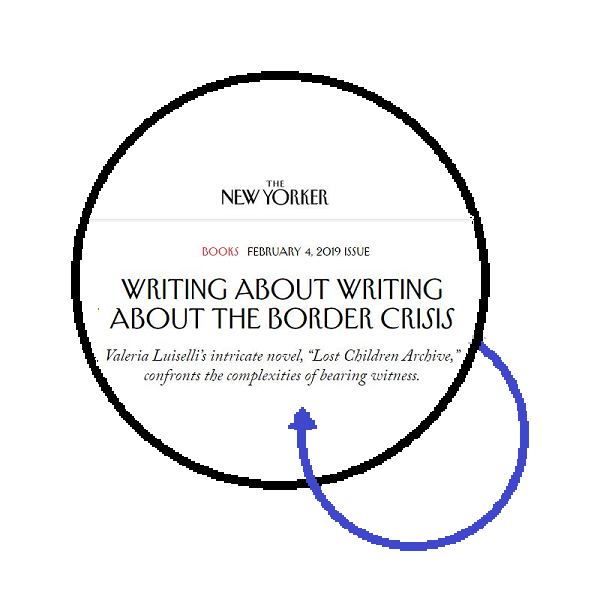
I think you’ll see why this New Yorker title jumped out of the page at me:

Writers like ’em!

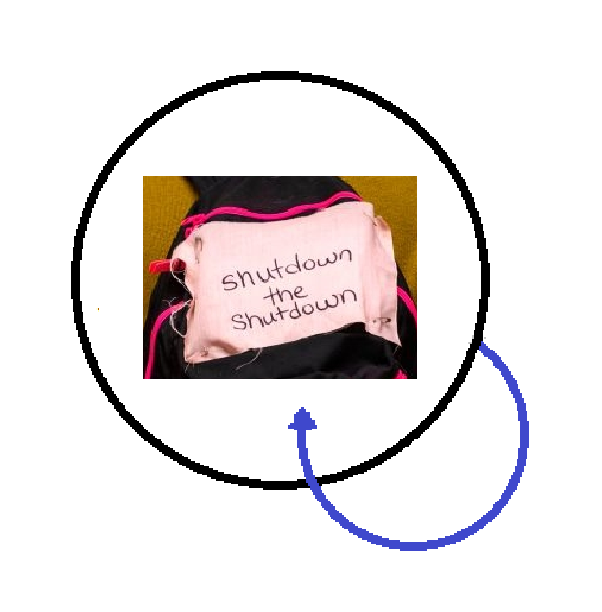
I really liked these two examples, carried by political activists — the first on a back-pack:

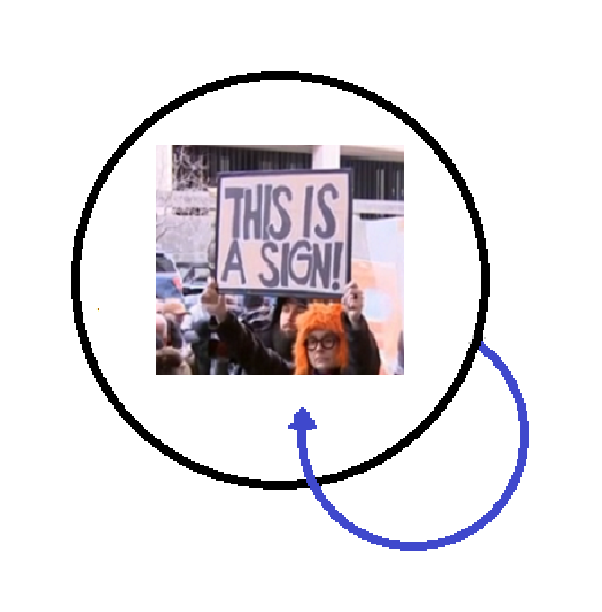
and the second on a placard — totally surreal, bearing no relation to the political event which was being protested:

That, too, is an ouroboros.

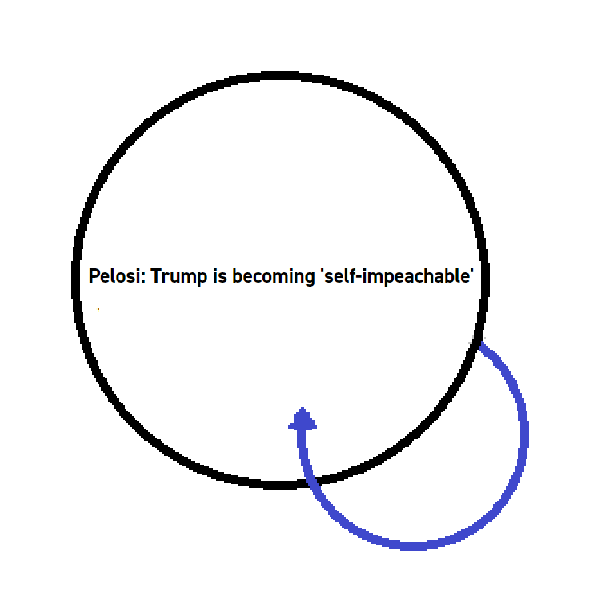
Nancy Pelosi used a weird ouroboros the other day, saying:

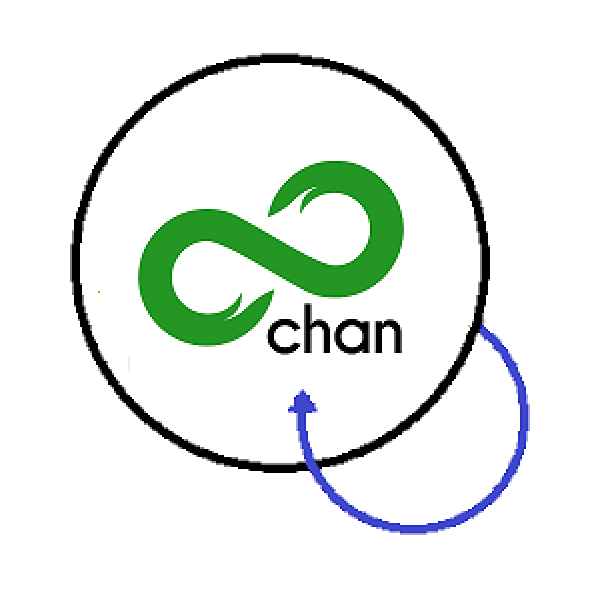
The logo of 8chan, home of the image-board where the extremists of the alt-right meet and plot away from prying eyes is another double ouroboros:

Here’s one from Hofstadter’s book, Godel Escher Bach:

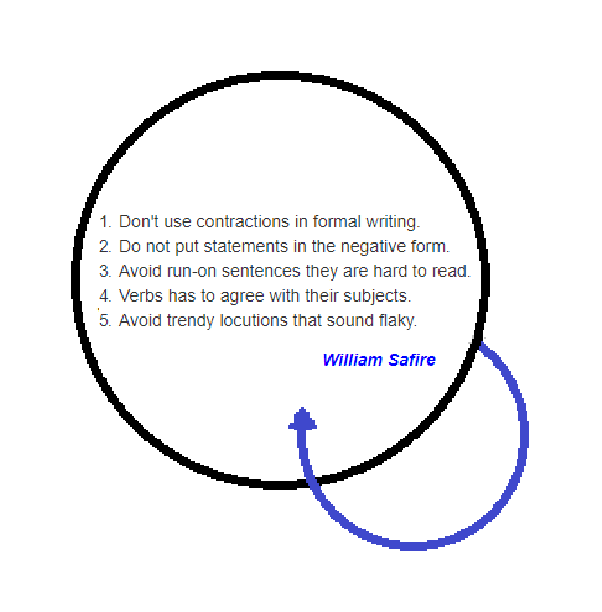
And finally, here are five instances collected by the writer William Safire:

**

I hope you like these, and find your own — here, again, is the empty Ouroboros game board in case you wish to drop your own examples into it!

Enjoy!

Magic and advertising

This is to alert BrownPundit readers to a series I’ve begun on Zenpundit, my other punditry-posting place. It’s about Ioan Couliano’s argument in his book Eros and Magic in the Renaissance that the Renaissance art of Magic was essentially a matter of conjuring desire in the recipient by means of visual imagery, and that the Art has been revived with great success in the present day, in the form of commercial advertising.

Roughly speaking, then, Magic is the defendant, modernity-secularity-technology is the prosecution team — who don’t bother to call witnesses because, m’lord, it’s plain obvious that magical thinking is superstitious nonsense — and a bucket-load of TV commercials form the evidence presented by the defense.

**

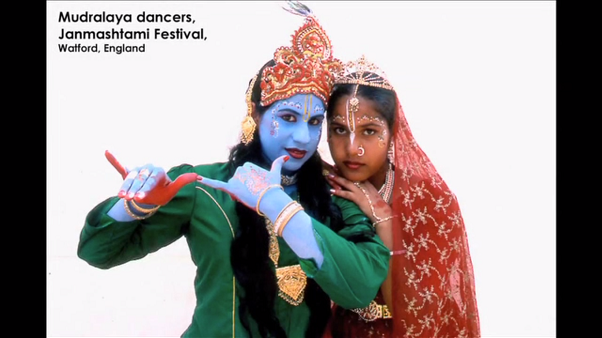
But wait a minute — here’s magic:

**

Whether you’re secular or a devotee, that photographic image is magical in that a simple hand-gesture conjures up a flute. The flute isn’t there, objectively speaking — and yet there’s a flute, Krishna is quite obviously playing it, and indeed its mellifluous power of enchantment has drawn the lovely Radha to his side.

About Krishna’s flute — you may know far more than I, but at least I can point to Denise Levertov and Edward C Dimmock’s poem in Songs in Praise of Krishna — from the Bengali:
.

Radha is terrified on her way to the forest

O Madhava, how shall I tell you of my terror?
I could not describe my coming here
if I had a million tongues.
When I left my room and saw the darkness
I trembled:
I could not see the path,
there were snakes that writhed round my ankles!

I was alone, a woman; the night was so dark,
the forest so dense and gloomy,
and I had so far to go.
The rain was pouring down —
which path should I take?
My feet were muddy
and burning where thorns had scratched them.
But I had the hope of seeing you, none of it mattered,
and now my terror seems far away. . . .
When the sound of your flute reaches my ears
it compels me to leave my home, my friends,
it draws me into the dark toward you.

I no longer count the pain of coming here,
says Govinda-dasa

**

And what does all this have to do with advertising?

My response is that the Krishna and Radha in this photo were captured, and Krishna’s flute conjured, by the eye of a pro commercial guy:

JEREMY HUNTER began his career in advertising – as a television creative, working for Young and Rubicam, Leo Burnett, Ogilvy and Bates, along the way winning a number of international awards in Cannes, Venice, New York and Los Angeles. During this time he worked with some of Britain’s most iconic film directors – John Schlesinger, Ken Russell, Tony Scott, Dick Lester, Nic Roeg, Richard Loncraine as well as Oscar-winning Editor Jim Clark and photographer Terence Donovan.

That’s the resume of a contemporary magician.

**

In case you’re interested, the posts in my Magic and Commercials series on Zenpundit to date are:

Advertising series 01: Music
Eros, the Renaissance and advertising
Authentic, spiritual magic!
The magic of advertising or the commercialization of magic?
Here’s magic!
The magic of miniatures

I imagine there will eventually be about twenty posts in the series — but more and more evidence keeps turning up in favor of the defense.

Magic, court observers seem to think, is likely to be vindicated.

Brown Pundits