America has been good to immigrants and we should be honest about who we are

Bangladeshi American teens preparing for NYC selective school admissions exam

Since there has been rather persistent confusion about my Unherd piece I will clear up a few things. I am rather tired of talking about it now, as I “said my piece”, but sometimes things need to be done.

First, for many months (years), friends of various backgrounds (brown and non-brown) have been speaking to me of the issue of very self-righteous South Asian American (Indian, Pakistani, and Bangladeshi) “social justice warriors.” There’s nothing wrong as such being a social justice warrior and brown, but, the problem is that these individuals often accrue to themselves the full-weight of colonialism and centuries of oppression to add to their credibility and authority.  The reason I finally punched out the Unherd piece is that an Indian scientist who I am familiar with made a reference to trauma and oppression on Twitter. This resulted in many “likes” and praiseworthy comments. It was a vague and amorphous statement and could mean anything, but the response made it clear that most people took it to be that they were alluding to the weight of colonialism and racism.

The problem I had with this is I know that this individual, a Brahmin raised in India, is from a literally rich family. Rich enough to pay undergraduate American tuition for international students in full. And, rich enough to pay graduate school tuition when otherwise this person would have to take up a teaching assistantship. This is not a person who is well-off in the Indian context. They’re well off in the American context.

This is an extreme case. But it illustrates a more general problem. People who by dint of their brown skin claim to be, or allow people to believe they are, marginalized and oppressed. The vast majority of brown Americans can tell you stories of racial discrimination and prejudice. That is true. But are these experiences determinative in their lives? Does their race define and limit them in a deep and powerful manner?

I would argue not. Today the Americans of brown background are flourishing. Indian Americans in particular are socioeconomically advanced, and now, becoming culturally prominent. Just like their white upper-middle-class peer, Indian Americans are benefiting from the system, and flourishing within it. Their realized outcomes are very different from African and Latino Americans. Some of the same is also applicable to poorer newer ethnic groups, such as Bangladeshis, who begin much lower on the socioeconomic ladder but are placing their children into elite public schools like Stuyvesant.

Second, selective immigration from India has resulted in a very atypical Diaspora. Many who responded to my piece argue that selective immigration is the whole story, so why bring caste into it? Because the criteria used have skewed the India Amerian community in a way where it is not representative of India at all. I am personally not bothered by this. But again, when issues such as caste oppression come up in the USA, non-Indians may not realize when talking to Indian Americans that they will almost never interact with a Dalit, who are 15% of India’s population (one could argue that except for Gujarat the “Cow Belt” is also totally underrepresented due to the way immigration has worked). Many Brahmin Indian Americans I know are vociferously against caste (sincerely, and in their actions!). But to me, this is a laudable idealism, not something that comes out of historical brutality, because their ancestors were willing executors of the system. In this way, they are like upper-class white people who wish for a more egalitarian economic system. Their views are sincere, but it comes from idealism, not trauma.

As a brown person from Bangladesh people who knew where I was from would always make assumptions about my background, as Bangladesh was the byword for incredible poverty for the second half of the 20th century. Those that did not know my family was of professional background would ask naive questions, such as “did you grow up in a hut?” I found it amusing, but I did make it clear that I couldn’t personally speak to the poverty and deprivation which were such serious concerns for everyone about the country of my birth. In Bangladesh, I was a very privileged person. In my day to day life in the USA, this was irrelevant, but I wasn’t going to go around speaking with authority about how horrible grinding Third World poverty was. It was just in many ways just as abstract for me as it was for my white classmates. Honestly, if I did grow up in a hut I’d probably brag about it since it would make my Horatio Alger story so much more inspiring.

Overall, the point of the piece is that when you make identity so important to the content of someone’s arguments and the force of their views, it creates a massive incentive for individuals to cultivate and shade their identity to add credibility. Ergo, a Nigerian American whose family is wealthy from brutal oil extraction which results in human rights violations and crimes in their ancestral homeland will likely not expose this fact when castigating a middle-class white American about their “white skin privilege.”

Brown American should just accept what they are in the main: a relatively privileged people from whom America works, who have to deal with some incidents of racism in their lives.

Why do Pakistanis not want to be descended from Hindus?

First, I want to enter into the record that among Punjabis and Sindhis there is almost no West Asian ancestry in Pakistanis.* I qualify this with “almost” because there is some, particularly in Sindhis. You can tell because of African ancestry, which is distinctive in even small fractions, and which is found in some of the HGDP Sindhis. I haven’t checked the 1000 Genome samples from Lahore (which clearly includes Punjabis but also other ethnicities), but they seem “more Indian” than the HGDP Sindhis.

Most people with half a brain can see the above fact in the data. That being said there is some ideological battle between Pakistanis and Indians about the Hindu origins of Pakistanis. Or, should we say “Hindu”?

On both sides of my family, I have “caste Hindu” forebears within the last few centuries. My paternal grandmother’s father was born a Hindu. So I have no compunction in admitting that my ancestors were Hindu, and my genetics indicate a rather generic Bangladeshi ancestry except for the higher fraction of East Asian (my family is from what was Tippera). It helps I’m not Muslim or Muslim-identified.

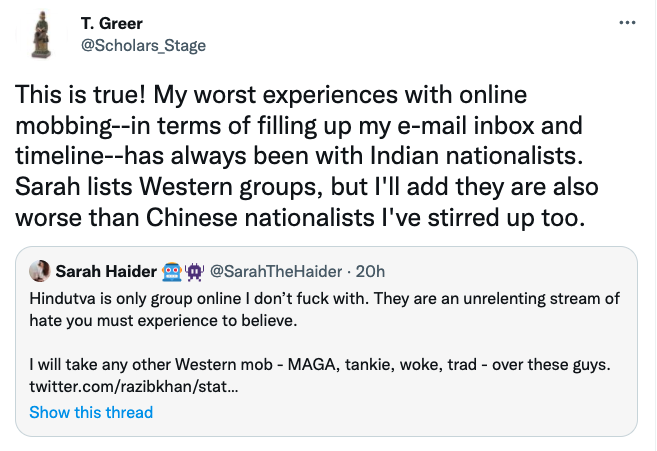
From Hindu Nationalists there something of schizophrenia on the topic. On the one hand, they loudly proclaim the Hindu origins of South Asian Muslims (correct). Often, there is also an assertion that these are low caste converts (perhaps correct, but specious to the argument). But then, they flip to the assertion that South Asian Muslims are invaders, oppressors, etc.

It’s not totally coherent. Perhaps more coherent is the position of some Pakistanis: “we were never Hindus.” The argument is straightforward, and about ten years ago I was quite open to it. To be frank, I probably leaned toward the proposition that Hinduism as an identity makes no sense without a reaction to Islam and later the British-Christian experience. Though probably not as extreme as “real Hinduism didn’t exist in the 19th century”, I wouldn’t have laughed that assertion out of the house.

There are several reasons I reject or have evolved from my older views.

Continue reading Why do Pakistanis not want to be descended from Hindus?

Why Hindutva Worries me: Annual Onam debates

This is first in the series of blogposts I plan to write about my worries with Hindutva.

Every year on Onam, social media witnesses flame wars between Hindutva and Anti Hindutva forces. The point of contention often is the Hindutva assertion that Onam is Vamana Jayanti and the counter to that is Onam is a secular harvest festival of Kerala. BJP handles have been tweeting their versions of Onam ever since they have been active on internet. The level to which both sides are unwilling to compromise on occasions of festivals – which ought to reflect human community celebrations, is petty. This year Arvind Kejriwal, flush with his success as modeling himself as a Hindu (or Soft Hindutva), took to twitter with this. It was met with a reply from Shashi Tharoor which in turn was countered by ever growing internet Hindutva – including the widely popular TrueIndology. One cant expect these flame wars to subside anytime soon, given the interest people have been taking in history & hindutva these days.

For decades, liberals have critiqued the Hindutva project as exclusionary. The Hindutva response is – wrt Abhrahamic faiths – if that only these people (religions) connected with the culture on ground and accepted native customs along with their own customs, we wouldn’t protest. For the Hindutvavadis, the said project was always Indianize (not Hinduize they claim) these monotheistic faiths, so that these faiths are more integrated in the larger Indian society. By that train of logic the Hindutvavadis should be happy if Keralites Christians & Muslims celebrate Onam as a Secular festival. Couldn’t this be held as a beacon of syncretic Keralite culture which the country should follow ? For most times, festivals evolve and change with times, their origins though not irrelevant, tend to become less salient as time goes on. The origins of Christmas are testament to the fluid nature of festivals. Onam in Kerala is a truly spectacular festival full of dances, food, music, boat racing and many things, not unlike Diwali. Across the world, harvest seasons have festivals and religious significance because of the underlying material importance. Do contested origins of festivals matter or the human community experience of festivals matters?  Nowruz (whether that is an Iranian mirror of Holi is something that interests me) celebrated by the broader Iranian people, after a millennium of Islam is a testament to the longevity festivals rooted in culture. The insistence of always getting sole ownership of the Onam story comes of as toxic chauvinism & deliberately exclusionary IMO. Yet every year, there are the same debates around Onam with Keralite Christians and Muslims abused for trying to own Onam in a way they have come to define it. (Ricebags and other demeaning words are often used). 

The apparently ironic way the Hindutva movement is becoming very much like its primary enemy is not really unprecedented. VD Savarkar, the foremost and most intellectual ideologue of Hindutva was critical of Muslims and Christians putting their religion above the country. Sadly during the negotiations of princely states, Savarkar himself campaigned for independent Hindu Travancore against the plans of Sardar Patel. It can be alleged he put Hindutva before the country at that moment – exactly what he accused Muslims of for all those years. Yet Hindutvavadis have no qualms putting Patel and Savarkar in the same tent – while claiming Patel and Nehru had irreconcilable differences.

These flames wars were merely part of twitter for a few years but now they’re penetrating larger audiences via whatsapp. While this may be a symptom of taking trivial social media more seriously than it deserves, the point I am arguing is beyond the flame wars of twitter. There is a deliberate and uncompromising framing of Hindutva underway – which covers a variety of tropes from calling Jains/Sikhs Hindus to soft diktats against celebrating Christman/Eid. I consider these manifestations of the nascent ideological moorings, troubling. In  a weird way at times, I hope Hindutva remains REACTIONARY and resists ideological framing, for I am more wary of deep ideological movements than mere reactionary ones.

While its not my argument that their might not be any deliberate maneuvering by the liberals in framing of the Onam as a secular festival – I dont know and I dont care enough to investigate. If the world Hindu is defined as broadly as some do, everything east of the Sindhu will be Hindu & most festivals will have some connection to traditional Hinduism/native religions. At end of the day what matters is Onam is a harvest festival for Keralites.

Post Script:

I personally have tried to indulge in the so-called Dharmic/Indic arguments for India (Harsh Madhusudan& Rajeev Mantri are publishing a book i am looking forward too), put they also indulge in unnecessary labeling IMO. I find the use of these labels – Dharmic/Indic – churlish at times.

As usual all comments short of abuse are welcome.

Why Turks ruled India for so long

After finishing Escape from Rome: The Failure of Empire and the Road to Prosperity I continue to believe that geography and economics explain the basic reason for the very long ascendance of Turkic people in the Indian subcontinent, and, their eventual eclipse.

The context for this is the fact that many Indian and Indian American friends have posited cultural rationales for the Turkic hegemony. That is, there was a passivity and disunity in Hindu society which made it vulnerable to the Turks, who were also adherents to a separatist hegenomic ideology in the form of Musim. All this may very well be true, but I have always held that the key factor was that Turks and Muslims more general had ready and easy access to warhorses.

Between 500 A.D. and 1500 A.D. was the heyday of the nomadic pastoralist as a geopolitical force in Eurasia for various reasons. Even in the centuries after 1500 A.D. horses remained critical for mobility. The problem is that in much of agricultural Eurasia there is not sufficient pasturage to raise large numbers of horses.

Pretty much every Eurasian society within reach of the steppe (so basically every society except for those in Western Europe, Japan, and Southeast Asia) had to deal with the menace of armed nomads. Sometimes they paid them off. Sometimes they mobilized enormous armies which incurring crushing costs. And sometime they were conquered.

Between 1700 and 1900 this spectre faded. Improvements in military technology, transport, and mass national mobilization, leveled the gap between the steppe and the settled peoples, to the point where by 1900 the steppe was a marginal factor.

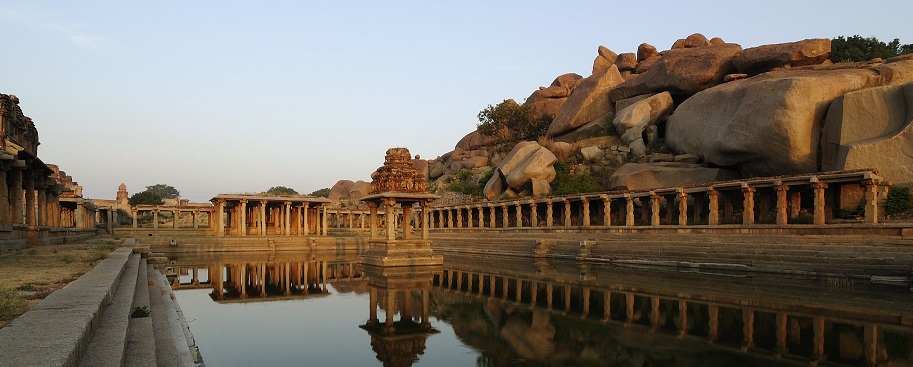
Note: the author of Escape from Rome attributes the rise and fall of Vijayanagara explicitly as a function of its access to horses.

Open Thread – 08/22/2020 – Brown Pundits

The usual.

But I’ll make a comment here. I am of the school that thinks facts matter a lot. Many of you trade in standard Hindu nationalist tropes and generalities about Islam. As someone who told Shadi Hamid on our interview, I am not a big personal fan of Islam, I don’t really mind people fearing Islam. I have personal experience of the religion after all.

But, facts matter. And a lot of the “facts” that get bandied about here are false.  I won’t tolerate that. There are two general categories I will point to:

1. First, people take traditional Muslim historiography at face value. You shouldn’t. This is like taking Christians at face value when they talk about the Four Gospels are pure positive history, when they were finally compiled and redacted decades later. Whether Muhammad exists is an empirical question in the same way that whether Jesus exists is an empirical question. As it happens, I’m modestly confident both figures existed in some form but were quite different from what Christians and Muslims depict them as (I do suspect that Josephus was a later interpolation).

The broader issue here is that Muslims on the whole have not gone through the modernist transition in regards to a critical-rationalist take on their religion. In Christianity, traditionalist-fundamentalists exist, but they have to take dialogue with modernists as a given. They exist in large part as reactions to modernism. This is not the case with Islam. Muslims accept that non-Muslims reject their religion, but within Islam, there is not a strong rationalist engagement with their texts that applies the sort of criticism than the Germans pioneered within Protestantism in the 19th century. That means they present a “unified face” about their early history which too many non-Muslims take for granted. Islam with all of its constitutive elements is not truly recognizable to us until about 850 A.D.*

2. Because this is a blog with a South Asian focus a lot of Hindu nationalist tropes and facts get presented at face value. I don’t really mind them as mythologies that give people succor or create their identity, but a lot of them have as much factual basis as a pagan Mecca: not much.

Most of the Hindu nationalist commenters do reflect a reality of “lived experience.” As someone who grew up around South Asian Muslims, I can admit they have total contempt on the whole (there are exceptions) for Hindus and their “bizarre” beliefs. But, as someone who is personally anti-Islam and literally tolerant of diverse views, many people from Hindu backgrounds of all ideologies have told me what they really think of Muslims, and the contempt is returned.

My issue is always when people turn their personal experiences into deep historical insights. Do not do that if you don’t enjoy me jumping down your throat, because if I’m not busy, I will do so.

More broadly, lots of Indian readers would benefit from reading more history. Especially non-Indian history. A broad cross-cultural perspective is essential, so do more!

For the curious here are a few books:

China: A New History
History of Rome
A History of the Byzantine State and Society
A History of the Arab Peoples: Updated Edition

* The Shia-Sunni split starts to become discernible in a way we’d recognize, Hadith culture is already on track to marginalize the “philosophers” and Hellenists, and the ulema centered around madrassas spread from the east to the west.

Citizenship Amendment Act – the straw that broke the camel’s back

Since the Ram Janmabhoomi movement, which culminated in the demolition of the Babri Masjid, nothing has polarized Indian politics and society as much the Citizenship Amendment Act. On its own, its fair to assume that CAA is not  a particularly insidious piece of legislature, but when it gets combined with National Register of Citizens (NRC) as explained by Amit Shah below, it becomes some to be vary of.

As Amit Shah stated, CAB(A) will be applied before carrying out the process of NRC. In his own words, the refugees(non Muslim migrants) will be granted citizenship and the infiltrators (Muslim migrants – he also referred to them as termites at one instance) will be thrown out or prosecuted (there was some talk of throwing them into the Bay of Bengal).

Its clear to conclude that by refugees – he means Bangladeshi Muslims who reside illegally in India as almost no Muslims from Pakistan and Afghanistan come to India illegally with an intention a  better life. (When they do cross the LOC illegally, they’re treated as enemy combatants or terrorists)

The ACT: 

The instrumental part of the act reads

any person belonging to Hindu, Sikh, Buddhist, Jain, Parsi or Christian community from Afghanistan, Bangladesh or Pakistan, who entered into India on or before the 31st day of December, 2014 and who has been exempted by the Central Government by or under clause (c) of sub-section (2) of section 3 of the Passport (Entry into India) Act, 1920 or from the application of the provisions of the Foreigners Act, 1946 or any rule or order made thereunder, shall not be treated as illegal migrant for the purposes of this Act

While this amendment to the ACT is seen as problematic, one must point out that large portions of the existing ACT are also extremely problematic – most of which were added after 1955 under various governments at various times. In particular the 1986 amendment (under Rajiv Gandhi) – which meant children born to both illegal immigrants wouldn’t get citizenship. This is seen as a contradiction with the Birthright naturalization (Jus soli ) principle of the Constitution. The 2003 amendment (under Vajpayee) further restricted citizenship to children, when either of their parents is an illegal immigrant.

The 2003 amendment also prevented illegal immigrants from claiming naturalization by some other legal means. So in short with the CAA 2019, this particular amendment (2003) has been annulled for Non Muslims who have come to Indian sovereign land from Bangladesh, Pakistan and Afghanistan.

In other words, the CAA facilitates the imagination of India as the natural homeland of subcontinental Non-Muslims (but not a Hindu Rashtra or Hindu State).

Objective Reasons for opposing the CAA:

Continue reading Citizenship Amendment Act – the straw that broke the camel’s back

Open Thread – 08/15/2020 – Brown Pundits

Dog days of summer..

One of the things with Indian American analysis of Indian culture/politics is the unselfconscious filtering of it through an American lens, rather than Indian. It’s annoying to listen to news shows where they interview an Indian American about Indian culture, and the interviewer and guest proceed to discuss Indian culture through the lens of American concerns, without ever acknowledging what’s going on. To give an example, talking about ‘colorism’, but immediately pivoting to anti-blackness.

Browncast Episode 120: Gaurav Lele, Liberal from a soft Hindutva background

Another BP Podcast is up. You can listen on LibsynAppleSpotify,  and Stitcher (and a variety of other platforms). Probably the easiest way to keep up the podcast since we don’t have a regular schedule is to subscribe to one of the links above!

You can also support the podcast as a patron. The primary benefit now is that you get the podcasts considerably earlier than everyone else. This website isn’t about shaking the cup, but I have noticed that the number of patrons plateaued a long time ago.

in this episode we talk to Gaurav Lele. Gaurav is a software engineer in Pune who identifies as an liberal Indian from a family with some RSS connections, so he is able to see “both sides” to some extent. He is also an impressive human being in that he seems to be willing to change his mind based on evidence.. Gaurav also writes on Medium and Culture Trip , including a very interesting long post on Pakistan.  Gaurav Lele

Brown Pundits