
I’ll probably be writing a piece (free) for my Substack on caste so that people can use it for a reference. The lie that it was “invented by the British” seems pretty pervasive and will spread in the next few years for various ideological reasons, so it is useful to always remember the truth even as the lie becomes regnant. Falsity always collapses, but it takes a while.
Category: Popular
Open Thread – 09/04/2021 – Brown Pundits
What’s going on? We’re out of Afghanistan!
What do Hindu nationalists think of the Taliban? Do they envy them?
I saw theses on some Instagram political meme pages (don’t ask, Herald and Newsline aren’t around and this is how satire gets passed around once the world and the economy make magazines un-viable) and I was left with some questions.
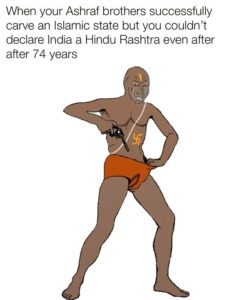
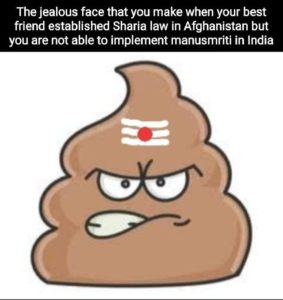
My query was:
Are Hindu nationalists jealous of the Taliban’s success?
How do they really feel about the Taliban taking over Afghanistan?
Afghan National Army Lieutenant General Sami Sadat
Below is an opinion essay in the New York Times by Afghan National Army (ANA) Lieutenant General Sami Sadat. LTG Sami Sadat,only 36, is one of the most loved and respected men in all of Afghanistan. He demonstrated remarkable success as the commander of the 215th Maiwand ANA Corps before being recalled to Kabul. The ANA lost over 70,000 Killed in Action (KIA). Including the MoI (Ministry of Interior) ANP (Afghan National Police), NDS (National Directorate of Security) and Arbekai the total Killed in Action was probably well over 100,000. The exact number is not known since the Afghanistan MoI and MoD (Ministry of Defense) have both classified the numbers since 2010 because they were afraid it would harm morale. In 2020 alone ANDSF KIA was likely over 15,000. I have been told that many of the ghost soldiers in many ANA battalions were actually KIA being kept on the rolls so that their salaries could support their families.
Posting LTG Sami Sadat’s NYT essay for those who can’t read it through the pay wall:
++++++++++++++++++++++++++++++++++++++++++++++++++++++++++++++++
GUEST ESSAY
I Commanded Afghan Troops This Year. We Were Betrayed.
Aug. 25, 2021
By Sami Sadat
General Sadat is a commander in the Afghan National Army.
For the past three and a half months, I fought day and night, nonstop, in southern Afghanistan’s Helmand Province against an escalating and bloody Taliban offensive. Coming under frequent attack, we held the Taliban back and inflicted heavy casualties. Then I was called to Kabul to command Afghanistan’s special forces. But the Taliban already were entering the city; it was too late.
I am exhausted. I am frustrated. And I am angry.
President Biden said last week that “American troops cannot and should not be fighting in a war and dying in a war that Afghan forces are not willing to fight for themselves.”
It’s true that the Afghan Army lost its will to fight. But that’s because of the growing sense of abandonment by our American partners and the disrespect and disloyalty reflected in Mr. Biden’s tone and words over the past few months. The Afghan Army is not without blame. It had its problems — cronyism, bureaucracy — but we ultimately stopped fighting because our partners already had.
It pains me to see Mr. Biden and Western officials are blaming the Afghan Army for collapsing without mentioning the underlying reasons that happened. Political divisions in Kabul and Washington strangled the army and limited our ability to do our jobs. Losing combat logistical support that the United States had provided for years crippled us, as did a lack of clear guidance from U.S. and Afghan leadership.
I am a three-star general in the Afghan Army. For 11 months, as commander of 215 Maiwand Corps, I led 15,000 men in combat operations against the Taliban in southwestern Afghanistan. I’ve lost hundreds of officers and soldiers. That’s why, as exhausted and frustrated as I am, I wanted to offer a practical perspective and defend the honor of the Afghan Army. I’m not here to absolve the Afghan Army of mistakes. But the fact is, many of us fought valiantly and honorably, only to be let down by American and Afghan leadership.
Continue reading Afghan National Army Lieutenant General Sami Sadat
Open Thread – 08/20/2021 – Brown Pundits
I might as well mention that I’ll be doing a Pathan genetics and history room on Clubhouse in a bit over 5 hours. Clubhouse is now open to anyone on all major platforms.
Council in Support of the Resistance of Herat
Establishing “Council in Support of the Resistance of Herat”
Kabul-09 August 2021
As our beloved country burns in the flames of foreign invasion, and the ancient city of Herat has turned into a stronghold of honor and liberty, a number of Herat youths have come together in Kabul with much love for their homeland to form a support mechanism for a people’s resistance movement against foreign invasion in Herat. The name “Council in Support of the Resistance of Herat” has been agreed for this newly formed council.
The following were agreed in the session on August 9, 2021:
1) While appreciating and supporting the epic resistance by the People’s Resistance Movement of the Western Zone, and Afghanistan National Defense and Security Forces, and also humble thanks to their efforts, sacrifices, and guiding the free and devout people of Afghanistan, especially the people of Herat;
2) Stressing on the important role and leadership of His Excellency Mohammad Ismaeel Khan at these crucial times for the future of the country and defending our land and honor;
3) Realizing the difficult times that the country is going through and stressing on collaboration, compassion, and companionship with the brave soldiers of our country, especially ANDSF, by the political parties and figures, social, political, media and religious institutions, women, businessmen, academics, doctors, and every individual citizen of the country;
4) Believing that the fate of Herat and the West Zone of the country is not separate from the rest of the country;
5) Calling on the central government to localize administrative and security institutions, and strengthen solidarity and coordination between the people’s resistance movement and ANDSF at national and provincial levels;
6) Emphasizing the core mandate of the Council for Integrating and Supporting People’s Resistance in Herat which includes strengthening solidarity, support, and coordination among influential figures and institutions in Kabul to assist people’s resistance movement and ANDSF in Herat and the West Zone;
7) Emphasizing on the responsibility of all citizens, and national, international, regional, provincial, and local institutions in further strengthening national unity and solidarity for defending national integrity of Afghanistan, as well as defending the lives, property, and honor of all citizens of Afghanistan, including Herat and the West Zone;
The Council in Support of the Resistance of Herat is established.
This council has a leadership board, and three functional committees (political, public relations, and fundraiser/financial support). Dr. Rangin Dadfar Spanta is elected as the president of the council unanimously.
More details about the council will be released soon. For more information, please contact Faridoon Azhand at:
WhatsApp: +93 (0) 797416062
Email: faridoonazhand@gmail.com
Continue reading Council in Support of the Resistance of Herat
Afghans march supporting the ANDSF against the Taliban across Afghanistan
Vast numbers of Afghan civilians in many cities across the country have been chanting “Allah Akbar” and other calls to support their beloved ANDSF (Afghan National Defense Security Forces) in the battle with the Taliban, Al Qaeda and Daesh. The cheering started at night in Herat and spread throughout the country. People were chanting on the streets, on roof tops, in mosques, through mosque speakers. Men, woman and children. There are hundreds or more articles and videos about this. Including:
https://www.aninews.in/news/world/asia/afghan-vice-president-amrullah-saleh-joins-civilian-protest-against-taliban-pakistan-in-kabul20210804110936/
https://www.aljazeera.com/news/2021/8/3/afghans-chant-allahu-akbar-in-defiant-protests-against-taliban
Anti-Taliban chants, thousands including vice-President Saleh took to streets
Mass popular cheering for the ANDSF synchronized across the country hasn’t happened before in Afghanistan.
Among the first to publicly discuss that popular chants were beginning in Herat was one of Afghanistan’s greatest living intellectuals, Davood Moradian–founder and director-general, Afghan Institute for Strategic Studies. (Is there interest in interviewing him for BP?)
I would recommend that everyone read Davood’s very fine article on how Britain has long supported violent extreme Islamists in Afghanistan and has been flirting with or even appearing to support the Taliban for over a dozen years. In former US defense secretary Robert Gates book, President Karzai famously asks Secretary Gates why Britain was de facto supporting the Taliban. Gates responded with silence. The British have repeatedly sabataged Afghans in many other ways too. Here are some highlights from Davood’s article about Britain’s negative role in Afghanistan:
Continue reading Afghans march supporting the ANDSF against the Taliban across Afghanistan
Open Thread – 08/04/2021 – Brown Pundits
I didn’t post an open thread last week because we haven’t been posting much content. But I’ll post this early.
A comment thread emerged on Twitter that “Indian American” culture is basically Punjabi culture. Thoughts? It was a fork on a comment that “German American” culture is a debased form of Bavarian culture.
I still post podcasts early from Unsupervised Learning on Patreon. Thanks to everyone who is a patron, since that keeps me paying for the podcast storage and software.
Open Thread – 07/16/2021 – Brown Pundits
In case you aren’t subscribed, Akshar interviewed an Afghan official on the latest BP podcast. Our cadence has dropped off lately, but I’m assuming we’ll speed up again at some point soon.
On Kushal Mehra’s show talking about Dragon Man.