Why not Persian for the pre-1971 Pakistan ?

Update: I’ve undeleted this since Zach has admitted that he overreacted below. If you want me to trash this post again Vikram just leave a comment below and I’ll do so. -Razib

I understand the nostalgia and desire for an Islamicate language among the Ashraf elite of British North India. After all, Hindus have a similar desire to live in the house of classical Indian languages, and the vast majority of Hindus give their children names from these languages.

But what baffles me is the the Ashraf insistence on Urdu. Choosing Persian as the national language of Muslim South Asia would have had many benefits:

  1. Just like Hindus, whether Kashmiri or Marathi, have a reverence for their classical languages (currently mainly Sanskrit for North Indian Hindutva types, but with a bit of maturity this sentiment also extends to other Indian classical languages), Muslims whether Sindhi or Bengali see Persian and Arabic as their classical language. This would have dramatically reduced the internecine conflicts amongst South Asian Muslims due to language.
  2. Persian as a national language would cement Pakistan’s relation with the Iranic world (and thus the core Muslim world), which is the ancestral land of much of the Muslim Ashrafi in South Asia. South Asian Muslims would come into deeper contact with a sophisticated and highly cultured Muslim population.
  3. Muslims of South Asia would have access to a true, expansive classical literature (including heroic epics, not just romantic poetry) dating back to antiquity, much like Indians have access to classical literatures in Sanskrit, Pali and classical Dravidian. This would diminish the need for extreme religiosity as the glue for holding the Muslim nation together, and produce a far larger, self confident cultural output.

On the other hand, the choice of Urdu created quite a few issues for the preservation and growth of Islamicate culture in South Asia:

  1. At the end of day, Urdu is an Indo-Aryan language with Sanskrit grammar and substantial Sanskrit vocabulary. Even the most Arabo-Persianized version of Urdu (Pakistan’s official Urdu) has at least 40% Sanskrit and Prakrit vocabulary. More so, since Hindus speak Hindi, which has the same grammar, but a steadily increasing Sanskrit vocabulary, it leaves Urdu perpetually vulnerable to an increase of Sanskrit vocabulary.
  2. Some key words in Urdu like aap and sakna have roots in Hindu concepts (aap comes from aatma, the higher self) and sakna derives from Sanskrit shakt, which has a higher meaning in Shakti, the feminine divinity of Hinduism, walla from pal, which means protector.
  3. Muslims in Pakistan and Bangladesh, already have their own languages and literatures, especially the Pashtun, Bengalis and Sindhis. No wonder the imposition has led to substantial conflicts instead of synergy towards the ultimate goal of a sophisticated, modern Muslim culture in South Asia, which is also shared by these populations.

All this leaves me baffled as to why the Muslim Ashrafi were so insistent on Urdu. My best guess is that they mistakenly felt that Urdu was a variant of Arabic and Persian, with no real Sanskrit influence. This is quite possible since the different language families would not have been widely known then, and since Urdu was written in the Arabic script, which is dramatically different from Indian ones.

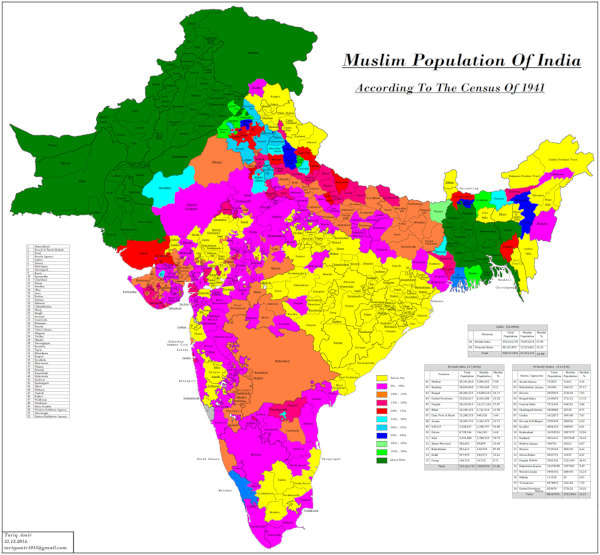
In any case, the Ashrafi insisted on Urdu. This led to a breakdown of Muslim nationalism when Bangladesh separated. Bangladesh now uses an Indic script, and speaks a language with mainly Sanskrit vocabulary. On the other side of the subcontinent, for the first time in more than two millennia Pashtuns could be under more Indic influence than Iranic (this might change as Iran rises again). Within India, Urdu has declined dramatically, as Muslim families in UP and elsewhere have reconciled themselves to Hindi[1]. Knowing Urdu leaves Pakistani Muslims vulnerable to a substantial amount of Hindu literature and concepts via television shows and Hindi movies.

None of these could have been the goals of the Ashrafi when they demanded a Muslim homeland.

[1] – Urdu is the only scheduled language in India that registered a decrease in the absolute number of speakers between 2001 and 2011. Its proportion of first language speakers has decreased from 5.22% in 1971 to 4.19% in 2011, despite an increase in Muslim population percentage.

Africa’s only Hindu island

https://www.facebook.com/drewbinsky/videos/1792525924117662/

I’m pretty sure that Mauritius is a secular democracy but it is 52% Hindu.

As an aside it would be interesting to study the evolution of Hindu island diaspora culture around the world (Suriname, Guiana, Fiji, Mauritius etc).

There doesn’t seem to have been much Brahmin migration and it was mainly done by farmers/labourers. The early 20th century into East Africa seems to have had much Gujarati merchant castes but if memory serves me right they also served as labourers for the railways so it’s all a bit complicated and understudied.

Disregarding the Out of India migration theory (but there must have been a pulse with the Mitanni in the Levant); India has periodically pushed out waves of migrants to spread its culture, script and religion. To my mind though the only Hindu society, outside of core South Asia, to have a strong Brahmin presence is Bali.

It’s brings a further observation is that can Vedic and Hindu be separated. The reason I suggest this is that the Hinduicisation of South India seems to have primarily mediated by Brahmin migrants from the north. They seem to have found local hierarchies and adapted it to the caste system (the Reddys seem to be indigenous Dravidians).

I’m still unclear what the original nucleus of Hindu society would have been. After the collapse of the IVC culture it seems that Indian/Hindu civilisation (I’m treating them as equivalent since we are talking about BC) was continually shifting towards Haryana than Western UP and then Bihar. It’s only the Islamic incursions in first millennia AD that shifted it back towards Delhi and plugged India back into the Turkic network.

Of course the Buddhist interruption can’t be ignored but the role of Brahmins in the coherence of Hindu civilisation simply can’t be ignored. What is interest is that all the Hindu islands sans Brahmins seem to become very relaxed creole island cultures that resemble Sri Lanka. All of sudden the pulsating sensuality and tropical sexuality that is so repressed in North India/Pakistan emerges and the hidden matriarchy also peaks through.

Much as the Muslim invaders were very obviously symbols of patriarchy and a stern nomadic culture; its not unreasonable to supposed that the Aryans represented much of the same stream and applied that to a relatively relaxed pagan Dravidian/AASI South Asia. It would make sense that Indra, a masculine thunder god, is Aryan but Lingala worship is an indigenous feature.

The model we would be looking at is Mother Goddess worshipping AASI with naturistic pagan beliefs being coopted by Dravidian farmers. It would be a classic case of farmers and hunter gatherers coexisting in the same spaces; most of the farmer culture and genes winning out over the generations. Then come the Aryans with their migration/invasion but progressively Sanskritise the rest of South Asia with a much more masculine pantheon.

A question comes to mind that if Malaysia/Indonesia had a strong and resilient Brahmin network, would they have become Muslim? Had the spread of Buddhism undermined Brahminism as it seems to have done in the northern Punjab/Bengal peripheries of the Subcontinent.

Ps: Smart comments welcome (as in the Climate Change thread) – I’m simply speculating. I’ll delete anything overwrought; everyone featured in this post (except the Mauritians) are long gone.

Kashmir

The government in Kashmir has fallen. What’s next for this troubled province?

As an aside my own preference is the LOC is a soft border between India and Pakistan. I don’t want any redrawing of the map whatsoever. I would rather Fawad Khan and Mahira Khan be able to act in Bollywood and Pakistani players play in the IPL. I can understand that for some Kashmir is a hot topic but I’m far too invested in Rising India as it is.

However if I see this post degenerate into low quality jingoism on either side; I’ll arbitrarily delete comments.

Comments are free but facts are sacred. If I see unnecessary emotionalism I’ll just remove it- the BP threads have turned into an Indo-PAK flame war and I have stayed my hand but in my own threads I’m going to be much more pro-active.

Caste in US medicine?

My last name “Theetha Kariyanna” has its origin from a small village Theetha and added to it is my dad’s name Kariyanna (a local folk god). Back in my school days, the name was weird to my friends as the name Kariyanna also literally translates to “black brother.” As a kid who was hesitant to loudly say his name clear and loud, I have grown up to say my name loudly with pride as I often do: “Hello there, I am Dr. Kariyanna, your heart doctor today.” I was likely hesitant to say my name loudly because of its literal translation and the fact that it easily discloses my roots in the Kuruba community — sheepherders of south India who fall into the shudra category of the caste system. The fear and hate for the caste system started very early on in my life.

The caste system is thriving in medicine in the U.S. via  Continue reading Caste in US medicine?

What the world can do to help Palestine?

I believe the world should attempt to surge the capacity and competence of Palestinians in collaboration with Palestinians. Foreign aid should be conditional on difficult Palestinian reforms to establish a globalized neo-liberal economic system based on meritocratic hierarchies of competence and capability. As this happens, the Palestinians will have the leverage and influence to negotiate a deal with Israel on their own terms and many of Palestine’s other problems will take care of themselves. This FT article covers some of challenges in surging Palestinian capacity.

When Faris Zaher, a Palestinian Jerusalemite, graduated in Hong Kong with a masters degree and returned home at the peak of the financial crisis, he drifted for a bit, working in consulting and property, and starting a website for classified ads.

Then he hit on his big idea: a start-up travel portal catering to the $50bn market for hotel bookings in the Middle East. There was no regional competitor back then and with the web opening up the prospect of borderless business, the West Bank city of Ramallah was as good a place as any to set up.

Less than five years later, Yamsafer is one of the region’s largest hotel booking sites, according to its founder. It recently closed a $3.5m funding round in one of the biggest venture capital deals the Israeli-occupied Palestinian territories have seen.

Yamsafer employs 70 people in Ramallah, a place where too many young university graduates are chasing too few jobs. “The people we hire are more hungry than people you would have hired in Dubai, Jordan or elsewhere,” Zahar, who is 29, told me recently.

Continue reading What the world can do to help Palestine?

When writing about India is actually just writing about America

The web magazine Slate posted a piece, Friends From India which I had initially thought was a parody. Its subtitle is: “I grew up watching the show in Mumbai. I worry about the damage its gender stereotypes still do there.”

It’s really bizarre. The author is Indian, and supposedly is making a comment about India. But the piece isn’t about India at all, but the worries and concerns of a liberal person in the West. Friends isn’t that important in driving social views in India, and gender relations and attitudes toward homosexuality in India have little to do with Friends. But, today Friends seems retrograde to many American liberals, because of its attitude toward gender relations and gayness, which were mainstream in the 1990s.

So it seems here that to get another piece on Friends and social justice into Slate, they just commissioned a piece that was officially about India, but quite obviously wasn’t.

This gets to a major dynamic in American society today which worries me somewhat: foreign affairs being filtered through purely American concerns and perceptions. Americans care so little about the rest of the world that they turn the rest of the world into the United States in substance, if not exterior styles.

The problem is that we are living through a great transition in the world. America is no longer as much the center, and economic, social, and political, power will rebalance toward Asia. In such a multipolar world pandering to purely American preoccupations will lead to gross misunderstandings and likely catastrophe.

India as the hydra against Islam

In some versions of the legend of the Hydra, every time you cut off one of the heads of the monster two more grow in its place.

I have been thinking about why and how India remained predominantly non-Muslim despite most of the subcontinent being under Muslim ruling for 500 years (dating from 1250 to 1750 approximately). The contrast here would be most stark with Iran and Turan. While the zone of the Islamic Empire between Mesopotamia and the Maghreb was dominated by a Christian populace which spoke an Afro-Asiatic language, Iran and Turan retained their language and their cultural distinctiveness, as evidenced in the nationalism clear in the Shahnameh.

There was a comment on this weblog that implied India was unique because of violent resistance to Islamicization. This is patently false. To give a concrete example, the region of Tabaristan in northern Iran was dominated by warlords and dynasties which adhered to the Zoroastrian region until the 9th century, 200 years after the Arab defeat of the Sassanians. Despite the inroads of Islam in the 9th century, after more thorough integration into the Abbassid Caliphate, Tabaristan was still throwing up Zoroastrian anti-Muslim warlords into the 10th century.

But most attempts to infer the religious demographics of Iran, which are to a great extent guesswork, suggest that it was in the 10th century the region became majority Muslim. One indication of this that this is so is that this period correlates with a more muscular and resurgent Iranian high culture and reemergence of political non-Arab political power. As Zoroastrianism was no longer seen as a threat to Islam, Persian cultural identity could reassert itself without a non-Islamic connotation (there is in the 10th century a shift away from ostentatiously Arab names by Persian Muslim elites).

Basically, it seems that it took about 300 years for Iran to become majority Muslim. I’ve seen similar numbers for Egypt and the Maghreb, though in the latter region indigenous Christianity became extinct by the medieval period.

There are two related issues that I want to suggest for South Asia: scale and complexity. Though the Indian subcontinent is geographically smaller than the Arab Caliphates as their height on paper, the reality is much of the Near  East and North Africa are empty of people. Islamic rule really consisted of a string of cities and fortifications interlaced over broad swaths of the territory occupied by pastoralists, as well as a few regions of dense cultivation.

Iran, Turkey, and the Arab world consist of between 400 and 500 million people. The Indian subcontinent has 1.7 billion people. The population in the past may have been different, but I think it gives one a rough sense of the differences in magnitude over the long-term.

Second, the social complexity of South Asia is astounding. I say this as a geneticist: the differences between different castes in the same region are hard to believe. Though there is a great deal of ethno-religious diversity in the Middle East, they are not surprising. Arabs engage in a consanguinity. Ethno-religious minorities such as Copts or Assyrians have less cosmopolitan ancestry than their Muslim neighbors. This is all to be expected.

In contrast, any analysis of ethnic “Telugus” has to take into account local structure because it is so extreme. Dalits are different from middle castes are different from Brahmins. Some of this is due to genetic drift, but much of it is due to continental-scale differences in genetic admixture.

The genetic differences tell us something us deep about the nature of South Asian social relations. Defection to Islam occurred on the individual scale, but generally, quantity could only be had by mass conversions. Even when groups of people of the same community are of different religions it was probably through mass conversion of particular subsegments.

Which brings me to Bengalis. The Rise of Islam and the Bengal Frontier was written many years ago, and I read it long before I ever knew much about the genetics of South Asians. In it the author explains that the dominance of Islam on the eastern march of Bengal was due to the fact that it was a frontier society that emerged during the period of Islamic rule. Meanwhile, western Bengal was a culture which was in a stationary state.

The ability of Islam to penetrate into the Bengali-speaking peasantry was due to its fluid and unordered character. In contrast in western Bengal, a more traditional South Asiab society with well-delineated caste boundaries had already crystallized by the time of the Muslim conquest.

So here’s the thing that genetics adds: the topology of genetic variation of Bangladeshis is totally different than what you see in other South Asians. There’s very little structure. Basically aside from a few half-Brahmins and a small community of Dalits, the 1000 Genomes sample from Bangladesh shows none of the genetic variation partitioned by the community you see in most Indian samples. Or, that you see in the Indian Telugus, Gujuratis and Pakistani Punjabis (the Tamils from Sri Lanka are somewhat less structured, but still have more than the Bangladeshis).

To me, this confirms the thesis of The Rise of Islam and the Bengal Frontier. As a frontier society, eastern Bengal was mixed in a way where the structure socially and genetically that was the norm in most of South Asia by the time the Muslims arrived simply wasn’t present. Without the powerful collective substructure, Islam was able to swallow up the rural society in toto. Perhaps the best analogy might be to Indian communities in Trinidad, where caste has mostly disappeared, and Christianity has made extensive inroads.

So why didn’t India become Muslim? What is this “India” of which you speak?

Note: I moderate comments, please don’t stupid spam me.

Will India and Pakistan Learn from the Historic Korea Summit?

The gradual process of mending ties through sports, cultural exchanges and the historic meet presents a lesson for several sparring countries across the world. This is particularly true for India and Pakistan, as the South Asian neighbours were also partitioned from one region and share a historical, socio-cultural and linguistic inheritance, as the two Koreas do.

So the question remains of whether India and Pakistan be rid of their adamant attitudes and restart the athletic and cultural exchanges that have been on pause for years. This is a lesson they could take from the historic meeting in the Korean peninsula, which has witnessed much more violence and bloodshed than the Indian subcontinent in the last six decades. Over 12 lakh people are estimated to have been killed in the Korean War, as compared to over a lakh in the Kashmir conflict, the main bone of contention between India and Pakistan.

Will India and Pakistan Learn from the Historic Korea Summit?

My quibble is that the two Koreas are more akin to the two Punjabs or Bengals than they are to Indo-Pak.

India and Pakistan now have very different national traditions where the modern states are built on a rivalry with one another. Pakistan much more so than India but as Kabir says there is far too much blood under the bridge (I’ve butchered that saying) that the best we can hope for is normalised relations.

I don’t know much about Korean history but there is another different; unified Korea is a bit like unified Germany there is one national narrative. But think Anschluss (Austria + Germany) would it be the Catholic Hapsburg or Protestant Prussians (let’s set aside the last example of Anshluss) that would define the hypothetical Germanic state.

Similarly would Indo-Pak reunification be Akhand Bharat or the Mughals resurrected since I imagine no one has the appetite for the Raj.

Why do Indians care about OIT/AIT

From my blog:

Razib: I follow your super feed and read your postings here and on Brown Pundits. The subject of the ancestry of South Asians comes up frequently. It seems to have a political valence that I, as an outsider, do not understand.

Can you explain it? or point us to an explanation?

My response is “British colonialism and modern-day culture wars.” I could say more, but honestly, I don’t care that much. The science is more interesting to me, and it’s a lot to keep track of. Can readers comment?

(Related: there are some Pakistanis who try and pretend as if they are descended from Persians, Turks, or even Arabs. The explanation is pretty straightforwardly summarized as “self-hatred”, though we could all elaborate on that).

Brown Pundits