Open Thread; The Archive, The Lynching, and Humanity First

Open Thread — The Archive, The Lynching, and Humanity First

A note: we are currently backtagging the entire BP archive — all 3,987 posts. The comment boards may show cross-linked notifications as the system processes older threads. We will update when complete.

Gaurav Lele’s post today asks serious questions about asymmetric condemnation. It is worth reading carefully.

But one comment in the thread deserves to be elevated. Calvin wrote:

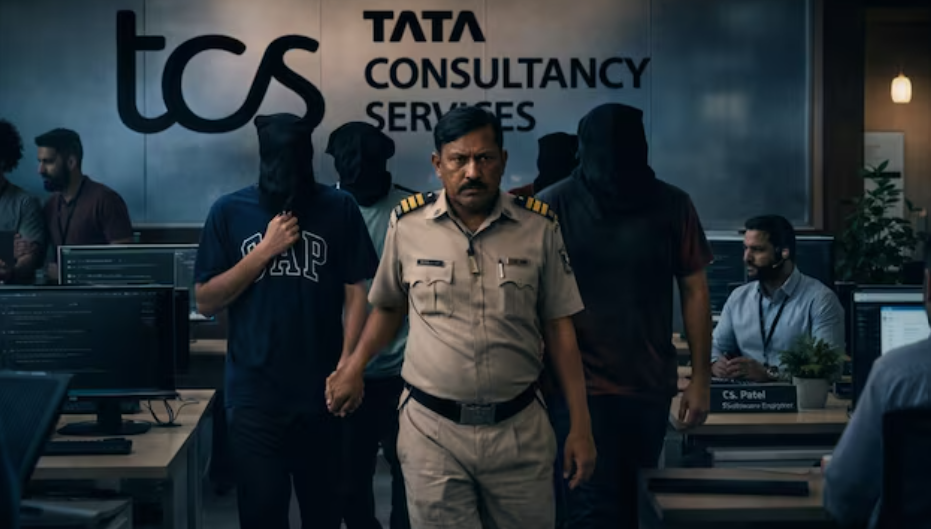
https://article-14.com/post/even-after-their-son-was-lynched-the-khan-family-did-not-leave-the-hindu-village-3-months-later-they-fled-694f49ba99322The fact is that the people caught in TCS case will be tried and spend years in jail. That is where the fundamental difference in response comes from, we know when the perpetrators are muslim not only them but even their family will suffer, this is not guaranteed when the muslim may be the victim.

Calvin is right. And the story he linked proves it.

Continue reading Open Thread; The Archive, The Lynching, and Humanity First

At the Heart of the conflict

Reams of digital pages on this forum have been devoted to India–Pakistan relations and the broader Hindu–Muslim, or Muslim–non-Muslim, conflict. I think most of these discussions miss the crucial issue at the heart of these conflicts.

I will try to navigate to that core. This particular reflection was triggered by a news item that broke recently:

TCS Nashik conversion case widens: Undercover women cops, Malaysia-linked preacher angles surface – India Today

If, twelve years into the Modi government’s Hindutva agenda, a dozen educated Muslim employees can allegedly engineer a conversion racket in TCS—with all its POSH and diversity guidelines—one wonders what Muslim radicals might get away with in majority-Muslim countries.

One doesn’t need to wonder. A Dawn report from 2014 alleged that around 1,000 non-Muslim girls are forcibly converted and married off every year. Even if the number is 100, that is a huge number for 2-3% of population. The demographic change in East Bengal over the last eight decades is a testament to these currents.

Continue reading At the Heart of the conflict

Brown Pandas: Rising Toward a Saffron Crescent.

A meditation on conflict, identity, and the severed wings of Mother India


The Name

A small irony to begin: the blog is Brown Pundits, not Brown Pandas. Though Brown Pandas has a certain charm; large, slow-moving, occasionally comic, surprisingly fierce when cornered. Perhaps not so different.


What Is Happening Here

Look at the comment boards today. We have a serious thread on the Aryan Migration Theory; which needs its own Precedent Post, and will get one. We have Indians and Pakistanis locked in the same mutual obsession that has consumed multiple generations post-Independence, the energy of which, if properly directed, might have built something extraordinary.

Here is the paradox that strikes us: the mutual antipathy between India and Pakistan, Iran and Israel, is not only destructive. It is, in a strange and uncomfortable way, generative. These four states, small by population or GDP relative to the great powers, have nonetheless forced themselves into the front rank of military and strategic relevance. China displaced Japan; the Anglo-French condominium displaced Germany; America and Russia defined the twentieth century. Yet India, Pakistan, Iran, and Israel sit alongside them at the table where it matters. That is not nothing.

Conflict, at a certain calibration, makes nations. The Romans knew it. The Persians knew it. The question is dosage. Too much tension and you get stasis, poverty, the endless self-consumption of the security state. Too little and you get complacency. The great irony is that India and Pakistan have had almost exactly the wrong calibration; enough conflict to militarise, not enough resolution to grow. The long peace that compounds prosperity never arrived.

Qinling panda: The shrunken pandas that diverged 300,000 years ago and sometimes come out brown | Live Science
Perhaps, like the Qinling Panda; brown, shrunken, diverged for three hundred thousand years before anyone thought to ask why. The Brown world is simply waiting to be recognised for what it always was.

The Venal Bargain

When Kabir took issue with the phrase “barely educated country” in reference to Pakistan, it was taken as hostility. It was not hostility. It was a diagnosis. Continue reading Brown Pandas: Rising Toward a Saffron Crescent.

On Censorship

We need to have a honest discussion about censorship on BP. We have a contributing author who demands and exercises the right to “ban” other contributing authors from commenting on ‘his’ threads. This, while continuing to spout distinctly one-eyed perspectives and cherry-picked regurgitated content.

Do we want BP to be a space with ‘dueling’ threads, or actual discourse? If Indians and Pakistanis can’t even manage a written conversation on a blog post via comments, without arbitrary petty ‘bans’ justified in the name of “I simply don’t like you” – this is the sort of thing that ends up having a disproportionate impact on the nature of what this space is.

Brown Pundits: Traffic Report, March 2026

The Dhurandhar effect

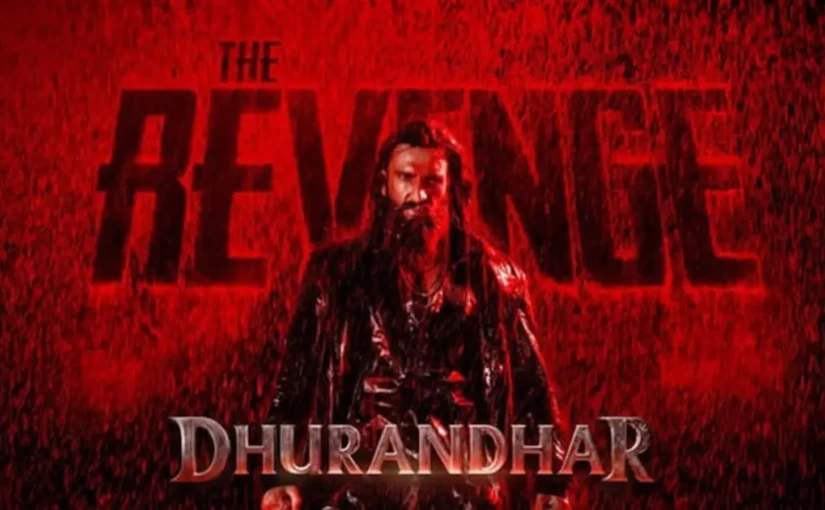
Omar Ali’s Dhurandhar review is our highest-traffic page by a distance followed by BB’s Kohrra season 2 review. It ranks 20th on a keyword with 87,000 monthly searches in India alone. A single film review, by one writer, on one streaming title, is pulling 37% of our traffic. Continue reading Brown Pundits: Traffic Report, March 2026

The Game We Can Smell

Asha Bhosle Deserved the Lead

Asha Bhosle passed away this week.

She was one of the most recorded artists in human history. She worked with Ustad Ali Akbar Khan on Hindustani classical music late in her career. She was, by any measure, a civilisational figure. She deserved the lead.

The Disguise

The language of the liberal left has become the preferred disguise for Hinduphobia and Indophobia. This is not a new observation, but it bears repeating because it keeps working. You dress the hostility in the vocabulary of literacy rates, developmental failure, civilisational backwardness. It sounds like concern. It is not concern. If it were concern, one would ask the same questions about Pakistan. One would not, because the point was never the question. The point was the target.

The Playbook

This is what a significant segment of Muslim liberal discourse does. It has learned the language. The vocabulary is progressive. The instinct beneath it is not. It hides deeply illiberal commitments behind the cover of global left credentials. The irony is that this playbook, run long enough, galvanises exactly the forces it claims to oppose. Jews, Hindus, and other minorities watch institutional Islam operate under liberal cover and draw their own conclusions. They are not wrong to do so.

The Mughal Test

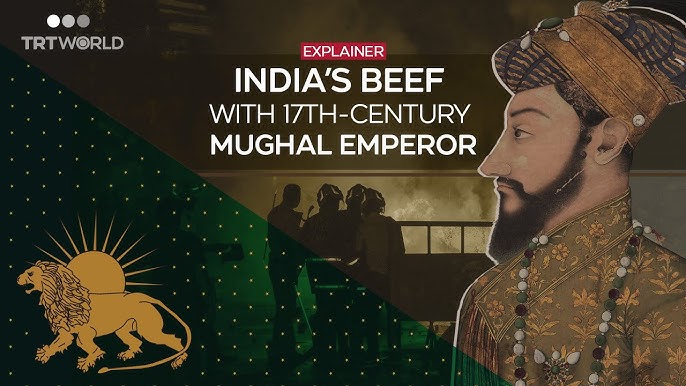
In the discourse of the Western, Muslim & Indian liberal left, a Hindu is only a good human being if they love the Mughals, especially Aurangzeb. Not merely acknowledge them, love them. Never mind that the Mughal period was, for large parts of the subcontinent, a period of genuine civilisational injury. You are not permitted to say that. You are not permitted to have a complex relationship with your own history. You must perform gratitude or be dismissed as a chauvinist.

We say this as people who have integrated Zoroastrian and Islamic history into our own civilisational understanding, not because we were required to, but because our tradition demands synthesis. That is our path. It is not everyone’s path, and Hindus are not obligated to take it. Partition, on QeA & Allama Iqbal’s insistence, largely ended the experiment in synthesised civilisation on the subcontinent anyway. That wound is real and it is not healed by demanding that Hindus perform affection for the dynasty that inflicted much of it.

What Is Changing

Hindus before were easy-going. The hardcore commitment to civilisational identity belonged elsewhere. That is changing, and the people somewhat responsible for that change are the ones who spent two decades weaponising liberal language against a civilisation that mostly wanted to be left alone.

We can smell the game.

We do not like it.

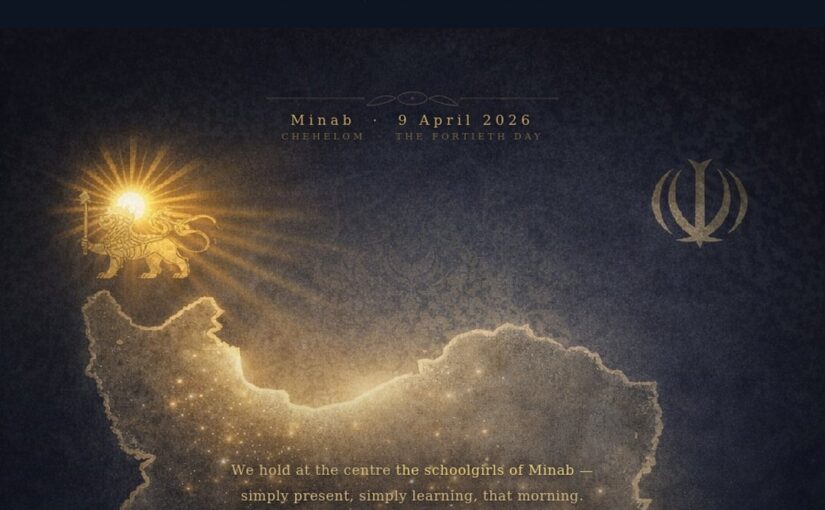
A Minute of Silence for the Schoolgirls of Minab | Chehelom, 9 April 2026

If you would like to receive an invite to the Minab Zoom Memorial; please email the Brown Pundits email address on the left. Thank you.


The Chehelom, چهلم, is the Persian tradition of gathering on the fortieth day after a death to pray, remember, and bear witness. It predates Islam and runs through every strand of Iranian culture. We mark it here not as a political act but as a human one. Set your alarm. One minute. That is all we ask. XTM

At 10:45am on 28 February 2026, 165 human beings, most of them schoolgirls aged 7–12 from the Bandari and Afro-Iranian communities of southern Iran, were killed in the bombing of the Shajareh Tayyebeh school in Minab.

9 April is their Chehelom; the Persian fortieth-day memorial.

Wherever you are in the world, please set an alarm for 10:45am Tehran time on Thursday 9 April and take one minute of silence.

For the girls of Minab. For every innocent life lost in this war. No hierarchy of grief; Jewish or Arab, Muslim or Persian, American or migrant.

We are all One.

🕰 Tehran 10:45 · London 08:15 · New York 03:15 · LA 00:15 · Sydney 17:15

Share as far as you can. 🕊 Continue reading A Minute of Silence for the Schoolgirls of Minab | Chehelom, 9 April 2026

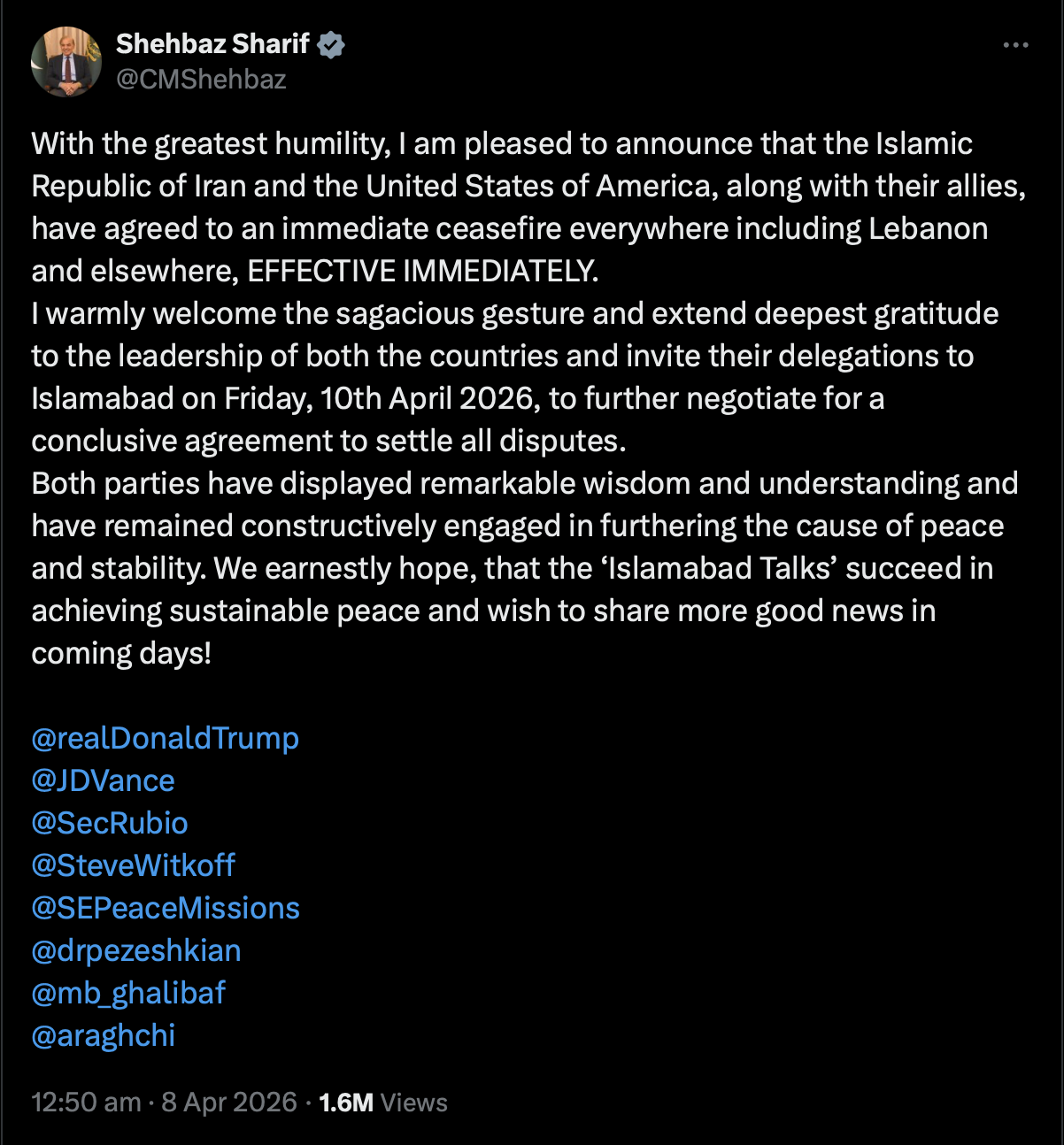
The Forty-Day War: Pakistan Saved the World?

[A note before we begin: We held back out of respect for Iran Zamin and the weight of what was unfolding. Pakistan has now acted where others would not, and the moment deserves acknowledgement.

This should have been India’s role. No other power sits closer to both Tehran and Washington. No other civilisational bridge existed with the credibility to hold both sides. That fatal trip, PM Modi’s visit to Tel Aviv, poisoned those waters permanently. It did not merely signal a foreign policy choice. It signalled comfort with regime change in a neighbouring civilisation. The opportunity cost is historic and will not be recovered.

What Pakistan has achieved is without precedent in its modern history. The Muslim Prussian Republic, forged in argument, held together by will, perpetually doubted, walked into the gap the subcontinent’s greater power vacated and stopped a war. The world owes a debt to Quaid-e-Azam and Allama Iqbal’s creation that it will not rush to acknowledge. That is how it goes. But we are noting it here, now, while the moment is live.]

History named the last one. It was called the Twelve-Day War. Clean. Surgical. A rehearsal. This one will be called the Forty-Day War. It began on 28 February 2026 with a decapitation strike that shattered Iran’s command structure in a single night and a brutal attack on a girl’s school. It paused on 8 April, when a Pakistani Prime Minister’s tweet achieved what five weeks of bombardment, ultimatums, and a pope’s intervention could not.

Pakistan forced the pause the world could not secure.

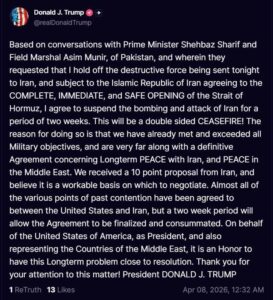
This is not sentiment. It is structural. Islamabad was the only room both sides could enter. Pakistan maintained working diplomatic channels with Tehran throughout the war. It shared enough institutional credibility with Gulf capitals to be trusted as a mediator. It was sufficiently operationally relevant to Washington; Field Marshal Munir’s name appeared, unremarkably, in Trump’s own ceasefire announcement, to be taken seriously rather than patronised. No other state sat at that intersection. Egypt tried. Turkey tried. Neither had all three legs of the stool.

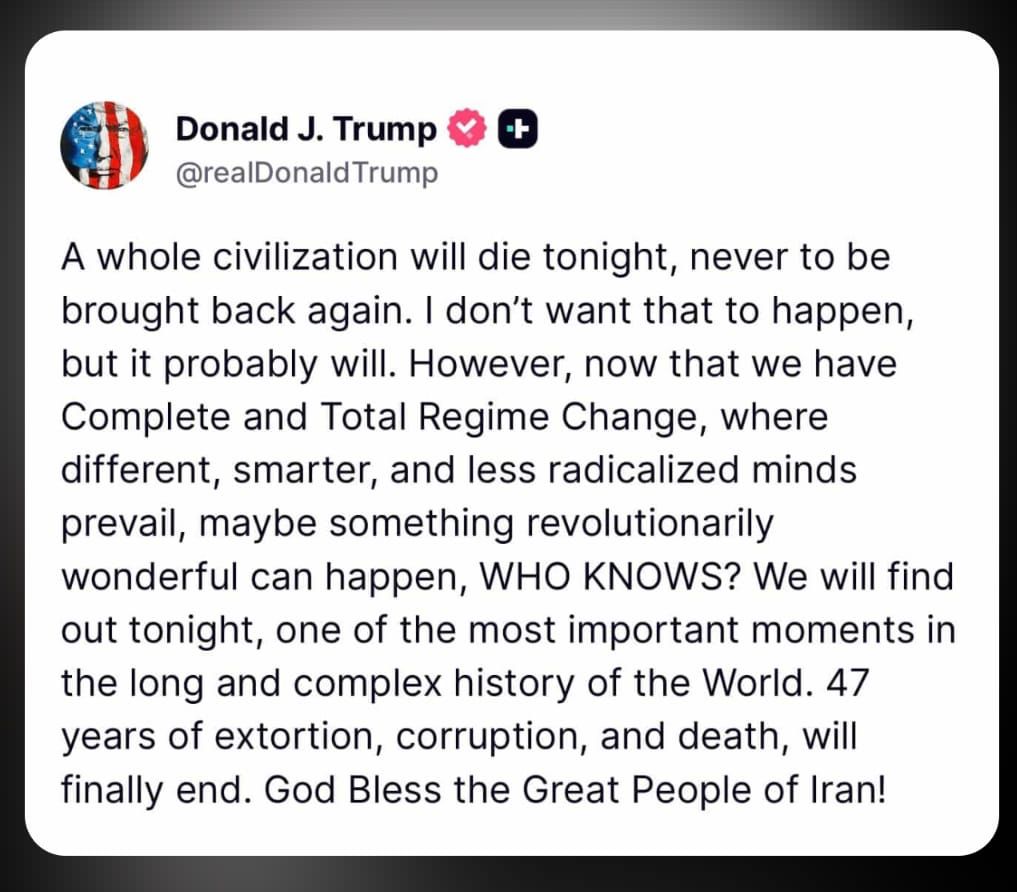
Over forty days, escalation outran control. Oil surged past $110 a barrel and briefly touched $117. Insurance markets seized. Traffic through the Strait of Hormuz reduced to a trickle. American signalling moved from coercive to apocalyptic, “a whole civilization will die tonight.” Iranian signalling hardened even as its leadership structure absorbed shock. Each side retained the capacity to raise costs further. Neither had a clean exit.

Pakistan supplied one.

The mechanics of the pause reveal everything. Tehran accepted a two-week window in which maritime traffic would resume under its coordination. Read that precisely. Coordination, not surrender. The Strait remains, in Iranian framing, an instrument of state power. That is not the language of defeat; though states rarely speak the language of defeat in real time, regardless of battlefield reality. What matters is what the text actually says. Iran controls the reopening. Iran does not yield it.

Washington will declare victory. The machinery is already running. Continue reading The Forty-Day War: Pakistan Saved the World?

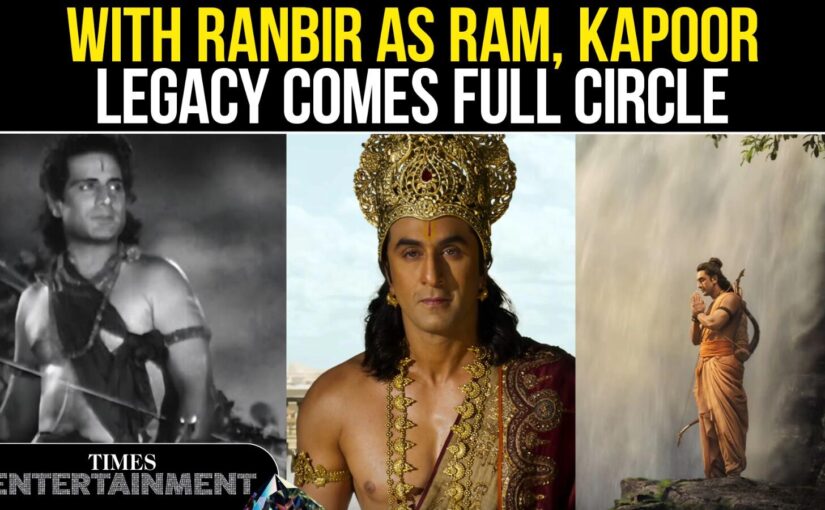
Ranbir as Lord Ram: The Indus Paradox

The riveting Ramayana teaser dropped today, and Ranbir Kapoor looks the part. Imperial, restrained, emotionally loaded. But the casting raises a question Bollywood won’t ask aloud.

The male axis of Hindi cinema runs through the Indus, not the Gangetic plain. The Khans, Aamir (Afghan UP-origin), Salman (Hindu, Pathan), Shah Rukh (Delhi, Hindko-Deccani stock), are Musulman. Their anointed successors, Ranbir (Kapoor lineage from Peshawar) and Ranveer (Bhavnani, Sindhi), are Hindu but Indus-blooded all the same (Hindus of the Indus are 99.9% genetically identical to Pakistanis apparently). The geography of stardom in Bollywood is the geography of Partition.

A Kashmiri nationalist once told me, Srinagar-bred, Ivy-educated, who sang Pakistani ghazals with more feeling than most Lahoris, that Ranbir and Ranveer were being aggressively promoted to eclipse the Khans.

Of course the connective tissue of the Ranbir-Ranveer rivalry is Sonam Kapoor. She is third cousin to Ranbir through the Punjabi mafia, and second cousin to Ranveer through their Sindhi mothers. The Sindhi presence in Bollywood runs deeper than most realise; Karan Johar, Kareena Kapoor, Kiara Advani all carry it. The two men being positioned as Bollywood’s future are bound into a single pre-Partition Hindu kinship network. The contestation isn’t just cultural. It’s familial.

The man cast as Maryada Purushottam, the ideal Hindu man, the conscience-keeper of a civilisation, descends from Prithviraj Kapoor of Peshawar; a Hindu Pathan (his kinsman Anil Kapoor states on record that he is the son and grandson of a Pathan). Bollywood’s Ram comes from the other side of the Wagah.

Ranbir versus Ranveer is the wrong frame. The real question is what it means that Hindu epic cinema, ₹4,000 crore, Hans Zimmer and A.R. Rahman, DNEG VFX, global IMAX release, chose a Kapoor. The answer is that Bollywood has always understood something the BJP perhaps never quite has: the cultural power of the Subcontinent flows from its Mleccha western rivers, not its sacred eastern ones.

Continue reading Ranbir as Lord Ram: The Indus Paradox

Cholistan: The Desert at the Edge of Everything

There is a desert in the southern Punjab of Pakistan that does not quite belong to Pakistan. Administratively it sits in Bahawalpur Division. In practice, it is shared with Abu Dhabi. Deep in the Cholistan, there is a private airstrip, Al Habieb, also known locally as Sheikh Zayed Airport II, with a runway long enough to receive the world’s largest cargo aircraft. Each winter, C-17s and Antonov-124s arrive from the Gulf loaded with vehicles, staff, telecommunications equipment and falcons, depositing the UAE president and his court into what is effectively a private desert palace. The Houbara bustard, an endangered migratory bird that Bedouin tradition prizes above almost any other quarry, is hunted here under special permits issued by the Pakistani government to Gulf royalty. The airport at Bahawalpur proper was financed by Dubai. The international airport at Rahim Yar Khan, 200 km away, is named Sheikh Zayed International Airport after the UAE’s founding father, who considered this corner of Pakistan a regular retreat.

This is not a footnote. It is a civilisational signature. The Khaleeji sheikh pursuing the Houbara across Cholistani sand dunes is, without knowing it, re-enacting something very old: the desert as a shared zone, unbounded by the nation-states that nominally contain it. Cholistan does not belong to Pakistan. It does not belong to India, or Sindh, or Rajasthan. It is a seam; and seams, by definition, belong to no single side.

The Hinge of Seraikistan

The name Cholistan derives from the Turkic chol, sands, and the Persian suffix -istan. Both layers arrived later than the place itself. The culture that defines Cholistan is Derawali: the Seraiki dialect of the encampment, the dera. It is nomadic speech in the most literal sense. Its richness is not courtly but ambulatory.

Seraiki itself is one of South Asia’s underappreciated civilisational languages. For centuries it served as the lingua franca across the interface zones of the northwest, among Baloch, Sindhi, Pashtun and Punjabi speakers, as the language of trade and movement. Cholistan sits at the heart of Seraikistan, flanked by Sindh to the south, Rajasthan to the east, and greater Punjab to the north. It is not peripheral to these zones. It is where they meet, and where, historically, what they share becomes visible.

That structural position, edge as synthesis, is the key to understanding what Cholistan is.

The Dead River and the Living Civilisation

The Hakra River, the Sarasvati of Vedic memory, once flowed through Cholistan, fed by the Sutlej and the Yamuna. It sustained dense settlement from roughly 4000 BCE until 600 BCE, when it changed course and the floodplain became desert. Along its dried bed, over 400 Harappan archaeological sites have been catalogued; among the highest densities in the entire Indus Valley civilisation.

The people who now pursue camels across that same terrain, collecting water in seasonal pools called toba, are the cultural descendants of one of the ancient world’s great urban traditions. What looks like marginalisation is, on a longer view, adaptation. The civilisation did not collapse. It reconfigured.

This matters because it frames the deeper question: who were these people, before the Hakra died?

The Dravidian Puzzle

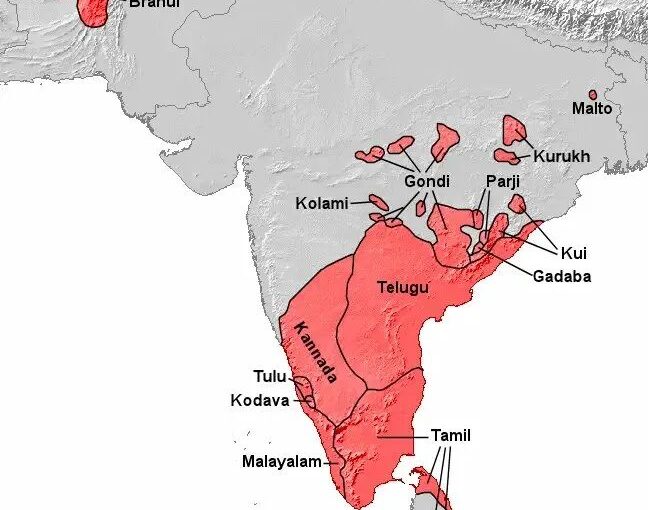
The map that accompanies this piece is one of the most quietly extraordinary images in South Asian studies. It shows the distribution of Dravidian languages today: a vast bloc across peninsular India, with isolated remnants in central India, Gondi, Kurukh, Malto, and then, stranded alone in Pakistani Balochistan, 1,500 km from its nearest linguistic relative: Brahui.

The scholarly consensus is that this map records the aftermath of Indo-Aryan expansion from the northwest after roughly 1500 BCE. Before that expansion, Dravidian languages were far more widely spoken across the subcontinent; including, most plausibly, across the Indus Valley civilisation zone that includes Cholistan. The central islands visible in the map, Gondi in Madhya Pradesh, Kurukh and Malto in Jharkhand and Odisha, are not coincidences. They are survivors.

Brahui is the most striking survivor of all. Its very existence in Balochistan suggests that something Dravidian persisted in the northwest long after Indo-Aryan became dominant; whether as a remnant population, a linguistic relic, or evidence of a deeper pre-Aryan substrate that stretched from the Indus to the Persian Gulf.

That last possibility is what the Elamo-Dravidian hypothesis proposes: a family linking the extinct Elamite language of ancient Khuzestan to Brahui and the Dravidian south. It remains a minority and contested position in linguistics, and should be read as such. But the geographic intuition behind it is not unreasonable. Khuzestan, now the Arab-majority southwestern province of Iran, was the heartland of Elamite civilisation. If Elamite and Proto-Dravidian shared a common ancestor, the implied civilisational corridor runs from the Persian Gulf coast through Makran and lower Balochistan, through Sindh and lower Punjab, and south into the peninsula. Cholistan sits directly in that corridor.

This is not established fact. It is a live and serious question, which is exactly the kind of question Brown Pundits exists to think about.

The Roma: The Longest Migration

One further thread, less speculative. The Roma, Europe’s largest ethnic minority, numbering somewhere between 10 and 15 million, originated in precisely this northwestern zone of South Asia. Genetic and linguistic evidence converges on Punjab and Rajasthan as the ancestral homeland, with significant shared ancestry also traceable to Sindhi, Balochi and Brahui populations in Pakistan. The Romani language is Indo-Aryan at root but carries innovations from the northwestern branch, Punjabi, Sindhi, consistent with an origin in the transitional zone between dialects, which is exactly where Cholistan sits.

The proto-Roma began their westward movement around the first millennium CE, passing through Persia and Armenia before entering the Byzantine world and eventually reaching Europe by the 13th century. They are the longest-range migration in South Asian history, and they began from the desert margin that Pakistani administrative maps label, prosically, Bahawalpur Division.

What Cholistan Teaches

Pakistan is discussed, almost always, in terms of its political present: the civil-military axis, the question of democratic consolidation, the India relationship, the nuclear deterrent, the IMF programme. These are real. They are also thin.

Cholistan is a reminder of the depth beneath the thinness. A Seraiki-Derawali nomadic culture whose civilisational roots predate Islam, predate the Indo-Aryans, and reach into a pre-Aryan substrate that may connect, linguistically and geographically, to the first cities on earth. A desert from which Europe’s most persecuted people likely began their diaspora. A terrain now seasonally occupied by Gulf monarchs pursuing an endangered bird across the ruins of a Harappan settlement.

The Hindu Presence

One further detail that the administrative map of Pakistan obscures: Cholistan retains a significant Hindu population. They are classified, in the caste framework, as Shudra; the lowest varna. But that classification tells you almost nothing about how they actually live.

In villages where Muslims and Hindus exist in roughly equal numbers, the communities are functionally indistinguishable by appearance, dress, or manner. Muslim neighbours organise protection for Hindu households during fairs and festivals not because there has ever been cause for alarm, but as a matter of custom and solidarity. Full social interaction is the norm. Intermarriage and commensality, sharing food across the line, are not. The boundary is observed without hostility.

What this means is precise: the racial and demographic integrity of the region is intact. These are the same people, shaped by the same desert, the same Hakra basin, the same pre-Aryan substrate. The religious difference arrived later than the people themselves. In Cholistan, you cannot tell a Hindu from a Muslim by looking. That is not erasure of difference. It is evidence of a shared civilisational root that predates the categories imposed upon it.

The Crescent and the Saffron are medieval categories imposed on a Neolithic reality. Cholistan predates both, and will outlast the argument.

Brown Pundits