
plus ça change, plus c’est la même chose
Multi Racial Multi Cultural Family in Ceylon
Banner Image: Photo from around 1940.
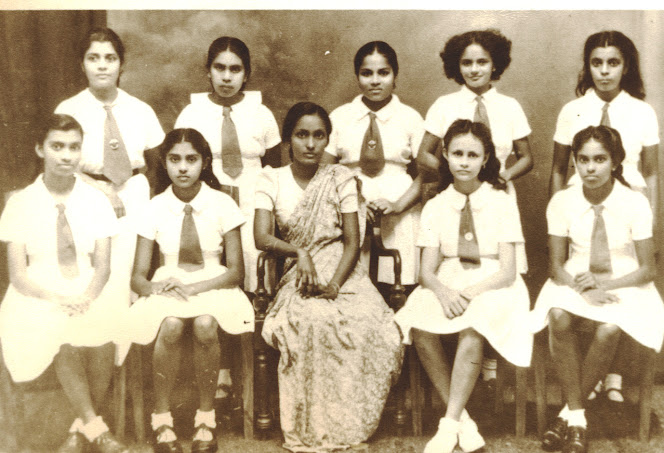
Standing far left: My mother Peace born 1926 (same age as Queen Elizabeth II) Standing one but Last with Afro, Estelle. Father a Judge from Barbados via England (African Heritage). Mother Eurasian
Seated. In Saree Miss Gnana (History Teacher, Tamil), Next to her: Miss White, Eurasian
This is about the maternal side of the family. My grandparents were one of the first inter racial marriage in the Deep South. It is also about how a children of an inter racial marriage do not belong and forge an independence of thinking (my mother and myself as examples). Even more so growing up in a cosmopolitan segment of Sri Lankan society
Let us start from the beginning. My Grandmothers mother was an Irish Nanny. Hearsay and rumor confirmed by my DNA tests. The Irish Nanny had my grandmother with my GreatGrandFather and left Ceylon. My GreatGrandfather did not have children so my grandmother was adopted by her father. Inherited all the wealth which was considerable. GreatGrandFathers family (Tillekeratnes) had been Administrators under Dutch and British times and were Sinhalese in the Deep South. Possibly were Anglicans during British times.
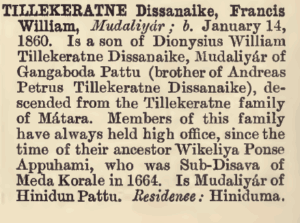
Tillekeratne Family of Matara.
From Golden Book of India and Ceylon (1900) Roper Lethbridge
My Grandmother married a Jaffna Tamil (from the North), a surveyor posted to Galle in the Deep South. My grandmother built a house in Galle so that it was convenient for work. Her ancestral home was even more deeper in the South in Matara.
Galle Town proper was very small, probably about 25,000 pre WW2. Still small about 150,000 now (2025), However, Galle was very Cosmopolitan because of the Harbor. It was the Main Harbor till the Colombo breakwater was built. My mother (and her sisters) attended a Catholic Convent, which was cosmopolitan. (a school photo and some names attached).
My mother and I dont really identify with any community in Sr Lanka. However, very Sri Lankan Nationalist. My mother never spoke about her opinions. Many in Galle thought they were Eurasians but they were not part of the Eurasian (Burgher) community. Burghers were a Fun crowd, parties dancing and Drinking (including women). (I would have liked to be part of that community) My mothers family were quite austere, their idea of nice time was probably singing hymns and big meal afterward. A lot of imported stuff from what I recall as a 6 year old. Edam Cheese, hams, sausage, puddings and homemade ice cream in churn. We inherited the ice cream churn after my grandfather died. Eventually rusted and was no longer usable.

Old fashioned Ice Cream Churn.
Because we dont really “belong” to any community we dont have a need to behave as society demands. Mother would dress like a street sweeper, without footwear even to extent of going to nearby shops. On the flip side she would go to Colombo to get her dresses made. Wore platform shoes, high heels, pastel light shade dresses and sarees. (There were some in her wardrobe when we were children).
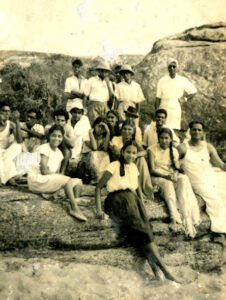
Mother in White Dress (left in image) on a Trip to Yala National when she was a teacher. Probably around 1952
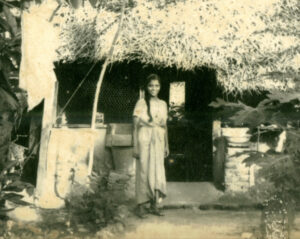
Mother in Batticola just after marriage. Parents lived there for 5 years. I was conceived in Batticola just before they left. Born in my grandmothers house in Galle.
Another big issue was she traveled alone, without chaperones since an older teenager. I think she just couldn’t deal with the slow pace of Sri Lankans. One gets the impression that she was some kind dress up person. Anything but, workaholic like her father and mother. Mothers father died at 84 getting ready to go to work surveying. Most Stories told by Katrina Hamy who was about my mothers age. I think mother liked her more than her sisters, some of whom were big time gossips. Apparently even as a young teenager would come home and help in cleaning, toilets, drains washing up. Hated cooking but was a reluctant good cook when we were children. We did not have “help” as my mother didnt approve of “help”
Anecdote told by Katrna Hamy
Mother was the youngest in the family. Somewhere in her teens she took it upon herself to supervise some coconut properties that belonged to my Grandmother. She would get up at 4:00am and take the first train (5am night Mail). She was supposed to go with a chaperone. Mother does not wait for anyone. Once she is ready she leaves. The walk to the train station (about a mile) is dark and lonely. As she was walking there was a man following her. Mother probably heard the footsteps and turned and walked back to the man and he just ran. Probably thought my mother was Mohini a female demon who dresses in white.
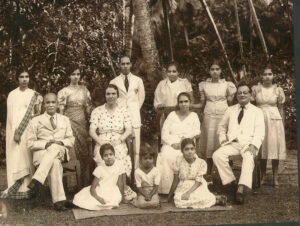
Mother family
Seated: Sanford BeeBee (Jaffna Tamil), 2nd from Right Lilian Edith Tillekeratne (Half Sinhalese, Half Irish. note: No Jewellery). The two westerners are Mr and Mrs Graves. Missionaries
Seated on Ground. Peace BeeBee (my mother), next to her Katrina Hamy
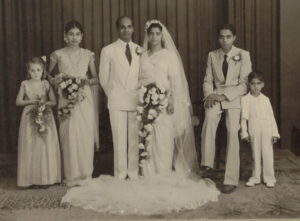
Parents Wedding Photo Galle, 1953
LR: Ms Anthin (Swedish Missionaries daughter), Sunethra neighbor and family friend, Sinhalese, AC Barr-Kumarakulasinghe (Jaffna Tamil), Peace Beebee (mother), Wilson Allegacone (fathers nephew, Tamil), Lal Liyanage (mothers nephew, Sinhalese)
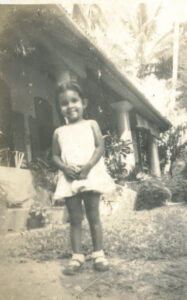
Grandmothers House in Galle
*For those who think this is boast. End of the line for my male Paternal line (about two males who carry the surname in Malaysia). The same for my grandmothers fathers line. The last in the male line was a classmate. As the Buddha says everything is Impermanent
Why we must talk about caste
Every few months (years?), Brown Pundits goes through its own small earthquake. A post lands wrong, a comment thread ignites, and the whole Commentariat erupts.
The latest rupture began with a mild jibe on caste. I pointed out, in passing, that caste shapes political instincts far more than many admit. The backlash was instant. A section of the readers declared a quiet boycott. The threads went cold. No one wanted to break ranks. The more one claims to have transcended caste, the clearer its caste blind-spots become. Silence itself becomes a shibboleth.
And when the silence hit, the blog froze. Continue reading Why we must talk about caste
Love Jihad Zohran
Congrats to Furan who was mentioned in this Five lessons for India’s Opposition from Zohran Mamdani’s triumph.
Born a Shia Muslim, he spoke to the Indian Eye of being raised in an interfaith family. “My mother’s side of the family is Hindu” he said, “and I grew up celebrating Diwali, Holi and Raksha Bandhan. Though I identify as Muslim, these Hindu traditions and practices have shaped my worldview…” His mother named him Zohran, which means the first star in the sky.
Zohran does seem to be a product of Love Jihad.
Pak Journalist Blames Munir for India and Pak Blasts
Fascinating take by Taha Siddiqui.
Taha is in exile.
He says Red Fort and the bombing in Pakistan both done by Munir. Is it sour grapes or does he have evidence that points to Munir?
“
Taha Siddiqui, a Pakistani journalist living in exile in Paris, is a strong critic of Pakistan’s military. He has claimed on X that the suicide bombers involved in the Delhi and Islamabad blasts were ‘assets’ of the Pakistan Army. Pakistani journalist Taha Siddiqui has linked the recent blasts in Delhi and Islamabad to suicide bombers he termed as ‘assets’ of the Pakistan Army. His claim has drawn wide reactions online. The blast near Red Fort in India on November 10 claimed at least 13 lives while 12 people were killed in the Islamabad explosion, the next day, on November 11.”
https://newsable.asianetnews.com/amp/world/pakistani-journalist-taha-siddiqui-pak-army-assets-claims-delhi-islamabad-blasts-articleshow-r0sg3mc
Where is Odette Yang
Red Fort Attack and Aftermath: Initial Thoughts by Manav S.
Red Fort Attack and Aftermath: Initial Thoughts by Manav S.
Last evening’s devastating car-explosion near the Red Fort in Delhi is not only a cruel assault on innocent lives but an assault on the very symbolism of our nation. According to early reports, a vehicle detonated close to the busy metro zone at the historic Red Fort complex, killing at least eight people and injuring more than twenty.  The government has invoked anti-terror legislation and launched a full probe under the Unlawful Activities (Prevention) Act (UAPA). 
First, we must recognise the human tragedy behind the headlines. Lives shattered, families devastated, fear spreading in a city already grappling with chronic insecurity. For those of us of South Asian heritage who carry memories of communal strife, of migration and displacement, this attack touches a deeper chord of vulnerability and of collective memory. Hospitals have reported frantic cries, missing persons, relatives screaming for loved ones. 
Second, the choice of location amplifies the message. The Red Fort is not just another landmark: it is an emblem of India’s sovereignty, its layered history, its identity. To strike here is to strike at the heart of public confidence and to send a message of audacious defiance. As scholars writing on “brown diasporic publics” know, our public spaces carry meaning not just for those inside India, but for those of us abroad who anchor our identity in ‘homeland’ narratives. This attack disrupts that anchor.
Third, we must resist both fear and simplistic narratives. The invocation of terror laws suggests the state is treating this as a planned act of violence, not an accident.  But let us guard against quick binaries: Us vs Them, Hindus vs Muslims, India vs Outsiders. In a plural society like ours, sweeping communal attributions too often deepen fault-lines rather than heal them. Our commentary must demand both justice and wisdom: meticulous investigation, transparent process, and safeguarding civil rights in the process.
Fourth, what does this mean for our shared public culture? For someone born in Punjab and now living across borders, the explosion challenges our sense of movement, of belonging, of normalcy. We think of carrying family across continents, of re-configuring identity in Washington–DC and Delhi , how do such apparently random acts of terror recalibrate the psychic cost of migration and the distance between home and homeland? The answer is: they make the cost higher, the emotional freight heavier.
Finally, the path forward must hold three imperatives: one, empathy – for all victims, irrespective of religion, class or residence; two, accountability – for whoever plotted, financed or enabled this attack; and three, renewal – of the public realm, the shouting panic, the fear-laden sighs, with something stronger: resilient civic culture, public institutions we trust, cross-community solidarity.
As a brown pundit, I urge our readership to see beyond the flashes of violence, beyond the political spin, and to ask the deeper questions: What kind of society are we building? What kind of public spaces do we imagine, and what cost are we willing to pay for them? For if we shrug now, the symbolic scar will grow — far after the immediate blast damage is repaired.
In that moment of stillness after the blast, we owe to our fellow citizens not just sorrow, but vigilant hope.
Free Speech
Free speech is inviolable, and unfortunately I can not restore the deleted thread (it’s been deleted from archives).
The notion that criticism of Pakistan, or of any country, should be off-limits on this platform contradicts everything Brown Pundits stands for. It is always better to err on the side of liberty than against it.
I am weary of the threats and emotional blackmail that appear whenever freedom is exercised. BP will continue to stand, whatever exoduses may come.
Two of my recent essays
I have two pieces of writing I want to share. The first is an essay I wrote on Iqbal for his birthday (9th November), exploring how we have misread him, and how, in a way, he misreads himself.
https://inkelab.substack.com/p/iqbal-an-uninteresting-poet
The second piece discusses how book reviews can nudge critical readership in Pakistan. It includes a situational analysis of reading habits in the country, the role of reviews and sugarcoating, and the emerging Bookstagram and BookTok communities.
https://dunyadigital.co/books/jumpstarting-critical-reading-the-power-of-a-book-review
Would love to know what you people think about both. Thanks!
Book Review: Empire’s Son, Empire’s Orphan. Ikbal Shah and Idries Shah (of Sufis fame)
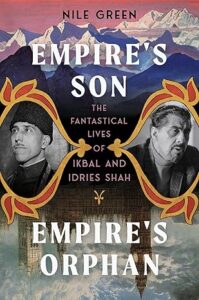
Idries Shah (1924-1996), a British citizen of Afghan and Indian origin, became world famous with his books about Sufi-ism (especially his magnum opus, “The Sufis”), selling over 15 million copies worldwide. In the course of this career, he also hinted (more than hinted, he wrote several books under other names in which he built up these claims about himself) that he was a sufi master himself, descended from an ancient and aristocratic family of Afghan Sufis who trace their descent to the Prophet Mohammed and are now bringing this ancient wisdom to the western public. His father, Syed Ikbal Shah, had settled in England and written several books about the esoteric east, but the careers of both father and son were dogged by accusations of making up stories and exaggerating their depth of knowledge about these matters. Professor Niles Green (who is the Ibn Khaldun Endowed Chair in World History at UCLA) has spent a long time researching both father and son and has now written a biography to settle this controversy and tell us who they really were.
So we learn that Ikbal Shah was a descendant of Jan Fishan Khan (famous indian actor Naseeruddin shah and retired general Zamiruddin Shah are also descended from him), an afghan who had sided with the British expedition to Kabul in the first Afghan war, and who escaped to india with the survivors of that expedition. For his loyalty, he was given a small estate in Sardhana, near Delhi. In 1857 Jan Fishan Khan again proved loyal to the British and was rewarded with the title of Nawab. It is here that Ikbal Shah grew up, and somehow decided to travel to Edinburgh to study medicine just before the first world war.
In Scotland, Ikbal fell in love with a Scotswoman and they married against the wishes of his dad, who therefore cut him off. Ikbal Shah proved to be a capable and energetic person who managed to make a life for himself in England as an expert on Afghanistan (where he had never been) to various branches of British academia and the British govt. Nile leaves us in no doubt that Ikbal Shah was a serial fantasist who made up wild stories about Bolsheviks and their operations in Afghanistan to British officials who sort of knew he was fake, but found him useful. To his credit, he was able to sell enough stories about the exotic east to survive in England and even joined the BBC during WW2 to make propaganda broadcasts for the British empire.
Ikbal Shah had three children (Omar Ali Shah, Idries Shah and Amina Shah) who grew up in the UK and Idries Shah followed in his dad’s footsteps to become an expert on the mysterious east (Omar Ali Shah also sold himself as a sufi teacher). Starting as an expert on “oriental magic”, he soon invented himself as a Sufi master and acquired several high profile fans, including the poet Robert Graves and the writer Doris Lessing. His book on sufism remains a bestseller and he wrote dozens of other books on various aspects of sufi-ism, all of which continue to sell. Nile Green regards this as more or less the result of gullible people being fooled by Shah, but the fact is that if you read the books in question (I have read several of them), they do seem to have genuine insights into human psychology and the various “teaching stories” Idries Shah claimed to have collected do indeed have the capacity to teach useful lessons for life. From within his own world, he can claim that what looks like fakery is just how this esoteric knowledge works in this world. After all, we are talking about sufi-ism and it is by no means clear how one can distinguish a sufi charlatan from a real sufi, since “genuine sufi-ism” itself thrives on mystery and misdirection, almost by design.
The fact that the brothers Idries and Omar Ali Shah falsely claimed at one point to have the oldest manuscript of the rubayat of Omar Khayyam (Professor Green makes a solid case that they made up the whole story) is itself enough to condemn them as charlatans, but as Professor Rawlinson once said ” Shah cannot be taken at face value. His own axioms preclude the very possibility.” If Sufis are enlightened beings who possess some esoteric knowledge that is not available to ordinary mortals, and if they are supposed to help you by telling you what you need, not what is “true” or false, it is by no means clear that this book and its careful examinations are the end of the matter. As Idries Shah’s epitaph states: “Do not look at my outward shape, but take what is in my hand”. The story continues..
By the way, the title “empire’s son, empire’s orphan” is a good indicator of the fact that the professor also has to labor under the limitations of his own field. Basically, it means nothing, but if you are into postcolonial writing then it is the fashion to connect every biography to “empire” and its discontents. It adds nothing to the story, but luckily it also takes nothing away.