The origin and variation of ethnic violence in South Asia

It’s been a few days since I last appeared here, so I don’t know what’s going on here. Either way, I had previously mentioned in some of my past comments about a few useful sources for understanding communal and caste conflict. One of the books that I mentioned was “The Colonial Origins of ethnic violence in India” by Ajay Varghese. I have been meaning to make a post about the book, but I couldn’t really fully summarize everything in a meaningful manner until I remembered a summary the author wrote in the concluding chapter himself, which I am just going to fully quote below since I think it’s an interesting insight about violence in present-day South Asia.

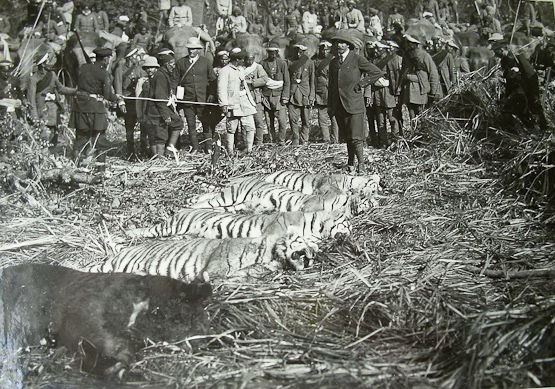
Summary of the Book

This book has argued that patterns of ethnic violence in India stem from legacies of colonial rule that were reinforced over time through institutions. India is well known as having been the “jewel in the crown” of the British Empire; less well known is that the British never controlled the entire country. Most of the areas that were already British colonies prior to the conquest of India had been brought under direct rule, but the Rebellion of 1857 prevented the subcontinent from being entirely annexed. Afterward, roughly one-fourth of the Indian population lived in princely states ruled by largely autonomous native kings. This key historical divide forms the colonial origins of ethnic violence in contemporary India. Both the British administrators and the princely rulers governed heterogeneous populations, but they had very different conceptions of how to manage this ethnic diversity. In the provinces, British administrators emphasized the centrality of caste. Colonial officials chose this particular identity after the Rebellion of 1857, which they perceived as a religious(primarily Islamic) uprising, because they were intent on de-emphasizing religion. Caste (along with tribal identities) was promoted as the central organizing principle for a new, modern society. During the latter half of the nineteenth century, the caste system was divorced from its Hindu origins and became largely a system of social categories. It was subsequently viewed as scientific in character, bearing resemblance (depending on the administrator) either to race or to the class structure of Victorian England.

Continue reading The origin and variation of ethnic violence in South Asia

Is Pakistan primitive?

By new Precedent, ceasefires are lifted by default, and maintained only where a commenter requests one on Online Safety grounds, as K has (BB – RNJ – 0M).

We argued in “The Patriarchy Survives Everything” that has no religion.

Over the last month, in order not to be Islamophobic, a line was surreptiously moved. The proposition that women should be confined to the home and kept out of higher education stopped being an outrage to be dismantled in public and became a “perspective” to be weighed.

Silence on the right of a woman to leave her own house, and called the silence respect. A space loud for one liberty and mute on another has not been even-handed; it has been captured. That is the moment the emperor lost his clothes and the courtiers agreed not to mention it.

How a country starts eating halal

RNJ consistently brings up Nassim Taleb’s seminal piece on “The Most Intolerant Wins: The Dictatorship of the Small Minority.” Continue reading Is Pakistan primitive?

Indus Water Treaty: What lies in the future?

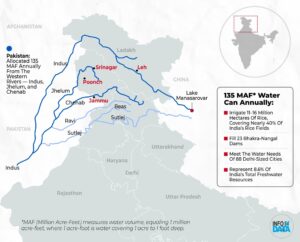
Indus Waters Treaty was signed in 19 Sept 1960 between India and Pakistan under mediation provided by the World Bank. As a political compromise between Pakistan and India seemed improbable the US and UK decided to pressure both into signing onto a technical treaty which could outline the claims and limits of both nations on the flow of the water. Over the years it was touted at the most successful and unequal water sharing agreement where the upper riparian nation only made claim to a minor portion of the river’s waters.

The Indus basin was categorized into two groups of rivers. With the Eastern Rivers (Beas, Ravi, and Sutlej) being controlled by India and the Western Rivers (Indus, Chenab and Jhelum) being controlled by Pakistan.

Many still blame Nehru for this treaty in India for only allowing India to control less than 20% of the Indus’ waters, while many in Pakistan still decry the unequal nature of the treaty in directly awarding a set of rivers to India as that may eventually cause droughts in the parts of Pakistan which are mainly fed by the Eastern rivers. However, the main calls for renegotiations of the treaty have originated in India which at this point has put it into ‘abeyance’. In this post we will go through the main areas of dispute in the treaty and what the possible solutions for the current impasse may be.

Continue reading Indus Water Treaty: What lies in the future?

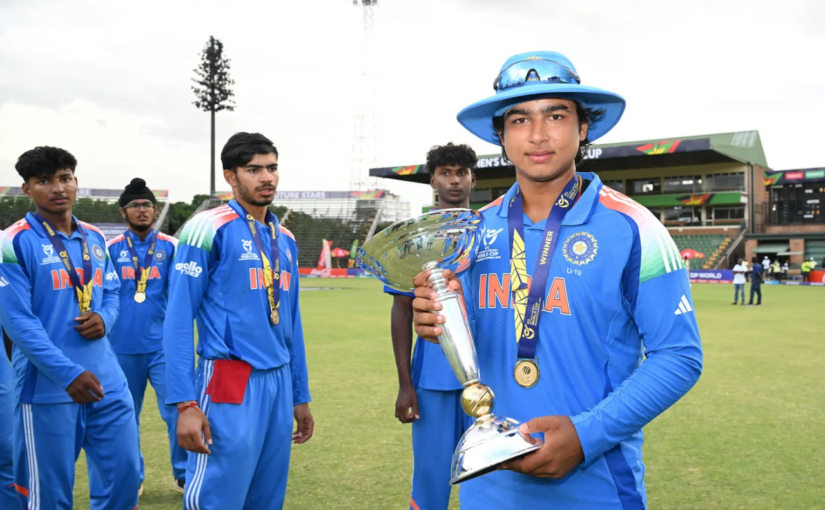
The joy of watching Vaibhav Sooryavanshi

After the twin pleasures of the Indian cricket team’s campaign in the T20 World Cup in February and early March and Dhurandhar: the Revenge in late March, the thing that has given me a lot of joy throughout the months of April and May is watching Vaibhav Sooryavanshi’s batting in the IPL.

As I write this, he has been selected for the Ireland and England tours in late June-July, becoming the youngest Indian to get an international callup ever, surpassing the great Sachin Tendulkar. He also won the IPL MVP award along with the Emerging Player Award (usually people win them years apart, not in the same year) along with a variety of other awards. This follows the U-19 World Cup in February where he was Man of the Match in the final as well as Man of the Tournament.

And it is not just me, but the entire cricketing world which has been set aflutter by his exploits. His extremely fast pace of play (even compared to some of the fastest players in the world) plus his insane shot making and bat swing have made him a fan favourite already.

Continue reading The joy of watching Vaibhav Sooryavanshi

Is Kabir Right?

Kabir’s claim, is that much of the Saffroniate comes to Brown Pundits for one purpose: to litigate Pakistan, and to litigate the Muslim. Take that fixture away and the room goes quiet. The post on Hindustani classical music sinks without a ripple. The translated short story draws three comments and dies. Only the threads that arm the two camps against each other run to hundred+.

Is he right?

Continue reading Is Kabir Right?

The Patriarchy Survives Everything

The day before yesterday, we published a general interest piece on the Philippine birth rate. Within a day it had drawn over a hundred comments and stopped being about the Philippines at all. It became, in turn, a debate on female autonomy, a referendum on Islam, a quarrel about civility, and a meditation on why human beings have stopped reproducing themselves. This is what Brown Pundits does that almost no other space on the internet can do, and it is worth pausing to say why, and to say plainly where we stand.

The diagnosis and the cure

Qureishi proposed, with complete seriousness, that the only solution to collapsing birth rates is to restrict female access to contraception, higher education, employment, and political representation. We disagree with every word of that cure. Restricting half of humanity from education and public life is functional enslavement, whatever euphemism of “policy” it travels under, and we said so in the thread.

The ecumene does not breed any longer

But we will not pretend the diagnosis is wrong merely because the doctor is. Birth rates are plunging everywhere, faster than any demographer predicted, and the $300 billion South Korea spent on subsidies did not move the needle. Q is right that this is not a money problem. He is wrong about what kind of problem it is.

The fashionable answer is that women got free and chose otherwise. Our answer is the opposite: everyone got less free, and women are simply the first to act on it. People are voting with their wombs. They are refusing to manufacture children for a world whose only offer is endless consumption, a working (waged?) life that begins at twenty-five and ends at sixty-five, and a retirement of warehoused loneliness. Marx called the failure to see one’s own condition false consciousness. The modern consumer is the Ye Olde Peasant with better teeth and a credit card, and somewhere the peasant knows it.

On the day of the trillionaire

Continue reading The Patriarchy Survives Everything

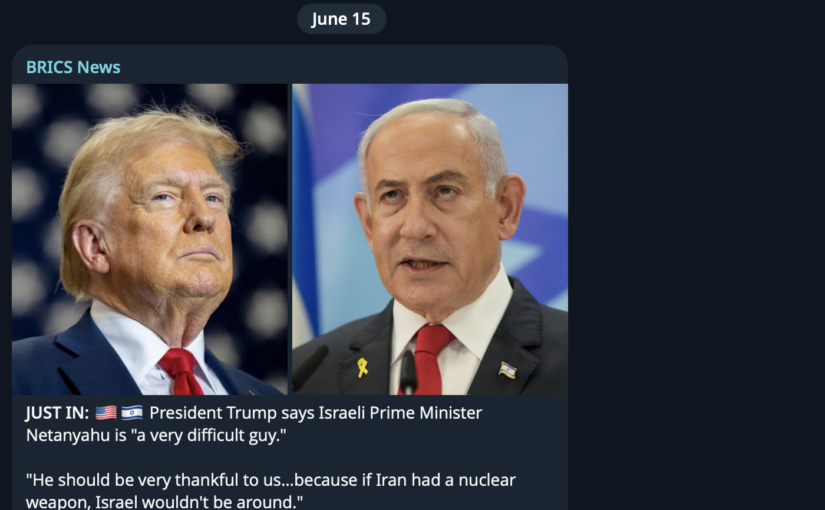
Open Thread: India, Israel, US & Iran

What is going on? We haven’t been following the Middle East for the past month and a half. India-US relations seem to be shakier?

The Philippines Birth Rate Crash

Precedent. Every Brown Pundits post, new ones included, must be at least 70 percent original to BP. Reposts from other sites are allowed, but the reposted portion must not exceed 30 percent of the post.


The Philippines has just recorded one of the fastest fertility declines in modern history, and almost nobody saw it coming.

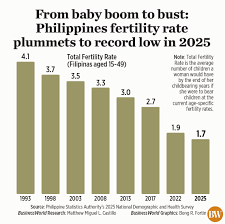
In 1993 the average Filipino woman had 4.1 children. By 1998 it was 3.9, by 2013 around 3.0, and by 2017 it was 2.7. Then it fell off a cliff. The 2025 National Demographic and Health Survey put the figure at 1.7, well below the 2.1 a population needs to replace itself. That is a 37 percent drop in about eight years, the steepest the country has ever recorded. In the early 1950s, Filipino women were having more than seven children each.

At 1.7 the Philippines is not yet as low as East Asia. It still sits above Japan at 1.2 and well above South Korea at 0.8. What unsettles demographers is not the level but the speed, and the direction, which is the same one every developed Asian society has already taken.

Why nobody expected it

Continue reading The Philippines Birth Rate Crash

Architecture of belonging

There is a lot of debate taking place in the digital space regarding the safety of women in public spaces. Here, I am sharing an old opinion piece published in The News International on this issue.


Walk through any major city in Pakistan, and you’ll find that urban spaces speak a masculine language – the result of a parochial, patriarchal project sustained over centuries.

From dimly lit streets and poorly maintained sidewalks to male-dominated public transport and unwelcoming parks, our cities have long been built for and around men. This isn’t by accident; it’s the result of decades of planning that excluded the voices and needs of women, girls and gender-diverse individuals.

Unfortunately, Pakistan’s urban centres (Karachi, Lahore, Islamabad, Peshawar, and Quetta, etc) have ample room for improvement. Despite women making up nearly half the population, their visibility in public and economic life remains limited.

Continue reading Architecture of belonging

Brown Pundits