The India of my dreams is yet to be seen: Dil Se with Kapil Sibal

Dil Se with Kapil Sibal, hosted by Kapil Sibal, presents its landmark 100th episode, reflecting on India’s economic journey and the challenges ahead. In this special edition, Kapil Sibal engages in a deep, insightful conversation with two distinguished guests — Shri Yashwant Sinha, former Finance and External Affairs Minister, and Shri P. Chidambaram, former Finance and Home Minister. Together, they discuss India’s economic direction, the credibility of government data, the global power–economy relationship, and the urgent reforms needed for India to truly become a Viksit Bharat. 


Multi Racial Multi Cultural Family in Ceylon

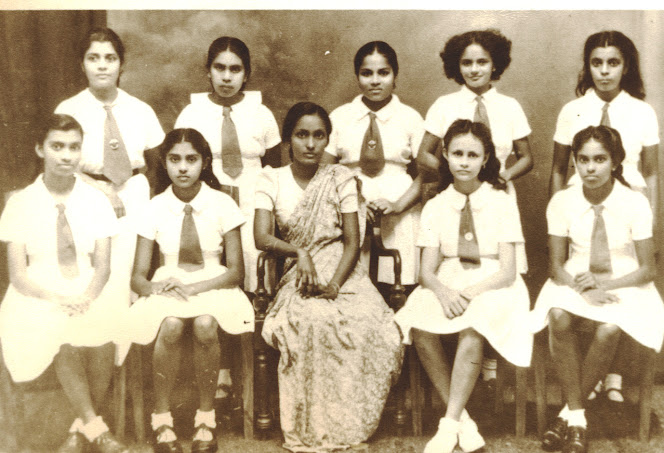
Banner Image: Photo from around 1940.
Standing far left: My mother Peace born 1926 (same age as Queen Elizabeth II) Standing one but Last with Afro, Estelle. Father a Judge from Barbados via England (African Heritage). Mother Eurasian
Seated. In Saree Miss Gnana (History Teacher, Tamil), Next to her: Miss White, Eurasian


This is about the maternal side of the family. My grandparents were one of the first inter racial marriage in the Deep South. It is also about how a children of an inter racial marriage do not belong and forge an independence of thinking (my mother and myself as examples). Even more so growing up in a cosmopolitan segment of Sri Lankan society

Let us start from the beginning. My Grandmothers mother was an Irish Nanny. Hearsay and rumor confirmed by my DNA tests. The Irish Nanny had my grandmother with my GreatGrandFather and left Ceylon. My GreatGrandfather did not have children so my grandmother was adopted by her father. Inherited all the wealth which was considerable. GreatGrandFathers family (Tillekeratnes) had been Administrators under Dutch and British times and were Sinhalese in the Deep South. Possibly were Anglicans during British times.
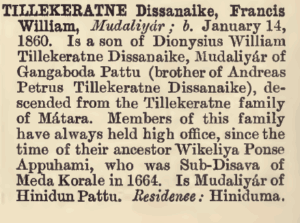

Tillekeratne Family of Matara.
From Golden Book of India and Ceylon (1900) Roper Lethbridge

My Grandmother married a Jaffna Tamil (from the North), a surveyor posted to Galle in the Deep South. My grandmother built a house in Galle so that it was convenient for work. Her ancestral home was even more deeper in the South in Matara.

Galle Town proper was very small, probably about 25,000 pre WW2. Still small about 150,000 now (2025), However, Galle was very Cosmopolitan because of the Harbor. It was the Main Harbor till the Colombo breakwater was built. My mother (and her sisters) attended a Catholic Convent, which was cosmopolitan. (a school photo and some names attached).

My mother and I dont really identify with any community in Sr Lanka. However, very Sri Lankan Nationalist. My mother never spoke about her opinions. Many in Galle thought they were Eurasians but they were not part of the Eurasian (Burgher) community. Burghers were a Fun crowd, parties dancing and Drinking (including women). (I would have liked to be part of that community) My mothers family were quite austere, their idea of nice time was probably singing hymns and big meal afterward. A lot of imported stuff from what I recall as a 6 year old. Edam Cheese, hams, sausage, puddings and homemade ice cream in churn. We inherited the ice cream churn after my grandfather died. Eventually rusted and was no longer usable.

Dual Six-Quart Ice Cream Maker
Old fashioned Ice Cream Churn.

Because we dont really “belong” to any community we dont have a need to behave as society demands. Mother would dress like a street sweeper, without footwear even to extent of going to nearby shops. On the flip side she would go to Colombo to get her dresses made. Wore platform shoes, high heels, pastel light shade dresses and sarees. (There were some in her wardrobe when we were children).
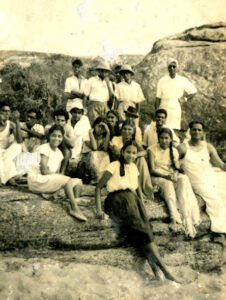

Mother in White Dress (left in image) on a Trip to Yala National when she was a teacher.  Probably around 1952
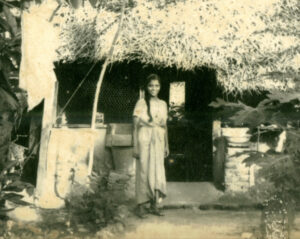

Mother in Batticola just after marriage. Parents lived there for 5 years.  I was conceived in Batticola just before they left.  Born in my grandmothers house in Galle. 

Another big issue was she traveled alone, without chaperones since an older teenager. I think she just couldn’t deal with the slow pace of Sri Lankans. One gets the impression that she was some kind dress up person. Anything but, workaholic like her father and mother. Mothers father died at 84 getting ready to go to work surveying. Most Stories told by Katrina Hamy who was about my mothers age. I think mother liked her more than her sisters, some of whom were big time gossips. Apparently even as a young teenager would come home and help in cleaning, toilets, drains washing up. Hated cooking but was a reluctant good cook when we were children. We did not have “help” as my mother didnt approve of “help”

Anecdote told by Katrna Hamy
Mother was the youngest in the family. Somewhere in her teens she took it upon herself to supervise some coconut properties that belonged to my Grandmother. She would get up at 4:00am and take the first train (5am night Mail). She was supposed to go with a chaperone. Mother does not wait for anyone. Once she is ready she leaves. The walk to the train station (about a mile) is dark and lonely. As she was walking there was a man following her. Mother probably heard the footsteps and turned and walked back to the man and he just ran. Probably thought my mother was Mohini a female demon who dresses in white.
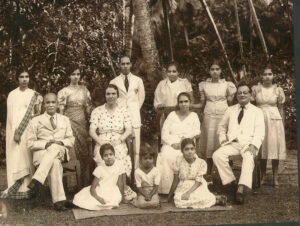

Mother family
Seated:  Sanford BeeBee (Jaffna Tamil), 2nd from Right Lilian Edith Tillekeratne (Half Sinhalese, Half Irish. note: No Jewellery). The two westerners are Mr and Mrs Graves. Missionaries
Seated on Ground. Peace BeeBee (my mother), next to her Katrina Hamy
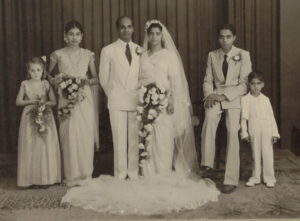

Parents Wedding Photo Galle, 1953
LR: Ms Anthin (Swedish Missionaries daughter), Sunethra neighbor and family friend, Sinhalese, AC Barr-Kumarakulasinghe (Jaffna Tamil), Peace Beebee (mother), Wilson Allegacone (fathers nephew, Tamil), Lal Liyanage (mothers nephew, Sinhalese)
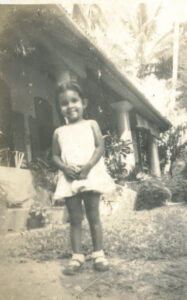

Grandmothers House in Galle


*For those who think this is boast. End of the line for my male Paternal line (about two males who carry the surname in Malaysia). The same for my grandmothers fathers line. The last in the male line was a classmate. As the Buddha says everything is Impermanent

Why we must talk about caste

Every few months (years?), Brown Pundits goes through its own small earthquake. A post lands wrong, a comment thread ignites, and the whole Commentariat erupts.

The latest rupture began with a mild jibe on caste. I pointed out, in passing, that caste shapes political instincts far more than many admit. The backlash was instant. A section of the readers declared a quiet boycott. The threads went cold. No one wanted to break ranks. The more one claims to have transcended caste, the clearer its caste blind-spots become. Silence itself becomes a shibboleth.

And when the silence hit, the blog froze. Continue reading Why we must talk about caste

Love Jihad Zohran

Congrats to Furan who was mentioned in this Five lessons for India’s Opposition from Zohran Mamdani’s triumph.

Born a Shia Muslim, he spoke to the Indian Eye of being raised in an interfaith family. “My mother’s side of the family is Hindu” he said, “and I grew up celebrating Diwali, Holi and Raksha Bandhan. Though I identify as Muslim, these Hindu traditions and practices have shaped my worldview
” His mother named him Zohran, which means the first star in the sky.

Zohran does seem to be a product of Love Jihad.


Pak Journalist Blames Munir for India and Pak Blasts

Fascinating take by Taha Siddiqui.

Taha is in exile.

He says Red Fort and the bombing in Pakistan both done by Munir.  Is it sour grapes or does he have evidence that points to Munir?


“

Taha Siddiqui, a Pakistani journalist living in exile in Paris, is a strong critic of Pakistan’s military. He has claimed on X that the suicide bombers involved in the Delhi and Islamabad blasts were ‘assets’ of the Pakistan Army. Pakistani journalist Taha Siddiqui has linked the recent blasts in Delhi and Islamabad to suicide bombers he termed as ‘assets’ of the Pakistan Army. His claim has drawn wide reactions online. The blast near Red Fort in India on November 10 claimed at least 13 lives while 12 people were killed in the Islamabad explosion, the next day, on November 11.”


https://newsable.asianetnews.com/amp/world/pakistani-journalist-taha-siddiqui-pak-army-assets-claims-delhi-islamabad-blasts-articleshow-r0sg3mc


Karan Thapar’s Interview with Ajai Sahni about Red Fort Bombing

A very insightful interview. I obviously don’t agree with some of Ajai Sahni’s analysis of Pakistan. His fears about an Islamist takeover of Bangladesh also seem overblown.

However, he does make the important point that the Indian government is reluctant to blame Pakistan for the Red Fort attack because that would box them into resuming “Operation Sindoor”.  “Operation Sindoor” obviously didn’t go well for them the first time (contrary to the bluster of right-wing Indians on BP). Sahni notes that the only  countries that accepted India’s narrative without reservation were Israel and the Taliban.  Pakistan, meanwhile, is currently friends with both the US and China.

Karan Thapar asked him about the suicide attack in Islamabad on Tuesday and his reaction to the Pakistani government blaming India. Sahni replied that the default in India is to blame Pakistan while the default in Pakistan is to blame India.  Neither side’s domestic audience requires evidence.  However, in this case, the Indian government doesn’t want to blame Pakistan because that would require them to declare war on Pakistan (as per their own “new normal” from May) and such a declaration would have consequences.


“Killing the Constitution”

Note: Indians on BP have repeatedly called DAWN Pakistani government propaganda. This is completely incorrect. DAWN is one of the most progressive newspapers in Pakistan.  For example, in recent days, the newspaper has been taking a very strong line against the proposed 27th constitutional amendment (already passed by the senate and likely to be passed by the National Assembly in the next few days). 

Zahid Hussain in DAWN:

While the 26th Amendment had shaken the very foundation of the trichotomy of power, the 27th has virtually murdered the Constitution. The last rites were being performed in haste under the watch of ‘Big Brother’. It is perhaps, the darkest moment in our unenviable constitutional history.

It has been more of a puppet show — one after another, the lawmakers rose to defend the amendments that they are likely not to have been consulted on. Other members just shouted ‘aye’ when the vote was called perhaps without even reading the draft of the law provided to them at the session. They just had to follow the party line.

And:

There is indeed no denial about the PPP’s struggle for democracy in the past. But the current leadership has betrayed that legacy. Bilawal Bhutto-Zardari has justified the changes in the Constitution particularly the establishment of a separate constitutional court saying it was a part of the Charter of Democracy signed by the PPP and PML-N in 2006. But his argument about the court is completely out of context. Moreover, there is much more in the charter related to the establishment of civilian supremacy and the Constitution. The 27th amendment totally negates the charter and will lead to authoritarianism. History will judge the current leadership in a completely different way from the past leadership.

A big question is whether the Supreme Court will now act to protect the Constitution and whatever little autonomy the judiciary has been left with after it accepted the 26th Amendment. Sadly, the amendment has also weakened the unity of the federation.


Red Fort Attack and Aftermath: Initial Thoughts by Manav S.


Red Fort Attack and Aftermath: Initial Thoughts by Manav S.

Last evening’s devastating car-explosion near the Red Fort in Delhi is not only a cruel assault on innocent lives but an assault on the very symbolism of our nation. According to early reports, a vehicle detonated close to the busy metro zone at the historic Red Fort complex, killing at least eight people and injuring more than twenty. ïżŒ The government has invoked anti-terror legislation and launched a full probe under the Unlawful Activities (Prevention) Act (UAPA). ïżŒ

First, we must recognise the human tragedy behind the headlines. Lives shattered, families devastated, fear spreading in a city already grappling with chronic insecurity. For those of us of South Asian heritage who carry memories of communal strife, of migration and displacement, this attack touches a deeper chord of vulnerability and of collective memory. Hospitals have reported frantic cries, missing persons, relatives screaming for loved ones. ïżŒ

Second, the choice of location amplifies the message. The Red Fort is not just another landmark: it is an emblem of India’s sovereignty, its layered history, its identity. To strike here is to strike at the heart of public confidence and to send a message of audacious defiance. As scholars writing on “brown diasporic publics” know, our public spaces carry meaning not just for those inside India, but for those of us abroad who anchor our identity in ‘homeland’ narratives. This attack disrupts that anchor.

Third, we must resist both fear and simplistic narratives. The invocation of terror laws suggests the state is treating this as a planned act of violence, not an accident. ïżŒ But let us guard against quick binaries: Us vs Them, Hindus vs Muslims, India vs Outsiders. In a plural society like ours, sweeping communal attributions too often deepen fault-lines rather than heal them. Our commentary must demand both justice and wisdom: meticulous investigation, transparent process, and safeguarding civil rights in the process.

Fourth, what does this mean for our shared public culture? For someone born in Punjab and now living across borders, the explosion challenges our sense of movement, of belonging, of normalcy. We think of carrying family across continents, of re-configuring identity in Washington–DC and Delhi , how do such apparently random acts of terror recalibrate the psychic cost of migration and the distance between home and homeland? The answer is: they make the cost higher, the emotional freight heavier.

Finally, the path forward must hold three imperatives: one, empathy – for all victims, irrespective of religion, class or residence; two, accountability – for whoever plotted, financed or enabled this attack; and three, renewal – of the public realm, the shouting panic, the fear-laden sighs, with something stronger: resilient civic culture, public institutions we trust, cross-community solidarity.

As a brown pundit, I urge our readership to see beyond the flashes of violence, beyond the political spin, and to ask the deeper questions: What kind of society are we building? What kind of public spaces do we imagine, and what cost are we willing to pay for them? For if we shrug now, the symbolic scar will grow — far after the immediate blast damage is repaired.

In that moment of stillness after the blast, we owe to our fellow citizens not just sorrow, but vigilant hope.

Brown Pundits