
What’s in a name? That which we call a Swastika, isn’t exactly a symbol of hate

Disclaimer: As this post deals with an academic discussion on the Swastika symbol, I have included various images containing Swastika below. If you are repulsed by the symbol or do not like to look at it, please consider yourself warned. Also, for the same reason, this post is NSFW.

Growing up in India, I had developed this habit of drawing symbols of auspiciousness and good luck on my exam answer sheets. I have no recollection of who taught me to do that or when I started doing it but I can clearly remember even during my bachelor studies, I would collect the answer sheet from the invigilator and immediately proceed to draw an ‘à„’ (Om), a ‘à€¶à„à€°à„€’ (Shree) and a ‘捐’ (Swastika, albeit with 4 dots in the middle as one would draw in India) at the top of the first sheet of the answer paper. This rather innocent practice wasn’t unique to me. Apparently many other students used to do this until the universities started cracking down on this ‘malpractice’ for ‘displaying symbols of faith on answer sheets’ and ’emotionally appealing to the evaluators’. In a religiously polarized India of the 2010’s, I don’t expect any less ham-handed response from our University VCs. But, personally, what prompted me to stop this practice was my move to Germany for my master’s.

In the first few weeks of the semester, all international students took part in an orientation program at the university. One of the most shocking things I learnt  that day was that any public display of Swastika was BANNED in Germany. I was not ignorant of Germany’s sordid past. Watching ‘Schindler’s list’ beamed onto the wall of a dark classroom with my fellow drama club members in high school is one of the most vivid memories I have. I was just 15 then and the movie shocked me to my core. It was one of those instances of loss of innocence in my life when cruelty, inhumanity, Germany, Hitler, Jews and hate took on a whole other meaning in my psyche. In spite of that, discovering Swastika, an omnipresent sign in India that I had grown up seeing everywhere and that which is considered good and auspicious by everyone around me, could be a banned symbol of hate in the country I had just moved to, was another instance of loss of innocence.

Just like me, many Indians who have moved to the west have discovered this in their own way. The subreddit r/AITA (no connection with raitas 😛 ) has quite a few posts from hindus who have been mistaken for a white-supremacist (Oh! The irony!) for displaying Swastikas as a pendant gifted by grandmother, in the form of a rangoli/kolam in their frontyard, a tattoo on the arm they got while in India, having portraits of hindu gods at home, etc. All these instances happened in the US. From my personal experience, I have found the germans to have better awareness about Swastika; it’s use as the Nazi party symbol, a hate symbol of neo-Nazis and also as the auspicious symbol for many asian religions and cultures. This is because of two reasons:

1. The curriculum at schools explore all aspects of Germany’s sordid past with a level of frankness that I can only describe as ‘very German’. The curriculum makes the differentiation between the two symbols very clear as you can see from this children’s website that takes them on a german historical journey of the last 100 years.

2. The germans use two different words for this symbol. The symbol of hate used by Hitler and the neo-Nazis is called ‘Hakenkreuz’ while the auspicious symbol of the orient is called ‘Swastika’. Just the existence of two different words makes it easy to differentiate the meaning of the two symbols.

Funnily enough, even though I lived in Germany for 5+ years, I was not aware of the existence of ‘Hakenkreuz’. I only came to know about it in the past year or so through twitter! It was probably through a thread by True Indology (lost when his account was suspended) that I became aware of the german word ‘Hakenkreuz’ that when translated to english means hooked cross and not Swastika. The problem lies with the current mistranslation of Hakenkreuz in English.
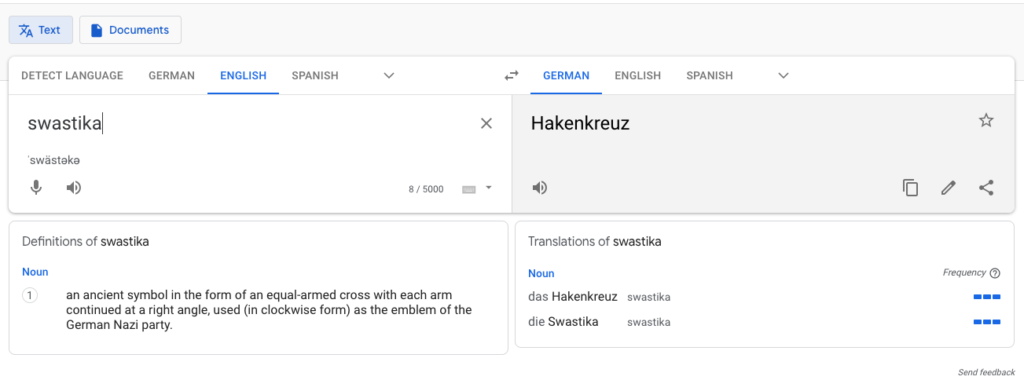
Google translate translates Swastika as Hekenkreuz in German. Notice the possible translations of the word – das Hakenkreuz and die Swastika. Also notice the definition of Swastika in english. It only defines the Hakenkreuz, the symbol used by Hitler.

Instead of translating into hooked cross, it is translated as Swastika, which is clearly wrong. So, why IS it mistranslated to Swastika? Who first translated Hakenkreuz to English as Swastika and how did that translation stick? More importantly, did Hitler adopt the eastern symbol Swastika as the anti-semitic symbol of his political party or did the inspiration come from elsewhere? These were some of the questions that recently led me to write a thread on twitter (you could also read it on the thread reader app here). I will summarize my findings below.

Colonialism and imperialism in the 18th and 19th century CE brought about a great deal of interest in the eastern cultures by the west which gave rise  to the field of oriental studies and orientalism. All things east were considered exotic and the ‘popular’ phenomenon of cultural appropriation led to the adoption of various eastern symbols in the west. One among those was the Swastika. It shot up in popularity among the western academicians in the 1880’s and pretty soon entered the pop culture scene as a symbol of good luck, akin to today’s good luck charms like Maneki-neko (Japanese beckoning cat), Chinese fortune cookies or the Irish shamrock.

A report by Thomas Wilson titled ‘THE SWASTIKA, The earliest known symbol, and its migrations; with observations on the migration of certain industries in prehistoric times” for the US National museums in 1894 wonderfully compiled the then existing knowledge of Swastika. It is meticulous and very clearly written with almost no bias from Mr. Wilson. This also happens to be the first recorded instance where an English speaker tried to compile all the crooked cross like symbols and used the umbrella term of Swastika in English. Until then, the word Swastika did not exist in any english dictionary or encyclopedia. He writes in the preface:

An English gentleman, versed in prehistoric archéology, visited me in the summer of 1894, and during our conversation asked if we had the Swastika in America. I answered, “Yes,” and showed him two or three specimens of it. He demanded if we had any literature on the subject. I cited him De Mortillet, De Morgan, and Zmigrodzki, and he said, “No, I mean English or American.” I began a search which proved almost futile, as even the word Swastika did not appear in such works as Worcester’s or Webster’s dictionaries, the Encyclopédic Dictionary, the Encyclopédia Britannica, Johnson’s Universal Cyclopédia, the People’s Cyclopédia, nor Smith’s Dictionary of Greek and Roman Antiquities, his Greek and Roman Biography and Mythology, or his Classical Dictionary. I also searched, with the same results, Mollett’s Dictionary of Art and Archéology, Fairholt’s Dictionary of Terms in Art, “L’Art Gothique,” by Gonza, Perrot and Chipiez’s extensive histories of Art in Egypt, in Chaldea and Assyria, and in Phenicia; also “The Cross, Ancient and Modern,” by W. W. Blake, “The History of the Cross,” by John Ashton; and a reprint of a Dutch work by Wildener. In the American Encyclopédia the description is erroneous, while all the Century Dictionary says is, “Same as fylfot,” and “Compare Crux Ansata and Gammadion.” I thereupon concluded that this would be a good subject for presentation to the Smithsonian Institution for “diffusion of knowledge among men.”

In this report, Wilson examined different forms of crosses that had been found all around the world and concluded that Swastika is the most ancient one of them all.
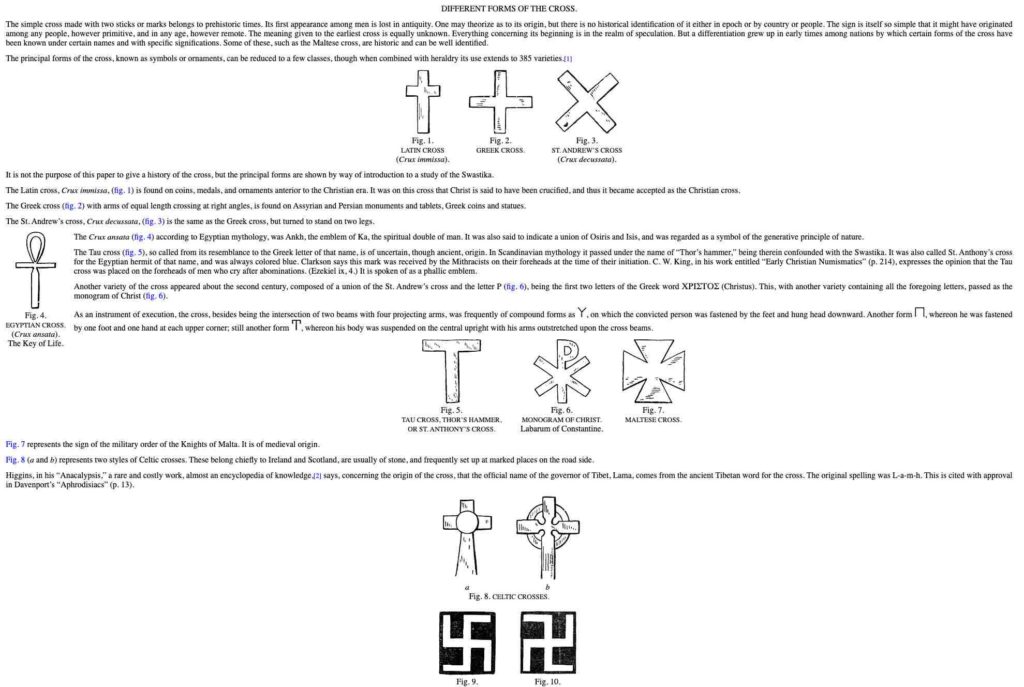
Different cross-like symbols examined by Thomas Wilson in THE SWASTIKA

He complied various definitions of Swastika as recorded by different researchers and it was commonly understood to mean ‘good being’ or ‘good fortune’ in Sanskrit. The symbology was interpreted by different academicians differently. Although mostly everyone agreed that it is an auspicious symbol for the hindus and buddhists, there was no consensus on how to interpret the symbology. He writes,

Many theories have been presented concerning the symbolism of the Swastika, its relation to ancient deities and its representation of certain qualities. In the estimation of certain writers it has been respectively the emblem of Zeus, of Baal, of the sun, of the sun-god, of the sun-chariot of Agni the fire-god, of Indra the rain-god, of the sky, the sky-god, and finally the deity of all deities, the great God, the Maker and Ruler of the Universe. It has also been held to symbolize light or the god of light, of the forked lightning, and of water. It is believed by some to have been the oldest Aryan symbol. In the estimation of others it represents Brahma, Vishnu, and Siva, Creator, Preserver, Destroyer. It appears in the footprints of Buddha, engraved upon the solid rock on the mountains of India. It stood for the Jupiter Tonans and Pluvius of the Latins, and the Thor of the Scandinavians. In the latter case it has been considered—erroneously, however—a variety of the Thor hammer. In the opinion of at least one author it had an intimate relation to the Lotus sign of Egypt and Persia. Some authors have attributed a phallic meaning to it. Others have recognized it as representing the generative principle of mankind, making it the symbol of the female. Its appearance on the person of certain goddesses, Artemis, Hera, Demeter, Astarte, and the Chaldean Nana, the leaden goddess from Hissarlik, has caused it to be claimed as a sign of fecundity.

Until then, Swastika, as a symbol was known by different names in different languages because the symbol existed almost everywhere in the world, in Asia, Europe, northern Africa and the Americas. Also in Great Britain. So, what did the English call the symbol? Fylfot. Wilson writes,

In Great Britain the common name given to the Swastika, from Anglo-Saxon times by those who apparently had no knowledge whence it came, or that it came from any other than their own country, was Fylfot, said to have been derived from the Anglo-Saxon fower fot, meaning four-footed, or many-footed.

So, there existed a word for the 捐(crooked cross) symbol in english but only for the 捐 found in and around great britain. Instead of using this word for all crooked crosses in English, Mr. Wilson instead chose to use the word Swastika since he found it to be the most ancient of them all. This was a ham-fisted move because the Indic name swastika corresponded to the 捐 that symbolized auspiciousness which the other crooked crosses did not. Even Wilson admits that by quoting a letter by the famous Indologist Prof. Max MĂŒller,

I do not like the use of the word svastika outside of India. It is a word of Indian origin and has its history and definite meaning in India. * * * The occurrence of such crosses in different parts of the world may or may not point to a common origin, but if they are once called Svastika the vulgus profanum will at once jump to the conclusion that they all come from India, and it will take some time to weed out such prejudice.

So, in 1894, the word Swastika was proposed by Mr. Wilson to denote all crooked crosses in english language and we see that the practice stuck since the use of the word in english language increased since then. So, is this when the German word ‘Hakenkreuz’ started being called as Swastika? Interestingly, no! In fact, the report mentions finding variants of swastika in Germany but mentions no name in German. ‘Hakenkreuz’ was barely used until then and was relegated to 19th century vocabulary books like the Bailey-FahrenkrĂŒger’s Wörterbuch der englischen Sprache and the Deutsches Wörterbuch von Jacob Grimm und Wilhelm Grimm (yes, they are the Brothers Grimm of Grimm’s fairy tales). So, to answer one of the questions posed above, ‘Hakenkreuz’ wasn’t actually translated into English. By the time germans started using Hakenkreuz as the word for the infamous anti-semitic symbol, the English speaking world had already picked up on the word Swastika and called any crooked cross symbol as such.

So, when and why did the Nazis adopt the Hakenkreuz as their anti-semitic symbol? The reason goes all the way back to Troy, the location of the fabled trojan war (it’s an interesting story, you can read a detailed article here). When a german businessman and amateur archeologist Heinrich Schliemann found the remains of the mythical city of Troy in modern day Turkey in 1871, along with the ruins, he found the 捐 symbol on everything – pieces of pottery, ruins of buildings, marble carvings, etc. Being an amateur archaeologist he did not understand the significance of his find. So, he consulted his orientalist friends – Max Mueller(yes, the same guy who didn’t want to call ‘Swastika’ found outside India as Swastika) and Émile-Louis Burnouf, a leading expert of Sanskrit. Fun fact: Bernouf was also an anti-semite and a propounder of Aryan master race.

Burnouf made a bunch of dubious claims (debunked by Wilson in his monumental report on Swastika) which was covered in Schliemann’s book ‘Troy and its remains‘ and concluded that Suastika (that was the spelling he went with) is an essential symbol of the Aryan race. The popularization of this flawed idea led to its appropriation as the symbol by the German ‘Völkisch‘ national movement gaining steam at the juncture of 19th and 20th century. It was a nationalistic movement which propounded that Germans belong to the Aryan ‘master race’ and hence need to dominate the world. Poetically, the year Burnouf breathed his last, 1907, was also the year when the Swastika was first used as a symbol of Aryan dominance by a secret society called ‘Order of the New Templars’ (Ordo Novi Templi, or ONT) in Austria by Lanz von Liebenfels, an Austrian racialist. So, in early 20th century, as most of the west started embracing Swastika as a ‘cool’ motif, it was also being appropriated secretly by an anti-semitic and racist underground movement becoming a symbol of racial supremacy for various organizations until it was mainstreamed by Hitler in the Nazi flag in 1920.
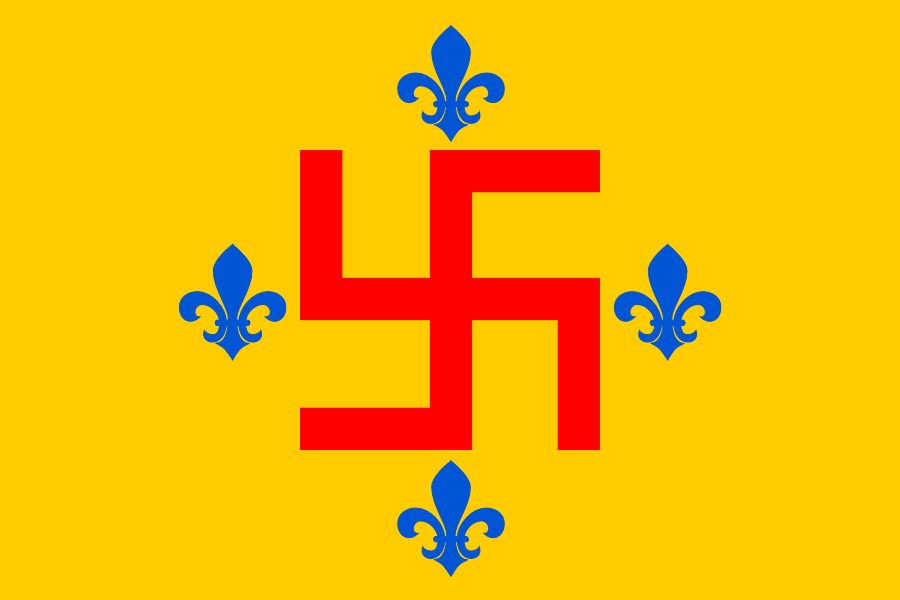
Flag of the ‘Order of the new Templars’. This was the first instance of Swastika used as a symbol of Aryan dominance in 1907.


What inspired Hitler to choose this symbol for his political party? Was it just the connection to Aryan race or did the inspiration come from elsewhere? The anti-semitism displayed by the Nazis did not arise from a vacuum. Anti-semitism or anti-Judaism has existed in Europe since pre-Christian times but morphed into ‘religious anti-semitism’ due to the early christian belief that jews were collectively responsible for the death of Jesus Christ. This sentiment and the associated conflict intensified after Christianity spread as a state religion in Europe. However, the pseudo-scientific racial theories that became widespread in 19th century Europe threw up an additional strain of ‘racial anti-semitism’ where the basis of discrimination and persecution was the ‘scientific evidence’ that jews belongs to a separate lower ‘non-Aryan’ race. The combination of these two strains of anti-semitism, one historic and one modern, manifested politically in the form of Hitler’s Nazi party.
Professor William Brustein’s book, Roots of hate delves deep into pre-Holocaust anti-semitism in Europe

Adolf Hitler was a complicated man to understand. Forests have been felled to publish books speculating his inspirations and motives. Most scholars however agree that although Hitler distanced himself away from Christianity in his later years, he leaned heavily towards christianity in his early years. His catholic upbringing, his admiration for
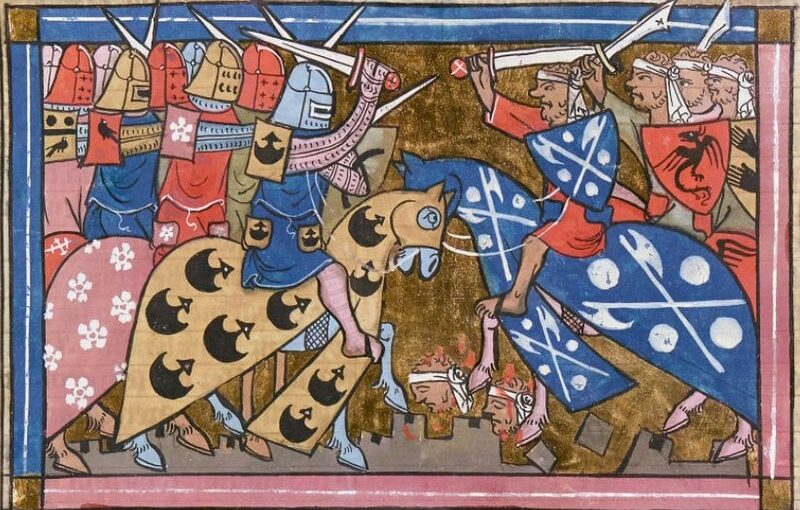

Roman Palestine and the Crusades

I am quite familiar with History of England and Europe since even before my teens. That was because my father had beautifully illustrated school History text books from England. Plus many historical novels eg Walter Scotts The Talisman which is set in Palestine during the Crusades. I read them all many times over as nothing better to do as no TV then in SL till 1977.

Let us start with the historical Jewish Diaspora. Historical as verified from sources other than the Bible. The Romans controlled the middle east around 1 BC. (Think Julius Caesar and Cleopatra an Egyptian Queen of Greek Origin)

To quote
Asia Minor after the Macedonian Wars (214–148 B.C.). In 63 B.C. The defeat of the Carthaginians gave Rome almost complete control of the Mediterranean. Romans conquered most of Asia Minor in 188 B.C., Syria and Palestine in 64 and 63 B.C.

In 70 C.E. (a few years after the purported passing of Jesus Christ the Romans Destroyed the Judaism Temple in Jerusalem. Apparently this ended the ability to make animal sacrifices to God (Yahweh). Plus the Roman persecution of the Jews and Judaism led to their disperal from Palestine, i.e. the Diaspora

Note: There is no evidence of a Kingdom or Country called Israel in any of the Historical or Pre-historical records of the Babylonians and Assyrians. There was region called Palestine (PalaistinĂȘ, ΠαλαÎčÏƒÏ„áż‘ÌÎœÎ·) since at least since the Greek times. The word Israel became considered “Fact” when Europe became Christian and the Bible an accepted source of fact given by the Divine. The Jews became notable and rich because they were money lenders. Christians (and Muslims) are forbidden to lend money on interest (usury). Think Merchant of Venice and Shylock the Jew

Continue reading Roman Palestine and the Crusades

Sacred Texts and Jewish-Muslim Relations

From Dr Hamid Hussain

This is part of a series of my work on Jewish-Muslim relations encompassing a wide canvas of similarities in scripture, rituals, Arabic & Hebrew language, mysticism, literature, coexistence in historical context and conflict in recent times. It has been a fascinating journey tracing the sibling rivalry of Isac and Ishmael.

Hamid

Jewish Muslim Relations – Sacred Texts – The Torah and the Quran

“Lighthouses don’t go running all over an island looking for boats to save; they just stand there shining.”

                                               Anne Lamott

The Tanakh (Hebrew Bible) and the Quran are two sacred texts considered revelation from God by Judaism and Islam respectively.  Both sacred texts are considered foundational stones of faith.  Tanakh is acronym for Torah (five books of Moses called Khumash in Hebrew), Navi’im (Prophets) and Ketuvim (Writings). The Torah is called sefer (book) and the Quran um al kitab (mother of books).  Both texts share several commonalities in terms of themes, narratives, and ethical teachings and are at the same time quite different.  One can pick any side depending on what one is trying to convey.  In the inter-faith interactions, participants stress commonalities sometimes exaggerating the similarities or trying to find common ground where none exists. On the other hand, polemics with aim of denouncing the other side can give a long list of differences between two texts. Continue reading Sacred Texts and Jewish-Muslim Relations

National Register of Citizens (NRC) and Citizenship Amendment Act(CAA)

Brown Pundits favorite Kushal Mehra explains the National Register of Citizens (NRC) and Citizenship Amendment Act (CAA).

I don’t understand why the NRC and CAA are controversial among some. Can anyone explain this to me?

American Caste (b)

America has a national crisis in math capacity, competence and merit. American students sharply underperform students in many countries all over the world. Including Vietnam, which is a poorer country than India per capita. We will heavily refer to the 2018 OECD PISA report in below paragraphs, but the below chart graphic is from the 2015 OECD PISA scores report because math scores are reported for more countries in the 2015 report. Perhaps the 2018 report will be revised to add more countries in the future:

In my view  a level 5 PISA score is the minimum requirement for a person to be considered a high school graduate who is literate in math, able to function in the modern global economy, or be qualified to attend college. The PISA report defines a level 5 PISA score or better as a fifteen year old that “can model complex situations mathematically, and can select, compare and evaluate appropriate problem-solving strategies for dealing with them.” How does America perform in the 2018 PISA report?:

  • United States: 8% of students scored at Level 5 or higher in mathematics
  • OECD average: 11%
  • Six Asian countries and economies had the largest shares of students who did so:
    • Beijing, Shanghai, Jiangsu and Zhejiang (China): 44%
    • Singapore: 37%
    • Hong Kong (China): 29%
    • Macao (China): 28%
    • Chinese Taipei: 23%
    • Korea: 21%

Note that these six countries were among the poorest countries in the world in the 1950s, far poorer than poor Americans or poor Europeans or poor Chileans can even imagine. In 1979 China was unbelievably poor. Much of the population of China–perhaps as many as 100 million–had starved to death because of extreme poverty in the 1970s. Poor children around the world are outperforming American children in mathematics despite extremely low education spending per student and very low socio-economic level of their legal guardians, where socio-economic level is defined as:

  • income
  • wealth
  • formal education of parents

Do any American high school student subgroups perform well in Mathematics? Yes, “people of color” or “minority” Americans perform well in Mathematics. America’s “people of color” or “minority” students are orders of magnitude more likely to get an 800 on the mathematics SAT than European Americans. If we assume this is an extreme tail end distribution issue related to European Americans having a lower standard deviation and non standard distribution in mathematics performance relative to “people of color” or “minority” Americans, we can explore the breakdown of Americans who score between 750 and 800 on the Mathematics SAT. Here European Americans perform far better relative to “people of color” or “minority” Americans.  In 2015 16,000 European Americans scored 750 or higher. 33,000 “people of color” and “minority” Americans scored 750 or higher. We further know that 51% of SAT test takers were European Americans and 49% were “people of color” or “minority” Americans.  “People of color” or “minority” Americans are [33,000/16,000]*[51%/49%] or 2.15 times as likely to score 750 or higher on the mathematics SAT compared to European Americans.  If we examine the 107,900 test takers who got SAT math scores of 700 or higher; 59,900 are “people of color” or “minority” Americans, versus 48,000 European Americans. “People of color” or “minority” Americans are [59,900/48,000]*[51%/49%] or 1.30 times as likely to score 700 or higher on the mathematics SAT compared to European Americans. For data junkie geeks like me there is a lot more data on SAT math score distributions here and here. The Greta Anderson article’s comment section in particular has some very intelligent commentators who have studied the American SAT score distribution. This is likely to be the subject of many future blog posts and Brown Pundits Podcasts.

What about this is worrying?:

  1. European Americans in particular are sharply under-performing both very poor children around the world and “people of color” and “minority” Americans in mathematics.
  2. American mathematics SAT scores have fallen between 1972 and 2016. 1972 is the earliest year for which I could find comparable SAT mathematics scores. In 2017, 2018 and 2019 the SAT mathematics exam was completely restructured to make scores no longer comparable to SAT mathematics scores between 1972 and 2016.
  3. 90% or more of current jobs and businesses are likely to be replaced by artificial intelligence (AI), brain electro-therapy (meditation . . . practiced by civilizations around the world for over 5,000 years), brain sound therapy (naad or mantra yoga and their equivalents in Native American, Egyptian, Sumerian, Taoist and other civilizations around the world for over 5,000 years), bio-engineering tissue, genetic editing, and fused AI-brain interface synthesis intelligence. Almost all of these future disciplines are complementary to mathematics.

Future articles and podcasts are planned all six of these future disciplines. If you are curious about fused AI-brain interface synthesis intelligence, please watch my main man Elon Musk:

Some say that the tension and relationship challenges between America’s four big castes–European Americans, European “Latino” Americans, Black Americans and Asian American–are driving low math scores for European Americans “AND” other Americans. One example is where thought leader Mark J Perry explores the possibility that tension between the European American caste and the Asian American caste are lowering American  mathematics performance. Excerpts of his article are reproduced below:

Continue reading American Caste (b)

Post Modernism (d)

Five thousand years ago the greater Egyptian, Sumerian, Eastern (defined as pan Arya plus China) civilizations were very mathematically oriented.  Many caucasians appear to believe that these ancient civilizations were racist. Possibly because of this many caucasians believe that math is racist.


Another possible reason many caucasians appear to believe that math is racist is because they fear it might unfairly advantages “brown” people (Asians, Arabs, Latinos) and “brown” cultures (eastern philosophy including Toaism and Confucianism, native american religion) at the expense of caucasians in the new global artificial intelligence, neuroscience, genetics economy.


Could part of the anger against math come from fear that mathematics, science, technology, seeking the truth through thought, seeking the truth without thought might be haram or blasphemous? (Obviously most Abrahamics do not believe this and this is not a critique of Abrahamism.)


I believe that mathematics is part of art; and that it derives from beyond normal gross thought. From what in Sanskrit is called Buddhi, Vijnayamaya Kosha, Ananda Maya Kosha, Sukshma Sharira, Kaarana Sharira, the subtle heavens.


Perhaps the anger against mathematics is part of a deeper anger against the subtle heavens? If so, one possible way to look at this is that to transcend the subtle heavens (including mathematics) it might be helpful to love them and love our way through them. Or to love and respect the racist (subtle heavens–including mathematics) until we transcend the various subtleties of thought and feeling.

What are everyone’s thoughts?

+++++++++++++++++++++++++++++++++++++++++++++++++++

Post Modernism (c)

Post Modernism (b)

Post Modernism (a)

Intellectual Dark Web (a)

Intellectual Dark Web

Pakistani Psychosis

https://www.youtube.com/watch?v=iEnrcpeIsYY


Our Brown Pundit Zachary Latif will hopefully share his perspectives on Pakistani Psychosis soon. Tarek Fatah gives a good synopsis of Pakistani Psychosis and Islamism in the above video. I am not an expert on Pakistani Pysochosis, and cannot validate many of Tarek Fatah’s perspectives on Pakistan. However, with respect to Islam, many muslims (including prominent religious leaders) privately share many of Tarek’s views, but the vast majority are too afraid to share their views publicly. Tarek Fatah is very knowledgeable about Arabic, Islamic scripture and Islamic law. If you have the time, please watch the entire video.

What is Pakistani psychosis? I am not completely certain and look forward to evolving my views with new information. To oversimplify, it is the combination of several things:

Continue reading Pakistani Psychosis

Why do nonmuslims treat muslims so badly (c)?

Please watch this short excerpt from a conversation between my main man in the house Veedu Vidz and Shaykh Shabbir Ally.

Veedu Vidz is one of Hindustan’s brightest sons, hottest heart throbs, most talented thesbians, funniest comedians, most enlightened leaders, wisest Islamic theologians and Brown Pundit favorites. He now lives in the UK with his beautiful wife and youtube sensation Mimzy Vidz.  Shaykh Shabbir Ally is also one of Hindustan’s greatest lights. He is one of the world’s leading Murdhids or Islamic scholars.

This post is aimed at not so bright nonmuslims who back Islamist extremists against reasonable muslims (such as Shaykh Shabbir Ally) and muslimish leaders (such as Veedu Vidz and the ever elegant Mimzy Vidz). Let me summarize the wise Shaykh Shabbir Ally for you:

  1. Blasphemy and apostasy laws (such as those that require the recitation of pbuh after the name of the holy prophet, or don’t allow visual depictions of the holy prophet pbuh) are unislamic and should be ended.
  2. The holy Koran is consistent with freedom of religion, art, thought and speech.
  3. Mohammed pbuh use to follow Jewish law in absence of specific divine guidance since Mohammed pbuh considered Jewish law to be divinely ordained and better than nothing. Many of the Hadiths show Mohammed pbuh following Jewish law and can be discarded.
  4. Mohammed pbuh probably stopped stoning adulterers when the Koran revealed that the punishment for adulterers should be different [and in AnAn’s opinion lighter].
  5. Many Islamist interpretations of the Islamic Shariah jurisprudence are not based on the holy Koran and can be discarded.

I 100% agree with the wise Shaykh about all of this. All global hate speech laws, demonetization of videos, or removal of videos regarding Islam should be ended immediately. All discussion of Islam and criticism of Islam should be allowed. The nonsensical phrase “Islamaphobia” needs to be retired. Muslims are mature enough not to be offended and engage in respectful dialogue. Muslims don’t need to be condescendingly pretentiously patronizingly infantalized or “protected”.

Every muslim in the world is entitled to freedom of art, thought, intuition and feeling. Once this happens Muslims and spiritual nonmuslims will automatically engage in dialogue with Islamist jihadi extremists and melt their hearts with the sweetness of love. The fourteen century Islamic civil war will end and the world will sing with joy.

Nonmuslims; first understand . . . then adjust. Please be slightly curious about Islam and learn the slightest bit about Islam before trying to “help” muslims. Please try to transform and improve yourself so that you have the ability to help others. Now you might ask, how can I learn about Islam and muslims? Good question. Right question. Please watch this discussion between six of the world’s leading Islamic theologians (I would rather our very own Brown Pundit resident Murshid Razib Khan was included too but it was not to be):

  1. Milo  Yiannopoulos
  2. Richard Dawkins
  3. Jordan Peterson
  4. Mehdi Hasan
  5. Maajid Nawaz
  6. and the ever innafable Zakir Naik

Still confused nonmuslim friends? Well, music is Haram:

Any more questions?

Continue reading Why do nonmuslims treat muslims so badly (c)?

Why do nonmuslims treat muslims so badly (b)?

Canada’s parliament passed Motion 103 by a vote of 201–91 on March 23, 2017. The vote is nonbinding and some might allege that Tarek Fatah [an important leader of the global minority and liberal muslim movement] is over-concerned with it. This bill was pushed by the nonmuslim post modernist global intelligentsia in collaboration with the Arabist Lobby and soft Islamists as a way to support soft Islamists against moderate and minority muslims. Many of the Canadians duped into supporting Motion 103 are well intentioned useful idiots.

Tarek argues that Motion 103–which he believes is on the pathway to bringing blasphemy and apostasy laws to Canada–is precisely what most of Canada’s muslim immigrants came to Canada to run away from. I would add that this brings chills of fear down the spines of Canadian muslims and muslims who want to move to Canada. If Motion 103  ever became binding, it could be used to severely limit the freedom of art, thought, intuition and feeling of Sufis, twelvers, sixers, other minority muslims, moderate Sunnis, atheist muslims, ex-muslims; on the grounds that their practices, songs and sayings are Islamophobic and offensive to “muslims.”

Tarek Fatah said:

  • “it is almost as if you say Hindu or white man is an abuse now a days.”
  • when the muslims [Umayyad dynasty] tried to kill all remaining blood descendants of Mohammed’s pbuh family, the only country that protected the prophet’s pbuh family was Hindustan. For which Hindustan was attacked.
  • the holy Koran is not currently sequenced in the order Allah and Gabriel revealed it to the holy prophet.
  • Usman [and Fatimah] assembled the holy Koran in its current order twenty years after the holy prophet pbuh passed away.
  • Usman burnt three hundred copies of the holy Koran that didn’t exactly match his preferred written Koran.
  • muslims murdered the first four rightly guided muslim Caliphs.
  • the guys we are expected to follow got murdered by the very guys telling us we should follow them
  • my Hindu, Christian and Jewish friends make jokes . . . but when I do I can be killed
  • Hindus laugh all the time because Hindus have 50 million Gods so Hindus can pick a God and make fun of Him (the God they picked) because the other guy doesn’t even know that is a God.
  • [Hindus] have 50,000 books. No one can read them all. So no one knows how to get offended.
  • Just by holding the Koran [in a public talk] someone can get offended
  • Our greatest [muslim] saints . . .  are celebrated by Sikhs and Hindus, not by muslims
  • Hindus are too busy getting MBAs or becoming CEOs to notice
  • All Islamaphobes in Iran die
  • Mansur Al Hallaj was beheaded for speaking the truth in Iraq 922 AD.
  • Nizammuddin Auliya said I have two doors in my house, when the mullah and the king enter from the front door I leave because evil comes from the front door with the ruler and the mullah come together [I would strongly recommend that everyone visit his Dargah in Delhi during their next trip. It is a life altering visit.]
  • There is a fatwa against the same microphone which is used to broadcast the morning prayer across the world.
  • Holy Land Foundation trial revealed that the Muslim Brotherhood or Ikhwan internally said in 1991 that “these are our organizations that we run under different names”:
    • Islamic Society of North America or ISNA
    • Muslim Student Association or MSA that has a presence in every urban high school in Canada and the United States
    • The Muslim Association of Scientists
    • seven others
  • We are waging a civilization jihad against western civilization by infiltrating and destroying from within
  • Not a single Indian muslim volunteered to fight on behalf of the Mukti Bahini [this is unfair . . . they were asked not to volunteer by Indira so that the Bangladeshi freedom struggle was not discredited. The mistake is Indira’s if there is a mistake.]
  • War between Mullah’s Islam and Allah’s Islam
    • There was no “Mullah’s Islam” during the life of the prophet pbuh.
  • The middle east was the only part of the world to not side against the Nazis in WWII.
    • many Nazis went to Egypt and Saudi Arabia in 1945
  • Soviet muslims defeated Hitler in WWII
  • Islam owes a lot to the Eastern Orthodox Church, to the Zorastrians and to the Hindus
  • Islam is Judaism planted on pagan Arab culture
  • We will eliminate Jihad in India before we do it anywhere else.

    • India is the only country where a muslim can speak the truth and survive [I would add the United States]

  • Despite a bounty on Tarek Fatah’s head with an Imam saying I will slit your throat was conquered by a million Indian muslims protecting Tarek Fatah.

Continue reading Why do nonmuslims treat muslims so badly (b)?

American Caste

Our featured post modernist scholar Daria Roithmayr appears to believes that America has four castes: caucasions, latinos, blacks, asians; and emphasizes the importance of caste (which she calls “race”) over class in understanding how the world works and changing societal socio-economic outcomes. And our featured hero, leader of the intellectual dark web, global respected elder, and leading global intellectual Glenn Loury believes in emphasizing class over caste. I am 200% with my hero Glenn Loury on emphasizing class over caste.

Discussions at Brown Pundits seem to be overrun with discussions on caste that I don’t fully understand. The parallels of caste in the muslim world (various different sects of Islam), Arya societies (Iran, Hindu Jain Buddhist influenced societies) and America are uncannily similar. Perhaps a discussion of American caste might help lower extreme passions and facilitate a more productive discussion of caste in muslim societies and Arya influenced societies.

Start watching 35 minutes in if interested.

Daria Roithmayr believes that due to a series of historical events humans are not born with the same social capital. This inequality in social capital is inherited across generations and she believes drives differences in average socio-economic outcomes between America’s four castes. The way she believes social capital in inherited across generations is:

  1. Inter-generational wealth transfer from parents to children [I think this is easily overcome]
  2. Rich kids go to better public schools funded by high property tax revenues [I don’t think school funding matters as much as she does. Expensive versus cheaper public schools matter far less than the power of “good company”, or the effect of kids being surrounded by other amazing kids.]
  3. Social networks [this or the power of “good company” is even more important and valuable than she thinks]
  4. Leadership of or influence on social networks [I don’t think I understand this point]

Daria Roithmayr is right that social capital advantage is inherited across generations. My belief is the way social capital transfers across generations is through affecting four types of privilege:

  1. Physical health [Sharira Siddhi in Sanskrit]
  2. Mental health [Chitta Shuddhi in Sanskrit]
  3. Intelligence [Buddhi in Sanskrit] {Intelligence is affected by physical and mental health as well as by meditation in eastern philosophy}
  4. Good company [This is the least important of the four and primarily works via the influence good company has on physical and mental health and intelligence. There is an eastern saying: “tell me your company and I will tell you who you are”. Social networks or what Glenn Loury calls “relations over transactions” is part of “good company”.]

The other issues Daria is discussing has a far smaller effect on inter-generational social capital transfer than these four.

Brown Pundits