3,920 | Building out the Archive

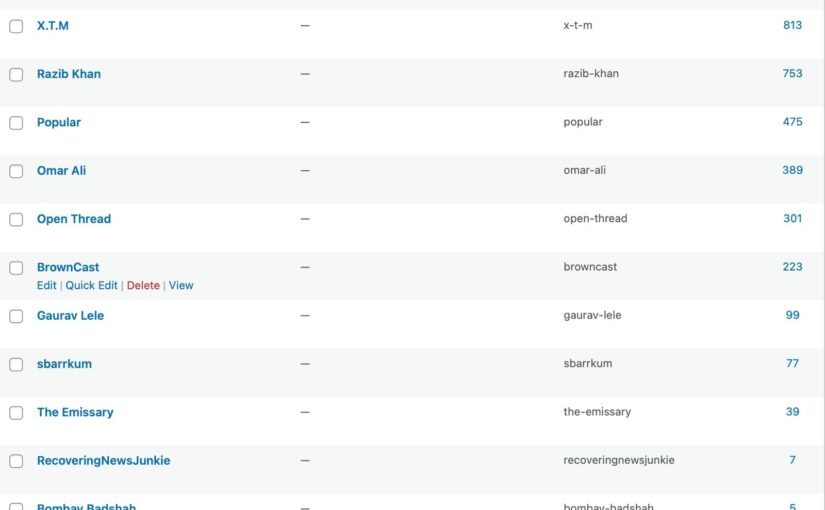
A small administrative note that matters more than it sounds. Brown Pundits now has 3,920 posts. Every single one is categorised. There are no uncategorised posts left. The entire archive is structured.

That is not glamorous work. It does not trend. It does not go viral. But it is the difference between a website and a timeline. Writing is not just producing new content. It is tending an intellectual garden. Adding categories, refining tags, standardising slugs, back-tagging fifteen years of material; this is not clerical labour. It is editorial discipline. It forces you to reread your own history. It reveals patterns. It exposes gaps. It shows where the site has been narrow and where it has been expansive.

Substack has made everyone an author. It has not made everyone an editor. Most platforms reward velocity and outrage. The incentive is to post faster and louder than the next person. Community becomes an audience. Conversation becomes branding. Writers become marketers. We are structured differently.

Different Eras of the Internet Continue reading 3,920 | Building out the Archive

📊 Brown Pundits Hits 63,094 Visits in August (+156% Surge)

That’s more than 2,000 visitors a day. What’s driving it?

✅ Open Threads

✅ Honest takes

✅ And yes — argumentation.

But arguments only work if they spark thought, not just heat. Take Kabir; he’s a regular, and I’ve given him free rein. But his tendency to argue without reflection rubs people the wrong way. He blames his relative unpopularity on identity, but it’s more about tone than religion; highhandedness vs humility.

In my own recent disagreement: I paused, thought, reflected deeply. That’s the spirit of BP; a messy, open-minded search for truth.

🎭 Meanwhile, the real tamasha isn’t cricket 🏏 (India did trounce Pakistan) — it’s on X, and on the BP comment section.

X 🧵:

Image

The stupas raises a deeper question:

How central was Buddhism to the Indian subcontinent — and how total was its erasure? In the heartlands, Brahmanism absorbed and displaced it; in the frontier zones, Islam swept away what remained. What we see today are ruins — but once, this was the dominant civilizational framework of the region.

Was its disappearance a slow assimilation, or a deliberate effacement?

On Moderation, Minoritization, and the Elite

Pulse: The Threads We Weave —

Lately I’ve wondered whether I over-curated the threads. Things feel quieter. Maybe too quiet. But perhaps that’s the cost of raising the bar—of asking for dialogue instead of dopamine. Still, this lull has me reflecting not just on moderation but on why some arguments no longer move me.

Take the Indo-Pak conflict: once electric, now strangely inert. That shift reflects my own evolution over two decades. I no longer inhabit that binary. I carry a layered identity—a South Asian Bahá’í sensibility shaped by Persian aesthetics, grounded in British institutions, and fluently navigated through English. That complexity is my compass. It’s why I care less about flags and more about forces.

And the real force that shapes our lives? The elite. Not as a pejorative, but as a structural reality. I see it as nested tiers: Continue reading On Moderation, Minoritization, and the Elite

Brown Pundits