
Happy Birthday Pradhan Mantri:
I watched several videos — four or five, maybe more — of public figures sending their wishes. Among them: Donald Trump, Narendra Modi, Benjamin Netanyahu, Shah Rukh Khan, Aamir Khan, Mohammed Siraj, and Mukesh Ambani.
Mukesh Ambani, of course, remains closely aligned with the establishment, and Aamir Khan seemed to lean heavily into his Hindu heritage — adorned with Rakhis on his wrist, even a Bindi. He’s presenting himself now in a distinctly Hindu cultural idiom, though he comes from a very prominent Indian Muslim family.
By contrast, Shah Rukh Khan stood out. His message was subtly sardonic — he remarked that the recipient was “outrunning young people like me.” It was light, but just subversive enough to feel intentional. Interestingly, both Shah Rukh and Aamir spoke in shuddh Hindi, which added a certain performative weight to their gestures.
Hindu Art
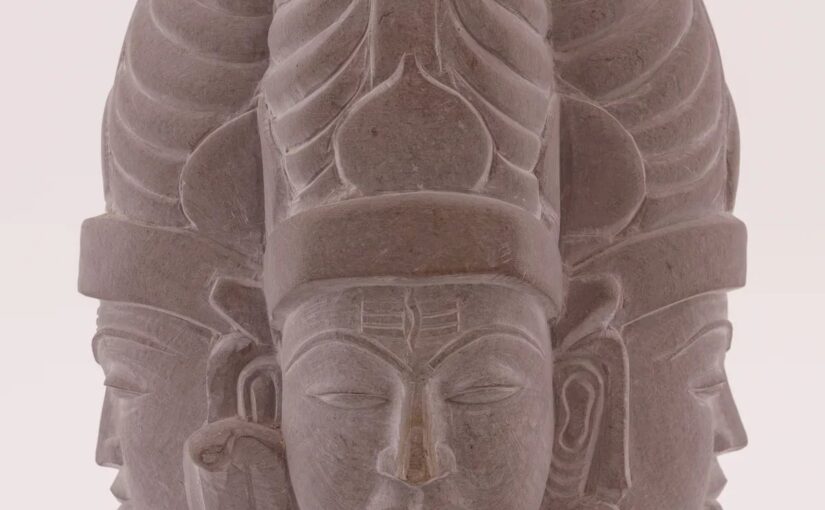
I’ve been fairly busy the past few days, mostly focused on BRAHM Collections; writing about carpets, curating Trimurti sculptures, and exploring Ardhanarishvara iconography. It’s been a deep dive into the civilizational grammar of India and by extension, the porous boundary between sacred art and civil religion.
In the background, I’ve also been chipping away at longer-form reflections; trying to crack the formula for my newsletter (believe it or not the readership is neck to neck with BP but different demographics). It’s all a bit scattered, but the writing has become its own brown paper trail.
On the Commentariat (and Why I’m Stepping Back)
I still follow the commentariat but I’m slowly easing off. There’s a rhythm to it, sure, but too often it turns into exhaustion. I’ve removed all of Honey Singh’s abusive posts. Abuse is now a hard red line for me, but beyond that, I’m stepping back from constant moderation or sparring.
And to be honest, I no longer want to fall into the Kabir trap; a trap where technicality becomes provocation and clarity becomes combat. Kabir can be vexatious, yes, but I know better than to keep taking the bait. That’s growth, I suppose.
Gaza, 9/11, and the Consequences of Overkill
The situation in Gaza has become morally undeniable. It’s genocide, plain and painful.
It reminds me of the post-9/11 moment: the justified strike against Osama bin Laden turned into a decade-long quagmire across Iraq and Afghanistan, eroding American credibility. The hegemony of the U.S. wasn’t defeated by China; it was hollowed from within.
Now we live in a world where China rises cautiously, avoiding those mistakes; while the U.S, and its proxy, seem unable to resist overreaction. The new multipolar world isn’t shaped by strength alone, but by restraint and timing.
Pakistan: A Country Built for Multipolarity
Pakistan, curiously, may thrive more in a multipolar world than in a unipolar one (as it did in the ’80s and Musharraf era with the War on Terror). In a U.S.-dominated order, it’s too easy to sideline. But when power becomes distributed, China, Turkey, GCC, Russia, Pakistan becomes useful again. Its ambiguity becomes an asset.
That said, the average Pakistani is in an unenviable position. I’ve read stories about the makeshift Sialkot football team used to enter Japan; desperate, symbolic of deeper rot. Unrestrained population growth, dwindling legitimacy, decaying institutions. Hence my annoyance with Kabir, is that he ignores the plight of ordinary Pakistan to wage ideological warfare across the border.
Yet Pakistan is adaptive. It fits into emerging gray zones of global politics. It is not North Korea, but it’s not India either. It straddles desperation and relevance.
India, Muslims, and the Fallacy of Equivalence
There’s a false equivalence being drawn between Indian Muslims and Pakistanis. That comparison is deeply flawed and, frankly, offensive. Whatever India’s problems, Muslims in India remain within a pluralistic political framework. They face challenges, but they are not boxed in by a state built to serve only them.
Conversely, Pakistan is built around Islam, which means that Muslims can rise freely but non-Muslims face systemic ceilings. It’s not just a matter of formal exclusion; it’s about cultural legitimacy. In India, everyone must negotiate pluralism. In Pakistan, only non-Muslims do.
I’d also add: when the state is essentially owned by a particular population, upward mobility becomes asymmetrical. Yes, Muslims and Pakistanis in the West are generally better off than back home but even then, it’s worth asking whether class and cultural barriers keep certain communities locked in place across generations. That, too, is an important thread to follow.
Persian Echoes and Indo-Persian Realities
A Persian teacher once told me that Iranians today can only study in failed countries: Afghanistan and Pakistan. That stuck with me not because I agreed, but because it framed a painful truth. The Persian zone is in retreat, caught between two collapses: Persian nostalgia and Islamic populism.
Pakistan, in some sense, is an Indo-Persian hybrid with neither the stability of Iran nor the brutal clarity of Afghanistan. It is uniquely in-between.
And maybe that’s the story: the in-between country that still matters. Useful, liminal, tragic and oddly poised for relevance again, now that the West is tired and China is careful.
Final Thought
Kabir, like Pakistan, provokes. But perhaps the wiser path is to observe rather than obsess. I’ll keep writing about carpets. They have more continuity than borders.
The definition of insanity – expecting a different outcome. The sooner everyone realises this, the better.
IMHO There is little point in moderating a bar fight, you’re better off letting them tire themselves out.
To the commentariat – please think about contributing an article on something that interests you, even if is just a matter of putting your views across (my preference is for something out of the mundane).
Highlight an injustice, an interesting connection, some non-intuitive statistics, an overlooked bit of history. Just channeling energies.
Tamasoma – Jyothirgamaya
yes that’s true.. great points!!
I mostly try to avoid the ‘bait’, but feel like responding occasionally, especially if its a topic that I have something to say on, not just ‘banter’ with him. Like the cricket discussion on the comments for the -honey trap post.
Honestly, I’ve told myself multiple times to just ignore the silliness, but there are times when the repetitive stupidity gets to you.
(Sigh) Been there, done that. Some people just want attention at any cost. You might think you have a great argument, or that your logic is unassailable, but that isn’t the point, the person you are arguing with just wants someone to talk to.
Eventually you are feeding a craving, like an addict they will keep taunting for a fix. Ignore them and they will provoke more.
There are always new victims though, you just need to figure out what you get out of this site.
Frankly, if Pakistan were not constantly attacked, I wouldn’t feel the need to defend it.
Write about something that has nothing to do with Pakistan and the comments will be an entirely Kabir free zone.
But if my motherland is attacked, I’m going to defend it. I am above all else an extremely patriotic Pakistani.
Also, on your point of “the state being owned by a particular population”– many people would argue that Hindus own India. Minorities (particularly Muslims) are increasingly considered a fifth column.
Look, this is not just my opinion. Many many Indian analysts (as well as international observers) have noted that Indian Muslims are treated as second class citizens.
Your country allowed a mob to destroy a mosque and build a temple in its place. Who do you think you are kidding?
the Waqf Board has historical property and territorial rights..
to be honest if we were to undo historic landowning provisions; it would be chaos the world over.
OMG this is incredible; exactly ONE year ago (17 September 2024) I wrote on this very topic!
https://www.brownpundits.com/2024/09/17/the-battle-for-the-taj-mahal-indias-sacred-lands-waqf-boards-under-fire/
exacto
I think the Pakistani mentality can be seen with their boycott of the match/tournament (details are yet hazy).
They care more for “pride” than material loss.
India bombed the shit out of them and killed many people and they were okay to play India.
India not shaking their hands on live tv and closing the dressing room door on them was the breaking point.
They could not bear the public humiliation.
calm
[…] remains, but how the same debate has reassembled; not just thematically, but almost ritually, with new voices circling back in familiar […]
I agree with below. If one is on a Visa it is none your business to comment on internal politics. Go back to your home country and write all tou want. In SL we had a blanket ban on “journalists” on Tourist Visa writing on the Civils War
Rubio Says US Visa Revocations Underway After Charlie Kirk Death Celebrations
https://www.zerohedge.com/geopolitical/rubio-says-us-visa-revocations-underway-after-charlie-kirk-death-celebrations
but, please tell me, who called norway to mediate in your civil war? so called civil society?
Invited by both LTTE and SL Govt in 2000. Chandrika Kumaranatunga was President at that time.
At the outset, the report states that Norway’s role in the Sri Lankan peace process is by and large a failed mission in terms of bringing an end to the civil war.
The West kept saying “negotiated settlement” was the only way. Around 2009 after many broken ceasefires Mahinda Rajapakse went for a Military Solution. One of the only modern Civil Wars settled militarily
Institute of Peace and Conflict Studies is a Indian NGO
Norway in Sri Lanka: A Tale of the Failed Peace Process
https://www.ipcs.org/comm_select.php?articleNo=3502
u s troops are in bangladesh for ‘exercises’, very interesting indeed.