
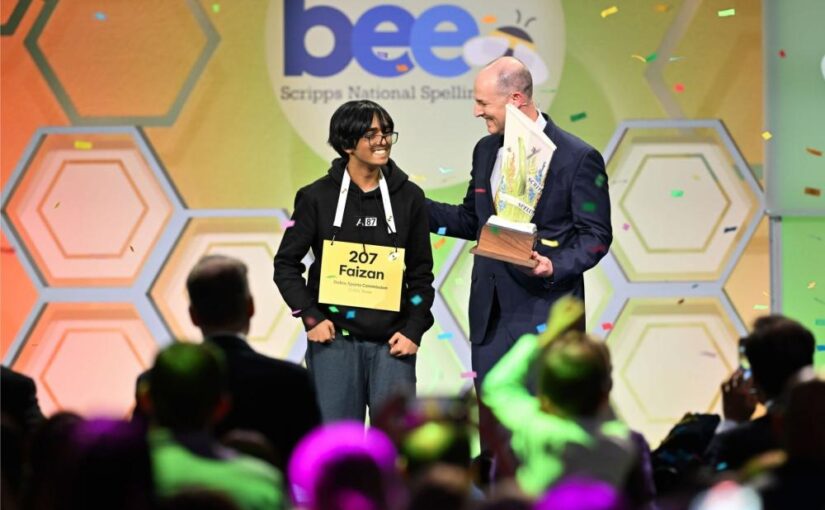
On Faizan Zaki, Spelling Bees, and Civilizational Osmosis
Another year, another Spelling Bee crown for an Indian American. But this one, the 100th Scripps tournament, is different.
Faizan Zaki—young, brilliant, and by name Muslim—just became the latest in a long line of Indian-origin champions of America’s most idiosyncratic intellectual ritual. Faizan is the 32nd Indian American to win—meaning they’ve claimed 32 out of the last 40 Spelling Bees. But he is very likely the first Muslim American to do so.
Which raises an old but essential question:
- Is this phenomenon the product of Indian culture?
- Or more specifically, Hindu culture? I could clarify it further to Brahmin, the wise and sage ancient caste who preserved learning in the Sanskritopolis, but let’s stick to the Hindu-Indian duality for now as it is possibly less contentious (Pakistanis alas are quite insecure of Brahmins as sadly they don’t have their own having displaced them in ’47 & ’87).
This is not about religious exclusion. It’s about cultural inheritance.
What Dr. V was mentioning earlier (and I agree): Indian culture is, in large part, Hindu culture. Her home city of Chennai is defined by the intellectual prowess of the TamBrams and their proclivity for STEM. Not necessarily in belief, but in ethos—in what gets rewarded, what gets praised, and what gets quietly enforced. Even for minorities, it seeps into their core culture.
A young Indian-Muslim American in America may not feel Hindu. But as Javed Akhtar argued, he’s definitely not Pakistani either. But if he’s from an Indian family in Dallas (as the brilliant young Faizan is) or Edison or Fremont, chances are his reference group isn’t Farrukh or Nadeem—it’s Patel and Mishra. The civilizational gravity pulls him toward rigor, repetition, reward—toward excellence. That’s not uniquely Hindu, but it has become encoded in the cultural software exported by the Indian middle class.
This isn’t just an Indian Muslim phenomenon either. I’ve seen it in Bangladeshis too—particularly Dhaka and secular families more integrated with their Hindu civilizational legacy. In contrast, the Pakistani elite—especially post-Zia—have been more culturally Arabized, detached from their Indic roots. Or perhaps romanticized; my ethnic kind, the last neo-Mughals (who are of more Afghan descent than anything) of Karachi evoke the decadence of Bahadur Shah Zafar more than the scholasticism of Ibn Khaldun.
Result?
Pakistan produces hustlers (I never got Omar’s points a decade ago but I grew up).
India produces overachievers.
Pakistanis are improvisers, charmers, survivors. But the long-haul rigor—the grinding, Sisyphusian, Tiger Mom path to excellence—that’s less culturally reinforced. It’s not that Pakistanis can’t do it. It’s that the system doesn’t reward it. The hustler wins; the scholar stagnates.
Persians, interestingly, are somewhere in between. Iran produces genuine excellence in math, semiconductors, even philosophy—but often in tension with its own state. The culture values intellectualism, but the system stifles it. Pakistan, by contrast, is often too unmoored for that tension to even exist.
So yes, I sided with Kabir over Honey in the last flame thread. That was a moderation call. But intellectually? Pakistan still has a lot more to learn from India than vice versa. And India, whatever else one says, is a civilizational engine. And her minorities in Diaspora, like Faizan, whether he knows it or not, carries that civilizational fuel—all the way to the winner’s circle.
— X.T.M
Acting Editor, Brown Pundits
I suspect you have spent too much time with Tamil Brahmins. They do consider themselves the guardians of Hindu culture in Tamil Nadu and abroad, with good reason, they have kept alive the rituals and art forms, blending STEM with (often rigid) personal orthodoxy.
Hindu diaspora culture however is not brahmin culture (with the exception of the TamBrams most others lose the orthodoxy). The push for excellence is a very immigrant hunger, Japanese, Chinese, Koreans and Indians exhibit it in spades. The common cultural element is the mode of immigration. With the IIT’s grads filling up research departments their children provide competition to the Patel kids of parents who had come as hoteliers and gas station owners.
If you have a steady influx of academic talent the next generation plays keeping up with the Joneses. This works for the muslim Indian kids too, as it should.
This also explains why you do not have Filipino/Pakistani/Vietnamese/Mexican excellence in America.
Also has to do with birth rates perhaps; try getting a Hindu family, outside of the Hindi belt, have more than 2 children.
To paraphrase Steve Sailer; oftentimes it’s one or none..
Actually btw Chennai is very segregated; the Tamils & TBs have their own spaces. But Chennai is my favourite place in South Asia, maybe South Bombay is close..
That’s feels like mixing correlation with causality. Is the logic there that you cannot spend enough time with each kid, pushing them to excellence? Why doesn’t this work with other groups who have low birth rates? Why did the Irish do so well in America (academically too)?
Reading back this comment to myself. I realise I semi consciously find caste references quite jarring. Non Indians tend to ask about caste and my answer is to shut it down as a taboo subject and they should never ask an Indian such things. Amongst my Indian social circle it is more in the abstract, with regards to elections and reservations, less about contributions and excellence.
To imply the excellence and therefore superiority of a particular caste is a social abomination, similar to talking about IQ and race.
Your theory could be correct, I might just be rejecting it due to ingrained bias, still the promulgation of such needs to be done with academic rigour, these aren’t subjects to be delved into with casual speculation.
Just background for my rudeness in tone, context helps understand intent.
There isn’t a biological basis in caste of course but values, networks and privilege due to history are a real thing.
While not a topic of discussion in polite urban Indian circles, it is also true that most of these circles are almost entirely upper caste.
Even in the USA, certain races will be more prominent in certain positions (as @XTM mentioned in his coffee shop post) and that is a first world country.
Yes I agree, also the reason my attempt to self correct my own ingrained biases. Razib I believe did some work on the biology, castes are distinct but not incredibly so.
I don’t know how much Brahmin/Bania culture influenced the diaspora rather than the modern world rewarding education and monetary risk taking + the redundancy of martial arts and globalization depressing the value of labour.
Correlation, not causation.
Yeah true.
But in India Brahmins and Banias were there to take advantage of that fact due to historical reasons and show a pathway to success for the other groups (the IIT peer groups were predominantly Brahmin in the first phase).
Other nationalities including Pakistanis didn’t have that.
Razib Khan had a post/comment) that said DNA shows stratification by caste in India (not Sri Lanka). Maybe XTM can locate that post.
Meanwhile
Analysis of these data demonstrated that the upper castes have a higher affinity to Europeans than to Asians, and the upper castes are significantly more similar to Europeans than are the lower castes.
https://pmc.ncbi.nlm.nih.gov/articles/PMC311057/
TBs (and Brahmins) in general have both extremes tbh – the super conservative as well as the super liberal westernized ones simply due to education.
I’d say Brahmins influenced the culture but other Indian groups (including non Muslims) adapted to it.
This is similar to how US culture is mainly WASP/Anglo culture primarily (although everyone else has added their own flavours) even though white people of English descent are a minority.
Patels from Gujarat, Kammas/Kapus/Reddys from the Telugu stages, Gounders from TN, Nairs from Kerala, Gowdas from Karnataka etc who are mainly martial/agrarian castes have also bought into the brahmin/bania mentality of education and business.
Also being spread to other OBC, dalit, tribal, muslim groups although not to that extent.
Remember, India right now is only a $3000 pci country so lots of development still left.
By the 2050s the transformation should be complete.
Brahmins in reality are declining due to low fertility rates due to being one of the more educated and richer communities in India. But the initial shape they gave the country (Brahmin Nehru opened the IITs for example) means that even if they don’t occupy the position they had once (Almost all the first CMs of states were Brahmin including the PM of course. Now I think there is at most one or two.) their values persist.
Pakistan’s issues were the opposite. While they had a small smattering of educated Mohajir elite, including a Gujarati mercantile class who guided the country in the early years it soon fell into the hands of the Punjabi “martial/agrarian” castes – Jaat, Gujjar, Rajput. Their cousins on this side of the border are more known for creating a nuisance in the NCR with caste stickers on their SUVs. Now these guys run a country without the influence of the brahmin/bania? The results are there for everyone to see.
Lahore and Karachi, Pakistan’s two big cities were mainly setup by the Hindu Punjabi and Sindhi mercantile class who post partition went to Delhi and Mumbai respectively and have done very well there. The people who remained in charge couldn’t sustain them at the same levels.
Karachi has no metro.
Lahore has 27 km of metro with 1 line and 26 stations with 0km under construction.
Nagpur (which is the 3rd biggest city in its state) has 38km of metro with 2 lines and 37 stations with 43 km under construction.
Great comment
Very succinctly put, and absolutely accurate!
Thank goodness Sri Lanka does not subscribe to the Varna Dharma. Buddhism expects one to be educated regardless of rank. So for over 2,000+ years Sinhalese have been educated and wanted education often imparted by Buddhist Priests in Pirivena at Village level
Hence the 90+% literacy rate of Sri Lanka
Every comment you go on and on about how Sri Lanka is more literate, has higher hdi, has longer life expectancy etc etc. None of these stats are statistically better than the south Indian states, Kerala and Tamil Nadu who are your closest neighbors and outperform on many indices. Just give it a rest.
None of these stats are statistically better than the south Indian states, Kerala and Tamil Nadu who are your closest neighbors and outperform on many indices
Why dont you compare some indices, per capita if necessary please .
Just keep in mind HDI etc have very little std deviation as they are derived from large datasets.
Anyway I am open to be proved wrong. Show that SL numbers are statistically not different from Kerala and TN
Culturally similar places just end up in the same place with time.
Not all that culturally similar. Maybe Kerala somewhat. Majority Buddhist, all Sudras (No Brahmins), plenty of water and 80% rural population
you go on and on about how Sri Lanka
No different from how most here compare India to Pakistan. So a little balance if you may.
I love Sri Lanka, one of the best places in South Asia along with South India .. u r completely correct
SL has done well for itself but it is a small country.
Its socieconomic indicators are matched by the southern states of TN and Kerala which are far more populous states which also have a higher GDP pci than SL.
Ofc they benefit from the sheer size of India.
Is the size of India a benefit for Kerala and Tamil Nadu?
I feel Kerala & TN are like SL, WB is like Bangladesh, Nepal is very similar to UP, Bhutan:Sikkim, almost all the stats match up with mild statistical variance.
Is there a real benefit to the size of India developmentally?
The political influence is much more and defence is an advantage but from a HDI perspective it feels like country size is not a factor. Culturally similar places just end up in the same place with time.
Congratulations to Faizan.
I don’t know that he or his family would take kindly to his achievement being credited to “Hindu culture”. Many Indian Muslims probably wouldn’t. If anything, spelling bees seem to be a particularly American thing.
Also, I’m not sure what kind of intelligence spelling bees actually measure. Memorization? Many Muslims memorize the entire Quran. Even Asim Munir is a Hafiz. I don’t know that that has any great correlation with scholarship.
Finally, is “Tiger Mom” culture something that should be uncritically promoted? There’s something to be said for allowing kids to develop their own interests, be in school plays, learn music etc.
The grapes, they are oh so sour. From spelling bees to moon landings. To making Iphones.
I congratulated the kid. Questioning what the point of spelling bees is doesn’t take away from the kid’s achievement.
I don’t buy the generalizations in this post about “Hindu culture” but that’s another matter.
I mean even in artistic pursuits like literature, music, film Indian Americans do well compared to Pakistani Americans.
They don’t run away to Lahore.
What’s your point?
You are a rando on the internet. I don’t need to justify to you why I’m in Lahore.
As we discussed, be calm. I’ll otherwise void everything you write .. use calm. The post I voided was terrible..
Don’t do that again. Otherwise I’ll also put on temp suspension as I did with Qureshi, who just started getting obnoxious.
Calm – they are allowed to express their opinions .. don’t weaponise
I’m sorry, the salt is literally dripping from that ‘comment’ contribution. Is it not allowed to call a spade a spade? I did not use derogatory language whatsoever.
This is the age of the internet and now AI. Spelling bee contests are completely useless in my opinion, and winning these types of contests is the scholarly equivalent of holding a guineas record for sewing the largest flag or how many pumpkins one can smash with a bare forehead.
The only benefit maybe that it sharpens mental faculties and memory as a side effect, but these could be achieved by memorizing the Quran (in this case) or Vedas (in most other cases)..storing sacred unchanging religious texts in the human mind seems to have much more utility than storing the English language which evolves with time.
Another interesting point that follows from this post is the comparison between the Indian Muslim and the Pakistani Muslim.
The Indian Muslim might face prejudice due to their religion which might manifest in discrimination both violent and non violent but due to being part of a much much larger growing economy, the opportunities available to them are simply not available to a Pakistani Muslim.
The only two Muslim billionaires in the subcontinent are Indian – Azim Premji and Yusuf Hamied. Pakistan’s movie industry has never produced anyone as big as the Khans or Dilip Kumar or AR Rahman. The likes of Mohammed Shami and Siraj get to play in a top team which wins back to back ICC tournaments. Nikhat Zareen gets to win gold at world boxing championships whereas a Pakistani woman would probably not even be allowed to pickup boxing. Similarly Sania Mirza has won grand slams. The world’s biggest Urdu fest Jashn-e-Rekhta is held in India not Pakistan.
Also it is not like there isn’t any oppression in Pakistan. The axis is just different. The Baloch who disappear are Muslims as are Ahmadis who get lynched as well as the people who die in mosque blasts on the prophet’s birthday like in Mastung.
A similar comparison would be say African Americans vs Africans. African Americans might not enjoy the same privileges that a White American does but by virtue of being part of the USA they get to positions of extreme prominence in music and sport and are the pre-eminent black group in the world who all black people (and even non black ones) emulate.
No African American would ever move to Africa simply because their standard of living would tank considerably (most African American ghettoes/hoods are better than the vast majority of Africa) and like Muslims in Pakistan would not be immune to violence – just that the violence will be on a different axis, say on tribal lines.
Now of course, India is not that much richer than Pakistan as the US is compared to say the richest black African country of South Africa.
But the gap is GROWING as it has been since India’s economy opened up and if we reach a point where the socioeconomic gap is huge and the overt violence against Muslims reaches zero (non-existent in southern states and increased development means it will end in the northern states as well although tensions will remain as they do in the American South) we might see more Pakistanis, especially the liberal ones jump ship.
We already have people like Adnan Sami, Tarek Fatah in this category.
You might say it’s a very very small number. That is true. But then you don’t have any Indians who are doing the same. Even Sania Mirza (who was mentioned before) kept her Indian citizenship post marriage and kept representing India.
Excellent post and comparison. I just want to add that there are more deaths/casualties in Pakistan due to sectarian violence than there are in India due to communal violence. Not per capita, outright numbers.
Yup.
The highest quality of life for Muslims in the subcontinent imo is in Kerala.
They get to live in a high HDI highly literate state with zero persecution and have ample culture representation and are part of the mainstream (Fahaadh Faasil, Mamooty etc).
Another thing that came to mind regarding the long-haul rigor is the fate of cricket players of the two countries.
Good Indian players come in, keep on improving and hit their peaks in their early 30s before slow decline in their late 30s.
Pakistani players come in, have a few good performances but then start regressing and are out of the team 3-4 years in.
The much loved Babar, Rizwan and Shaheen who were so celebrated in 2021 find themselves out of the T20 teams less than 4 years later at the age when they are supposed to be in their primes.
And they are not the only ones – there is a long list of such players.
The last Pakistani fast bowler to take 200 test wickets was Waqar. And he debuted in 1989 and retired in 2003.
Excellent comment on institutional continuity vs. volatility; you should think about posting on the main weblog, these are high-quality comments and give good food for thought.
Indian cricket has matured into a system, not a series of moments. From the NCA pipeline to IPL’s year-round exposure, players evolve within a structured arc. Ashwin peaks tactically in his mid-30s; Kohli reinvented his fitness at 30+.
Pakistan, by contrast, still banks on flashes of generational talent. Players debut young—Amir at 17, Shaheen at 18—but without planning, they burn fast. Babar, Rizwan, Fakhar—all peaked early, with form and roles poorly managed. As you say Waqar’s 200 wickets stand as a generational outlier because the system never learned to sustain excellence—only to spot it.
It’s not just cricket—it mirrors a broader truth: one nation has built institutional depth; the other still relies on individual brilliance to bend fate.
Do I need admin access to post? I don’t mind posting but will do so intermittently.
Let me know when u have a post ready and we can chat. I prefer to keep author and contributor access tight to active members like those who post a forthnight at least
Also cricket has just become a more professional sport with analytics, match-ups, fitness regimes etc.
Hence countries like England and New Zealand are also thriving while Sri Lanka and Pakistan, two teams who coasted on “natural talent” have regressed.
You need to keep re-inventing yourself all the time if you have to survive. In this age of readily available footage and analytics, weaknesses can’t be hidden.
Finally got to read this without rushing. XTM, you have the rare ability to juxtapose two seemingly unrelated threads of thought and put them together in a contemporary example. I agree with the holistic way you’ve approached this. Definitely food for thought moving forward as a unifying force in a heterogeneous and complex society like India. Being in a plural society definitely has its advantages. It’s like a silent osmosis of taking in the good from all those around you even if subconsciously.
Thank you buddy for the kind words; it’s encouraging
47 is understandable. but who is 1987???
also who are equivalent to brahmins in pakistan?
I think he was referring to Kashmiri Pandits though that wasn’t in Pakistan but in Kashmir.
I don’t think it makes sense to talk about caste in reference to Pakistan. Islam doesn’t have a caste system and we don’t think in those terms.
You do Kabira, you do.
You are not Arabs, you are converted Hindus and you have taken things like caste with you.
Maybe Ahmadi.
No one really cause most Brahmins didn’t convert.
They had a Gujarati mercantile caste consisting of Bania converts but that has declined.
“Indian Pakistan” aka Sindh/Punjab is basically an Thakur/OBC nation consisting of mostly the middle castes and Rajputs.
The Mohajirs were somewhat educated (most of the muslim peasantry stayed behind) but the Sindhis and Punjabis are the former rural class. The urban class was almost exclusively Hindu who migrated.
“Iranic Pakistan” aka Balochistan and KPK have a tribal culture resembling the Northeast Indian tribes but without the westernizing effect of Christianity that the NE Indian tribes went through.
Ethnic cleansing & displacement of Kashmiri Pandits.
Going by the number of Syeds in India and Pakistan, this is a wild claim made by our spam commentator.
Conversions to Islam in India, when adjusted for proportional percentage, were significantly higher among Brahmins and upper Hindu castes in urban areas. Rural villages on the Gangetic plains remain 85–90% Hindu, while Muslims are over represented in urban areas. In Pakistan, all Hindu castes converted.
In 1947, the regions that formed Pakistan were extremely poor and underdeveloped (both in the West and East), semi-arid, and sparsely populated (West). Today, Pakistan is a strong nuclear power, and Bangladesh is also performing well despite losing its natural port.
Indians (mostly Hindus and Sikhs) are often preoccupied with caste and genetics, viewing the world through this lens. This perspective is not only prevalent here but also widespread on Twitter and Instagram, sometimes to a shocking extent.
For instance, someone commented on how “backward” Punjabis are for displaying caste stickers on their cars, yet ironically proceeded to analyze why Pakistan lags behind due to caste and listed 360 reasons why Brahmins are superior to others.
This type of projection onto other societies through the lense of one’s own society, is clearly clearly flawed.
Yes, caste is a Hindu thing. It has no religious sanction in Islam. Muslims can pray together in the same mosques while until recently Dalits could not enter upper-caste temples.
We have “biradaris” in Pakistan (Rajput, Gujjar etc) but that’s not the same as caste in the Hindu sense.
>until recently Dalits could not enter upper-caste temples.
Brahmins are nice enough to allow them in these days (only in some selected temples), just a few decades ago they would not even be allowed into a town unless their services were specifically required (sewage cleaning).
Naah this is you again projecting.
It’s the Ahmadis who are not allowed to pray in mosques.
And India has never had mosque bombings like Mastung.
Caste is South Asian
The only exception is Syeds — and this is another discussion entirely– but this has more to do with Sufi & Shia Islam than Hinduism as this doesnt really mirror the Indian caste system .
I voided this comment since it’s clunky
Caste is not is not generally practiced anymore in the two Muslim countries of South Asia.
Extremely prevalent in Pakistan.
The syed grift in ‘south asia’ would make an interesting socio-anthropological case study for some budding phD. Maybe the ‘South Asian’ endowments in Ivies funded by desis ought to sponsor something along those lines….
Total scam it is. Aren’t overwhelming majority of self-proclaimed ‘syeds’ utterly fraudulent?
Syeds (lineage of the Prophet) were heavily persecuted after the Prophet’s death because their existence posed a legitimacy challenge to the Ummayad caliphs who had wrested control of the empire.. There are theories that Ummayad governer bin Yusuf singled out Sindh & sent Muhammad bin Qasim to attack Sindh, because the Sindhi king was harboring some of the Syeds that had taken shelter from the Ummayads.
The persecution of Syeds gave rise to two movements in Islam, Shiasm and Sufism.. both common in Central Asia. In both these movements, lineage to the Prophet is very important and is revered, and Central Asia and Khorasan was the hub of Shiasm and Sufism. Islam is India was spread by Sufis and as such, having Syed ancestry was extremely privileged and sought out. South Asian syeds in different places are different.. in Sindh there may be a chance that many do have some Arab descent but in other places, most are likely more Central Asia and may have nothing to do with Arabs. Also Brahmins upon conversion would have likely taken on Syed title or intermarried with Syeds to maintain their status.. and may cluster with Syeds genetically in some areas while not in other areas. More research is needed on this
this sounds a lot like ‘we wuz’ BS. Surya-vanshi, Chandra-vanshi types.
Have you heard of the Indian Pasmanda Muslims? They were the so-called lower caste converts to Islam primarily because they could not afford to pay the “jaziya”. And guess what, in today’s India, they are discriminated by the Ashrafis because of the fact that they were converts from a lower caste. Google Dalit Muslims and Dalit Christians too if you are so inclined.
‘caste’ oh so bad, very bad. (what is it, a lineage based tribalist social grouping). we don’t have ‘caste’ we have ‘biradari’. (what is biradari? – lineage based tribalist social grouping).
Lineage based tribal social grouping exists in most places in the world. This has nothing to do with the Hindu caste system which is quite unique – based on not just ancestry but occupation and extremely strict endogamy not just at surface level but right down to jati level. Don’t think anywhere outside India was un-touchability ever practiced on a social scale.
why don’t you try “explaining” to me what’s ‘quite unique’ about the cast system?
Ur ancestors were probably enthusiastic about it; Qureishis are caste markets
Plus ça change, plus c’est la même chose
I am not ‘Qureishi’. It’s a pseudonym.
Within my first and second cousins of my generation, I have Syeds, Sheikh-Siddiquis, Jatts, Yusufzais, and even a Kashmiri Butt.. The topic of “caste” has never even come up.
You will simply not find this in a Hindu household.
And if you hadnt deleted my comment, I explained exactly why my ancestors would be enthusiastic about caste.
All of those things are literally castes which are also present in India and some come under affirmative action lol.
When you are marrying within your “biradiri” you are marrying within your “caste”.
a random ‘truthy’ factoid doesn’t allow you to LARP as some sort of expert on jati/varna. I’m going to leave it at that.
Biradiri is literally caste.
All of those Jatt, gujjar, rajput are listed as castes in India.
And Pakistan treats its dalit chuhra community like shit.
Even Yousuf Youhana was forcibly converted.
Biradri is literally caste.
Those same “castes” – Rajput, Jatt, Gujjar exist on the Indian side.
Ahmadis beg to differ.
What does that have to do with caste? The discrimination they face is because they have been declared constitutionally non-Muslim (which again I’m not defending).
I mean Pakistan is still extremely poor and undeveloped compared to the rest of the subcontinent (and the world tbh) so I don’t know what you are going on about.
Like I had mentioned before, its HDI is closer to Afghanistan than India and many sub saharan African countries actually are higher.
North Korea is a nuclear power. Its hardly a “prosperous” country.
And judging by trends over the last 25 years the gap will only widen.
And “biradiri” is Pakistan is literally caste.
Naah, another lie by the resident troll.
In Pakistani Punjab, the Khatris never converted and moved to Delhi. Even the Sindhi urban classes never did hence Mohajir control of Karachi.
There is a reason why Pakistan lags behind in the subcontinent and will lag behind even further.
[…] has glibly informed me that caste doesn’t exist in Pakistan, and that had I not deleted his comment, I would have […]