
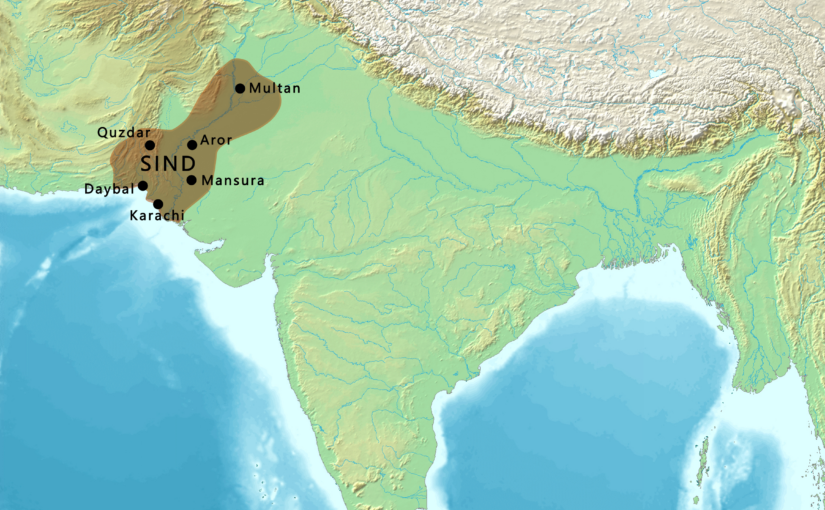
A Pakistani Sindhi song, Paiso Aa, has crossed the border and gone viral among Indian Sindhis. It is light, playful, and unselfconscious. And it exposes something we repeatedly forget.
Sindh has been Muslim for over thirteen centuries.
The region was conquered in 711 CE by Muhammad bin Qasim, the teenage governor of Fars—thirteen when he entered Sindh, dead by nineteen. Almost an Alexander figure in miniature. Since then, Sindh and Multan have known uninterrupted Muslim rule longer than many parts of the Islamic world itself.
That matters, because it complicates a habit of thought that treats Islam in the Indian Subcontinent as permanently “foreign.”
In Sindh, it is not.
What is striking is not that Islam endured, but how it endured. After more than 1,300 years of Muslim governance, Sindh remained roughly 30% Hindu, with Hindu urban populations often exceeding 50% well into the colonial period. Yet Buddhism, once dominant across the Indus, vanished almost completely.
That asymmetry tells us something important.
The surviving Hindu population of Sindh was not simply a residue of ancient Indus religion. Much of it likely descends from Punjabi Hindu Khatri migrations, which explains why Sindhi Hindus were disproportionately mercantile, urban, and networked across western India. Hinduism re-entered Sindh demographically even as Buddhism disappeared civilisationally.
This was not conversion by force, nor erasure by decree. It was a slow sorting of social functions. Islam absorbed agrarian, pastoral, and political life. Hinduism remained dominant in trade, finance, and administration. Buddhism, lacking a comparable social niche, faded.
That is how civilisations actually change.
Which is why Partition was such a conceptual disaster. It froze fluid histories into rigid categories. It encouraged the idea that Islam was an alien graft on Indian soil, rather than something native to entire regions like Sindh and Multan. It turned layered identities into mutually exclusive ones.
Upper and western Punjab did Islamicise later, largely in the late medieval period. But Sindh did not “become Muslim.” It has been Muslim for longer than England has been Christian.
The viral success of a Sindhi song among Indian Sindhis is not irony. It is continuity asserting itself despite borders. Language, rhythm, and memory move where states cannot.
Islam in Sindh is not a foreign influence. It is indigenous history. Hinduism in Sindh is not an anomaly. It is a mercantile inheritance. Both can be true at once.
What failed was not coexistence. What failed was the attempt to partition civilisation itself.
Partition was a “conceptual disaster”? For whom?
Why is the idea of the Muslim majority provinces of British India deciding to rule themselves instead of being a permanent minority in a Hindu majority India so threatening?
Obviously the ethnic cleansing that happened on both sides of the Radcliffe Line was tragic. But thank God the Islamic Republic of Pakistan exists and we Pakistani Muslims are in charge of our own destiny.
I feel Indian Muslims are much more behind than Pakistanis in some ways..
Unfortunately, it is no fun being a beleaguered minority in South Asia–whether that is being a Hindu in Pakistan or being a Muslim in India.
It is better for all concerned that Hindus have a country of their own and Muslims have Pakistan and Bangladesh.
Ah yes! The Bollywood Khans. Surely that makes up for the Indian Muslims being lynched for eating beef. The Muslims murdered in a pogrom watched over by Hindu Hriday Samrat…
But no! The Bollywood Khans….
It sucks to be a Muslim in India. Indian Muslims themselves know that they are not living in Pandit Nehru’s India anymore.
.
Remove the glee in your tone when talking of death & show Respect.
.
You are constantly alluding to Pakistani mortalities; it’s very creepy tbh and in very poor taste.
You are on short shrift to complain about anything with respect.
Get back inside the line and you will be allowed to comment again.
@XTM:
This is Islamophobia 101.
I don’t think you want BP to become a cesspool of anti-Islam comments. This is not a good look for any forum.
You may want to have a more balanced opinion?
Thank you.
He sounds absolutely unhinged.
@XTM:
Once again, he’s taking pleasure in the deaths of Pakistani soldiers.
If nation-states are supposed to exist and function as intended (i. citizens subscribing to a national creed, ii. government having the sole right to impose nationwide rules and exert power), rigid categories have to be established on some basis, and that will often require the “freezing” of erstwhile fluid categories. The alternative is some form of open borders (which I personally don’t have a problem with, but which seems to drive most people nuts, so is infeasible in this day and age).
Such categorization happened in Europe after the Thirty Years War, incidentally on similar lines to our Partition (kingdoms/realms consolidated on the basis of religious affiliation, which was more important to people than linguistic or cultural affiliation.) That too over relatively minor theological differences between the various Christian denominations; compare that to the chasm between Hinduism and Islam.
Excellent comment
It was the Thirty Years War (I believe) that led to the concept of secularism. It was the prince of a particular kingdom that got to decide the religion of the people. Eventually this led to separation of church and state.
Article very important to history,discuss in dip sense islamise of west punjab.how when islam entre west punjab jat,baloch,pashtun settlement cultivation work, political structure most important thing population component in CE Multan,thal,potohor region?
What did you all think of Bad Bunny at the Super Bowl
https://web.facebook.com/reel/2083952952361987
Make it as an open thread?