Bangladesh podcast # 2 -Regime Change; The Fall of Sheikh Haseena and its Consequences

It will also be on Apple Podcasts and Spotify. as well as on Libsyn and a variety of other platforms.

In this podcast we talk to two Bangladeshi expats who have been involved in recent pro-democracy activism within the BD diaspora. Dr Shafiqur Rahman is a political scientist who teaches in Vancouver. Mr Jyoti Rahman is an activist and blogger who is also an economist and a fiscal policy expert who has worked with the IMF and other institutions. We asked them about what is happening in BD and how this is likely to play out in the coming days..

If you want to support the costs for hosting and Zencastr, you can give to my Patreon.

Elamo-Dravidian and the Koraga

Novel 4,400-year-old ancestral component in a tribe speaking a Dravidian language:

Research has shown that the present-day population on the Indian subcontinent derives its ancestry from at least three components identified with pre-Indo-Iranian agriculturalists once inhabiting the Iranian plateau, pastoralists originating from the Pontic-Caspian steppe and ancient hunter-gatherer related to the Andamanese Islanders. The present-day Indian gene pool represents a gradient of mixtures from these three sources. However, with more sequences of ancient and modern genomes and fine structure analyses, we can expect a more complex picture of ancestry to emerge. In this study, we focus on Dravidian linguistic groups to propose a fourth putative source which may have branched out from the basal Middle Eastern component that gave rise to the Iranian plateau farmer related ancestry. The Elamo-Dravidian theory and the linguistic phylogeny of the Dravidian family tree provide chronological fits for the genetic findings presented here. Our findings show a correlation between the linguistic and genetic lineages in language communities speaking Dravidian languages when they are modelled together. We suggest that this source, which we shall call ‘Proto-Dravidian’ ancestry, emerged around the dawn of the Indus Valley civilisation. This ancestry is distinct from all other sources described so far, and its plausible origin not later than 4,400 years ago on the region between the Iranian plateau and the Indus valley supports a Dravidian heartland before the arrival of Indo-European languages on the Indian subcontinent. Admixture analysis shows that this Proto-Dravidian ancestry is still carried by most modern inhabitants of the Indian subcontinent other than the tribal populations. This momentous finding underscores the importance of population-specific fine structure studies. We also recommend informed sampling strategies for biobanks and to avoid oversimplification of ancestral reconstruction. Achieving this requires interdisciplinary collaboration.

Not definitive, but I think this shows the value of greater sampling in Indian subcontinental populations.

Bengalis are all basically very similar (except for Brahmins)

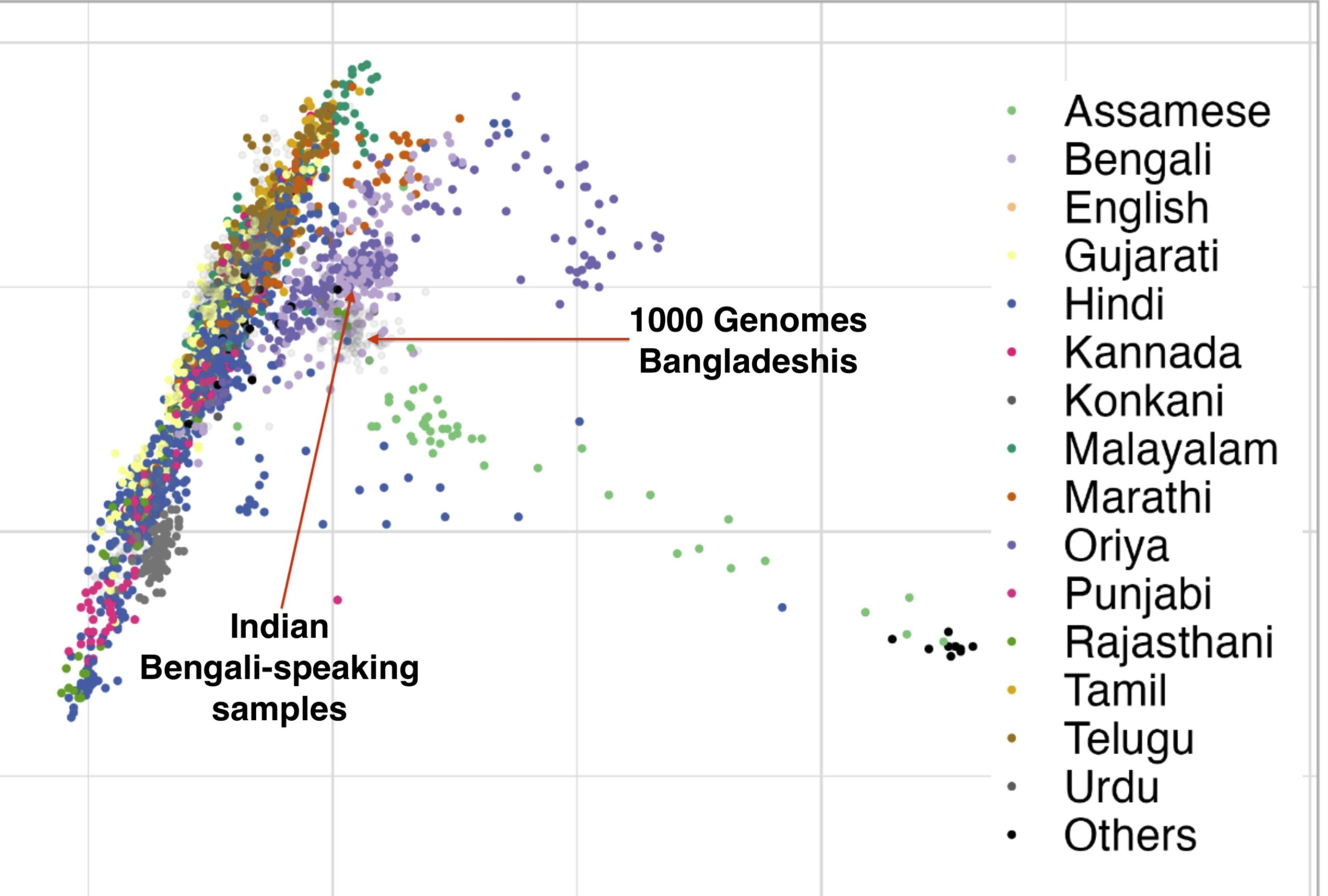
The new paper, 50,000 years of Evolutionary History of India: Insights from ~2,700 Whole Genome Sequences, is very good. It also answers a question that comes up sometimes: how different are West Bengalis from Bangladeshis? We haven’t had a apples to apples comparison until this paper that’s easy to understand.
There are figures in the paper that make the overlap clearer. The main difference is more variance in the West Bengalis, and a greater East Asian shift among Bangladeshis. But the latter is clearly just geography; those whose ancestry is from the east of the Padma (like me) always have more East Asian ancestry than those from the west, while those in the north also seem to have more.

The variance in West Bengal is probably driven by caste. You can see Brahmins, and probably what are Bengali-speaking scheduled castes and tribes. In the Bangladesh Muslim population everyone eventually intermarried.

The Assamese are even more East Asian shifted than the Bangaldeshis. As I said in a previous post, these Indo-Aryan groups look like they mixed with a Khasi-like population at some point.

Finally, the West Bengal population had admixture from an East Asian group between 500 and 600 AD. This is the same date as for the Bangladeshis, meaning they are both the same population with the same origin. The major difference seems likely to be the proportion of East Asian ancestry and lack of caste structure within eastern Bengal.

Brown Pundits