Reposting this piece by @JuggadiJatt, originally published on his blog, The Sikh Mindset:
FOREWORD
It is a wonderful (if not sad) coincidence that on the day before I finished writing this post, Nikki Hailey came out with her statement about Sikhi “acknowledging Jesus as the Son of God”. If that doesn’t justify an article of this nature being written, I don’t know what does. Unfortunately, Hailey’s blunder is but the latest in a long line of misconceptions held about the Sikh faith, many of which belong to Sikhs themselves. The community’s meteoric transformation from a rural South Asian demographic into a global entity has brought with it a whole host of novel challenges, the root of all stemming from the difficulty in navigating a Western conceptual framework of ‘religion’ with the realization that Sikhi is wholly unsuited for that category.
I felt writing this that each paragraph topic could have an essay dedicated entirely to itself. I don’t think this is an exhaustive look at how Sikhi differs from Abrahamic theology in any way, but hopefully it can be a start. Unlike most content of this variety this is not an academic journal entry written for scholars so should hopefully be able to resonate with and speak to normal people. If it becomes a reference point for future discussion on the matter, helps just one person see things differently or even just acts as a link-able piece when misinformation about our faith sprouts up in the future, this write-up will have fulfilled its purpose.
INTRODUCTION
The Western World has been the dominant civilizational force on the globe for much of the past 500 years, and its hegemonic power is demonstrated in full force through the Sikhs it has been responsible for producing. The erosion of traditional Sikh theological context is evident when speaking with young Sikhs born and brought up in nations from the Americas to Europe and Australia. The internet is awash with questions about why bad things happen if God is good, comments indicating disbelief in God and concerns that “religion,” including Sikhi, “is hopelessly outdated in modern times”. Though perhaps all fair game, the lack of any semblance of historical Gurmat framework in which these queries are rooted is strikingly noticeable.
When we think of globalisation our brains tend to focus on intercontinental communication at the click of a button, migration patterns giving rise to diverse nation-states and visits to exotic lands nothing but a day’s air travel away. What we often overlook is the impact of the cultural, social and ideological shifts taking place as a result of our planet being connected like never before. In the space of 50 years, our very understanding of our faith has transformed to such an extent that it may be almost completely unrecognizable to previous generations.
In this post I want to devote a bit of effort aimed at addressing the problem. And while I am aware this is too complex an issue to resolve completely here, I hope I can at least offer a starting point towards doing so. It is my belief that Sikhi is too important a way of thought with far too much spiritual value to offer to allow the tides of time to dilute it beyond recognition.
On August 15, 1947, an ancient civilization manifested into a new nation. Near the stroke of midnight, Jawaharlal Nehru, freedom fighter and India’s first Prime Minister, would make one the greatest speeches of the 20th century – “A Tryst With Destiny.”
One passage stands out the most which is integral in this piece:
“A moment comes, which comes, but rarely in history, when we step out from the old to the new, when an age ends, and when the soul of a nation, long suppressed, finds utterance.”
The Soul of a Nation
The idea of the soul, or Atman, has been a central topic in Indian philosophy. Most strands posit it as eternal, unchanging, and inherently good. Liberation is achieved when one identifies with the soul and disassociates with the body.
But what defines the soul of India?
The Ancient Indian Motif of Reincarnation and Rebirth
Nehru tried to define this soul or “idea” of India in his book, The Discovery of India. Nehru idolized India’s diversity, tolerance, and tradition of pluralism. Most Indians today and in the past would agree with these values.
But problems arrived with the body of this newly born India state. Its hands were tied by excessive government regulations where profit was a plague, and a mercantile people’s instincts were silenced. The feet of the masses marched behind the banners of caste (for Hindus) and religion (for minorities) rather than behind the Indian tricolor or tiranga. The brain or “intellectuals” of India veered into a Red Sea where Marxists rewrote books to vilify India’s indigenous culture and deify its conquerors as civilizers of the heathen brown savage.
Post-colonial India became a state ruled by Brown Englishmen exploiting mass corruption while spitting on mass tradition. To maintain this equation, balance was achieved by pitting community against community; while feudal lords doled out sops and calculated political arithmetic. This all changed when a new variable entered the board – unity.
Truth is One
Ekam Sat Viprā Bahudhā Vadanti – Truth is one, the wise know it by many names.
— Rig Veda (1.164.46)
I’ve quoted the above several times before. The reason I do is because how integral this verse is in explaining India. Nehru’s idea of India indeed traces itself to this verse spoken thousands of years ago. However, what Nehru and his disciples did not acknowledge is that their “Idea of India’s” origin was rooted in this Vedic verse. They would think of any and every reason to explain India’s inherent diversity and tolerance other than its actual cause – the soul of India: Dharma.
Ekam Sat is the social contract of the Indian experience. As long as people abide by it, sectarian peace can prevail and has in India for millennia. When ideologies came that did not accept Ekam Sat, India has witnessed terrible bloodshed in the name of God or lack there of. This is not to say that India was some peaceful fantasy land for all of its history, but it is reasonable to say that inter-and intra-religious violence amongst Dharmic sects has been extremely minimal compared to its foreign analogues.
But how did this unity manifest itself in modern India – an India of hundreds of colonial and cultural divisions filled with struggle and strife?
The Price of Saffron
Two currents would force the struggling streams of the Indian state into the beginnings of a singular and mighty river: saffronization and economic liberation.
It was in the late 1980s/early 1990s was when India’s reincarnation truly began.
Movie Poster of Shikara – Based on the Kashmiri Pandit Exodus; Capturing the Initial Refugee Flight From Kashmir
Across the Arabian Sea, Saddam Hussein launched an invasion into Kuwait in 1990. Oil prices and India’s oil payments jettisoned while exports slumped with its balance sheet teetering. India was now forced into an IMF bailout conditioned on massive economic liberalization. The curse of the Kuwaiti invasion would turn into India’s blessing.
Political whirlwinds would give air to an upstart party in the BJP, which would grow in strength and numbers over the years. Reaching a zenith in 2014 with a massive victory of Prime Minister Modi, the BJP now began laying ground for a new India. On a foundation of welfare, infrastructure, and promotion of indigenous tradition, Modi would build the first pillars of rebirth in 2019 with an even greater mandate than prior.
Through this trident of tectonic maneuvers, Modi and the BJP signaled their intent to the world in 2019 – India would no longer sit by and be defined by haughty intellectuals or journalist editorials; India would define itself, and it was now defined by reclamation.
Amongst hyperventilating outlets publishing misinformation after mischaracterization, much of the international public has been caught dazed by what is happening in India. The BJP’s shambolic public relations department does not help either. In all 3 actions, India is placing primacy on indigenous tradition and history. It is addressing the festering scars that have been open since partition and caused by conflict from ages past.
In Narendra Modi, they have found the Special One. His background, achievements, and character have captured the Indian imagination. He is an every man coming from humble roots who has given a precedent of defiance to those of doubt. Modi has not only given hope to the average Indian, but also a mirror.
He has laid out the corruption and hypocrisies of the old elites. His orations give the tales of an ancient people, speaking to the deep seated cultural trauma and perseverance of India. Modi’s Hindutva is breaking the Brown Englishman’s idols and killing its sacred cows, while reminding India of its old ideals and sanctity.
Narendra Modi Worships At Kedarnath Temple in the Himalayas
But the old elites also have an even more alarming fire at their doorstep – caste is breaking down.
With urbanization, increased economic mobility, and indeed with the strengthened of Hindutva, people are identifying as Indian or Hindu first rather than their caste like in the old days. Social media and the internet have broken the stranglehold of academia and mainstream media to deliver narratives that are much more in tune with reality today, history yesterday, and the future tomorrow. The carefully carved world of postcolonial India is crumbling to ashes. And the BJP is intent on dashing those ashes away as a preparation for reincarnation.
Jawaharlal Nehru’s “Idea of India” was only partially correct. India is not just the land of diversity and pluralism. India is the land of Dharma, of ancient traditions, and uniquely indigenous narratives. It is the land of Ram, of Krishna, of Buddha, of Mahavir, and of Nanak. It is the land of Chanakya, with a state that seeks to improve diplomacy and statecraft. It is the land of Yoga and meditation. It is the land of science and spirituality; of Aryabhatta and Aryavarta. It is a land of the Dharmachakra, where the wheel of change forever turns on the spokes of Dharmic virtues.
It is the land where the soul of a civilization, long suppressed, is reborn today in a new avatar.
An argument that emerges now and then on this website has to do with the nature of the ancestors of Indian (South Asian) Muslims. Where they Hindus? Much hinges on semantics. The term “Hindu” after all simply meant Indian in the days of yore, so by definition, they were.
On the other hand, Hindu today denotes a set of beliefs, practices, and identities, which exists at counterpoint with the confessions of Islam, sects like Jainism and Sikhism, and the dharmic world religion of Buddhism. To say that the ancestors of Muslims were Hindus may not give the correct impression due to the fact that that implies a level of fidelity to practices and beliefs which we today recognize as Hindu. Even setting aside the fact that substantial numbers may have been adherents of counter-cultural sects such as Buddhism, many of the threads of contemporary Hinduism developed in situ in the Indian subcontinent at the same time as many regions became predominantly Muslim.
And yet I think I have come to an elegant and accurate solution to this problem: those of us of Muslim origin or belief should simply admit that we were the descendants of idolators. Whether Buddhist, caste Hindu, or animistic peasant, from a Muslim perspective all these groups are idolators.
What I would like to see more in the media is the voice of the Korean American Christian pastor and the Indian American tech-bro. They exist. And there are a lot more of them than there are post-colonial theorists.
(I was in a very liberal [pierced people] cafe in Austin once when they were talking about Indians…and I realized the conversation stopped as people looked sideways at me, so I get what the author is saying)
Another BP Podcast is up. You can listen on Libsyn, iTunes, Spotify, and Stitcher. Probably the easiest way to keep up the podcast since we don’t have a regular schedule is to subscribe at one of the links above.
You can also support the podcast as a patron. The primary benefit now is that you get the podcasts considerably earlier than everyone else.
Would appreciate more positive reviews! Alton Brown’s “Browncast” has 30 reviews on Stitcher alone! Help make us the biggest browncast there is!
In this episode we talk to Mohammed Zeeshan, who is a foreign affairs analyst and columnist. He has written for The Diplomat, The National Interest, Swarajya and DailyO, among others and is a founder of the Freedom gazette. We talk about the current anti-CAA protests, the current and future prospects of Indian Muslims and how they perceive the BJP.
Another BP Podcast is up. You can listen on Libsyn, iTunes, Spotify, and Stitcher. Probably the easiest way to keep up the podcast since we don’t have a regular schedule is to subscribe at one of the links above.
You can also support the podcast as a patron. The primary benefit now is that you get the podcasts considerably earlier than everyone else.
Would appreciate more positive reviews! Alton Brown’s “Browncast” has 30 reviews on Stitcher alone! Help make us the biggest browncast there is!
In this episode we talk to Omar Al Nidawi, who is an Iraqi-American who works to promote development and democracy in Iraq and talks to us about his impressions of the current crisis in Iraq and what may lie in the future. He also tells us a little about homebrewing beer and how he got to be the President of the Washington DC homebrewers club.
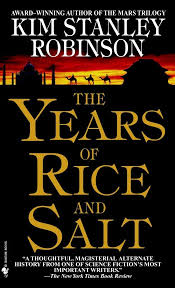
Going back twenty years I have been fascinated by “alternative history” science fiction. This is often termed “Uchronia.” If you want to explore this genre, I suggest the Uchronia website.
Probably the biggest breakout into “mainstream” science fiction of this sort of work is Kim Stanley Robinson’s The Years of Rice and Salt. Here the “Point of Departure,” where history forks from our timeline, is the Black Death. White Christian Europeans go extinct, with small groups getting absorbed by expanding West Asian and North African Muslims. Eventually, Europe becomes one of the outposts of the Near Eastern Islamic civilization. The world becomes defined by a “Cold War” between a Chinese-led bloc, and an Islamic-led bloc, with the Indian subcontinent, split between the two (though leaning toward the Chinese-led bloc).
The reason I’m bringing this up is that it presents a thought experiment: what if the Hindu Rajputs had managed to prevent the expansion of Turco-Muslim polities into the Indian subcontinent beyond the Sindh and parts of Punjab?If this had happened, the shock of the Mongol sweep south would probably be even more devastating for the Turco-Muslim polities of Persia and Central Asia (India being less of a fallback). One can imagine a scenario playing out where Islam and Muslims in the Indian subcontinent remain a small distinct minority, with higher concentrations in coastal areas impacted by trade. Islam would perhaps play the same role in India as it does in mainland Southeast Asia: a minority religion that serves mostly as an interface with the Indian Ocean trading network, rather than a religion of a dominant ruling class.
A more interesting question is what are the cultural ramifications of this historical fork? A comment was made on this weblog stated that to a great extent it is hard to imagine North Indian culture without Muslim (so Turkic and Persian) influence. One may disagree with this comment, but it is not a crazy assertion.
But the question of the nature of the alternative history is interesting. Because it is a way one can get at an answer as to what a reconstructed Hindu identity which genuinely strips away Islamicate accretions would look like. Something some people do aspire to…
I spent a month in India recently and wanted to share some impressions.
Prima facie, India is a distressing and depressing place. The overwhelming feeling is one of criminal neglect and carelessness. This feeling needs to be tempered with the real difference in wealth between India and rich countries, but the differences are present even when in comparison to similar income countries like Vietnam.
The classic example is of driving. There are a 130 fatalities per 100,000 vehicles in India, the same number for is 55 for Vietnam and 37 for Indonesia. Drivers are reckless, contemptuous of rules, near maniacs on the road. Traffic police is nowhere to be seen.
The other apparent feature of India is trash. India actually generates very little trash per capita. But virtually none of this seems to be disposed properly. The constant sight of trash on the roads, every nook and corner eventually starts to appall one. More importantly, the health and safety implications are grave.
A newer menace is pollution. In the winter, it is a permanent fixture in the sky, casting a depressing spell. Health implications will become clearer in the coming years. Street lighting is also very poor.
Cumulatively, this series of neglects produces an urban environment that leaves one paranoid, morbid and irritated.
Our Constitution makers committed a grave oversight by allowing states to decide the structure of urban governance. Legally, cities in India exist at the whim of state legislatures. Mumbai city has no independent legal existence. Tomorrow, the state of Maharashtra can merge it into Pune if it wants. Imagine the state of Texas abolishing Austin. The central government doesnt seem to care that it hasnt appointed 37% of high court chief justices. The list of governance befuddlements goes on and on.
We actually have good urban schools (PPP or government aided), which are funded by the state and managed by independent religious, cultural or educational societies. These schools have produced a generation of excellent human capital. But it is the West and Gulf states that benefit from this excellent system, due to our own short-sightedness. Those who care about India’s future need to think seriously about why the best of India’s talent leaves at the first available opportunity.
My own hope lies with Delhi. Through sheer providence, we managed to have an urban area with a sensible model of governance. The city actually has a real mayor, who by most accounts has done a great job in the last five years. If policing responsibility was also shared with the Delhi government, rather than being in the hands of a Union minister, we will see what Indian democracy can truly achieve in an urban area.
Rishabh Gulat–who I respect greatly has a different take on Datuk Mahathir Mohamad, Hero of Asia, than I do. Some argue that Datuk Mahathir has recently shifted his policy and allied with conservative Wahhabi (subset of Salafi, subset of Sunni) muslims, MBS, Saudi Arabia and Pakistan against India. Mr. Gulat implies that Datuk Mahathir is backing Brown Pundit favorite Dr. Zakir Naik against India:
https://www.youtube.com/watch?v=GfhVQoIvGIs
Please watch Mr. Gulat and come to your own conclusions.
The Indian Malays (7% of the population, 15% of the professional workforce, 40% of all Malaysian doctors, economic engine that moves Malaysia) are rallying the opposition to Datuk Mahatir. Mr. Gulat thinks the global Indian diaspora and global Eastern philosophy diaspora (presumably inclusive of Confucians, Toaists and Chinese) should back the Indian Malays in this.
I need to do a lot more research before proposing an alternative course of action. But here is a question. Can the Indian Malays, global Indian diaspora, global Eastern Philosophy, global Muraqabah tilted Sunnis and Shia and global liberal muslims unite and offer Datuk Mahathir Mohammed an offer he can’t refuse?:
There are many great and powerful Indian and Indonesian muslims–friends of PM Modi–who can make the offer.
As an aside, many Brown Pundits readers know Dr. Zakir Naik fanboy and heart throb Veedu Vidz. Please ask him to come on the Brown Pundits Podcast!
Mr. Rishabh Gulat is a great thought leader and expert on Indonesia, Malaysia and South East Asia more generally. He says that India and Indonesia should make a civilizational, cultural, economic and geopolitical alliance. Is there an interest in the Brown Pundits Podcast interviewing Mr. Rishabh Gulat?



 An argument that emerges now and then on this website has to do with the nature of the ancestors of Indian (South Asian) Muslims. Where they Hindus? Much hinges on semantics. The term “Hindu” after all simply meant Indian in the days of yore, so by definition, they were.