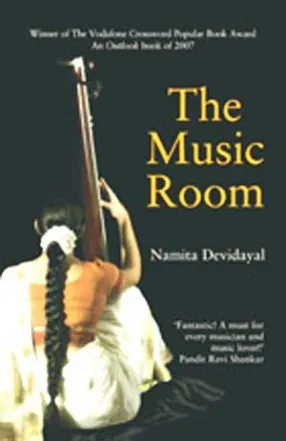
Review: The Music Room by Namita Devidayal

In an attempt to cool the temperature, I am sharing this review of Namita Devidayal’s book The Music Room.  I appreciate that BP is not afraid to tackle controversial and fraught topics relating to India-Pakistan but we need to mix it up with less controversial (but no less important) topics. 

Namita Devidayal’s memoir The Music Room is a chronicle of her relationship with her guru Dhondutai Kulkarni (1927-2014). The book describes Devidayal’s initiation into Hindustani classical music as a reluctant ten-year-old from Bombay’s upper-middle class. Along with describing her growing appreciation for Dhondutai and the music that she imparts to her, the narrative also tells the story of two other important figures in Hindustani music: Ustad Alladiya Khan (1855-1946)–the founder of the Jaipur-Atrauli gharana–and Keserbai Kerkar (1892-1977)–one of the most famous khayal singers of the 20th century. Through telling the stories of these individuals, Devidayal elucidates several important themes such as communalism and “Hinduization” of music as well as the place of women in classical music.

Devidayal describes the process through which Hindustani music became communalized and “Hinduized”. Though Dhondutai is extremely proud of the musical legacy passed on to her by Alladiya Khan Sahib’s family, she still expresses some bigoted views about Muslims. When pressed on this by Devidayal, Dhondutai attempts to square the circle by telling her that Ustad Alladiya Khan was not a real Muslim since he was (allegedly) descended from a Brahmin singer who had been forced to convert to Islam by a Muslim king. She also notes that he always wore the caste thread usually worn by Brahmins. This story allows Dhondutai to hold the belief that Hindustani classical music is essentially Hindu despite the fact that many of the most prominent gharanas had Muslim founders. Dhondutai’s prejudices connect back to the broader process through which–during the colonial period– Hindustani music was “Hinduized” by reformers such as Pandit Bhatkhande and Pandit Paluskar. Bhatkhande wanted to create a “national music” and believed that Hindustani music had been degraded by Muslims and dancing girls and needed to be rescued from both. This process has been extensively discussed by Janaki Bakhle in her book Two Men and Music: Nationalism in the Making of an Indian Classical Tradition. Unfortunately, while most ethnomusicologists agree that Hindustani music is a syncretic tradition, many (on both sides of the India-Pakistan border) persist in claiming it for one or the other religion. Continue reading Review: The Music Room by Namita Devidayal
On Bigotry

“Unfortunately, my experiences dealing with Indians (not all Indians obviously) have shown me…”

“I find a large subset of Hindus extremely toxic and hateful. I’m glad I don’t have to share a country with them. …”

“The “Saffroniate” cannot now claim innocence. The fact is that they get off on loss of life in Pakistan. They have real psychological problems.”

“There seems to be a genuine bloodlust for war and the decimation of Pakistan among Indian nationalists.”

Replace the target ‘Hindu’ with black, or even muslim, and what would happen if such statements are repeatedly published?

Pakistani claims of “false flag” has been a consistent pattern going back to the Mumbai attacks of 26/11/2008, where the Pakistani government for years refused to accept that Ajmal Kasab and his co-murderers were Pakistani.

It is deeply offensive for Brown Pundits to platform such preposterous assertions regarding the brutal massacre of Hindu tourists in Pahalgam. It has barely been a year since the tragedy occurred.

Platforming such propaganda is an overt choice. This is not free speech. This is spitting in the face of trauma.

Open thread

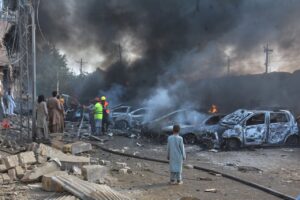
On early Sunday morning, May 24, 2026 — Just a few days before the festival of Eid al-Adha — on a quiet morning in Quetta’s Chaman Pathak neighborhood.  An explosive-laden vehicle ripped through a shuttle service carrying passengers, from the Quetta Cantt station –  killing at least 24 and 70+ wounded, mostly military personnel, laborers and families, that were headed to the Peshawar-bound Jaffar Express. These were ordinary Pakistanis looking forward to getting back to their hometowns for the Eid holidays. The Balochistan Liberation Army has claimed responsibility for the attacks. This tragedy comes just around the first anniversary of the Khuzdar school bus bombing  — killing 8 civilians, injuring dozens, most of the fatalities being school girls. This attack was also connected to separatist militants in the province. Celebrated by journalists, talking heads and govt officials across the eastern border along with their social media commentariat – blinded by nationalism.

Jaffar express sounds familiar as that train was also attacked a little over a year ago, March of 2025, early in the holy month of Ramadan. That attack orchestrated by the BLA, killed over 60. It seems like attacking Pakistan around the holidays is the M.O of these militant groups and their handlers.

There is grief across Pakistan as terrorism has gone up, patience is wearing thin among the general public with the states inaction against these adversaries of the nation. The Dhurandars are running up their kill streak, maiming innocent Pakistanis across the country, trying to instill fear, chaos and division. There is palpable frustration among the citizenry due to government incompetence and lenience towards ethno-fascism and a failure to protect its citizens from this regional proxy war. Will the Dhurandars be brought to justice for the mass murder of innocent civilians or will the Dhurandar-ing continue with more violence, terrorism and bloodshed across Arz-e-Pak to no avail.

Here’s to another somber Eid and world peace.

The Crescent has a sharp edge

Context in BP is cumulative, mes amis.

As we know, certain members of the Crescentiate remain emotionally invested in Pakistan, and certain members of the Saffroniate respond by undermining Pakistan. Neither tendency is a criticism in itself, we try to keep as few Shibboleths as possible in BP.

As an aside the Crescentiate are “Zionesque” (or perhaps more appropriate Jinnahesque) in the sense of preferring Pakistan to Islam.

What is a criticism is repeatedly reaching across that line, eliciting the predictable reaction, and then presenting oneself as the neutral party once it arrives. This is a small community with a very long memory. The personality maps build over time, and we remember who did what first.

The Crescentiate, with whom Sbarrkum is aligned, correctly called Iran the victor in this year’s confrontation with the United States and Israel, a reading the Saffroniate has refused to grant. We deeply dislike the regime but acknowledge that its valiant defence of the homeland may augur new glimmerings for the Ummah (we are who we imagine ourselves to be hence why psych warfare is so dangerous).

Getting Indian Classical Music Wrong

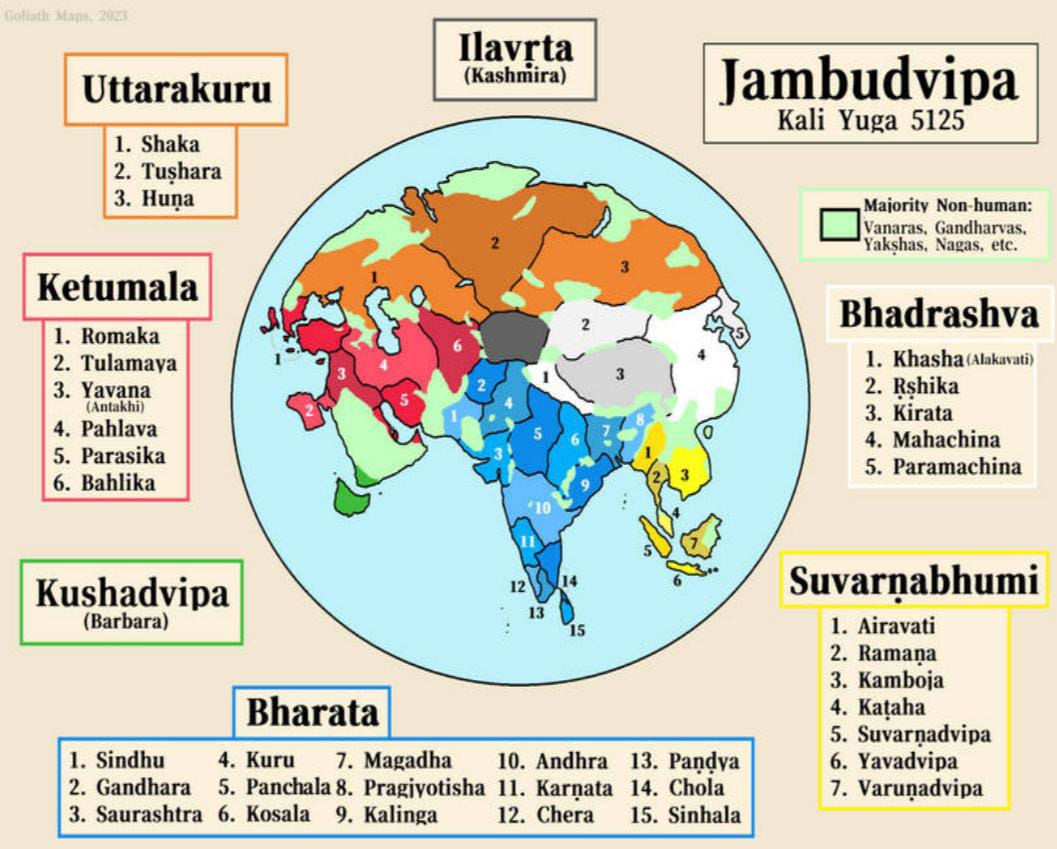
For instance, to tell our resident ethnomusicologist, an academic at Pakistan’s top university (Ivy+ crawls with LUMS researchers), that his field is entirely Hindu is ahistorical. Lest we be accused of green-washing, we prefer the Indian Continent be called Jambudvīpa.

Let's dive into the forgotten map of the ancients - Jambudvipa as described in our Puranas & Itihasas. This isn't just geography, it's cosmic cartography: mapping realms of humans, Devas, Nagas, Gandharvas

But we are also appreciative of historical truth: all major khayal gharanas have Muslim founders, converts or otherwise. Islam has long since moved past the mawali stage.

Imam Bukhari, compiler of Sahih al-Bukhari and the most authoritative hadith scholar in Sunni Islam, had a great-grandfather who was a Zoroastrian convert and mawla of the Banu Ju’fa.

So when someone is triggered, we will look to understand whether the trigger is justified, and what “triggered” the trigger, before acting.

Parliament at her Best:

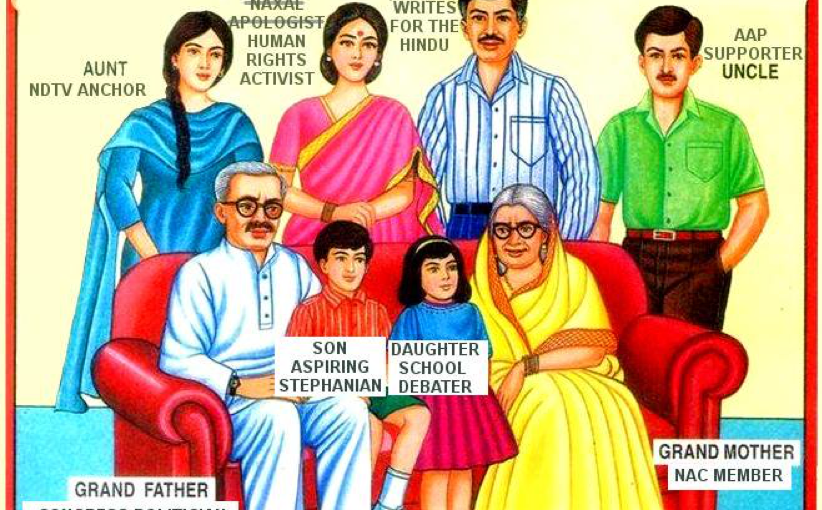
Remember this is Parliament. And in Parliament, the curious thing is that members of opposing benches are often more cordial with one another than they are with members of their own party. The hostility you see across the aisle is theatre. The knife-work happens at home.

We moderate by nunchi, not by formula, encouraging congeniality both within and across the benches.

Mocking Modi Is the Only Nationalism Left-Liberals Know

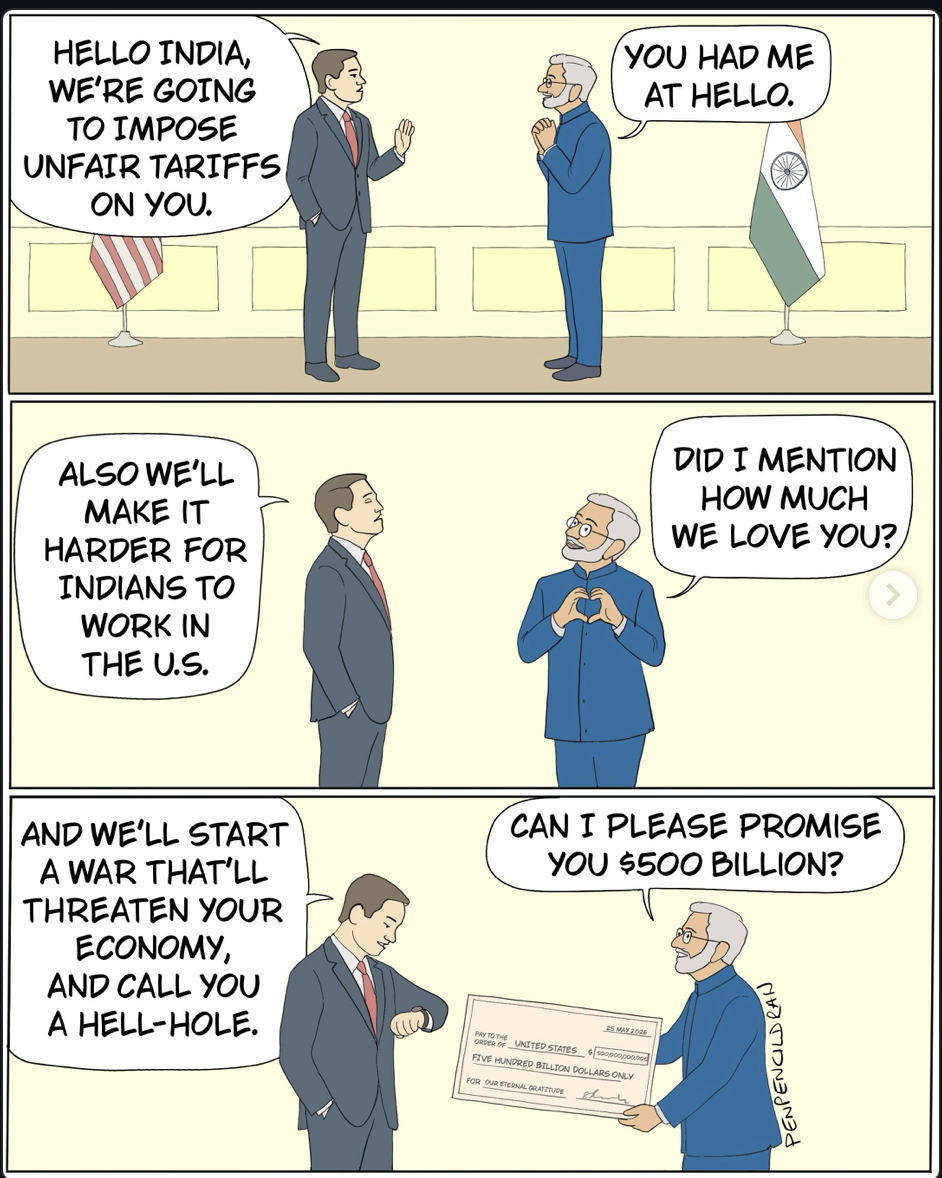
A Trump-coded American (a mix of JD & Rubio) imposes tariffs, restricts H-1B work, threatens war, calls India a “hell-hole.” Modi, eyes lowered, hands folded, writes a cheque for five hundred billion dollars. The signature reads penpencildraw, a left-liberal account. The Instagram account is run by urban anti-Modi liberals who, on most other days, want a poorer, slower, more Nehruvian India.

Continue reading Mocking Modi Is the Only Nationalism Left-Liberals Know

Mardana’s Children: The Rababis of Lahore (Short Film)–Kabir’s Open Thread

I don’t want to post too much in one day but this short film is worth sharing. On BP, there is a lot of focus on the negative side of Pakistan (understandably since this blog’s commentariat is mostly Indian nationalists and of a “Saffron” persuasion). Often, I feel that this commentariat finds the very existence of Pakistan personally offensive.  

This film serves as a counter to that discourse. 

A short film on the Rababis of Lahore, a community of Pakistani Muslim musicians with deep-rooted ties to the Sikhs by way of a centuries-old music tradition. Mardana’s Children traces the current descendants of Bhai Mardana (the 15th century musician and disciple of Guru Nanak), piecing together a story of shared devotion across India and Pakistan, traversing the modern boundaries of religious and nation, and highlighting the unifying power of music in the face of the divisive legacy of identity politics and the partition of 1947.

Disclosure: I know one of the producers (Kirit J Singh) from SOAS where he was doing a Phd on Sikh Music.  My father facilitated one of Kirit’s research visits to Lahore.

A useful piece to accompany this documentary is Arieb Azhar’s essay “Soundscape: When Punjab Sang as One” published in yesterday’s DAWN.

Finally, I would like to share a clip of myself performing the Shabad “Suraj Kiran Milay”. This shabad was composed in Raga Darbari by Ustad Hamid Hossain.


Nehru Lost India, Not Jinnah

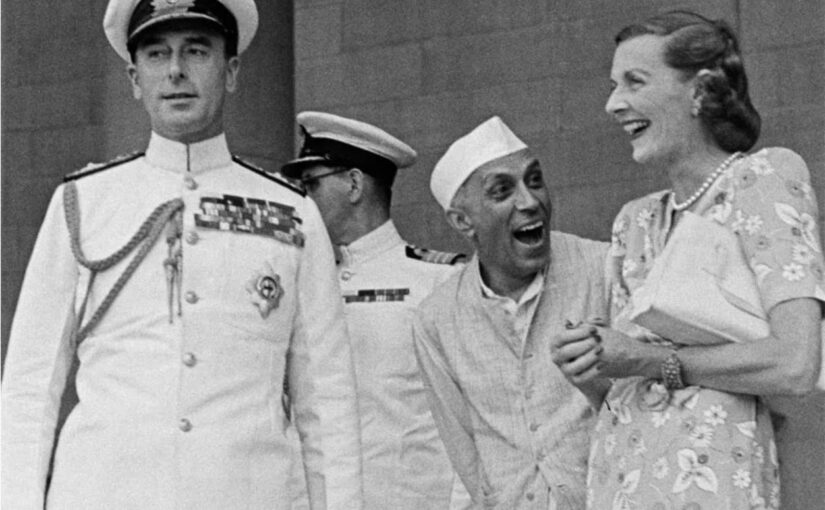
We write this from the chair of those who have just declined, again, to partition their own blog. The exercise concentrates the mind. Brown Pundits has a Saffroniate. It has a Crescentiate. It has an awkward intermediate seat between Viceroy and Prime Minister. We have chosen, repeatedly, to hold the centre.

We have observed that Nehru did not.

1. The Men.

Jinnah was self-made. He was technically brilliant. He was legalistic to the point of pedantry, which is the only kind of legalism that ever wins a constitutional argument. Nehru rode on his father’s coattails, on Gandhi’s affection, on the Mountbattens’ hospitality.

The asymmetry was decisive. One man knew the document. The other man trusted the room.

2. The Cabinet Mission Plan.

The Cabinet Mission Plan of 1946 already confederated India. Grouping A, Grouping B, Grouping C. The Centre held defence, foreign affairs, communications. Everything else devolved. This was workable. The League accepted it provisionally as the best available route to parity. Nehru wobbled, then in his July Bombay press conference reserved the Congress right to revise the groupings once seated in power. The League withdrew within weeks. The edifice collapsed.

The question the Saffroniate refuses to ask is the simple one. Why was it harder to confederate on linguistic lines than on religious lines? The States Reorganisation that the Republic executed in 1956 was already latent in 1946. Madras Presidency was a Tamil, Telugu, Malayalam, Kannada tinderbox. Bengal was Bengal. The Indus was the Indus. The Hindi belt was the Hindi belt.

Four groupings could have been negotiated. Continue reading Nehru Lost India, Not Jinnah

The Ministry of Utmost Happiness: A Look into the Underbelly of Modern India

Since we are being encouraged to look at the seamy side of each other’s societies (see BB’s post on child sex abuse among British Pakistanis), I am sharing this review of Arundhati Roy’s novel The Ministry of Utmost Happiness.  Ms. Roy is one of India’s greatest public intellectuals.  

Also see my review of her memoir Mother Mary Comes to Me

Ever since The God of Small Things was published to great acclaim in 1997, Arundhati Roy’s fans have been eagerly awaiting her next novel. It was a long wait—two decades—as Roy transitioned from being a novelist to being an activist and a non-fiction writer. Now, the wait has finally ended with the publication of The Ministry of Utmost Happiness.

The novel focuses on several characters, most of whom are outcasts from the new rising India. They include a hijra named Anjum, a Kashmiri separatist (or freedom fighter) named Musa and Tilottama, the Malayali woman who loves him. Over the course of the novel, these disparate characters encounter one another and their stories intersect, sometimes in surprising ways. Continue reading The Ministry of Utmost Happiness: A Look into the Underbelly of Modern India

Caste & British Pakistani Grooming Gangs

Admin Note: this thread was permitted and indeed encouraged. We hold that every community benefits from examining its own shibboleths. Members of the Saffroniate are accordingly asked to state their caste identity, and the privilege attendant on it, before participating in discussions about their Achilles heel. Intellectual honesty requires such disclosure to precede the argument.

Pakistan and North India

Pakistan is more “North Indian” than India. India has a much greater chunk of North India, both by area and population but it has a much bigger non North Indian population which changes the overall nature of India. Pakistan doesn’t so it remains steadfastly North Indian – in culture, language, food etc.

One of the side-effects of this is that Pakistan views India through the North Indian lens.

And while Pakistan is diverse in its own right, Indian diversity is orders of magnitude higher – in terms of race, language, culture, religion etc. India is a continent as a country. You could call it a “subcontinent”. Continue reading Caste & British Pakistani Grooming Gangs

Brown Pundits