
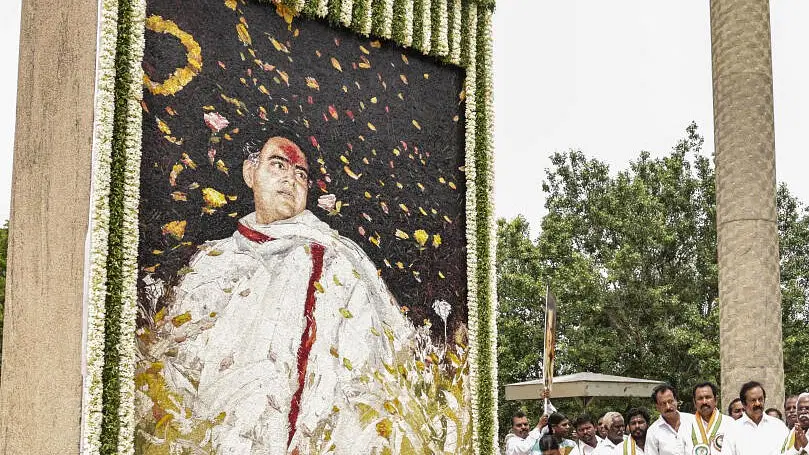
On this tragic day 34 years ago, Rajiv Gandhi was brutally assassinated in Chennai. It would be timely and worthwhile to respectfully reflect on his legacy — the good, the controversial, and the unresolved.

Southasia Is One Word
Reflections on Pervez Hoodbhoy at MIT
Zachary L. Zavidé | Brown Pundits | May 2025
Pervez Hoodbhoy needs no introduction. As one of Pakistan’s leading physicists and public intellectuals, he has long stood at the uneasy crossroads of science, nationalism, and conscience. He spoke this week at MIT’s Graduate Tower — the final stop on a grueling five-city U.S. tour, a new city every two days — in support of The Black Hole Initiative, a cultural and intellectual space he’s building in Pakistan. Despite its ominous name, the initiative is a wormhole, not a void: a cross-disciplinary bridge connecting physics, literature, art, and civic life.
What followed was less a lecture, more an exposition — sober, lucid, and grounded in decades of hard-won clarity.
The Logic of Annihilation
Dr. Hoodbhoy walked us through Pakistan’s nuclear doctrine: under long-standing military assumptions, if the north–south arterial route is severed, a tactical nuclear strike becomes viable. But the calculus is disturbingly abstract. Hiroshima’s 20-kiloton bomb killed 200,000. India and Pakistan each possess an estimated 200 warheads. One general once told him that, by crude arithmetic — obscene as it sounds — “only” 80 million would die in the event of a full exchange. Continue reading Southasia Is One Word
Flame Thread Warning
Comments are starting to get out of hand. I usually just trim the offending lines, but moving forward, moderation will be stricter. If something crosses a clear line, I may delete the entire comment—editing takes too much time. This is still a forum for disagreement. But juvenile antics help no one.
If you disagree with the moderation or with me, you’re welcome to voice it—respectfully—in the comments. I don’t want my own subconscious biases contaminating the tone of this site. But I also won’t let it descend into brawling.
A personal view: if Pakistan gave up all claims beyond the LoC, it would be a historic act of good grace—and help South Asia immeasurably. Knowing when to stop is also part of dignity.
First, gratitude to @phyecho1 for flagging the tragic assassination of Dr. Sheikh Mahmood Ahmad, a respected Ahmadi physician. He was a genuinely good man—returning from the UK to serve Pakistan, often offering treatment free of charge. May he rest in peace, and rise in the highest heaven.
“What You Hate is What You Love” — Reflections on the Indo-Pak Obsession
I hadn’t expected my open thread to ignite such a volume of comments. But it’s confirmed something I’ve long suspected: many Indians claim Pakistan is not their rival—but their reactions say otherwise.
Let me be clear: I deeply love India. I venerate her civilizational breadth. But the passion with which some Indian respondents—particularly North Indian Hindus and sections of the South Indian Brahmin class—engage with Pakistan is disproportionate. China, despite being a far more formidable geopolitical competitor, rarely evokes this level of visceral response.
Why? Because Pakistan is the sibling to Bharat. It’s the mirror. And rivalry with a sibling is always more intimate, more consuming. Continue reading “What You Hate is What You Love” — Reflections on the Indo-Pak Obsession
Open Thread — On Foundational Clefts and Brown Pundits’ raison d’être
It’s been remarkable to see Brown Pundits flicker back to life—fueled not just by posts, but by the comments. I’m realizing now that much of what I write draws direct inspiration from those who engage here. This is less a broadcast than a feedback loop.
And it’s made something clearer to me: BP’s real niche isn’t commentary—it’s incision. Academic, civilizational, ideological incision into the deepest fault line of the subcontinent: the Two-Nation Theory.
Every society has a foundational cleft: Continue reading Open Thread — On Foundational Clefts and Brown Pundits’ raison d’être
From Yohani to Nora: How Bollywood Mughalizes Everything
I’ve been watching Royals—Netflix’s palace drama starring Bhumi Pednekar, Ishaan Khatter and featuring Nora Fatehi—and it struck a familiar chord with where our comment threads, concerning Pakistaniat, have been going post-conflict.
It all began with grace.
Years ago, a Sinhala pop hit — Manike Mage Hithe — went viral as an IndiGo air hostess danced mid-flight. Simple. Elegant. Subcontinental. Un-Bollywood.
Two years later, it reappears: Nora Fatehi and Sidharth Malhotra, glammed up in Mughal court-wear, gyrating under chandeliers, mouthing Urdu couplets. Same song, different universe. Bollywood hadn’t remixed it. It had annexed it.
That’s the pattern: Bollywood doesn’t just Hindi-fy — it Mughalizes. Every regional input is re-rendered through a Ganga-Jamuni lens. The vibe is Ganges. The look is Indus. And the aesthetic is unmistakably Mughal. This is the real Indo-Pak cultural divergence: Continue reading From Yohani to Nora: How Bollywood Mughalizes Everything
“Mimicstan”: the burden of Purity from Pagan origins
Kabir: Lastly, KGS and other schools like it are never going to replace English with anything else. English is the way to get ahead in Pakistan (as it is in India to a large extent). The real divide in Pakistan is between those who are Urdu-educated vs. those who are English-educated.
As Kabir states, correctly, that Pakistan’s real divide is between those educated in English and those in Urdu. But what’s startling is that the English-educated class who should, in theory, be intellectually equipped to think critically often recycles the same tired tropes, increasingly unmoored from history or reflection.
The irony is sharp: those schooled in Pakistan’s vernacular languages, closer to the soil, are often more grounded in the idea that Pakistan should not be an alien implant, but a natural outgrowth of the subcontinent. It’s the Anglo-Urdu elite, disconnected from both India and the Ummah, that has imposed a post-colonial ideology designed to obscure origin and suppress complexity.
Let’s call this what it is: a mimic elite with settler instincts. Like Israel’s Ashkenazi founders or apartheid South Africa’s Anglo-Afrikaner elite, Pakistan’s ruling class sought to distance itself from the land it governed while claiming divine or ideological legitimacy to rule it. The mass displacement of Pashtun nationalism, the long war against Baloch identity, the obsession with Kashmir, the suppression of Bengali, the toppling of Afghan regimes—these were not accidents. They were acts of statecraft designed to fracture any natural civilizational or ethnic continuity that could threaten the state’s ideological foundations.
By contrast, Indian nationalism, especially that of the Congress, was pluralistic, even if patronizing. Its flaws were real: Brahminical bias, Hindu cultural dominance, an elitist bent. But it emerged organically from within the civilizational matrix. Nehru and Gandhi, despite their faults, belonged to the land in ways Quaid-e-Azam never did or, rather more tellingly, never wanted to. A fifth generation Hindu convert, QeA cosplayed as a brilliant British barrister with Muslim sympathies (the Pakistani elite are so proud of his pork-eating proclivities). QeA’s creation was brilliant—possibly a poker bluff played to perfection. But it came at enormous cost.
Partition wasn’t merely territorial—it was a civilizational rupture, most violently felt in Punjab, the Urland of South Asia: once serene and syncretic, peaceful and prosperous, suddenly shattered. Continue reading “Mimicstan”: the burden of Purity from Pagan origins
Norouz or Nowhere: The Identity Pakistan Can’t Claim
🌇 Dispatch from Dubai: The City-State That Arrived

Date: April 29, 2025 | Location: Dubai
Dear Friends,
I’ve been to Dubai countless times. I even got married here.

An Arabian Night
But this trip—technically for work—landed differently. Something in the skyline had shifted. And this time, I saw it.
The City That Clicked
Dubai isn’t a city in progress anymore. It’s a city in command. The lighting, the landscaping, the infrastructure, the energy—after decades of relentless building, it has finally snapped into harmony.

Celestial
For years, Dubai dazzled. Now, it breathes. Someone quipped to me, “Here, fuel is cheap—but water is expensive.” They weren’t wrong. I found myself driving 20km stretches without thinking twice—distances that, in the Home Counties, would take you through ten towns and two sets of speed cameras. Everything here is scaled differently: the lighting spectacular because energy is almost free, the landscaping evolving into more “natural” forms with drip irrigation discreetly running through the sand. And the traffic? Dubai has less congestion than Calgary. That says everything.
Continue reading 🌇 Dispatch from Dubai: The City-State That Arrived
The Arrogance That Binds: Post-Colonial Delusions in the English speaking Pakistani Mind
It’s been startling—at times dispiriting—to witness the tenor of Pakistani responses to recent BP posts. Not just the jingoism, but the denial. A refusal to acknowledge the civilizational reality of India before 1947. It isn’t just ahistorical—it’s tragicomic. And it reveals a deeper pathology: the English-speaking Pakistani elite is afflicted with Post-Colonial Derangement Syndrome. Omar has long argued this. I’ve become a convert over the past decade.
I love Pakistan. But that love doesn’t require denying India. I can honour my father and mother without disfiguring one to exalt the other. Civilizations are not exclusive claims—they are overlapping inheritances. Nationalism demands we choose. Patriotism allows us to belong. One blinds. The other binds.
Pakistan’s identity hinges on rupture. It claims to be not Hind, not Bharat—something purer, separate, superior. And yet, its elites remain obsessed with India. At least the Koreas and Vietnams acknowledge their shared past. Even China and Taiwan did—until foreign interference fractured that memory. But here? Not even a name is spared. There is no sign of “India” in the very land that birthed the name. If India truly didn’t exist in the Pakistani imagination, why the resentment? Why the rivalry? The schizophrenia is telling: deny the mother, envy the sibling.
Take Kashmir. If this is a political conflict—not religious—why were the victims in Pahalgam targeted as adult Hindu men? That wasn’t strategic. It was sectarian. Either the attackers acted from religious hatred, or the political cause they serve is entangled with it. You cannot claim secular nationalism while endorsing ideological murder. Continue reading The Arrogance That Binds: Post-Colonial Delusions in the English speaking Pakistani Mind
Let’s unpack Kabir’s comment. Credit where it’s due; his opinions inspire more of my posts. Perhaps it’s time he rejoined as a contributor.
“That may well be true. But you can’t deny that it is the liturgical language of Hinduism. There is zero reason for any Muslim to identify with it (unless they are specifically interested in languages). You could make a case for Pakistanis learning Persian since our high culture is Persianate. The same case cannot be made for Sanskrit.”
If Persian is truly the high culture, then why do ignore the one holiday that defines the Persianate sphere, Norouz? Afghanistan, Tajikistan, Iran, the Kurds, all speak different tongues, yet Norouz unites them. It is the civilizational cornerstone of Persian identity, the cultural “Jan. 1” across centuries of shared memory. But in Pakistan, Norouz is invisible. Not because Pakistan is un-Persian. But because Pakistan is post-colonial. The elite curate rupture, not heritage. Distance, not descent.
And let’s be honest: the erasure didn’t start with the British. Aurangzeb, still lionized by most Pakistanis (his fanaticism and Hinduphobia a plus point), abolished Nowruz as part of his Islamic “reforms,” replacing it with religious festivals. So how can one claim Persianate lineage while revering the very figure who uprooted it?
Continue reading Norouz or Nowhere: The Identity Pakistan Can’t Claim