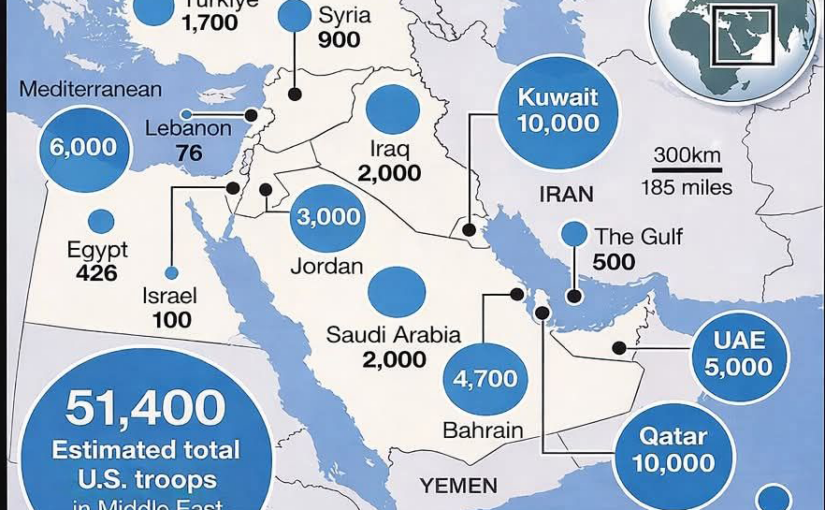
Header Image: US Bases in Mid East. Iran is the only Sovereign country in the Mid East without US Bases
“God created war so that Americans would learn geography” ― Mark Twain
Why are the Gulf Countries not attacking Iran. Because they are extremely vulnerable
a) Resource and Economic Vulnerability
b) Political, Regimes can be overthrown
c) Targets because they host US Bases.
The US though they have bases in the Gulf, have not come to the aid of Gulf Countries. To the contrary they are evacuating personnel from the Gulf.
Bahrain: Politically Vulnerable: Hosts the biggest US base in the Gulf. It is also has Shia 50% with Sunni regime. The Shia majority have been very restive and any war related turmoil can allow the Shia to overthrow the Sunni Regime. (Shias were previously the majority, being approximately 55% in 1979. However, the increased naturalization of Sunni migrants and persecution of Shia Muslims by the ruling Sunni Al Khalifa family led to an alteration in the demographics.)
Qatar: Has the biggest LNG production and they have shut down production. Why: Cant afford to have drones or missiles or even debris hitting the storage. The whole storage will go up like a Nuclear Bomb
Qatar accounts for 20% of global LNG exports, with 80% of those volumes to Asia.
Saudi Arabia: Like Qatar Saudi Arabia is Resource attack vulnerable. Oil production can go up in flames even though the oil is less volatile. Also with the Gulf or Hormuz shut down oil exports are nearly nill. However, they have pipeline to the Red Sea port of Yanbu. So Saudis need to also keep Houthis happy so that the oil that reaches Yanbu and loaded into Tankers is not attacked by Houthis. (Only about 1 million barrells/day to Yanbu, compared to 6.8 miilion Barrells/day thru Gulf Hormuz.
Saudi too has significant Shia population (10-15%) located near the oil fields in the Eastern Province (Najran, and Medina)
UAE/Dubai; Very Economically vulnerable. Falling Debris has closed Dubai Airport, the busiest in the world. Dubai is an Worlds Financial center in the League of Hong Kong, London and New York. 90*% of Dubai are expatriates, some extremely wealthy. Revenues from oil and natural gas account for less than 5% of the Emirate’s revenues. If Iran hits world’s tallest building, the Burj Khalifa thats the end of Dubais Economic Wonder.
So as you can see the Gulf countries need to play nice with Iran until the wsr End.
How will the War End. (some possibilities)
a) Iran Runs out of Missiles. (also low probability of layers of Iran Leadership Killed)
b) US Missiles are depleted
c) US has an Economic Shock (eg Stocks, DJI falls significantly eg to 40,000. Or US Treasury Bond yields spike to above 5%
When the dust settles regardless of Iran having lost it is going to be new Landscape in the Gulf. The US bases are most likely gone. When personnel are evacuated the looters come in like ants to dead carcass.
 Saudi East-West Pipeline can pump oil from the country’s main eastern oilfields to the Red Sea and has capacity to transport around five million bpd if Yanbu has the capacity to load that amount of crude the pipeline can carry onto ships, traders and buyers said. Crude loadings at Yanbu hit a peak of just under 1.5 million bpd in April 2020
https://www.bairdmaritime.com/shipping/tankers/aramco-moves-oil-flows-to-red-sea-as-hormuz-grinds-to-a-halt
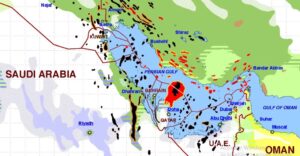
What the map below shows is that, due to a peculiar correlation of religious history and anaerobic decomposition of plankton, almost all the Persian Gulfs fossil fuels are located underneath Shiites. This is true even in Sunni Saudi Arabia, where the major oil fields are in the Eastern Province, which has a majority Shiite population.
https://theintercept.com/2016/01/06/one-map-that-explains-the-dangerous-saudi-iranian-conflict/