Why India’s National Calendar Needs Urgent Correction

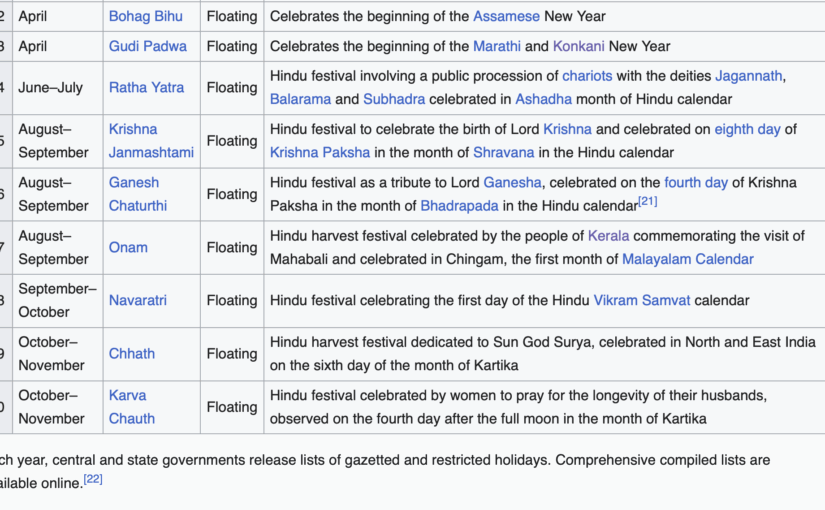
India’s national holidays should reflect its civilisation. They do not. Five Abrahamic festivals sit at the centre of the calendar, while most indigenous ones sit on an “optional” list. This is a distortion, not pluralism.

National holidays are public signals. They show what a country holds to be central. When non-indigenous festivals are guaranteed space and indigenous ones are not, the state sends a clear message: it is unsure of its own foundations.

This was a mistake made at independence. India had full freedom to shape its symbols. Instead of anchoring the calendar in its own tradition, the new state tried to avoid offence. That caution hardened into policy, even though no society builds confidence by sidelining itself. Continue reading Why India’s National Calendar Needs Urgent Correction

The Unfinished Contract II: Citizenship, Partition, and the Questions Liberalism Won’t Ask

A far-right senator, Pauline Hansen, recently walked into the Australian Senate wearing a burqa. Muslim MPs (one of whom wearing a hijab) angrily called it racist, bigoted, Islamophobic. They were right. But they also dodged the underlying question: What does citizenship mean when communities fracture along religious lines?

The same evasion dominates debates about Indian Muslims after 1947. One camp says: “They stayed, they’re citizens, case closed.” The other mutters about loyalty tests and fifth columns. Both positions are intellectually lazy. Neither grapples with what Partition actually did to the social contract.

This isn’t about defending bigotry. It’s about refusing to let bigots monopolize legitimate questions.

I. The Contract That Never Closed Continue reading The Unfinished Contract II: Citizenship, Partition, and the Questions Liberalism Won’t Ask

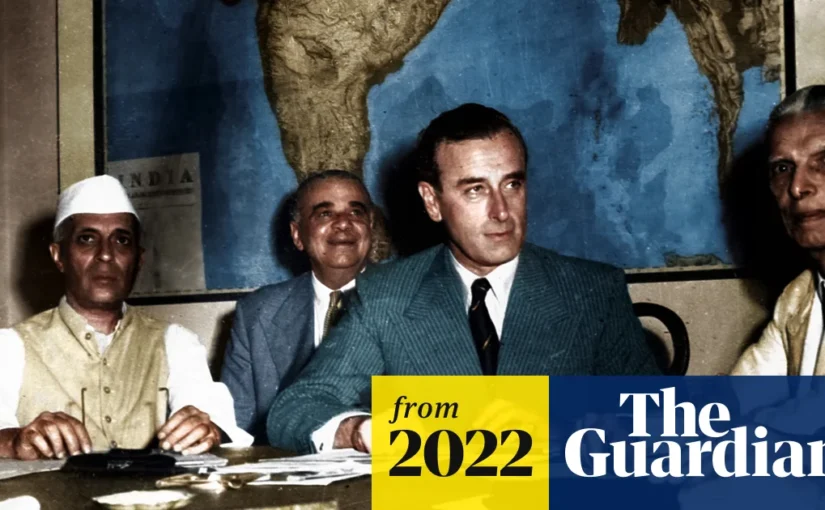
The Partition of Elites: India, Pakistan, and the Unfinished Trauma of 1947

I was speaking recently with a cousin who grew up in India. Their family has been Bahá’í for generations, but their older relatives once lived as Sunni merchants in Old Delhi. When they visited their grandparents as a child, they noticed something striking: in many lanes of Old Delhi, long after Independence, the sentiment was not Indian nationalism but Pakistan-leaning nostalgia. This was not hidden. It was ambient.

That single observation exposes something almost no one in Indian liberal discourse wants to say aloud: post-Partition India inherited a large Muslim population whose political loyalties were, at best, ambivalent. That is not a moral judgement. It is a historical one.

And once you notice this, a second truth becomes obvious: Kabir’s secularist vision of an emotionally unified India makes sense only in a world where 1947 never happened.

Continue reading The Partition of Elites: India, Pakistan, and the Unfinished Trauma of 1947

Pakistan’s Inner Logic

On Nivedita & Archer’s joint request (Mamnoon/Tashakor/Merci for the kind words); I’m going to expand on my comment:

Kabir is definitely right. Ethnicity in Pakistan is complex; there are three tiers of society. The English speaking elite (Imran is part of that so is Kabir), who are “Pakistanis” and ethnicity isn’t really reflected on…

This comment, which the BP archives have tons of similar posts on (BP was venerable even in 2014), sketches the bones of Pakistan’s sociological map. But what lies beneath the skin?

Pakistan is feudal; India is not.

That one statement alone explains much. Landholding elites dominate politics, rural economies still function on patronage, and class mobility is rare. Caste, though “denied,” is real and sharper, in some ways, than it could ever be in India (the reservation system does not really exist in Pakistan except for religious minorities but not for socio-economic castes). Pakistanis can sniff out class in one another with a dexterity that’s probably only matched in the United Kingdom, which is the home of class stratification (I remember reading Dorian Gray in Karachi in the early millennium and shocked how similar late Victorian early Edwardian England was).

The postcolonial state froze itself in amber. There has never been a serious leftist rupture, excepting 1971’s successful Bengali revolution. Even Imran Khan, who styled himself a reformist, is a product of elite schools, Aitchison College, Oxford, and aristocratic lineage. His “Islamic socialism” was only ever viable because Pakistanis still believe in myths of the benevolent landlord.

And yet, Pakistanis sometimes seem happier than their Indian counterparts, even if not remotely successful. Why? Continue reading Pakistan’s Inner Logic

Open Thread; Trans in the Muslim World

Other Stories (thank you Nivedita):

🔗 India Today – Harshvardhan Jain Scam

A man posed as a diplomat, set up fake embassies, and ran a multi-crore loan fraud racket via fake companies. He even issued “official” visas.

🔗 Business Standard – Karnataka Vendor GST Nightmare

A vegetable vendor in Karnataka received a GST notice due to high UPI volume — triggering a cascade of tax bureaucracy.

🔗 Economic Times – Indian Man Stabbed in Ireland

An Indian man in Ireland issues a public warning after surviving a random stabbing in Dublin.

🔗 NDTV – Hyderabad Man Kills Wife

In Hyderabad, a man stabbed his estranged wife to death at a birthday party for a child.

Brown Pundits