India and Pakistan used to dance together; locked in step, even if offbeat. Now, they move in opposite directions, occasionally brushing shoulders, never quite facing each other.
There is no context to this poem; it was a pure exodus of emotions. An expression / defence of romanticism in this capitalist, postmodern, post-ideological world.
This is just a quick note inspired by Indosaurus’s excellent suggestion; which I’d like to add to. I’m pinning this post to give it visibility.
First, it’s great to see the voluminosity of posting lately. Some days the blog pulses with original thought; other days, the comments surge while posts remain sparse. Both are signs of life and I’m glad for that.
But as Indosaurus rightly observed:
“A lot of the posts over the past 2 weeks are reposts from old publications elsewhere / mass media publications… I see no real point in posting to BP if it is going to get submerged off the top page within a few hours… Would it be possible to pin 100% original unpublished content to the top of the page?”
I think that’s a very reasonable proposal. There’s value in resharing good content, but I agree we should prioritize original, unpublished writing, especially content that reflects the spirit of Brown Pundits. So here’s what we’ll trial:
* Original, unpublished pieces will be pinned where appropriate. I request Editors / Authors to use their judgement / “nous” to sense what is original and / or value-add.
Please continue to post, read, comment, and share. But also reflect on what sticks, and why. Let’s keep the signal high.
I cannot moderate as effectively as before so I’ll relying on the Editors, Nivedita & Furqan, for support. I hadn’t realised I had made Furqan an editor a few days back as I wanted him to add Dead Poetstanis to BP.
As again we aren’t going to get this perfectly right as we grow so apologies if I/we misstep.
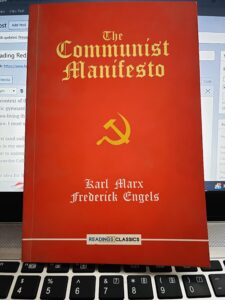
The context of this poem is a bit complex. I wanted to experiment with some poetic gymnastics to venture into new terrain, like writing from the perspective of non-living things. So I chose The Communist Manifesto. Such a paradoxical choice, I must say in hindsight.
The copy I still possess.
I first (and sadly, the last time) read it many years ago, sometime in 2019, when I was in my second (and final) year before university (though I never actually went to university, another detour we can explore some other time). I was at Edwardes College then (see the post “Against Platonic Love”for more details).
The idea for the poem surfaced after watching a dogfight — intellectually speaking — between the Slovenian philosopher Slavoj Žižek and Canadian psychologist Jordan Peterson. If you haven’t already, I recommend watching their full debate.
I’d said to myself: Why don’t I do my own Bhartiya-karan, that is, Indianise myself, before someone else thinks of doing it? The first problem was my name. Perhaps you don’t know: my name is Iqbal Chand. It occurred to me that “Iqbal” is an Arabic word. What kind of nationalism is it to live in India and have an Arabic name? And so, I changed my name to Kangaal Chand. As it happens, this name is far better suited to my financial condition considering that “kangaal” means “poor”. And why just me, it suits the rest of my country too.
The second problem that arose was of the dress. There was no trace of Indianness in the pants, coat and tie that I wore. In fact, all three were a reflection of my slave mentality. I was amazed that I had worn them all this while. I decided to wear pajamas instead of pants. But then, a certain Persian person told me that the pajama had come to India from Iran. And so, I began to wear dhoti and kurta. But not a kameez, as the word “kameez”, too, is of Arabic origin and it reeks of the stench and stink of an Arab!
The third problem was of hair! After all, was it not treachery against the country, a blatant form of antinationalism, to keep one’s hair fashioned in the English style? I instructed the barber to keep only one lock of long hair at the back of my head and shave off the rest. He did exactly that. I had seen images from ancient India showing men with long and lush moustaches. Following their example, I began to grow my moustache. When my friends saw the large moustache on my somewhat small face, they assumed that I had put on a fake one, possibly because I was acting in some play. Forget my friends, when I saw myself in this new look, I began to feel that I had been created not by God, but Shankar, the cartoonist. But I did not lose heart. One has to do all manner of things to be Indian.
An excerpt from a story by Kanhaiyalal Kapoor in ‘Whose Urdu Is It Anyway?: Stories by Non-Muslim Urdu Writers’, edited and translated by Rakhshanda Jalil.
As the posting on BP (and the comments) are pretty fast and furious; my capacity to edit and moderate is getting pretty stretched..
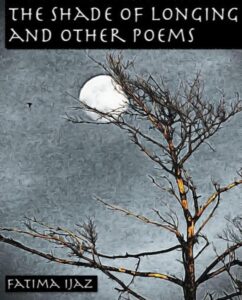
Fatima Ijaz, born in Karachi, studied linguistics in the United States and currently serves as the editor of The Pandemonium Journal. Her debut poetry collection, The Shade of Longing, offers a complex interplay of memory, language, and abstraction, often resisting closure and certainty.
In the preface, she articulates a powerful and poignant idea that serves as a compass for the book’s aesthetic and emotional journey:
“The contemplation of the past involves an evocative presence of a surreal present…In doing so, you are in a heightened state of present-past – a double consciousness that is more than the sum equal of its parts”
This is, in many ways, a deeply Hegelian thought. One is reminded of the famous assertion in The Phenomenology of Spirit that:
“That the True is actual only as system, or that Substance is essentially Subject, is expressed in the representation of the Absolute as Spirit-the most sublime Notion and the one which belongs to the modern age and its religion. “
In essence: the memories, she is talking about, are sort of in itself objects (fixed) and also subjects (variable—dependent on the person recollecting).
Reading this book feels like discovering a cache of love letters written in a fever of emotion, letters meant for someone dearly beloved. But just before mailing them, the writer realizes how insufficient they are. So she burns them all, and what emerges from the ashes are these poems: not just expressions of feeling, but indictments of language itself. A complaint, perhaps, that language lacks the fidelity to truly capture the depths of human experience.
By acknowledging the futility of language, she leans into abstraction. She chooses uncertainty over certainty and, the infinite over the finite, and invites the reader to participate in meaning-making. The gaps in her verse are not absences—they are openings. The reader is asked to bring their own memories, their own hauntings, to fill in the silences.
In the poem “Echo of a word, x memory,” the structure is minimal yet haunting. A single word—“(stray)”—is repeated eight times on one line, and this continues for thirteen lines. The effect is disorienting, hypnotic. Memory here is not narrative, it is reverberation, a stutter echoing in an unreachable corridor of time.
Celestial imagery recurs throughout the collection (stars, suns, moons) often to widen the emotional and metaphysical frame. She reaches for the planetary to express the personal, as in lines like:
“The face of the sun is smeared with the curse”
“I saw the shadow moon hunt down oblivion”
“Language emerges out of this exchange between fiery sun and eternal sky”
“The moon becomes a cosmic mirror on such…”
Another recurring anthropomorphic presence is that of bones and the black crow, symbols that oscillate between the sacred and the ominous.
“there wasn’t an ounce of regret in my bones / I knew I had practiced the art – and thus – the sacrifice.”
“Then there is the stubborn case of the black crow…”
In the poem “Tear-Drop,” regret and remorse seep through the lines:
“It does not matter, because I can touch / The midnight with my azure-blues / Perhaps the blame is on the harpsichord / Perhaps it’s on one of us / The black consciousness has entered / and there is no un-doing it.”
Her language—or rather, her suspicion of language—remains central. The “shade” she refers to is not just the shadow of longing but also a hue: the specific color of yearning that permeates the book. It’s a longing that refuses to be pinned down, named, or resolved.
In the penultimate poem, the titular piece, she writes,
“Do you think we become in the end / characters of our own stories? Do we finally / own them enough to discard them, have the infinite power / to reform our mind of its strange habitat?”
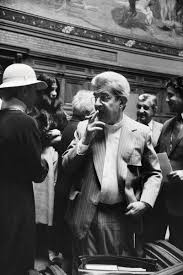
This is a moment of quiet brilliance. One could read this as a critique of ideology—first acknowledging the narrative scaffolding of the self (“I”) and then, in almost Lacanian fashion, gesturing toward the Real (one of Lacan’s three registers). To “discard” the story is to momentarily crumble the illusion of coherence.
Jacques Lacan (French psychoanalyst and psychiatrist)
Shade of Longing is not a book that yields itself easily. It is not meant to be understood in one sitting. It is a space to dwell in, misread, reread, and reinhabit. Like ghosts or witches watching from the periphery, these poems linger long after the final page is turned. Their magic lies not in answers, but in the haunting questions they leave behind.
Everyone, please take note of the following rules:
Authors may not void or edit the work\comments of other authors.
Maintain courtesy and respect in all interactions.
Nivedita has been made Editor. I believe it’s important to have a strong female editorial voice on the weblog. She has full discretion to void posts or comments she finds inappropriate; she has no need to appeal to me first. If you feel a decision was unfair, you’re welcome to raise it with me privately.
If anyone violates these rules, please contact me immediately. I’ll address the issue on a three-strike basis.
Lastly, a gentle reminder: please don’t post or comment in anger. It rarely leads anywhere constructive. I am present, I am paying attention, and I do my best to be fair. It’s late and I have an early start, but I’m a little concerned about the tone of the threads tonight; let’s keep this space thoughtful, not reactive.
The context of this poem is an interview of the legendary Urdu poet Ahmad Faraz (1931–2008) with Naeem Bukhari. Faraz is regarded as one of the true heirs of Urdu’s laminal poetic tradition and celebrated for his bold, progressive stances and romantic verses that deeply resonated with the masses.
Though I personally rank him second to Faiz Ahmed Faiz (his contemporary), due to the universality, conceptual depth, and themes Faiz cultivated in his poetry, what I love about Faraz is his radical romanticism and mastery of language. Especially since he hailed from Kohat, a non-Urdu-speaking city in Khyber Pakhtunkhwa, this is particularly remarkable.
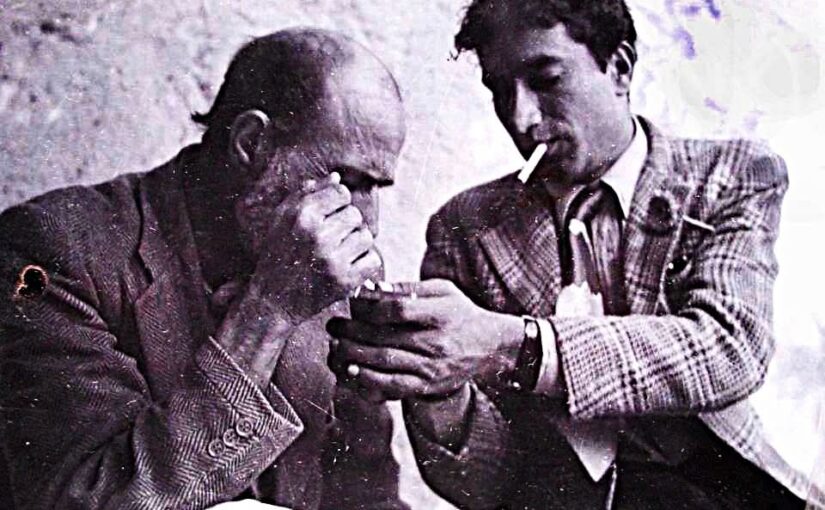
Two literary giants of NWFP/KP: Ahmad Faraz (right) lights a cigarette for Ameer Hamza Shinwari.
Another interesting connection between Faraz and myself is that we both attended the same institution, the prestigious Edwardes College. For those who don’t know, Edwardes College was established in 1900 and has produced generations of intellectuals and cultural figures, including Prithviraj Kapoor, the pioneering Indian film and theatre actor/director/producer; Dr. Khan Sahib (Dr. Abdul Jabbar Khan), the first Chief Minister of West Pakistan (The famous Khan Market in New Delhi is named in his honour.)
Edwardes College Peshawar
Coming back to the interview:
NB: Temperamentally aap ek romantic aadmi hain?
(Translated: Are you, temperamentally, a romantic person?)
AF: Haan, bilkul hoon. Main ek bharpoor ishq ka qail hoon. Ek mukammal insaan ke ishq ka. Main Aflatooni ishq (jo frustration ka ishq hota hai) ka haami nahi hoon. Us mein aap apne wujood ka aadha hissa zaya kar dete hain. Is liye aap mukammal mohabbat de hi nahi sakte kisi ko, jab tak apna poora wujood uske hawale na kar dein. Toh main ek mukammal insaan ki tarah, mukammal ishq chahta hoon. Jiske liye rona ho, jiske liye hansna ho, jisko aap yaad karein. Jo aapke wujood mein poori tarah sama gaya ho.
(Translated: Yes, absolutely. I believe in passionate, complete love — love for a whole person. I’m not a supporter of Platonic love, the kind that’s rooted in frustration. In that kind of love, you end up wasting half of your existence. That’s why you can’t give someone complete love unless you offer your entire being to them. So I desire complete love, as a complete person. Love for whom you cry, laugh, miss deeply — someone who becomes entirely embedded in your existence.)
And that is how I gestated this poem. Please enjoy!
Against Platonic Love
تسکین کو ہم نہ روئیں جو ذوقِ نظر ملے
[1] حورانِ خُلد میں تیری صورت مگر ملے
Sitting aimlessly on Eid day,
Thinking about the futility of the aeon,
I thought of the fractious spell
And the resultant intoxication I had, even
After years and years of encounter.
Peshawar is far more subliminal than Eden—
I can touch and lurch in the scent of the gated city
And prostrate upon it.
What maiden houris of the afterlife,
With a lightning appearance,
Pristine countenance,
And godly silhouette,
Could hold to the eyes of this crooked earthling
The wax of your ear,
The rusted steel nose pin,
Greyish, catastrophic hairs,
And the acned cheeks of yours?
Ah, the sensation of the earthly viscera,
The dysmorphia of every kind and sort—
It is incomparable to the untouchable,
and the non-sensorous holiest of holies.
Icarus [2] vaporized in this
Frenzy of the soar—
And so too the frustrated ones,
Whose beloved is exalted,
And merely and pathetically exalted
[1] taskīñ ko ham na ro.eñ jo zauq-e-nazar mile
hūrān-e-ḳhuld meñ tirī sūrat magar mile We would not weep for solace, if we had the gift of sight— If, among the houris of paradise, we found your likeness. (“`Ghalib)
[2] Icarus, a figure from Greek mythology, attempted to escape Crete using wax-and-feather wings made by his father, Daedalus. Ignoring warnings, he flew too close to the sun, causing the wax to melt and sealing his tragic fall.
I wrote this poem on May 14, 2025, after watching a deeply moving video of Robin Williams (1951–2014) hugging Koko (1971–2018). Somehow, the moment stirred something in me, and I was compelled to write.
Koko was a Western Lowland Gorilla, a critically endangered subspecies. Every year, thousands of these gentle beings are killed due to habitat loss and the illegal bushmeat trade in parts of Africa.
Robin met Koko in 2001, shortly after she had lost her closest gorilla friend, Michael. She hadn’t smiled since his passing. But on this day, with Robin, she laughed freely and fully. And so did he.