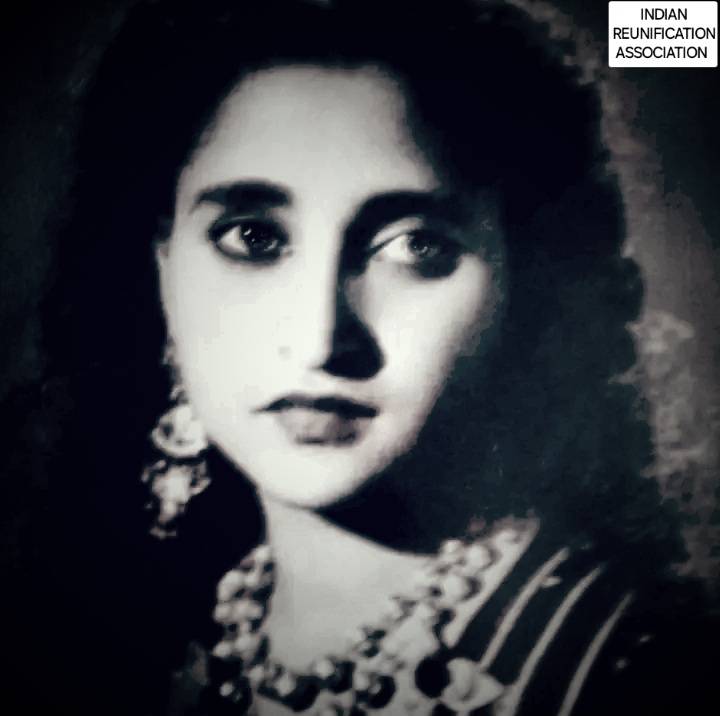
I’m Sumayya from Pakistan, it’s very nice to meet you all. I need your help, it’s about my Dadi.I’m attaching a picture of my Dadi a year after Partition. She opened up about Partition 1947. I believe it has been a severe kind of trauma where it took her nearly 70 years to open up completely, and even then she stopped talking after a while. It was a bloody massacre, Kashmir sadly bearing the brunt of it. Her last memories are being deceived to get in a bus which would take them to Pakistan, but then women yelling at the driver that he was taking them somewhere else.Then men standing outside scaring them with swords, while women ran away from the bus and jumped into a nearby river. My Dadi (fourteen at the time) and her younger sister also ran to jump, but her father held them and said nothing would happen to them, and directed them to hide under a seat. She doesn’t remember much after that, just the fact that she heard her baby sister being taken away, and then herself being dragged out, upon which she tried to clutch onto her mother’s kurta but it tore. At that point, herself and her mother were the last in the bus, everyone else was either killed or taken away.I am not sure, but she firmly, firmly believes that her sister was the most beautiful of them all and must not have been killed and maybe taken away to get married to someone. During her youth she tried posting about her in newspapers but it never helped. I know it’s probably too late, but maybe if she did get married and had children, she must’ve told her story to her kids, whom I could locate? I’ve registered to many Kashmiri directories and pages, let me know what else I could do to locate her family.
The only information I know is that they lived in Jammu, Kashmir and my Dadi’s name is Mehmooda. Her sister was Kulsoom (Ummul Kulsoom), they had eight more siblings. Their parents were Hakim Din and Amna.This is in no way a religious/political debate. Just want to use the internet to locate my long lost family.Post Credit: Sumayya T Malick
I rarely check Facebook. But I had posted my newsletter there and afterward I saw Sumayya’s post. Just like that, I knew what I needed to write.
Partition comes shrouded in fog and fire. We all inherit fragments of it. Some wear it openly; others bury it so deep it takes decades to name. What moved me wasn’t just the trauma in Sumayya’s words but the tenderness: a woman tracing the ghost of her great-aunt, lost in 1947, carried by generational hope.
Partition cannot be wielded to win arguments. It demands silence, humility, horror. The scale of violence was immense. The numbers unknowable but proportions matter. In East Punjab, Delhi, UP, and Bihar, where Muslims were minorities, serious historians estimate they made up 50–60% of all fatalities. In Bihar alone, tens of thousands were killed before Partition formally began.
But the violence went both ways. Sikh and Hindu villages were wiped out in West Punjab and the NWFP. Trains full of corpses ran in both directions. Pain had no monopoly.
Beyond the subcontinent lies an older, wider story of erasure; one in which Muslims, too, were devastated and often forgotten. The Armenian genocide and expulsion of Anatolian Greeks rightly haunt our memory of the Ottoman collapse. But so should the Circassian genocide, in which over 90% of the Circassian people were expelled by the Russian Empire, most perishing or settling in Ottoman lands. In today’s Armenia, especially the former Erivan Khanate, Turkic Muslim communities once formed the majority. Over the 19th century, under Russian and later Armenian control, many were displaced, dispossessed, or killed, often invisibly, as Armenians were resettled from Ottoman and Persian lands.
The pattern held across the Balkans. As the Ottomans retreated, Muslims, Turks, Pomaks, Albanians, were massacred, expelled, or forcibly assimilated. In Greece, especially after the 1923 population exchange, the Muslim presence was all but erased. While some expulsions were formalized, many were preceded by massive ethnic violence. The end of empire meant the catastrophic unhousing of millions of civilian Muslims, left stateless, and voiceless in the record.
Sumayya’s post brought this into focus. Dehumanization doesn’t stop at one event. Whether in Tigray, Gaza, the Rohingya, or Partition, it metastasizes. It hides behind law, civility, policy. But the logic is always the same: they are less.
Islamophobia, like casteism, anti-Blackness, or the erasure of Indigenous or Latino lives, isn’t always loud. Often, it’s quiet. Polite. But no less lethal. It shapes who gets believed. Whose stories get told. Who gets counted.
Trauma has many tones. Some are loud. Others, like her Dadi’s above, stay silent for 70 years. We must learn to hear both. And when we write, or remember, or reflect; let it never come at the cost of someone else’s humanity. That is the line. That is the work.
Am I being too cynical if I say this is exactly the kind of story the algorithms push. A Beautiful woman, utter tragedy (due to islamophobia) , appealing to humanity transgressing bounds of religion and border.
No, I don’t have a childhood trauma, this untrusting nature is all by my own self :).
The stories of Manto and Kushwant Singh are far more capable of bringing the horrors of the partition to life than the internet ever can (for me).
That maybe the case but it felt very authentic to me?
🙂 you’re a better man than I
the only Sumayya I could find: https://www.facebook.com/Kiva.Jones.Malik
“Toba Tek Singh” is perhaps the best commentary on the absurdity of Partition.
I haven’t read it
Sumayya must be referring to the Jammu massacres. This is a too-often ignored aspect of the Partition story. We talk a lot about Pakistani tribesmen invading the Kashmir Valley but we tend to forget that they did so in response to reports of Muslims being killed in Jammu (I’m not saying this to blame anyone but this is the causality). Some researchers have argued that the Dogra Maharaja knew about these massacres and was indifferent at best.
In 1947, Jammu province was also Muslim-majority.
Partition is definitely the foundational trauma for South Asia. If Mountbatten had stuck to the original 1948 deadline and implemented Partition in an organized fashion, India and Pakistan may well have been in a different place now. As it is, the ethnic cleansing on both sides created a cycle of trauma and hostility.
This is also why the term “Akhand Bharat” tends to trigger so many Pakistanis. We got Pakistan at an enormous cost. Any suggestion that India has a territorial claim on our land is unacceptable to us.
I don’t think Akhand Bharat is territorial.
But yes Partition was messed up on so many levels; Mountbatten was useless
You might not be using the term that way. But there are many Indians who do use it that way and deliberately mean to imply that Pakistan and Bangladesh are somehow illegitimate.
If we are to move forward, it can only be on the basis of respect for the sovereignty and territorial integrity of all three nation-states.
I don’t know why Lord Mountbatten wanted to rush the entire process through in only 70 days. That was only asking for trouble.
Later on when Quaid-e-Azam died (Sam Dalrymple notes that he had lung cancer), Mountbatten apparently said that had he known the Quaid was dying he would have delayed Partition and India may have remained united.
Pakistanis feel entitled enough to deny India’s civilizational state history, and pretend that its an entity only forged by the British. Why then, is it verbotten to point out that Pakistani is an artificial creation formed in the name of religious apartheid? It is what it is, it exists. And no sane Indian wants to question its existence. But demanding thought-policing on opinions on its creation?
doth protest too much.
I had to bring ur comments out of spam filter; I don’t know why Hoju & u are going to filter.
Q is the only IP address that is on filter; everyone else .
I think it is the name because we get a ton of spam comments, I think the Spam filter is scanning for short and common names.
That is my hunch.. also please upgrade ur profiles both you & Hoju
I tried to register for the site with my email address, and I did not get the link.
I do not think that Pakistan is entirely artificial
All nation-states are “artificial” to an extent.
in Bharat, more specifically, Chennai.
Vande Mataram!
I voided this ..
Why? I just read it and I can’t remember what it was. Couldn’t have been too shocking.
Just a quick note to explain why I deleted the comment. When I said that Pakistan is not a wholly artificial state, Daves launched into what felt like an emotional rant, implying that, because of my Pakistani origin, I couldn’t see things objectively, and so on. I’ve found it’s easier to simply void these kinds of exchanges.
Also, side note: for some reason, both Daves & Hoju’s replies still go straight to spam, even though Q is the only person actually marked as spam. Not sure why still?
Maybe wordpress can help.
🙂 Sry, I have to ask you to question whether you should be voiding comments asking whether you can be objective.
I didn’t register what was said, but my impression was it was very innocuous.
If theres a silver lining it’s that you know you’re doing a good job moderating when everyone is upset with you.
I am happy to discuss those; what I’m not happy with is being emotionally charged at.
Sorry, I don’t remember exactly what I had written, but I wasn’t at all implying anything personal about you, or for that matter anyone else. FWIW, I wasn’t even aware that you are of Pakistani origin. I assumed you had a Persian background since I saw some Baha’i references, and frankly it doesn’t matter that much.
I am…slightly disappointed at my comment being voided, and misunderstood.
This is the second time, my words have been misconstrued – the first when I was relaying the anecdote about the Balti Pakistani family I met in Guatemala. I think due to the friction with Kabir, there’s some generalization being made about me. conscious or otherwise. Again, its disappointing.
no worries; I am sensitive to tone rather than content per se. I am also. Persian btw
Like X.T.M, I object more to your tone than to any arguments you make.
Perhaps you may want to introspect about the way your words come across.
Nice try, is all I’m going to say.
Shashi Tharoor is not a Pakistani. He wrote an entire essay on why the “civilizational state” is inherently illiberal. You can Google it.
It is your opinion that Pakistan was formed on the basis of “religious apartheid”. Our point of view is that Pakistan was formed because the minority population of British India was afraid of being treated badly by the majority population once the colonial power left. This is not indefensible.
It is not “thought policing” to ask for respect for a country’s sovereignty and territorial integrity.
Holding an opinion, that Pakistan was created on the basis of religious apartheid, is not a violation of ‘sovereignty and territorial integrity’.
“Fear” of a particular ethnicity or sect, often drives apartheid. Arguably Nazis were “afraid” of the Jewish ability to dominate different sectors of the economy. Does that mean then, that their actions were somehow not bigotry?
The comparison with the Nazis is misplaced and gratuitous. Jews were a minority in Germany.
Muslims were a minority in British India. It is not indefensible for the minority to distrust the majority and seek self-determination.
I know that some of you have a thing about the sacred borders of “Bharat Mata” but unfortunately for you most people don’t believe there is anything particularly sacred about lines drawn on a map. Most national borders are created by human beings not by God.
Legends abound about how the Shakta pithas came into existence. The most popular is based on the story of the death of Sati, a deity according to Hinduism. Shiva carried Sati’s body, reminiscing about their moments as a couple, and roamed around the universe with it. Vishnu cut her body into 51 body parts, using his Sudarshana Chakra, which fell on earth to become sacred sites where all the people can pay homage to the goddess. To complete this task, Shiva took the form of Bhairava.
Most of these historic places of goddess worship are in India, but there are some in Nepal, seven in Bangladesh, two in Pakistan, and one each in Tibet, Sri Lanka[3] and Bhutan.[6] There were many legends in ancient and modern sources that document this evidence. A consensus view on the number and location of the precise sites where goddess Sati’s corpse fell is lacking, although certain sites are more well-regarded than others.
Akhand Bharat isn’t hard to find..
People are entitled to their religious views (whatever they may be).
As a rationalist, I believe national borders are inherently arbitrary and most of the time created by human beings. You just have to look at how many African countries have borders that are straight lines to know that.
There are of course natural barriers. The Himalayas is one of them.
yes Africa is a particularly pernicious case of arbitrary borders
national borders are a relatively modern creation anyway. But carving out an artificial state out of a civilizational one, purely based on religious apartheid, is what it is.
Muslims in pre-partition India, may be a numerically speaking a minority, but most definitely not an “endangered” one.
If it was simply just a fear of minority domination, then the Pakistani nation wouldn’t hardwire its constitution to outright ban any non-muslm from leading the country, would it. Its religious apartheid. That’s what it is.
Just because Indian Muslims aren’t endangered doesn’t mean they’re necessarily emancipated. Legal frameworks matter, yes but social bias often operates outside the law. Not all inequality is state-sanctioned; much of it is cultural, and that’s just as real.
Sure, but my argument is that just like the Southern states desire to secede was driven by an illegitimate cause ( “states rights” to perpetuate slavery of humans), the carving out of a separate muslim state was driven by religious supremacy that fundamentally bakes in religious apartheid.
Not all “emancipation” requires secession. And the rhetoric of ‘freedom’ is all too often co-opted by folks who actually want the ‘freedom’ to practice bigotry.
Now this doesn’t mean I’m calling for Pakistan to ‘dissolve’ or cease to exist. 80 odd years down the road, its a country with multiple generations of patriotic citizens. Fine. Let it be.
But let’s call a spade a spade. Am I going to stop criticizing caste based discrimination simply because some orthodox hindus would find it “deeply offensive”. No. It is what it is. Honest discourse requires honesty.
Pakistan has now been in existence for nearly 80 years. At what point does a state cease to be “artificial”? Anyway from a Pakistani POV it is deeply offensive for our nation-state to be called “artificial”. It is just as natural or artificial as any other nation-state. I would argue that all nation-states are artificial.
Pakistan is an “Islamic Republic”. That is the argument for why a non-Muslim cannot be PM. A non-Muslim PM would not be able to lead namaz. We have had Hindu and Christian chief justices.
India has not had a Muslim PM. And I believe it will not have one in my lifetime. And India (unlike Pakistan) actually is a constitutionally secular state.
we just agreed that all states are artificial, so why is it ‘deeply offensive’?
Calling it “Islamic Republic” or “New Medina” or whatever you want doesn’t change the fact that it was carved out in the name of religious supremacy and that continues to be its defining characteristic. Religious apartheid is what it is.
The problem is that Pakistan’s foundational myth is primarily a big lie. that somehow “muslims can’t live under non-muslim rule”. Which we know is a preference, not a requisite. Now in order to turn this big lie into ‘truth’ it becomes necessary to overstate and exaggerate the fear of “hindu domination”. Its a tough one, I grant you that. But don’t expect others to mollycoddle facts to protect your feelings.
You are entitled to your opinions. But your opinions are not facts and stating them as if they are is absurd.
You weren’t alive in the 1940s. So you have no way of judging the validity of the fears of many British Indian Muslims that British Raj would simply give way to “Hindu Raj”. Quaid-e-Azam was known as the “Ambassador of Hindu Muslim Unity”. He had tried for twenty years to negotiate a deal (separate electorates, weighted representation etc). When no compromise was forthcoming, he opted for the option of last resort which was a separate sovereign state. This is not indefensible.
Usually when Indians call Pakistan “artificial” they argue that India was always there and it is Pakistan which is somehow fake. We have seen that argument on this blog as well. From a Pakistani POV, that is deeply offensive. Both nation-states were created at the exact same time.
I’m going to leave it here. I’m actually not all that interested in re-litigating Partition.
“Syeda Hameed & Harsh Mander on Partition, pluralism and poetry”
https://www.youtube.com/watch?v=6z6RUeCJ76Y
Arun pooree of India today had a full issue regarding people who were separated during partition and were helped to reconnect. That was a nice issue.
Faiz Ahmed Faiz wrote a poem called “Dhaka Say Wapsi Par” (On Return from Dhaka). It’s usually referred to as “Hum kay thehrey ajnabi”. Though it’s about Bangladesh, it also fits the context of 1947.
Here is Nayyara Noor singing it:
https://www.youtube.com/watch?v=KB7aZ8RYTD4