
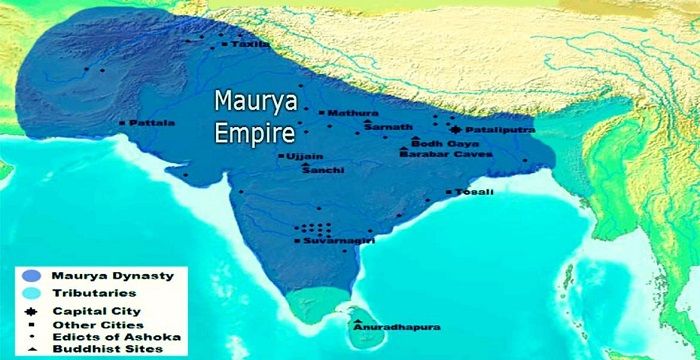
When people claim that India and Pakistan are “equally artificial,” they erase the long, uneven civilisational trajectories that produced both. Kabir, who is generally more courteous than the average Saffroniate imagines, still falls into this conceptual trap. But the question this raises is larger than contemporary geopolitics:
When was India’s Golden Age, and for whom?
A Golden Age can be political, cultural, philosophical, or civilisational. The answer depends on what we measure: scale, radiance, confidence, or continuity. Asking it forces us to examine whether India is a recent invention or a very old organism repeatedly broken and reconstituted.
Pakistan complicates this picture. As the Indus zone, it has deep civilisational roots of its own; older than Islam, perhaps as a geographic expression even older than the Vedic world. This is why, despite its ideological volatility, Pakistan will likely persist: it sits on a basin that has generated coherent cultures for five millennia. Its anti-India posture gives it political definition, but its underlying geography gives it durability.
India, that is Bharat, by contrast, has always been a continental project, but not a uniform one. The “wings” of India, Bengal, Punjab, Kashmir, the Northeast, have historically explored different variations of Indianness, each negotiating distinct external pressures and civilisational overlays. Yet all remained within the elastic but recognisable Indic sphere underpinned by the Ganges.
Meanwhile South India is the fourth civilisational zone: a core India rather than a frontier India. Dravidian polities were often the subcontinent’s most stable centres, imperial, literary, temple-building, maritime. They were not outliers. They were anchors. So when we ask about a Golden Age, we are not simply dating a dynasty.
We are asking: Which zone of India was flourishing, and according to which civilisational metric?
This cannot be reduced to modern borders. Nor can it be answered by pretending that India and Pakistan emerged from identical historical clay.
I keep saying that I am talking about Nation-States. The modern nation-states of “India” and “Pakistan” were both created on August 15, 1947. This is the historical consensus.
British India was a colony. The Mughal Empire was an empire etc etc.
There was no nation called “India”.
Those are technical definitions; so nation states only came into being with the Treaty of Westphalia but England & France pre-existed that
I am only clarifying the point that I am talking about the modern nation-states of India and Pakistan. In that sense they are both “equally artificial”.
France was not a nation-state until after the French Revolution. Before that it was a kingdom.
Obviously “India” has a long history. But that history does not all belong to the current entity called the Republic of India.
To argue anything else is a-historical.
Both are fair points that I happen to agree with, although sometimes the way you put it across gets interpreted as if you ascribe to the “india is completely arbitrary” view. This forum would do well to make a clear distinction between ROI (1950) and India, the civilisation. The argument that the UN recognizes ROI as the successor state to British India is a bit trivial to the long arc of history. That said, what would it take for pakistanis to assert their rightful inheritance?
Thanks for your response. I don’t see how my insisting that the nation-states of “India” and “Pakistan” were created at the exact same time can be interpreted as my arguing that “india is completely arbitrary”.
I find the Indian nationalist argument that India was always there and Pakistan is some fake entity extremely offensive. It is intended only to de-legitimize Pakistan.
All I’m really arguing is exactly what you said: That the “Republic of India” does not equal British India or the Mughal Empire etc. When we are talking about the Republic of India, we need to specify that.
I believe that Pakistan should claim all the history that occurred within our borders and not only the Islamic bits. LUMS has begun offering a course on Sanskrit so there is some hope.
https://thewire.in/south-asia/in-a-first-since-independence-a-pakistan-university-is-teaching-sanskrit
Kabir you are obfuscating; India was an entity that even Babur wrote on. Hindustan existed.
Pakistan was literally made up in 193x..
why is that offensive to acknowledge; Pakistan is a young state with deep roots.
IVC can be seen as a precursor to a Pakistani entity but the question of where has that entity “folded into” (Itself, India that is Bharat, the Middle East, Greater Iran)..
Once again, there was no nation-state of India until August 15, 1947. “Hindustan”, the Mughal Empire etc were not nation-states.
Girmit agrees with me on this point.
When Indian nationalists argue that Pakistan is “fake”, it is meant to de-legitimize the country.
People can make whatever arguments they want, but they are being a-historical. I, for one, have no time for a-historical arguments.
The Republic of India (1950) is India in the sense that the European Union is Europe. Certainly the administrative entity with the strongest claim, but with notable omissions. In the case of Pakistan, they have the Indus, two very important Indic provinces, and sites like Taxila and Sharada Peetha that are civilizationally important.
probably stronger than the idea of Europe?
i understand, was just indicating what i think gets lost in communication between you and others, although I disagree a bit with Pakistan being considered a homeland of all muslims of british india. I don’t think there’s a pathway for deccani or malabar and several other prominent muslim communities to identify with Pakistan in a meaningful way
I think they very much did; Muslim League was founded in the aftermath of the Bengal Partition.
But as Pakistan evolved into an “Indus state” now it’s more difficult to identify with
of course, the ideological kernel of Pakistan was in the hindustani core and bengal, but de facto, it is currently a very culturally north/northwest indic culture with major frontier Iranic influences. Most Pakistanis i know , barely relate to anything Indian outside of north/northwest, for natural reasons of ethnic distance. They seem to know next to nothing about Bengali culture or food. Islam in the subcontinent is actually fascinatingly diverse, from Assam to Jammu to Kutch to coastal Karnataka to southern Tamil Nadu. Being the inheritors of Awadhi or Delhi’s courtly traditions is such a thin slice of it. Its not all sherwanis and adabs. A hindu kayastha from Barabanki was more a part of that darbari culture and sabk-e hind milieu than the muslim mercantile families of konkan.
I think also because India is so centred on the North-Northwest cultural stream..
I do agree the Southern Muslims (non-Urdu speaking Muslims) have VERY different interactions with Indian culture and civilisation..
I do agree the Southern Muslims (non-Urdu speaking Muslims) have VERY different interactions with Indian culture and civilisation
I have always said that South India (non Indo Aryan) is more tolerant and accepting and allows assimilating.
Assimilation and Integration depends on the outlook of the majority community.
The corollary being Indo Aryan India is dragging its feet in assimilating its non dwija neighbors, i.e.the Sudras and Dalits. Thats about 70% of the population
I do see the logic that each wave of Indic civilisation would be more hybridised in an ancient setting.
South Indian are essentially IVC + AASI
North Indians are South Indian + Steppe
North Indian Muslims are North Indians + marginal Middle East
For instance the elite Christians (in the church and leadership) of Pakistan Punjab have Muslim surnames; they were converts from Islam I suspect, a few generations ago.
A hindu kayastha from Barabanki was more a part of that darbari culture and sabk-e hind milieu than the muslim mercantile families of konkan.
Interesting
In SL, specially in the South and West Muslims are fast integrating with the Sinhalese/ The young generation have become Sinhalese speakers (my generation they spoke Tamil).
In the East, not integrating and at loggerheads with the Tamils even though they speak Tamil.
2019 Easter Bomber mastermind and family was from the east. The govt had been warned that there was a Radical Islamic faction, but nothing was done. Political, so as not to antagonize voters.
I thought there was some issues between Muslims & non-Muslims in SL 6yrs ago.. politically Muslims have always been a different community?
I have generally been explicit that when I say India and Pakistan were created at the same time I am talking about nation-states. I don’t know how much more explicit I can be about that.
The point with Pakistan considering itself the homeland of the Muslims of British India is that at Partition, Muslims from any part of British India were free to migrate to Pakistan and become Pakistani citizens. That path to citizenship obviously ended after the first couple of years when Pakistani nationality laws were framed. Pakistan is not Israel which accepts Jews from anywhere. We have 240 million citizens of our own. We cannot accept people from elsewhere.
I don’t know about the rest of South India but people from Hyderabad definitely moved to Pakistan.
I believe that as of now the only way to become a Pakistani citizen is either to have a parent who is a Pakistani or to marry a Pakistani man. I don’t believe non-Pakistani men get citizenship through marriage to a Pakistani woman but I’m not sure.
so it is no longer a homeland in that sense
Pakistan is not Israel. We are not allowing Muslims from any other nation-state to make “aliyah” and become Pakistanis.
Pakistan is the nation-state of its 240 million citizens.
However, the ideology of Pakistan remains the Two Nation Theory. We do see ourselves as the homeland of the Muslims of British India.
Well said, Kabir. It’s not just offensive, it’s simply insulting. They are trying to insinuate that Pakistanis are “fake,” and modern-day Indians are “the real deal.” They want to erase our identity. Afghans and white supremacists do this as well. This is clearly false; both modern-day India and Pakistan were carved out of the British Raj in August 1947. Alexander the Great never stepped foot in modern-day India, but the history books speak of “ancient India” which is an attempt to erase Pakistan’s rich (cultural) history. Another good example is the Sanskrit grammarian Panini who lived in modern-day Pakistan, though they will falsely claim that he’s Indian, equating him with modern-day Indians. It’s beyond me why modern-day Indians think they can lay claim on our history that took place on our lands. It’s nice to see that a university in Pakistan is offering a course on Sanskrit, it’s time that Pakistanis start waking up and realize their history is being stolen by others that have nothing to do with it.
Thanks for your comment.
Definitely, it is a-historical to claim that India has always been there and Pakistan is fake. The historical consensus is that there was no nation-state of India before August 15, 1947. Thus India and Pakistan were created at the same time and are equally legitimate.
On Panini etc, I will disagree with you slightly. He was not “Indian” in the Republic of India sense in that he did not live or die on the territory of the Republic of India but certainly he was part of “Indian civilization”.
The problem on BP is that people use the term “India” very loosely. This is why I keep saying that if the modern nation-state is meant that should be clarified. If we mean British India, we should say British India etc.
Omg I thought S95 was being sarcastic!
Perhaps. But I tend to assume people are arguing in good faith until it is clear they are not.
That’s a generous assumption on the internet
R u for real?
I don’t know all of the “they”, but i know several hindu nationalist types and they would be thrilled to learn that Pakistanis are reclaiming sanskritic and broader pre-islamic heritage. One of the differences i see in the hindu mindset (if such a thing exists) is that the politics of religion is really about culture and fear of erasure. Westerners and muslims often project their own understanding of inter-religious strife being about faith. They are truly talking past each other. If Pakistani cinema created its own Mahabharata production that surpassed anything Indian cinema could achieve, hindu nationalists would stand and clap.
The people who like to “own” or “ratio” ppl on X with cruel memes are not part of any serious conversation and are too niche to react to.
This is a genuine question (I’m honestly not being snarky):
Do you feel that it is fair to say that part of why Hindu nationalists would stand and clap at a Pakistani production of The Mahabharata is because they want all of us Pakistanis to admit that we were by and large originally Hindu?
Personally, I don’t think there is anything wrong with Pakistanis choosing which part of our history we relate to and which parts we don’t. If we choose not to have anything to do with anything that is non-Islamic, that’s also a valid choice.
This is not a choice that I have made since I sing Hindustani classical music (including bhajans). But plenty of Pakistanis have a visceral aversion to anything Hindu. And I think they are entitled to make that choice.
I do think that in the South Asian context most “inter-religious strife” is really about politics. Partition remains the fundamental trauma of modern India and Pakistan.
Accordingly if Hinduphobia is an acceptable feature of Pakistani life and culture then India has every right to exclude anything to have to do with Pakistan..
Don’t misunderstand me. I’m not talking about state level policy. I’m talking about individual choices.
Suppose I (for example) want nothing to do with “The Ramayana” (for whatever reason–let’s just say I don’t relate to it at all). That’s a valid choice.
“India” has every right to exclude anything to do with Pakistan”– What precisely are you hinting at? If you mean Urdu then that is the native language of many many Indian citizens. It’s not a “Pakistani” language. If you mean Islam then that is the faith of 20% of Indian citizens.
That’s why this argument becomes problematic. At the individual level, people are free to relate or not relate to whatever they want.
I meant Pakistan not Urdu or Islam, which are separate matters
OK. Then you have to clarify what you mean when you say “India has the right to exclude anything to do with Pakistan”. What exactly are you thinking about concretely?
I also want to clarify that just because I don’t like “The Ramayana” doesn’t mean that I have any problem with Pakistanis who do like it. Literary taste is subjective.
LUMS is now offering a course on Sanskrit. Had such a course been available when I was at LUMS, I probably still wouldn’t have taken it. I’m not moved by Sanskrit. But obviously there are students who were interested enough to take this course.
> Do you feel that it is fair to say that part of why Hindu nationalists would stand and clap at a Pakistani production of The Mahabharata is because they want all of us Pakistanis to admit that we were by and large originally Hindu?
To some extent, yes, there are those who are fixated on that. Although i see them mostly online. In actual interactions, I experience the opposite, where people *overestimate* the ethnic disparity. They actually believe that muslims are mostly an exogenous group, despite looking identical. These are the same people that probably think that *all* north indians hindus are steppe aryans and *all* south indians are indigenous dravidians. Not the most nuanced takes, but that is most people, they are so locked into their present day household identities that they can’t imagine, mass cultural churn, and the ebbs and flows of endogamy over centuries.
Savarna hindus, and brahmins in particular, want sanskritic culture to expand because, as custodians of that culture, it elevates their prestige and thats important when you are a small minority. (Anyone nitpicking this, understand this is a kind of generalization, and yes, they are not the *only* custodians of sanskrit, ect) There’s always going to be some ethno-narcissistic angle to things, but its not an overtly premeditated plan to politically dominate people.
As far as Pakistanis having the right to be selective about what aspects of their past to elevate, of course, there’s nothing to disagree with. Likewise, many “hindus” do the same and aggrandize their ethnic culture over the classical/sanskritic one, or even within classical culture, appreciate prakrit/pali over sanskrit. That said, personally i’m a maximalist when it comes to cultural memory. It would be fascinating to see the people of KPK become the foremost experts on their own prakrits, sanskrit, art and philosophy, and still remain rooted in their modern faith. Much of “hinduism” is just indic philosophy and requires no faith. In fact, one of my closest friends who happens to be pakistani, and a devout muslim, also has a very subtle and deep appreciation of Advaita and and its leading thinkers.
I don’t really see anything to disagree with in what you’ve written.
I do think you perhaps underestimate how much the ideology of Pakistan is linked with the Two Nation Theory. Most mainstream Pakistanis are viscerally opposed to anything that hints of Hinduism.
I can’t speak for the people of KPK but what I know about Pashtuns is they tend to be some of the most conservative Muslims out there.
>Much of “hinduism” is just indic philosophy and requires no faith.
This is in of itself a very ‘Indic’ take if not a ‘Hindu’ one…
>>But plenty of Pakistanis have a visceral aversion to anything Hindu. And I think they are entitled to make that choice.
This is as damning a confession of prejudice among the many that I have seen you make on BP.
I think you struggle with reading comprehension. Either that or you’re being disingenuous. I don’t know which is worse.
I never justified that choice. I simply believe that it is the right of each individual to choose what they are or are not interested in.
I sing Hindustani classical music. My bhajans are available on Spotify. There are quite a few of them (by Bhagat Kabir and by Meera Bai). So clearly I personally don’t have a visceral aversion to anything Hindu.
Don’t make stupid arguments.
Yes Pakistanis turned into a caricatured Middle Eastern-Central Asian hybrid
Instead of having real cultural weight in the Indian Subcontinent.
For instance after Dhurndhar; the amount of Indian tourists that would want to visit Heeramandi & Lyari Town is staggering.
Own goal by Pak
Sorry, lived experience shows we are not “a Middle Eastern-Central Asian hybrid”. We are a Punjabi majority country. We wear shalwar kameez, eat South Asian foods, speak Urdu etc. There is nothing “Middle Eastern” about us except our faith.
On tourism: as long as the hostility (which both sides are responsible for) continues the borders will remain closed. There are many many Pakistanis who would love to visit the Muslim historical sites in India. They can’t do that either. I can’t do that even with my American passport.
But anti-Indianism & anti-Hinduism has made Pakistan exactly the.
A country of negatives and wannabes
You’re entitled to your subjective opinions on Pakistanis. I don’t agree with you.
“anti-Indianism”– India is a country with which we have a territorial dispute and with which we have fought multiple wars. A certain amount of anti-Indianism is justified. Many Indians are also anti-Pakistan. It goes both ways.
Be that is it may, the main point is that we are not by any means “Middle Eastern”.
The historical record is unambiguously clear. The hostility against India is largely if not almost entirely, initiated by the Pakistani side.
As has been said above already. Own goal indeed.
As has been pointed out to you multiple times and you refuse to understand your country has conducted “Operation Sindoor” against Pakistan. You all have murdered Pakistani women and children.
Your PM has Muslim blood on his hands. So clearly hostility goes both ways.
that’s a great question.. Pakistanis have still yet to imagine themselves..
We are very clear that Pakistan is the homeland of the Muslims of British India.
in that case you guys should have your own c a a type law and allow any indian, bangladeshi muslim who wants to settle there.
touche
We have 240 million citizens. We do not have the ability to take in any outsiders.
Then you are not the “homeland of the muslims of British India”.
We are not going to offer “aliyah” to every South Asian Muslim. Pakistan is one of the most populated countries in the world.
then it is not the “homeland.”
Again, the ideology of Pakistan is the TNT. Pakistan was founded as the homeland of the Muslims of British India.
However, we are not Israel. Israel has an incentive to increase the population of Jews vs Palestinians.
Pakistan has 240 million citizens, the vast majority of whom are Muslim. We don’t need to increase the Muslim percentage of citizens.
Tell that to the Bihari migrants in East Pakistan who are still to get access to their ‘homeland’.
‘homeland of Muslims of British India is a hollow claim.
They are Bangladesh’s problem not Pakistan’s. Bangladesh should give them all the rights due to Bangladeshi citizens.
“East Pakistan” no longer exists and hasn’t existed for more than 50 years.
Your anti-Pakistan agenda is patently obvious.
anti an opinion of kabir != anti-pakistan. No matter how many times you shriek it.
Oh please! Your agenda is so obvious.
For one thing, your comments on BP are almost entirely in response to me. They tend to be hostile (to Pakistan and to me personally). You question my intellectual credentials–which is ridiculous since we all know where I went to university and we don’t know where you went.
You don’t tend to comment on threads that don’t have anything to do with Pakistan. So the agenda is clear.
let’s keep it civil
“RecoveringNewsJunkie” clearly has an agenda. Why does he never bother to comment on any thread that has nothing to do with Pakistan?
He only comes on this site to attack Pakistan and to express hostility towards me.
He is for “peace.”
Kabir has his opinions?
Pakistan does have responsibilities, Kabir..
“East Pakistan” has not existed for more than 50 years. Those “Biharis” are no longer Pakistan’s problem.
In any case, it’s an issue between Bangladesh and Pakistan. “RecoveringNewsJunkie” has no locus standi.
That logic can be applied to France too. The history of France does not all belong to the current entity called the Republic of France.
India is real, Pakistan isn’t.
You are the one being ahistorical.
I don’t think you even know what the word “a-historical” means.
That’s OK. You’re an anonymous account. God alone knows what your intellectual credentials are. I went to some of the finest universities in America and England. Enough said.
.
Empirically 2025 is the Golden age: more prosperity more equality etc etc.
I just hope 2035 will be better 🙂
wrt the original framing:
North Indian golden age would be the Gupta-Vakataka age 400-500 CE including Maharashtra where the Vakatakas ruled.
As for south hard to look beyond the Chola peak from 1000AD onwards.
For Muslim elites it would be Mughal peak;
Question of Golden age is always wrt to for whom !
vijayanagar in south, its influence is still very much evident in telugu states, tamil nadu and karnataka. maratha rule is still evident in gwalior, baroda, jhansi, tanjavur, all outside their hinterland.
Asokas Empire never extended to Sri Lanka. The Empire stopped in Kalinga, modern Orissa.
What Asoka did was sen his son Mahinda and daughter Sangamitta to Sri Lanka to introduce Buddhism. For that Sri Lankan Buddhist have been grateful for 2000+ years. Regularly reminded by the monks during Buddhist Holiday sermons.
Asoka also sent emissaries to Myamar to spread Buddhism
Many have tried to occupy Sri Lanka over the millennia. It was only the British that conquered all of Sri Lanka
The Chola’s held the North Central Province the Raja-Rata for about 80 year. Their goal was to plunder the wealth. There is some huge Hindu Temple in South India that was built with this plunder.
Not bad for small country about the size of Ireland, next to a giant neighbor to have retained its identity for over 2000 years.
From AI
Chola emperors, especially Rajaraja Chola I and Rajendra Chola I, conquered Lanka (Sri Lanka) and utilized its resources, including revenue, gold, and manpower, for constructing their magnificent temples like the Brihadisvara Temple in Thanjavur, funding vast economic systems, and displaying imperial power, integrating Sri Lankan wealth and tribute into the Chola heartland’s economic and religious centers.
My note, the Cholas never grasped the that wealth of Sri Lanka was from its “Hydraulic” technology and its vast network of canals and huge reservoirs. They got the wealth, but not the technology that created that wealth.
“Not bad for small country about the size of Ireland, next to a giant neighbor to have retained its identity for over 2000 years.”
You say this as if India is one ethnic nation state. I am a Telugu and we are part of India but we still remained Telugu and maintained our culture and language. In fact, I belong to Telanagana, which split from Andhra Pradesh although both speak Telugu. Split was motivated by cultural and historical reasons..
Telanagana is not an Independent Country. At the moment a part of India.
Sri Lanka has been an Independent country for 2,000 years other than under British Rule
A factoid for you Ruthvik
The last three kings of Lanka (Kandyan Kingdom) were Telugu Nayakkars.
They didnt conquer, just inherited. The last Sinhalese King Narendrasinge wife was a Nayakar. When Narendrasinghe died the the throne went to the wifes brother. They were Telugu Nayaks and spoke Telugu. They filled the court with their Telugu speaking relatives. The The Sinhalese term “Andara Demala (Tamil)” means Tamil that one cannot understand
Credit to the second Nayak, Kirti Sri Rajasinha who revived Buddhism by bringing down Monks from Siam (Thalland) and revived the Upasampada ceremony.
https://en.wikipedia.org/wiki/Nayaks_of_Kandy
First I dont have much confidence in IQ by web participants.
SL Highest IQ in South Asia
SL 12th in the world
https://international-iq-test.com/en/test/IQ_by_country
“Were the Delhi Sultans Really ‘Foreign Rulers’?”
By Nikhil Agrawal
https://agrawalnikhil.substack.com/p/were-the-delhi-sultans-really-foreign
Very good article
you should post a few of his links – he’s a great writer
I liked his essay on Urdu.
https://agrawalnikhil.substack.com/p/urdu-an-indian-language
post it?
very dhimmi indeed.
this is how the gangetic hindoo survived the muslim rule. this is the so called ganga jamuni tehzeeb and later it was called secularism.
the number of hindu high officials in turkic and mughal rule was miniscule. apart from building palaces, mausoliums, these people did nothing.
further, did they consider themselves as sons of this soil?? i doubt very much.
“apart from building palaces, mausoleums these people did not nothing”
I’m sorry but you are factually incorrect. My own area of specialization is Hindustani classical music. This is part of the Indo-Islamic culture. It developed in the Mughal courts. Without the Mughals there would be no Khayal in its modern form.
Similarly, Urdu is a major part of Ganga-Jamuni Tehzeeb.
that’s not a university or a social good.
In which pre-modern empire were the imperial rulers building universities?
Imperial courts were primarily concerned with developing a courtly high culture and glorifying the dynasty.
that’s interesting to see what sons of the soil meant in the medieval ages. remember this does predate nationalism to some extent
i think that by aurangzeb’s time, the mughals lost their interest to recapture their original homeland. the court language was persian.
below is an excerpt from mohammed habib’s address, as reported by ramachandra guha.
https://ramachandraguha.in/archives/history-against-sectarianism-the-telegraph.html
Pakistan had been created as a homeland for Muslims. However, many Muslims had voted to stay behind in India. To those who questioned their commitment, Mohammad Habib answered that ‘the overwhelming mass of the Muslims of this land have an undoubted Indian paternity. It is true that there are innumerable Muslim families in India who claim a foreign origin, but this affiliation is purely fictitious’.
Habib warned Indian Muslims against nostalgia for the medieval past, when the rulers were of their faith. As he remarked: ‘The position of the Indian Musalmans in the middle ages was, if a very rough simile be allowed, not unlike Indian Christians during the British period’. Ruler and ruled might worship the same God; but in everything else they were separate and different. Habib further remarked: ‘In days when we were suffering from an inferiority complex owing to the brutal fact of a foreign government, which seemed unshakable, we made the best we could of our medieval Rajput Rajas and Turkish Sultans. That attitude is no longer necessary; and the plain truth has to be told that all our medieval governments were intensely exclusive aristocratic organisations. … War and politics were games which only the well-born were allowed to play. The governments were in no sense governments of the people. An analysis of the officers of the Moghul and the pre-Moghul governments of Delhi will reveal the plain and sad fact that Muslims of Indian birth were rigidly excluded from the higher military and civil offices of the state. An Indian Muslim had as little chance of becoming a warlord of the Empire of Delhi as a Hindu Shudra had of ascending a Rajasthan throne.’
I think Indian Muslims did make 10% of Mughal officials and a huge amount of intermarriage did happen..
I don’t think the Muslim elite were a caste, but had to be open to talent and influx..
oh ! god he is a hyderbadi. surprisingly none here picked it up but opened up after filipinos opened the issue.
who is?
Formerly brown is referring to the Bondi Beach shooter who was an Indian national.
One thing I’m trying out rhetorically is moving away from essentialist labels like North and South Indian, which serve as concrete identitarian polarities, and instead trying to use geographical vectors or intensities like northern, southern, western, and eastern Indian instead. I’m not sure if this is a fruitful idea yet, but we’ll see.
Why not Indo Aryan, Dravidian and North East India.
Tamil Nadu, Kerala, Karnataka and Andra considered Dravidian.
The rest of India excepting North East to be Indo Aryan
Very nice