Obituary: Brigadier Malik Mohammed Aslam, 1938-2023

Brigadier Malik Mohammed Aslam was born in August 1938 in the village of Choi in the Salt Range (Northern Punjab). He passed away after a long and eventful life on June 30 2023. I wanted to write a few words for a couple of different reasons: one, he was my father’s closest friend and one of the most extraordinary human beings I have ever met; but second (and perhaps more important for the historical record) he played an important role in the defense of Lahore in 1965 and yet this role is not recorded anywhere. I wanted to correct that oversight.

Brigadier Aslam attended Military school Sarai Alamgir and passed out from PMA with the 17th long course with the Norman Medal and other honors. He was commissioned in the artillery and was serving in Lahore in 1965 as a young captain. In August 1965 Pakistan had sent armed raiders into Kashmir (operation Gibraltar) to spark an uprising there. That operation failed miserably and instead the Indian army captured Haji Pir pass and threatened Neelam valley and Muzaffarabad, so the Pakistan army invaded Chamb (operation Grand Slam) to relieve pressure and perhaps get a breakthrough from that direction. While all this was going on in Kashmir, the high command in Pakistan remained confident that India will not expand the war to any other theater (this moronic confidence came about because Bhutto and friends had sold the Gibraltar idea to Ayub (who was a bit of a coward) with the assurance that India will never dare to extend the war to the “regular border” and it will remain confined to Kashmir). Indian PM Shastri was thought to be a weakling and Indian performance in Rann of Katch had been unimpressive, so the army high command bought this dumb idea. But on the night of 5-6th September the Indian army launched an attack on Lahore and the Pakistani army was caught off guard. The local GOC had started moving some troops forward, but most of the troops were still in Lahore cantonment when the Indians attacked. Captain Aslam, commanding a field battery, was woken up by the sound of gunfire. He tried to call his superiors to find out what was going on but nobody in corps HQ in Lahore had any orders for him and he was told to wait till they got in touch with superior officers. On his own initiative and without wasting any further time, Captain Aslam opened fire with all guns and was the first and only artillery battery to do so. This fact can be confirmed with other participants in that night’s events. He kept firing for the next 17 days and two of his barrels melted in the process. Several small and large decisions that night helped to save Lahore, but this was definitely one of them. (though to be fair if the Indian army had been better led, they could have taken Lahore that morning; that they failed is also due to the incompetence and cowardice of their commanding officer, general Niranjan Prasad (whom Harbaksh Singh wanted court martialed for cowardice). Continue reading Obituary: Brigadier Malik Mohammed Aslam, 1938-2023

Book Review: Grand Delusion; the Rise and Fall of American Ambition in the Middle East

From Dr Hamid Hussain

Book Review

Steven Simon.  Grand Delusion: The Rise and Fall of American Ambition in the Middle East (New York: Penguin Press), 2023.

“Grand Delusion” by Steven Simon provides a timely analysis of the dynamics that shaped American foreign policy in the post-Cold War era in the Middle East.

The major theme of “Grand Delusion” revolves around the notion that American policymakers suffered from a persistent delusion that military force alone can bring about sustainable change and security in the complex web of Middle Eastern conflicts.

In the last five decades, American involvement in the region revolved around many areas considered vital for American national security interests.  In the early phase, containment of Soviet Union was major area of concern.  The U.S. sought to prevent the spread of communism and Soviet influence in the region, leading to increased military and economic aid to countries perceived as strategically important allies, such as Turkey and Iran. Continue reading Book Review: Grand Delusion; the Rise and Fall of American Ambition in the Middle East

Podcast: A “Frank” conversation about modern Indian politics

Another Browncast is up. You can listen on Libsyn, Apple, Spotify, and Stitcher (and a variety of other platforms). Probably the easiest way to keep up the podcast since we don’t have a regular schedule is to subscribe to one of the links above!

In this episode Akshar and I talk to “Frank”, an Indian financial professional with an interest in Indian history and politics. We discuss everything from Nehruvian India to Modinomics, Hindutva and whether a boom is coming…

Frank tweets on twitter as @frankisalegend1 

Book Review: Four Battlegrounds by Paul Scharre (AI Defense Applications)


From Dr Hamid Hussain

Recently did a book review of an excellent book about AI use in defense realm.

 Hamid

 Book Review –   “Four Battlegrounds” by Paul Scharre

 “Four Battlegrounds” by Paul Scharre is a fascinating account of emerging technologies especially Artificial Intelligence (AI) in military affairs and modern warfare. New technologies from the invention of gun powder, artillery, automobile, airplane, tank, and submarine have propelled revolution in military affairs throughout human history. The first computer-based model was used by the Russian military known as the Unified Command and Control System (UCS). It was developed during the late 1960s and became operational in the Soviet Armed Forces in the mid-1970s. It integrated various data sources, such as radar, satellite imagery, and communications, to provide comprehensive real-time information about the tactical and operational situation to military commanders. Since then, computer technology has penetrated every aspect of military activity.

 Artificial intelligence (AI) is rapidly evolving and changing the military culture and has the potential of revolutionizing various aspects of warfare. AI assists in analyzing vast amounts of data collected by military sensors, satellites, and intelligence sources. By utilizing machine learning algorithms, AI can identify patterns, detect trends, and extract actionable intelligence from large data sets, supporting decision-making processes in a shorter time span. AI enables the development of autonomous systems operating on land, air, and sea, such as unmanned aerial vehicles (UAVs), unmanned ground vehicles (UGVs), and autonomous submarines. These systems can perform surveillance, reconnaissance, and even combat missions without human intervention, reducing risks to personnel.


AI is also employed in the development of what is called ‘intelligent weapons systems’. AI algorithms help improve targeting accuracy, optimize trajectories, and enhance overall effectiveness. This information can then be used to make better-informed decisions, AI algorithms can also be used to monitor and analyze data from military equipment, enabling predictive maintenance. By predicting failures and recommending maintenance actions, AI helps increase equipment reliability, reduce downtime, and enhance operational readiness.

 AI has a crucial role in military cybersecurity to detect and respond to cyber threats. AI systems can analyze large amounts of data, identify patterns, and detect anomalies that can prevent and mitigate cyber-attacks. AI’s role in training is developing sophisticated simulation tools for military training purposes. AI-based training systems can be used to simulate realistic combat scenarios, allowing soldiers to hone their skills in a safe and controlled environment. This technology can also be used in medical evaluation and ordnance disposal saving human lives.

 In addition to many limitations of technology in human conflict, use of AI in the military also raises ethical and legal considerations, such as ensuring appropriate human oversight and control, minimizing risk of collateral damage, and addressing potential biases in decision-making algorithms. The major challenge is the need for ethical guidelines and regulations to govern the development and use of AI in military contexts as different cultures have different perspectives.

 The book gives use of emerging technologies in four battlegrounds of the future: land, sea, air, and cyberspace. Scharre expertly navigates through each domain, providing readers with a comprehensive understanding of how traditional and unconventional warfare are being reshaped by advancements in technology. Scharre uses case studies to explain these technologies that are shaping the battlefield and changing the dynamics of conflict.

 Scharre is well qualified to discuss the subject in depth in view of his own career in the military, defense policy and technology sector. He is familiar with the terrain of all three areas as he a former U.S. Army Ranger who have served tour of duty in Afghanistan and Iraq, served as policy advisor in Pentagon and familiar with the culture of technology companies at the forefront of groundbreaking work on defense application of AI.

 Schare is not a disciple of ‘tech mania’ and presents a balanced view providing an insightful analysis of opportunities presented by emerging technologies while at the same time highlighting the limitations as well as potential dangers. He also addresses the moral dilemmas faced by policymakers, military leaders, and soldiers on the ground. He examines the challenges of adhering to international laws and conventions while leveraging cutting-edge capabilities and the potential for unintended consequences in an interconnected world.

 There will be fierce competition between United States and China to develop and implement the game-changing technology of AI in military domain and the winner will dominate the future. We hope that humans don’t repeat the history that in their quest for domination focus only on destructive creativity ignoring constructive creativity. Humans invented weapons for industrial scale carnage of First World War managing to kill about 18 million humans of all races, religions, and ethnicities in four long years. 1918, God reminded them what he can do by sending influenza pandemic that killed 21 million people globally in four short months. He has sent a signal in 2022 in the form of COVID-19 that should encourage reflection by all powers obsessed with global domination only through coercive means.

 Paul Scharre. Four Battlegrounds: Power in the Age of Artificial Intelligence (New York: W. W. Norton), 2023


Hamid Hussain

20 May 2023

coeusconsultant@optonline.net

Judicial Jitters in Pakistan, continued..

Two pieces from Dr Hamid Hussain on the higher judiciary in Pakistan. Well worth a read. Third piece is awaited.

What follows was written by Dr Hussain. 

Societies in general are becoming polarized and Pakistan is no exception. In times when main source of information is tweets, face book posts and a vlog by a youtuber, no one has the time or inclination to try to get information. Everyone picks his own set of facts that fits into his pre-conceived idea.  Facts are not shaping the opinion but it is the other way around where facts are adjusted to one’s opinion.

Judiciary has emerged as an important player in the power play. In the last few months, I have made an attempt to write about the subject that was a new ground for me.  I got educated and enlightened by many well informed folks.  This is first of the three part series on the subject matter.  Only for those interested in the background of unfolding events.

“Neither to laugh; nor cry

Just to understand”        Spinoza

Hamid Continue reading Judicial Jitters in Pakistan, continued..

Major Amin on the current crisis, May 2023

Another Browncast is up. You can listen on Libsyn, Apple, Spotify, and Stitcher (and a variety of other platforms). Probably the easiest way to keep up the podcast since we don’t have a regular schedule is to subscribe to one of the links above!

In this episode I talk to Major Amin, well knows to our listeners. Just a short chat about what is going on.

Pakistan Crisis: The Arrest of Imran Khan

Another Browncast is up. You can listen on Libsyn, Apple, Spotify, and Stitcher (and a variety of other platforms). Probably the easiest way to keep up the podcast since we don’t have a regular schedule is to subscribe to one of the links above!

In this episode I talk to Maneesh about the latest crisis in Pakistan. We start with a little background and then discuss what is happening right now and what we may expect in the future. Comments welcome.


I promised to link some good articles:

Best summary of how we got to this point: What Imran Khan’s Ascent did to Pakistan 

Good as always from Dr Mohammed Taqi (@mazdaki on twitter) https://thewire.in/south-asia/imran-khans-arrest-will-exacerbate-pakistans-multi-system-meltdown

Probably the best news and analysis show on Pakistani TV these days (as in well prepared, logical, usually objective) is Shahzeb Khanzada. 

The corps commander’s peacock

Soldier Sahibs-Review

I reviewed this book for the Pakistani magazine “Herald” 22 years ago. We had a podcast about the East India company yeseterday and it reminded me of this book, so I dug up my old review (posted unedited):

Soldier Sahibs is an old-fashioned and unapologetically imperialist book. And writer Charles Allen makes sure you know what you are getting into by giving it the flagrantly politically incorrect subtitle: The Daring Adventurers Who Tamed India’s Northwest Frontier. But imperialist does not necessarily mean inaccurate and Allen has taken a good deal of trouble to get his facts right. The book claims to tell “The astonishing story of a brotherhood of young men who together laid claim to the most notorious frontier in the world, India’s North-West Frontier,
which today forms the volatile boundary between Pakistan and Afghanistan.”
The men in question include John Nicholson, Harry Lumsden (founder of the Guides), Herbert Edwardes, William Hodson, James Abbot and Neville Chamberlain. ProtĂ©gĂ©s of Sir Henry Lawrence, these men were responsible for laying the foundations of British rule in the Punjab and the Northwest Frontier. The author’s intent is to tell the story of these young men and through their adventures, give the reader an idea of how the British conquered – or, as he would prefer, “pacified” – the ‘wild’ Northwest Frontier of India.
But while Soldier Sahibs gives a very readable account of the adventures of these (surprisingly) young men, it is not possible to piece together the broader history of those times from his book. Why the British were here in the first place and what were the factors that made a small island in Europe more powerful than any kingdom in India do not form any part of Allen’s concerns. Nor does he waste much time explaining the situation in the Punjab or of the East India Company at that time. In fact, the author does not even provide a map of the vast area over which his protagonists established their rule. If you are totally at sea about those times, then you may have to read a few other books to fully appreciate the goings-on in this one. But if you are one of those enthusiasts who cannot get enough of the Raj, the mutiny and all that jazz, then you will definitely enjoy this book. Its written in authentic ‘Flashman’ style, with wit and verve and loads of ‘local color’. Continue reading Soldier Sahibs-Review

Major Amin on the Current Crisis in Pakistan

A lot of our regular listeners have been asking for Major Amin’s views on the current crisis in Pakistan. We are fortunate that he shared his views today and gave a short summary of the political history of Pakistan, the current crisis and especially the role of the army and the impact its mishandling has had on its image.

You can listen on Libsyn, Apple, Spotify, and Stitcher (and a variety of other platforms). Probably the easiest way to keep up the podcast since we don’t have a regular schedule is to subscribe to one of the links above!

Major Amin – Brown Pundits

Science in Ancient India (aka “Hindu Science”)


A couple of days ago i saw a tweet from @theliverdr on twitter that made fun of some recent initiative to add Ayurvedic medicine to the medical school curriculum. I don’t know what they will teach and how useful it will be in practice (as a boomer of Pakistani origin my first thought is that expectations should be low, at least initially), but I thought the summary dismissal of the entire corpus of knowledge is also unscientific and tweeted out the tweets pasted above.

My point was not so much about what the Indian medical system will actually end up teaching. It was more a philosophical point that we should not dismiss the products of an ancient and sophisticated culture summarily; there is likely to be real knowledge that is captured in it, but the framework is very different (and “pre-scientific”) and will need “translation”. As an example I mentioned Ida, Pingala and Sukhmun Naadis, channels in which energy supposedly flows along our spine. Modern science recognizes no such channels, but that does not mean that the lore built up around this theory is all valueless. Methods to manipulate these channels can still work even if the channels do not exist, but even beyond that we know less than is advertised, and it is conceivable that we will discover elements in biology that we will then recognize as being the modern (and presumably far more scientific) equivalents of whatever observations and theories the ancients had along these lines. But having tweeted this out, I also know that I know very little about Ayurveda, my thoughts were just on “general principles”. So I asked a few friends if they had a good article introducing ayurveda or ancient Indian science in general.

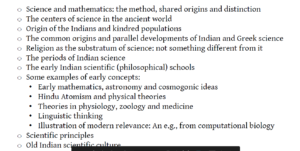
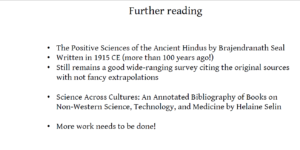
Lo and behold, I was sent a large document that has been written by a blogger who goes by the name “Manasataramgini“. Acharya ji (since he is anonymous, this title will have to do) is a Hindu nationalist who blogs at manasataramgini.wordpress.com and many of whose writings will no doubt be grounds for cancellation in left-liberal circles, but he is also a very serious and competent scientist, and an intellectual with very deep knowledge of Sanskrit and ancient Indian lore. It is a 51 page document, but it seems to me that this is worth posting on the internet. People can draw their own conclusions 🙂

A review of Hindu Science

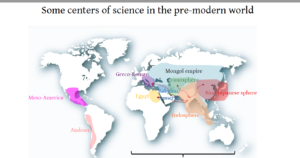
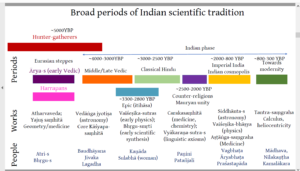
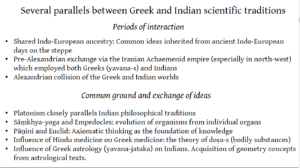
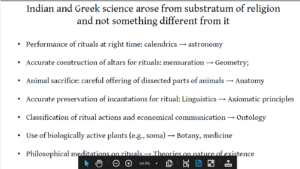
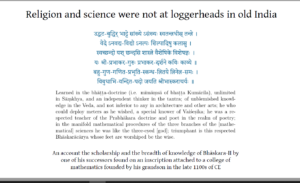
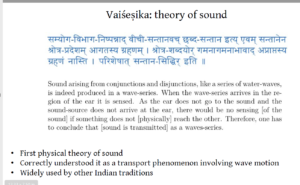
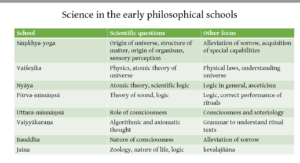
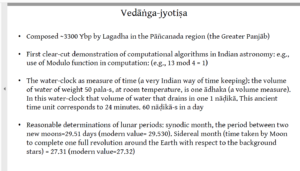
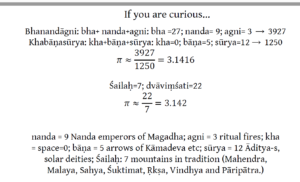
The entire document is at the above link. I am posting a couple of excerpts from the intro and the text as screenshots, but it is really easier to read at the above link (but since I know how lazy I am when reading blog posts, I am posting some screenshots.. note that similar early scientific speculations by the Greeks are treated as “the beginning of science”).


Brown Pundits