
What’s going on?
Category: Popular
Open Thread – 05/20/2022 – Brown Pundits
Open Thread – 4/22/2022 – Brown Pundits
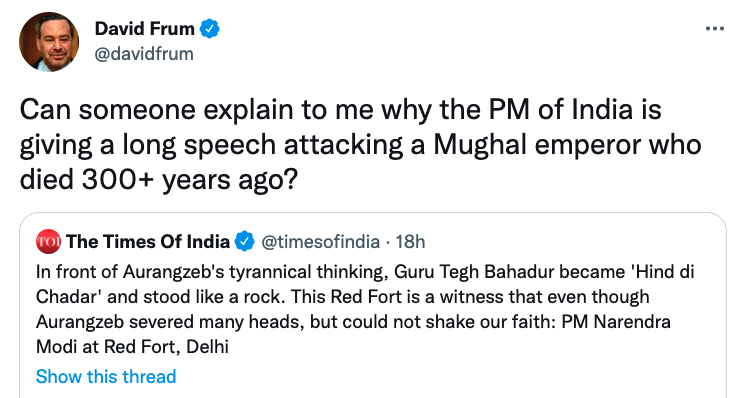 What’s going on? Some Twitter controversy around Aurangzeb.
So what’s wrong with being kaala?
 In the comments below there’s a lot of discussion on colorism among brown subcontinentals as well as a fixation on particular facial features. Since I’m an American coconut I don’t really understand many of the nuances, though I’m curious from an anthropological perspective. Much of it obviously seems ludicrous for American browns. What’s the point in commenting on whether one sibling is lighter-skinned than another when you live in America and most of the population is far whiter than even “light-skinned” Indians could aspire to? (ironically, or not, the ‘black-fishing’ swarthy Kardashians look like a lot of light-skinned Indian celebrities to Americans)
But about half of the readership of this weblog now readers from India. Cultural values differ, and so does offense. For example, for Americans asking how much money you make is a very offensive question. For people in other societies, it is not. Why is it so offensive to Americans? Because money is really all we care about! The trigger tells you something deep about our values.
Recently I’ve been meeting many more Indians (from India) on Clubhouse, and I’ve been trying to interrogate differences in values. And one thing that I’ve encountered is a strong aversion to being called “kaala.” Even the most well-off and Westernized Indians seem to wince at the term, and will privately tell me to stop using it the way I am (addressed to people). I ask what the problem is, and they won’t want to get explicit, sometimes saying the connotation is negative. That’s obvious literally true, but how are you going to ever change the connotation unless you change practice?
This is obviously a form of cultural imperialism. Though blackness is not always positively connoted in the US, as a term it doesn’t have the same strongly negative valence as it does in Asia. During the summers I get very kaala in my exposed body parts because I don’t avoid the sun. When my mother asks how I’m doing I say I’m fine, but also I tell her next time she’ll see me I’m “kalo” (Bengali). She gets mad but is used to me talking in this way because being kalo is not really bad substantively (it isn’t). Americans care about whether you are fat or not. Though I don’t condome being mean to fat people, being fat is associated with lots of health ill-effects, and just the way you move is often unnatural (those of us who gain and lose weight can attest to the biomechanical variation). In contrast, being dark or light doesn’t matter too much now since most people don’t need to work outside.
Even in India (and Pakistan and Bangladesh) there will come to be a time when the generation of aunties who grew up in the 20th century will pass on. At that point, the generations who grew up when kaala was a term of opprobrium used by older generations should perhaps rethink their conditioning. I’m not judging, but it’s not really “natural,” it’s conditioning.
How Indians view themselves vs. how Westerners view Indians

As A South Asian Woman, Seeing Two Darker-Skinned Women On Bridgerton Means Everything.
The headline is obviously a bit much. The casting of dark-skinned actresses of Indian-origin really isn’t going to change the norms of the Indian subcontinent, or the whole of Asia. But it’s an interesting window on aesthetic standards and cultural creation. Indians who I bring up this issue with routinely suggest “well, you don’t have ugly people in American films.” The implication for many people of subcontinental origin is that dark skin is ipso facto ugly (and in Asia more generally). This seems the ground truth and the rest is just commentary.
Open Thread – 4/1/2022 – Brown Pundits
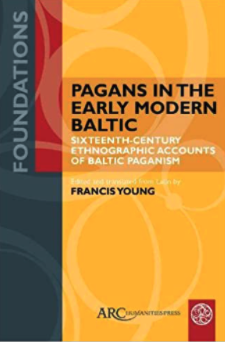 In the last week of this month I will be posting a podcast I did with Francis Young, author of Pagans in the Early Modern Baltic: Sixteenth-Century Ethnographic Accounts of Baltic Paganism (at my Substack). Over the hour and a half we talked about many topics, but one thing that struck me listening to him describe the details of the beliefs and practices of Lithuanian pagans, practices that persisted as living traditions centuries after the official Christian conversion of the state in ~1400 AD (Young estimates that in the 1500’s 30-40% of the population were what was then termed “Old Lithuanians,” baptized into Christianity but rural people who were almost totally uncatechized and continued to practice their ancestral religion), is how redolent they are of the Vedic religion. Young has convinced me that it is likely that the original Baltic branch of Indo-Europeans flourished somewhat to the south of their current distribution, which may be an outlier relic. If that is correct, they were likely positioned just to the west of the Indo-Iranian ur-heimat of the Fatyanovo-Balonov culture. Linguistically many scholars argue that Indo-Iranian and Balto-Slavic are a natural ‘clade’ within Indo-European languages.
The Wikipedia entry on Lithuanian neo-paganism (Romuva) has a section titled “Relation with Hinduism”:
…But for Lithuania’s Romuva community, which traces its traditions back to ancient folklore, it is evidence of a connection to India, Hinduism and Sanskrit that has become a part of their Romuva identity, along with its pantheon of gods and fairly standard pagan rituals. Some believe that the connection between Hinduism and Romuva made Romuva to be more than a “primitive, shamanic religious tradition”…
…
Similarly Ašvieniai are divine twins in the Lithuanian mythology, counterparts of Vedic Ashvins. The Ašvieniai are represented as pulling a carriage of Saulė (the Sun) through the sky. Ašvieniai, depicted as žirgeliai or little horses, are common motifs on Lithuanian rooftops…
Romuva and Hindu groups have come together on numerous occasions to share prayers and participate in dialogue. These events have taken place in Lithuania, Atlantic City, New Jersey, Boston, Massachusetts, Epping, New Hampshire, and elsewhere.
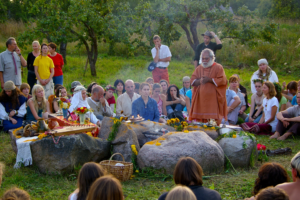
I had assumed that Lithuanian Catholicism derived its strength from the Counter-Reformation period (the last sacred snake groves were destroyed by priests in the 18th-century), but Young explained that the reality is that Catholicism and the Lithuanian national identity became associated only with the absorption of Lithuania into the Russian Empire, where the dominant religion was Eastern Orthodoxy. It was in the context of religious and ethnic marginalization in the 19th century that the two elements of modern Lithuanian identity finally began to become synergistic, and therefore heterodox peasants began to finally adhere more strictly to a Catholic identity.
Open Thread – Brown Pundits – 3/18/2022

A comment on the earlier open thread:
Interested to know what Razib and Omar sahab think of Holi, any experiences Razib?
I don’t have any experience and did not know it was Holi. Thanks for telling me!
I was going to visit India for business in 2020, but then COVID-19 happened, so I have never been to India. I have only been to Bangladesh twice in the last 40 years, so it did not overlap with Holi.
Open Thread – Brown Pundits – 2/26/2022

Open Thread – Brown Pundits – 2/11/2022
I did a podcast with roon on shape rotators and wordcels. Check out A Song of Shapes and Words.
Open Thread – 01/20/2022 – Brown Pundits
What’s going on?