A flying peacock

By Furqan Ali

Today, I was travelling to Tarkha, a small village near Taru Jabba, all situated in KP (erstwhile NWFP), from Peshawar, which is considered the oldest living city of South Asia.

There, I saw a flying peacock. It was a once-in-a-lifetime experience. I had never seen one fly before, except in caged settings. A dog kept pestering her, making her dart from one place to another. And then, there was a donkey too, without reins! Perhaps the spectre of capitalism was absent. In that rural pocket, so close to the bustling and chaotic city of Peshawar, constantly a victim of radical urbanisation (over 45%), there was still something untamed.

Here’s the poem, inspired by the errand, along with the picture I took. Pardon my pathetic aesthetic, I’m learning this craft for my IG.


a flying peacock

“My mistress’ eyes are nothing like the sun
”

— Shakespeare

In Tarkha,

a flying peacock—

Simurgh,

aphrodisiac,

like a newly resurrected girl

in the dark night,

and the sin of being born.

Wandering,

hand in hand, eye to eye,

with Quratulain Tahira in the heavens.

ScĂšne crĂšme de la crĂšme

landscape and portrait,

all green.

A darbar of some majzoob,

a Hindu majzoob

who lifted his hand—donning a ring of tourmaline—

and forgot,

like I forgot my birthday.

A free Jack—

a free, rapacious Jack

in the temporariness

of extraction,

with no reins

and obstruction.

Imbibed the aerodynamics

of the multicolored creature.

Everyone is colorblind

up to some extent—

too many hues.

Gobsmacked.

Kaleidoscope swaying

retina and brain.

And a thirsty dog

trying to bite—

for hemoglobin, and iron, and water.

The displacement angles

bottlenecked

between:

the dog must die.

It is ugly.

A brat with channa mewa,

wandering in the intricate ploy—

dusty and topsy-turvy roads.

A sheriff was maybe peeing somewhere.

I could not sense anyone.

Miscreant mist—

and resplendent.

Except

us.

I waited for a nimrod

who could bullet that beautiful ghoul.

A dragon scroll fell on my head,

with a sheesh mahal.

Every nook flummoxed

with those savage eyes.

I could see the song of the future—

Inconsequential.

How could I smoke and not puff?

The nicotine pouches in my jaw?

Pathetic!

Sweet coils of

paintings,

bureaus of linen—

I was painted

a zillion times

by the palette of that bird

that prowled through Tarru Jabba,

for the relief of my head,

and the reconstruction of

my senses—

and poems.
Open Thread; Trans in the Muslim World

Other Stories (thank you Nivedita):

🔗 India Today – Harshvardhan Jain Scam

A man posed as a diplomat, set up fake embassies, and ran a multi-crore loan fraud racket via fake companies. He even issued “official” visas.

🔗 Business Standard – Karnataka Vendor GST Nightmare

A vegetable vendor in Karnataka received a GST notice due to high UPI volume — triggering a cascade of tax bureaucracy.

🔗 Economic Times – Indian Man Stabbed in Ireland

An Indian man in Ireland issues a public warning after surviving a random stabbing in Dublin.

🔗 NDTV – Hyderabad Man Kills Wife

In Hyderabad, a man stabbed his estranged wife to death at a birthday party for a child.

Brown Pundits: Broad Church or Narrow Canon?

Brown Pundits Must Stay a Broad Church

Reading Kabir’s thoughtful post on the “soft Hindutva” bias at Brown Pundits, I found myself both agreeing with parts of his argument and diverging from its framing. My own journey with BP goes back to its inception. The blog was born in Twixmas December 2010; 10 days after I had met Dr. Lalchand, whose presence has profoundly shaped my civilizational views.

I say this not as a biographical aside but because BP, at its best, is where the personal and civilizational collide. We bring who we are; our marriages, our migrations, our contradictions, into this messy, brilliant conversation.

At the time, like many Pakistanis, I held a deep-seated assumption: that Hindus were fundamentally “other.” It wasn’t overt hatred; just a civilizational distance, internalized from birth. But Dr. V & Brown Pundits challenged that.

A Forum With Bias? Yes. But Which One?

The heart of BP is not neutrality; it’s the willingness to host contradiction. That is its genius, and it must be protected.

Continue reading Brown Pundits: Broad Church or Narrow Canon?

What Kind of Space Is Brown Pundits

A few of us authors have been actively discussing the future of Brown Pundits; the space, the tone, and the deeper ideas we’re engaging. It started informally on our WhatsApp group, but the questions are foundational: What kind of platform is BP becoming? What should it strive to be? And what kinds of ideas does it host best?

At its best, Brown Pundits is a bridge; across nations, faiths, ideologies, and lived experiences. It’s a space where one can be deeply Indian, wholly Pakistani, broadly Bangladeshi, or diasporic and disillusioned but still belong. But like any bridge, it needs conscious upkeep. If a conversation leans too far in one direction, it doesn’t stretch, it collapses inward.

Some contributors feel the platform has become overly shaped by one ideological current. Others argue that the real problem isn’t dominance, but disengagement ; those who want plurality must also show up. And both perspectives can be true.

Open Thread

Today will be a bit busy so I haven’t had time to attend to BP (running on 4-5hours sleep).

Talk about whatever you like; I’ll make this thread sticky a while. A good & engaged commentariat is the lifeblood of a platform.

I’m working on something that will be a bit interesting (my newsletter meets my work) but let’s hear from you w.r.t the wacky and the wonderful.

Bharat Needs No Validation

I’ve been following the usual commentary, the BP quadrant: Indosauras, Nivedita, Kabir. And I read Kabir’s offhand remark that the Ramayana “didn’t resonate” the way the Iliad or Odyssey did. That casual dismissal is telling.

The Ramayana is not just literature,  it is scripture, memory, and civilization encoded in verse. It has shaped the moral and cultural landscape of over a billion people for millennia. To compare it, then downplay it and to do so so glibly reveals less about the text and more about one’s own civilizational estrangement.

Let’s be honest: that kind of language would never be used for the Quran or Islamic texts. And the fact that it is used for Hindu epics by brown intellectuals raised in the shadows of colonial categories says everything about how deeply colonized the Pakistani mind remains. Pakistan is, in truth, an Urdufied Punjab insufficiently imagined, a fragment that lost its civilizational compass in the act of imagining itself apart. The fact that the Ramayan being Pakistani heritage is such a novelty speaks volumes.

Today I sat at Stratford Westfield, eating Dubai Hot Chocolate ice cream, and the man next to me clearly Pakistani asked me, in Urdu, “if I was in the queue?” His wife spoke Punjabi-inflected Urdu. It struck me how London has become the real unifying Punjab. Ten percent of Britain is now Desi. And outside of the subcontinent, the fractures of 1947 heal in ways that remain impossible back home.

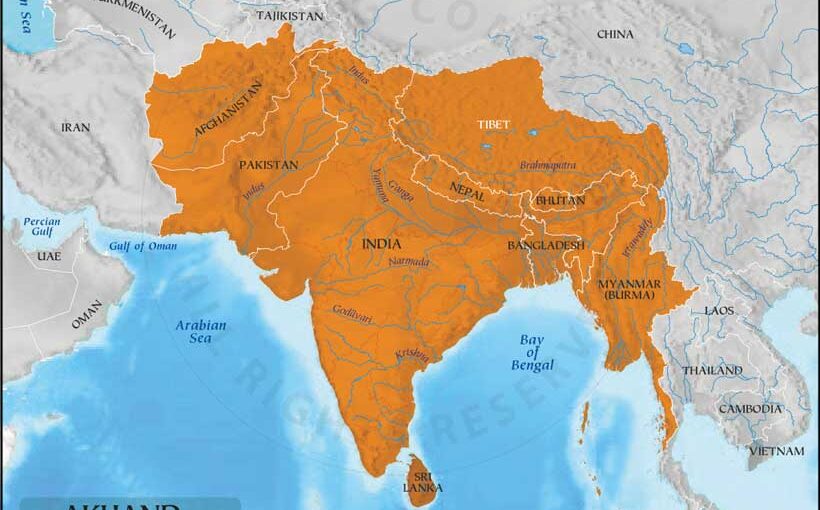
We speak of South Asia. But the term is bureaucratic; no one identifies with it. India is real. Bharat is civilizational. Aryavarta stretches from the Hindu Kush to the Indian Ocean — just as France is the Hexagon, Bharat is the Triangle. Partition clipped its wings, but its soul remains intact.

And look at the reality today: Indian Muslims are thriving in the mainstream. The title song of the upcoming film Sarai — written, composed, and directed by three Muslims: Ishaq, Fahim, and Arsalan. The leading lyricist is Javed Akhtar. This is a country that refused bitterness. A country whose largest minority chose Partition, and yet was never cast out, a unique precedent and testament the pluralism of Dharma.

Bharat needs no validation. It doesn’t need the approval of its neighbours or the heirs of partitioned imagination. It only needs to walk — and it is flying. Toward its own authenticity, on its own terms. And the world is watching.

Hans Zimmer and the Polite Dismissal of the Ramayana

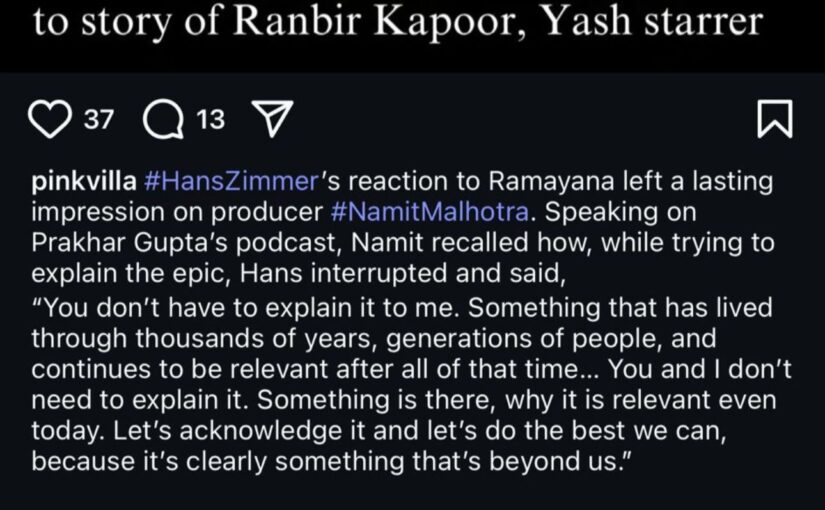
When producer Namit Malhotra began explaining the Ramayana to Hans Zimmer, the legendary composer cut him off:

“You don’t have to explain it to me. Something that has lasted thousands of years clearly has meaning. Let’s just do our best. It’s beyond us.”

Malhotra took this as reverence. In fact, it was erasure.

No serious Western artist would score The Ten Commandments or Schindler’s List without knowing the story. Imagine a composer saying, “Don’t explain the Illiad to me, it’s beyond me.” They’d be fired. But when it comes to Indian epics? The bar is subterranean. That’s not reverence.

That’s: I’m Western, I’m famous, I’m here for the cheque; not the history. The tragedy isn’t Zimmer’s line. It’s Malhotra’s awe. A Westerner shrugs off our most sacred text, and we call it wisdom. That’s not cultural pride. That’s civilizational confusion. It’s a pattern. Many elite Indians are fluent in the language of Islamic grievance; but tone-deaf to Western condescension.

Divide and rule still works:

  • Hindus thank the British for “freeing” them from Muslim rule

  • Muslims thank the British for “protecting” them from Hindu majoritarianism

Meanwhile, the West shrugs at our stories and we applaud.


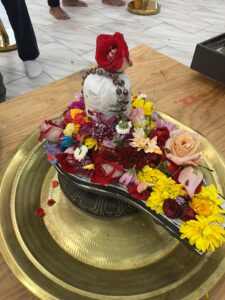
Shravan Monday at the New England Temple

Continue reading Hans Zimmer and the Polite Dismissal of the Ramayana

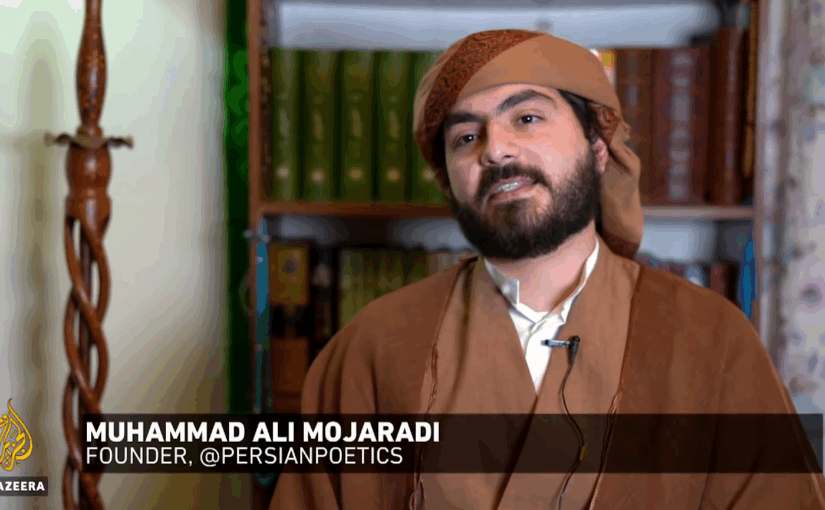
Open Thread: From Flattery to Fatigue — What the Iranian Diaspora Can’t Admit

On July 14, I wrote about Ta’arof ; the millennia-old Persian art of flattery, refusal, and ritualised courtesy. It’s often misunderstood in the West as “saying no three times,” but it’s really about emotional high-context negotiation, reading the room before the room speaks.

The next day, on July 15, Sharghzadeh posted a powerful video, calling it Iranian Diaspora Fatigue. A searing takedown of the Iranian Diaspora’s toxic racial insecurities, internalised Islamophobia, misogyny masked as modernity, and cultural denialism. He’s mostly right.

What he calls fatigue, I’d call poisoned flattery turned inward. Because Tehranglos are no longer performing Ta’arof to honour guests or elders. They’re doing it to whiteness itself. Hoping if they refuse our own identity long enough, maybe the West will say: “Yes, come in.”

That’s not assimilation. That’s exhaustion. And the worst part? Even the racism feels borrowed; against Arabs, against Afghans, against Iranians back home. It’s not even Iranian. This isn’t just about cringe TikToks or awkward panel guests. It’s about who gets to narrate Persian culture. And what gets flattened when tradition becomes product. I was stunned when Zachary Newman — one of the most prominent Persian-Jewish American chefs — endorsed Netanyahu’s strikes on Iran. That moment crystallised something.

Sharghzadeh and I are saying the same thing: Persian culture is being gentrified by its own children. What survives isn’t tradition. It’s content. It’s vibes. If Iran is an unreadable poem, diaspora is turning it into a slogan. If Iran is lived, diaspora is increasingly just captioned. And they wonder why they’re tired. Is the Persian diaspora preserving a culture, or just performing it for the algorithm?

Pakistaniat & Urdu from Qasim to Quaid

UP’s very long shadow:

As I board my flight back to the UK after a brief but productive trip, I find myself reflecting on a language that continues to haunt and inspire me: Urdu.

It is a tongue caught between paradoxes. The language of courtesans and qawwals, of sacred supplication and sly seduction. It carries within it the scent of jasmine and blood, of Delhi’s dusk and Lahore’s lingering grief.

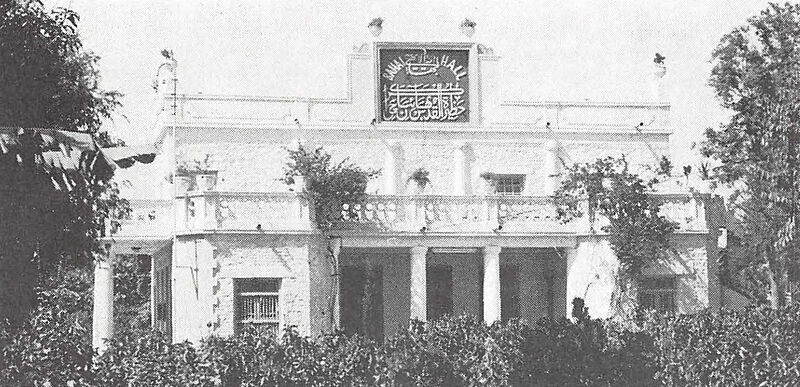
The Beloved Guardian of the Baha’i Faith once noted that while most Baha’i texts should be translated from English, Urdu alone is trusted for direct translation from Persian and Arabic. That proximity, that spiritual siblinghood with Persian, the language of kings, and Arabic, the language of God, renders Urdu magical.

Sanskrit, of course, is the language of gods, but Urdu, its stepdaughter of sorts, captures the longing of poet to partisan.

There’s a reason the Bahá’í prayer I share below is so piercing in Urdu. So here, before I cross back into another timezone, I offer this prayer—without commentary, without translation. Just Urdu, as it was meant to be heard.

And I wonder: perhaps this is what Pakistan truly is—a project in transcending the local. Not rooted in soil, but in sentiment. A place where Punjabis, Pathans, and Muhajirs are asked to shed skin and commune in Urdu. Where Pakistaniyat, for all its fractures, has succeeded in producing a common idiom: of piety, pride, and pain. Continue reading Pakistaniat & Urdu from Qasim to Quaid

Brown Pundits