The Cosmos of Ustaad Saami

By Syed Hasnain Nawab in DAWN 

[Note: Ustaad Naseeruddin Saami and his sons–The Saami Brothers– won the Patron’s Award at the 2025 Aga Khan Music Awards, held in London on November 22]

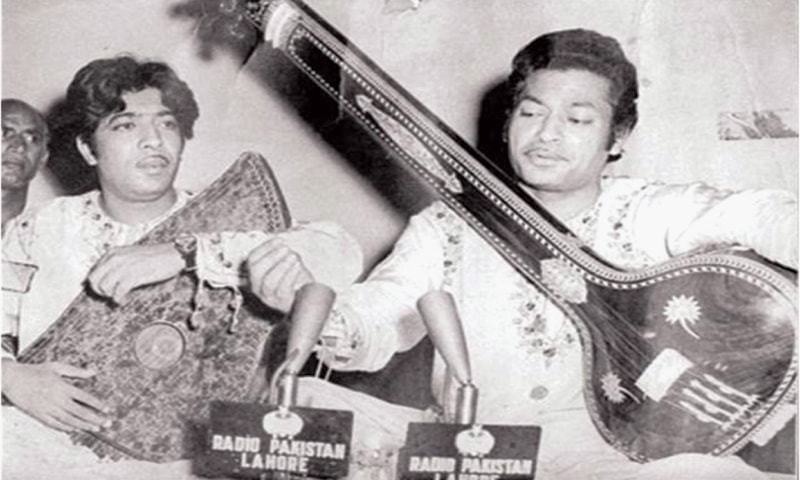
Hailing from Delhi’s famed Qawwal Bachcha gharana [musical lineage], Jaan traces his musical ancestry back to the likes of the 19th century Delhi gharana luminary Tanras Khan and Mian Saamat bin Ibrahim — with the latter being the principal disciple of Amir Khusrau. As the Saamis put it, their ancestors were chosen not by happenstance but by what the family believes to be Divine designation, stating, “Knowledge is given to whoever has a right to it, who deserves it. This is chosen and sent by God.”

In this vein, Jaan sees himself and his sons not simply as musicians but as carriers of a spiritual directive. Traditionally, these gharanas have maintained and safeguarded their expansive knowledge by transmitting centuries’ worth of musical heritage and experimentation seena-ba-seena [from ustaad to pupil].

Continue reading The Cosmos of Ustaad Saami

My singing featured on Khaliq Chishti Podcast

In the spirit of a palate cleanser, I am sharing this musical performance.  I was featured on Khaliq Chishti’s podcast (he runs a recording studio in Lahore).  I performed Raga Rageshri and a Dadra in Raga Desh (“Cha Rahee Kali Ghata” which was originally sung by Begum Akhtar).  Tabla is by Iftikhar Joseph.

I also want to use this opportunity to respond a bit to the recent post that argued that India and Pakistan are only linked by violence.  I am a singer of Hindustani classical music and an ethnomusicologist. Hindustani classical music is obviously part of the shared Indo-Islamic culture that links North India, Pakistan and Bangladesh.  Eight decades of separation, wars and political tensions have not managed to completely destroy this common culture. This very fact goes to disprove the argument that the ONLY link between India and Pakistan is violence.

Indians are fond of Pakistani dramas. Fawad Khan is very popular in India.  A new season of Pakistan Idol has recently started airing (Fawad is one of the judges along with Rahat Fateh Ali Khan) and I dare say Indians would be watching on YouTube.  I have seen comments on Insta from Indians expressing their appreciation for Pakistani music.  Pakistanis obviously watch Indian Idol.

My book–A New Explanation for the Decline of Hindustani Music in Pakistan (Aks Publications Lahore 2024)–was recently profiled on Scroll.in. Do read it if you are interested.  Currently, the book is only available in Pakistan but we are working on publishing an Indian edition soon.  One of the side effects of the bad relations between India and Pakistan is that books cannot travel across the border.


Caste in America

I’ve found myself drifting further left than I expected this year. Much of that is circumstantial, being involved in local activism in the United States naturally places one within progressive coalitions. Yet even in this frame, my ideological compass is firmly rooted in some admiration for Brahminical continuity and Bharat Mata as civilizational anchor.

At times I speculate on where Bharat truly ends. Is it the Hindu Kush? The Iranian plateau? The Persian world has always seemed to me about 20–30% Indianise; its mythology, musicality, and memory bear the imprint of the Indo-Aryan stream more than the Indo-European one, no matter how insistently modern Iranians lean toward a Westward identification.

This brings me to a provocative thesis I’ve often floated: that Brahmins are the civilisational custodians of the Indian subcontinent, and that their displacement often signals a broader cultural erasure. The tragedy of the Kashmiri Panditsis not merely a community’s trauma, but a warning. Without Brahminical continuity, Vedic frameworks falter. Hinduism in Pakistan and Bangladesh remains vulnerable precisely because it lacks the embedded authority and supervisory function of Brahmin elites to anchor Vedic traditions and calibrate resistance to incessant Islamisation. Continue reading Caste in America

Review: The Music Room by Namita Devidayal

From my Substack:

Namita Devidayal’s memoir The Music Room is a chronicle of her relationship with her guru Dhondutai Kulkarni (1927-2014). The book describes Devidayal’s initiation into Hindustani classical music as a reluctant ten-year-old from Bombay’s upper-middle class. Along with describing her growing appreciation for Dhondutai and the music that she imparts to her, the narrative also tells the story of two other important figures in Hindustani music: Ustad Alladiya Khan (1855-1946)–the founder of the Jaipur-Atrauli gharana–and Keserbai Kerkar (1892-1977)–one of the most famous khayal singers of the 20th century. Through telling the stories of these individuals, Devidayal elucidates several important themes such as communalism and “Hinduization” of music as well as the place of women in classical music.

Devidayal describes the process through which Hindustani music became communalized and “Hinduized”. Though Dhondutai is extremely proud of the musical legacy passed on to her by Alladiya Khan Sahib’s family, she still expresses some bigoted views about Muslims. When pressed on this by Devidayal, Dhondutai attempts to square the circle by telling her that Ustad Alladiya Khan was not a real Muslim since he was (allegedly) descended from a Brahmin singer who had been forced to convert to Islam by a Muslim king. She also notes that he always wore the caste thread usually worn by Brahmins. This story allows Dhondutai to hold the belief that Hindustani classical music is essentially Hindu despite the fact that many of the most prominent gharanas had Muslim founders. Dhondutai’s prejudices connect back to the broader process through which–during the colonial period– Hindustani music was “Hinduized” by reformers such as Pandit Bhatkhande and Pandit Paluskar. Bhatkhande wanted to create a “national music” and believed that Hindustani music had been degraded by Muslims and dancing girls and needed to be rescued from both. This process has been extensively discussed by Janaki Bakhle in her book Two Men and Music: Nationalism in the Making of an Indian Classical Tradition. Unfortunately, while most ethnomusicologists agree that Hindustani music is a syncretic tradition, many (on both sides of the India-Pakistan border) persist in claiming it for one or the other religion. Continue reading Review: The Music Room by Namita Devidayal

Brown Pundits