

Fascinating for me how two very different Indian-Americans are battling it out. There seems to be far less Indian asabiyyah?
Tag: Immigration
Why does the West get Immigrants and not Indigenous

A post as a result of discussion I had with a classmate, now an Aussie for about 30 years
Classmate: As for Australia and need for immigrants…. insufficient labor supply for the growing economy!
My reply::Plenty of Labor, the Indigenous Aborigines.
Why are they (First Aussies) not being educated, Racism ??
Classmate: Barr…you are clearly unaware of the reality..there is no simple solution to the barriers faced by Aborigines in integrating into the Australian economy.
My long reply, the crux of this Post
There are parallels of why Immigrants are preferred over Aus Aborigines and why the Brits got Indentured South Indian Labor for the Estates in Ceylon (Same as why Immigrants are preferred over African Americans in US too)
Indenture Estate Labor in Ceylon was essentially undocumented, i.e. not given any legal status (Residency ) or even Birth not recorded, The reason was simple, residency or similar would have meant Ceylon Labor Laws would have been applicable. Ceylon Labor Laws were pretty decent and reasonable for those times. So it was easier to control undocumented South Indian Labor. Sinhalese were notorious for NOT being docile and prone to Litigation. Just keep in mind only a select few Ceylonese got a decent education. Universal literacy (and Life Expectancy) only happened after Independence. Tamil were more prone to violent crime, but among themselves. Oppressed rarely fight the oppressor in this caste the high caste Tamils.
Continue reading Why does the West get Immigrants and not Indigenous

Everyone Western Becomes White Eventually
That’s a sharp observation, and worth expanding. The truth is, in the West, all immigrants eventually become “white”—not in phenotype, but in assimilation, in aesthetic, in aspiration. Continue reading Everyone Western Becomes White Eventually

The Elder Race and the English-Speaking Heat
As I write this from Dublin, waiting to board my connecting flight—I’d nearly missed it in Newark, too absorbed in writing to hear the gate call—I’m struck by how a Euro sign or EU flag can alter one’s sense of place. Technically, I’m still in the British Isles. But culturally—unmistakably—I’m on the Continent. A sensation I never quite feel in England.
It’s a strange feeling, this flicker of European belonging. In the early millennium, I was a passionate Brexiteer—young, angry, seeking change. By the time of the referendum, a decade later, I found myself morally conflicted. I knew the EU was not a good fit but as a Bahá’í, I knew I could never advocate for disunity, of any sort. I abstained. Ironically, Commonwealth citizens could vote, but EU nationals couldn’t—a bit of imperial gatekeeping that deeply irritated my liberal British-Irish friend. (“Why can Indians vote, but not the French?” he asked.)
Today, standing in Europe, I feel the contrast sharply. The Continent is genteel, even decadent, locked into postwar consensus. Meanwhile, the English-speaking world feels like it’s on fire—politically, culturally, psychologically. It’s not just the UK or the US. India, too, belongs to this hot zone of rhetoric and reinvention. Pakistan, by contrast, while elite-driven in English, remains emotionally and socially an Urdu republic. Continue reading The Elder Race and the English-Speaking Heat

Café Concord: A View from the Counter
I’m writing this from a bakery-café in Concord, Massachusetts—the cradle of the American Revolution, where ideals like liberty and equality were born anew in the New World. The croissants are fresh, the espresso is bespoke (lavender), and the staff layout is eerily familiar.
At the front: white staff—stylish, aesthetic, articulate—handling (bossing sometimes but in general everyone is exceptionally lovely & calm) model minority clientele with curated ease. In the kitchen: Mexican workers—efficient, invisible, foundational. It’s the same setup across most of America’s cool, clean consumer spaces: the aesthetic and the labor silently segregated by race and language.
No one talks about it. You’re not supposed to notice the subtle “Americanisation” at play (the American dream and its attendant complexities). But once you do, as a twice-immigrant (East to Britain, old England to New England), it’s hard to unsee. The roles aren’t assigned by policy, but by a deeper algorithm—one that sorts people into place based on centuries of sedimented power: race, class, culture, even aesthetics. Continue reading Café Concord: A View from the Counter
Amy Wax on “Asians”
Amy Wax Redux – Another round in the immigration and culture debate. Glenn Loury hosts a debate that has gotten some attention because Amy Wax said something in relation to “Asians.” Her interlocutor is an East Asian American, and Wax’s original comments were particularly targeted at Indian women. So this has spun a bit out of control.
I’ll say some quick things.
In Amy’s favor:
– Many people have noticed the overrepresentation of “market-dominant minorities” in particular activist groups, and the visible presence of South Asian (Indian, Bangladeshi and Pakistani) women is hard not to notice. Joe Biden’s statement that “Indians taking over” reflect Indian American power in Democratic politics in particular.
– Nations have a right to determine what they want to be. At least in theory. This is most explicit in Israel, founded as a homeland for the Jews. Hindu nationalists want India as a homeland for Hindus. While many Muslims view Muslim-majority nations as societies organized around Islam, and so they believe law and tradition should favor that religion. In the USA this was clear as well, with a 1790 law that allowed only for the naturalization of whites, later expanded to blacks and eventually other non-white races. The National Origins Act of 1924 aimed to keep the US a mostly Northwest European nation. And so forth.
The idea that America, or any nation, exists simply as an institutional transaction device between consenting adults and organizations that are bounded by particular borders is not realistic, though sometimes open and open borders adjacent people talk like that. American is a nation. A people. It will change. But how?
– Americans are going to be uncomfortable when “visible minorities” take all leadership roles due to their educational success. That’s a fact. I think people should get over it though. But that’s my opinion. Most people care a lot more about race and visible phenotype than I do from what I can tell.
– Immigrants bring their culture. Their culture impacts our culture. Sometimes good, sometimes bad. We can make decisions.
Against Amy:
– She talks about it like a Boomer who doesn’t really understand the landscape. She was born in the early 1950s in a black and white America, so when talking about Asians and Latinx she’s encountering new things to her experience.
– She elides in a sloppy way different groups of Asians. Indian Americans are politically very different than Vietnamese Americans. They are socially very different. Arguably Amy should want more Vietnamese Americans, who lean Republican and are educationally more similar to the average American. 30-40% of Vietnamese are also Catholic. Who are these “Asians” she speaks of? Not people she knows personally from what I can tell (I’ve met Amy, she’s charming and blunt at the same time), so she should read more stats.
– She elides the distinctions even among “Indians.” Most of the obnoxious woke Indians are 1.5 and 2nd generation people born and raised in the US. And yet 90% of Indian Americans are foreign-born immigrants, more than 50% arriving after 2000. Perhaps these new immigrants will also have woke children, or perhaps they won’t.
– Amy’s generalizations of Asian, and Indian, cultures is weird, and not too scholarly. If she’s going to offend (I know about this), you need to know your shit.
Moving out of India: The bigger picture
Economic growth in India has made the question of immigrating to the US vexing for a lot of young Indians. The old attraction of more material prosperity no longer holds, you can buy everything in India. The difference between siblings in the two countries is no longer the car, the modern electronics and superior amenities. In many ways, immigrating to the US has become a more ‘experiential’ move, with terms like ‘job satisfaction’, ‘latest technologies’ being used in addition to the touting of cleaner, safer and more hip environs.
So should you, as a young Indian teen or adult seek American shores? I was in the same situation nearly two decades ago, and took the plane to the US very unthinkingly, almost like an instinct. I always wished someone would have told me what the possible implications of such a big decision would be, the doors it would open as well as close. I seek to do so for any young person interested here. This post is not going to be about details of work and life in the US versus India, but rather the big picture.
Today, the cost of moving out of India is more than the loss of family and ‘culture’. India offers opportunities of its own. It is with this context that we move forwards with our analysis.
Career: Technological Leadership in Prescribed Areas vs Flexibility in a Growing Economic Power
US leadership on the technological front is significant and enduring. America attracts smart people not only from India, but from across the world, including other developed markets. Deliberately or unwittingly, America has been marketed to the world as the place a smart person needs to be in to maximize their potential. This is somewhat like the IPL being the cricket league where a cricketer can compete with the best in the world. There is a reason why America is the only country in the world that has a Google and an Apple.
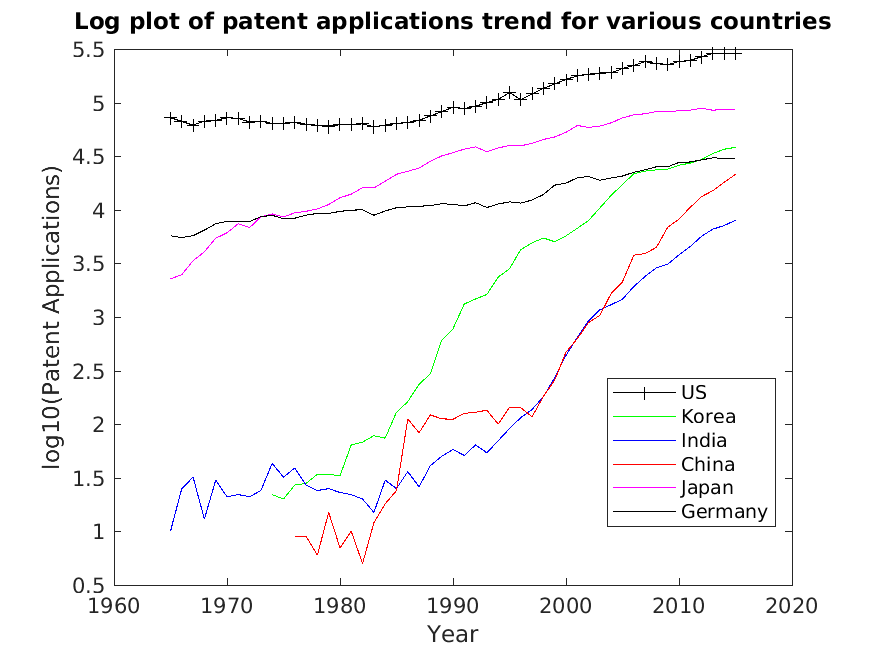
However, the last two decades have seen a sea change in India’s economic growth, technological prowess and integration with the world. Consider the number of US patents filed from India. From being four orders of magnitude lower than the US, India is now less than two orders of magnitude lower, with continuing growth. Similar trends are seen in the number of scientific papers published in elite journals, where India has moved from 1/20th of US output in 2000 to 1/3rd of US output in 2018. India today offers more opportunities than ever before.
Add to this the fact that the American work visa is exactly that, a visa. The visa is designed to bring in workers in areas where there is a shortage of Americans, so the bulk of opportunities lie in the computer software/data management sector. The flexibility and freedom to explore different career and life paths is severely constrained. You cannot easily leave your software engineering job in a global mega corporation and join a business development role in a start up. You cannot take two months off and wander away to see the world. Your US work visa needs full time employment, every second of your life.
So the trade off here is the opportunity to get a narrow but a truly world class exposure versus exposing yourself to a spectrum of career and life possibilities in India.
Life: Systems vs Services
If there was a one line summary for the difference between life in the US and India, it would be in America you can rely on systems, in India you can get a lot of services.
In America, systems work. The courts, police, municipal authorities all do their job professionally. You will not see mounds of rubble by the roadside and trash everywhere. The air will be clean, government authorities will be professional and accessible. The contrast with India is stark.
When it comes to services, lets just say this, the middle class homes of my relatives in India are a procession of cooks, drivers, maids, gardeners, electricians etc. We have a huge population whom we can now feed very well and transport cheaply around the country to markets which need them. As an example, in India, the service and variety of food on offer in a 3-star hotel buffet for 5 dollars was impressive. On the other hand, there were no Mexican options and stepping out of the hotel, you could literally smell the chemicals in the air.
Spirit: Continuity vs Renewal
Humans are not merely the work they do and the goods and services they consume, transcending our finite selves is a big part of the human experience. This is where notions of family, ethnicity, religion and nationality come into the picture. The US and India offer you contrasting pathways in this regard as well.
Being in India offers continuity and context. You can remain soaked in the arts, sports and traditions you have been familiar with since you were a child, and there is no need to separately make an effort to ‘access India’. You are the market whom the creative and talented people in the economy seek to serve.
America offers the chance for renewal and rebirth. Indeed, for the majority of its existence as a nation, America has offered the tired and beaten people of this planet a chance at reinventing themselves and starting a ‘new life’. The children of those pushed out by their home countries have achieved miracles in the American meritocracy.
So there it is, you can think about these three trade offs while making your decision. Do you want to achieve the summit of computer technology ? Or do you want to explore the world of work before diving into a committed career path ? Do you get annoyed and distressed by the dysfunction of the Indian governments ? Or do you appreciate all the services available to make your life easier ? Finally, do you feel India imprisons you and you need fresh air ? Or can you not bear to sever yourself from your gods and greats ?
Browncast episode 74: Maratha Bro Amey Talks Immigration, Ayodhya, etc
Another BP Podcast is up. You can listen on Libsyn, iTunes, Spotify, and Stitcher. Probably the easiest way to keep up the podcast since we don’t have a regular schedule is to subscribe at one of the links above.
You can also support the podcast as a patron. The primary benefit now is that you get the podcasts considerably earlier than everyone else.
Would appreciate more positive reviews! Alton Brown’s “Browncast” has 30 reviews on Stitcher alone! Help make us the biggest browncast there is!
On this episode Razib talks to our resident Maratha philosopher, Amey, discussing US immigration, Ayodhya and whatever else comes up.
Generations don’t exist, and neither do “immigrants”

I have heard it stated by some scholars that generations don’t exist, but cohorts do. That is, our bracketing of ranges of people into particular generations is artificial and bins what is truly a more continuous variable into a few categories. The same criticism applies to the Myers-Briggs typology in personality (the main reason psychologists prefer the “Big Five”).
But the flip side of this issue is that to talk reasonably about some phenomenon you have to bin and categorize continuous variables. Human races may not have hard and fast boundaries, but human genetic variation is difficult to talk about unless you use some categorical shorthand.
Some of the same applies to the term immigrant and native-born. The reason I’m putting up this post is that there was a discussion online about whether there can be something called a “second generation immigrant.” That is, someone whose parents were born abroad, but they themselves were born in the country of their citizenship. Myself, I think the term immigrant should only apply to those who were born abroad. Native-born and immigrant are disjoint distributions.
But, there are more than a few categories here within the dichotomy. When you arrive in your life, and where you arrive, matters a great deal.
Continue reading Generations don’t exist, and neither do “immigrants”
This is America
 As you may know, Reihan Salam, who I would consider a friend (albeit, one I see in person three years or so!), has a new book out, Melting Pot or Civil War?: A Son of Immigrants Makes the Case Against Open Borders.
It won’t be a surprise to know that I generally agree with him on a lot of issues relating to immigration. The first time I met him in person in 2007 we actually talked about the positive externalities of high skill immigration streams. Since then my views haven’t changed much, though my faith in these United States has declined some to be honest.
I will pass along this interview with Reihan today, A Son Of Immigrants Makes The Case For Tighter Immigration Policy. Reihan, as you may know, is the son of Bangladeshi immigrants who arrived in the late 1970s. The woman interviewing him happens to be ethnically Bengali herself (though her family is from India), raised in Oregon around the same time I was (we’re about the same age).
This is America 2018. An American of Bengali ethnic extraction writes a book and happens to be interviewed by happenstance by another Bengali American. Definitely not a world we could have imagined in the 1980s.