Genocide by any other name

“My nerves are shattered,” says Noura, a 26-year-old Palestinian woman, explaining that she has been “left with nothing”.

After years of IVF treatment, she became pregnant in July 2023. “I was overjoyed,” she remembers, describing the moment she saw the positive pregnancy test.

She and her husband Mohamed decided to store two more embryos at Al-Basma Fertility Centre in Gaza City, which had helped them conceive, in the hope of having more children in the future.

“I thought my dream had finally come true,” she says. “But the day the Israelis came in, something in me said it was all over.”

Israel launched a military campaign in Gaza in response to Hamas’s cross-border attack on 7 October 2023, in which about 1,200 people were killed and 251 others were taken hostage.

Since then at least 54,000 people have been killed in Gaza, according to the territory’s health ministry.

Like thousands of Gazans, Noura and Mohamed had to repeatedly flee, and were unable to get the food, vitamins and medication she needed for a healthy pregnancy.

The West’s War of Decline

Dear friends,

I just wanted to share a thought that’s been on my mind lately. Yes, Trump has attacked Iran — but Iran hasn’t responded in any major way. That in itself is telling. It seems less a climax than a provocation, more bait than strategy. In truth, this might be part of a larger Western pattern: in its long twilight, the West no longer seeks peace but relevance — and sometimes, relevance requires war.

I recently heard a wild claim: that Norway was positioning a remote island of 150 people to tempt a Russian invasion, hoping to activate NATO’s mutual defence clause. Whether true or not, it captures something of the moment — the performative anxiety of a declining order, looking for conflict to reaffirm its own centrality.

As Amar writes, “It is heart-wrenching to see Iran being bombed by two nuclear states, while it remains a signatory to the NPT and compliant with IAEA inspections.” He recalls living in Tehran in 1980, a schoolboy witnessing warplanes above Mehrabad and the skies of Tehran blazing with anti-aircraft fire. That memory isn’t abstract — it’s personal, etched in smoke. His excellent comment is after the jump: Continue reading The West’s War of Decline

🕊️ On Iran, Israel, and the Right to Self-Defense

Why loving Israel, believing in peace, and opposing regimes means defending Iran’s right not to be bombed.

Dear Friends,

I don’t usually write about politics. And when I do, I try to centre peace — not provocation.

Anyone who knows me knows I have always believed in the dignity of Israel, the rights of Palestinians, and the intertwined destinies of both peoples. I love Israel. I love Iran. I believe in Palestine. I believe in peace. And I believe that each nation — each people — has a right to their own story, their own future, and yes, their own defense.

Which is why I write today, with care and some sorrow, in response to the recent Israeli strikes on Iran’s nuclear facilities. Let me be clear: I oppose the Iranian regime. Vehemently. I stand with the brave women and men who chanted “Zan, Zendegi, Azadi” — women, life, freedom. But I cannot condone this unprovoked assault.

Read the rest at this link and please subscribe to my newsletter.

Why Iran Is Not Iraq

These reflections are evolving, and may shift without warning. The winds of change—Divine or otherwise—do not move by human forecast.

In the Western imagination, the idea that Iran could somehow be “dealt with” like Iraq is a dangerous illusion—one rooted not just in hubris, but in historical illiteracy.

Yes, Iraq was once the cradle of civilization. From Ur to Babylon, and later Baghdad under the Abbasids, its glories are undeniable. But geopolitically, Iraq is a lowland nation—deeply enmeshed within the Arab Mashreq, itself a corridor between Egypt and the Persianate world, susceptible to invasions, internal fragmentation, and competing powers.

Iran, by contrast, is a fortress civilization.

Continue reading Why Iran Is Not Iraq

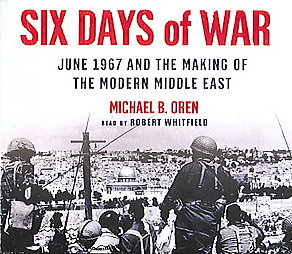
Six Days of War. June 1967 and the Making of the Modern Middle East

Today was the 50th anniversary of the 1967 war. What follows is a review I wrote last year of Michael Oren’s book about the 1967 war. I am posting it today to commemorate the anniversary, and to think about what has changed, and what has not, about the equation between the “Muslim world” and its more modern competitors.

To the extent that it existed, this sense of the Muslim world being one of several “competitors” in a war of civilizations  existed mostly in the Muslim world in the last 100 years; and even there, mostly in the minds of religious fanatics such as Maudoodi or Sayyed Qutb or modern Islamists such as the Indian Islamist Mohammed Iqbal.  Most Western, Chinese or Japanese thinkers were unlikely to have something called “The Muslim World” on their list of civilizations competing in the modern world. This has certainly changed in recent time, with at least the Right wing of Western Civ and (and to a lesser extent, of Chinese and Japanese Civ) becoming almost hysterical about the threat posed by Islam. But has the balance of power changed? and if it has, has it changed enough? I think today’s drama in the GCC (among many things) indicates that the balance on the ground has not changed by much. The Muslim world is richer, and some countries (Turkey, Pakistan, Egypt, Iran, Indonesia) are more powerful than they were in 1967; Pakistan is even a nuclear power (and in the minds of many of its own citizens, if not all its power brokers, an “Islamic nuclear power”), but in many other ways the dreams of May 1967 were the high point of (delusional) confidence in the Muslim core region. In that year, many, perhaps most, in the Muslim street were eager to believe that their armies could, if given the opportunity, annihilate the “Zionist entity”. Which is why so many spent the first few hours of the war celebrating what their leaders were describing as “great successes”; that reaction seems unlikely today. If there were a new war, and Arab radio stations claimed the Israelis were losing, most people would not believe it, even if the Israelis really WERE losing.
Anyway, on to the review. And don’t miss the documentary at the end.

Review Continue reading Six Days of War. June 1967 and the Making of the Modern Middle East

Brown Pundits