Why Hasn’t Pakistan Collapsed Yet?

A cultural explanation, not an institutional one.

The comments on the last post revealed something important: there is a difference between learning about a culture and living inside it. The Indo-Muslim legacy sits precisely in that gap. It is not owned by a census or a successor state. It survives in people whose habits, tastes and instincts are shaped by it, even if they no longer identify with the religion that produced it.

Most arguments in the thread reduced the issue to arithmetic. “India owns the legacy because most Muslims stayed.” “Pakistan can’t own it because Delhi and Lucknow are in India.” These claims are tidy, but they miss the point. Culture does not follow borders. It follows continuity.

My own shift in identity made this clear. As I Hinducised through marriage, I also Persianised. The Islamicate part of me did not vanish; it was absorbed into a Bahá’í frame where contradictions resolved themselves in a Dharmic canvas. It taught me something simple: civilisations are not inherited by territory; they are inherited by people who keep caring.


1. Rushdie and the Islamicate Without Islam
Continue reading Why Hasn’t Pakistan Collapsed Yet?

On the Question of Who “Owns” the Indo-Muslim Legacy

Reading Sophia Khan’s superb piece on the lost Muslim cities of Hindustan, and then watching the BP comment-thread unfold, a few thoughts crystallised for me; less about “ownership,” and more about the intellectual pattern that keeps resurfacing whenever Indo-Muslim history is discussed.

First: I genuinely did not know that Khan was originally pronounced with a silent n, nor that paan had such a deep Islamicate turn in its social history. Much like music, I had long assumed paan to be a largely Hindu-coded practice. The article forces a re-examination of how intertwined everything actually was. The same goes for Hindustani music: I once thought of it as essentially a Hindu, temple-rooted tradition. Then you realise how much of the courtly synthesis, Persian, Hindavi, Turko-Central Asian, was shaped by Muslims, even if the Vedic lattice underneath remained foundational.

This is partly why I found Bombay Badshah’s objection (“Pakistan cannot claim any of this”) an odd line to draw. One can, of course, make the territorial argument; but it collapses immediately once you observe what India itself is doing: aggressively appropriating the Indo-Muslim aesthetic while deracinating its historical context. If Bollywood, tourism, cuisine, and the Indian cultural machine can freely claim Delhi, Lucknow, Agra, and Hyderabad as national inheritances, then Pakistanis whose families actually come from those cities are hardly crossing an intellectual red line by acknowledging lineage, memory, or loss. Continue reading On the Question of Who “Owns” the Indo-Muslim Legacy

Come Fly with me to Far Bombay

I. Bombay: Between Beauty and Brutality
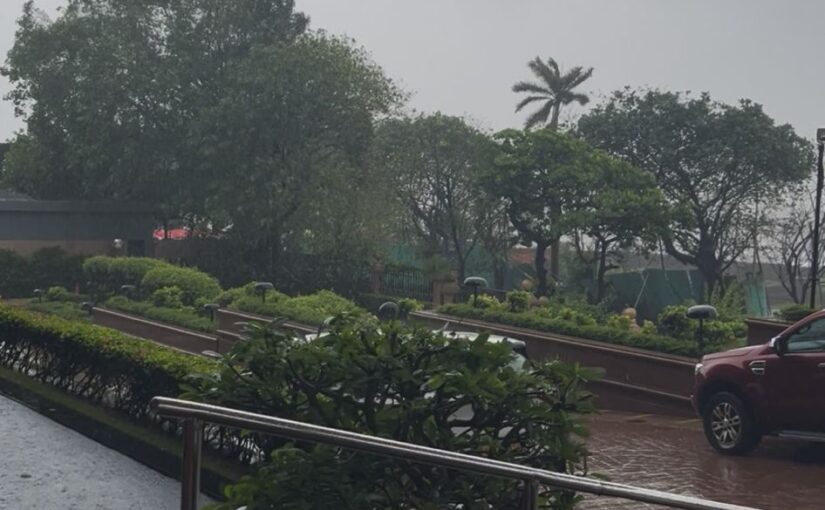
I’m writing from Bombay, where the monsoon floods are overwhelming; visually and viscerally. The rain hammers the city with a kind of sublime fury. From certain vantage points, it’s breathtaking. But it’s also undeniably brutal for those without scenic surroundings or structural shelter. It’s a reminder that Indian beauty is often doubled with burden.

II. Burden Burst: The Commentariat Awakens
Lately on Brown Pundits, I’ve noticed a revival. Old voices returning, new ones emerging, and many ideas worth engaging. But some themes have worn thin; for instance I’m in broad agreement with Indosaurus & I don’t want to waste too much breath on Audrey Truschke. And frankly, Aurangzeb is not a hill I want to die on. In fact, perhaps one of the key misreadings by Muslims in the subcontinent was turning every ideological disagreement into a hill to die on. Maybe it began with QeA-Jinnah and the Great Allama but it ossified into a pattern. Everything became a matter of principle, rather than pragmatism.

III. Concession Is Not Compromise
Compromise is seen as weakness, but I’m more interested in the capacity to concede especially when history clearly shows you’re wrong. The Mughals installed a two-tier system, subordinating Hindus and even native Muslims. Contrast that with the Suri dynasty, particularly Sher Shah Suri, who in just two decades built the Grand Trunk Road and reshaped governance without the alienation that marked the Mughals. If Hindutva attacked the Suri legacy, I’d call it pure bigotry. Sher Shah ruled with the land, not over it. Continue reading Come Fly with me to Far Bombay

Brown Pundits