Macaulay, Macaulayputras, and their discontents

We had some discussion about Macaulay on X and I wanted to write a piece about it, but I also know I probably wont get the time soon, so I am going to just copy and paste the discussion here, I am sure people can follow what is going on and offer their comments..

It started with this tweet from Wall Street Journal columnist Sadanand Dhume:

In India, critics of the 19th century statesman Thomas Macaulay portray him as some kind of cartoon villain out to destroy India. In reality, he was a brilliant man who wished Indians well. Link to article.Ā 

I replied:Ā 

I have to disagree a bit with sadanand here bcz I think while cartoonish propaganda can indeed be cartoonish and juvenile, there is a real case to be made against the impact of Macaulay on India.. Education in local languages with hindustami or even English (or for that matter, sanskrit or Persian, as they had been in the past during pre islamicate-colonization India and islamicate India respectively) as lingua franca would have been far superior, and the man really did have extremely dismissive and prejudiced views, the fact that they were common views in his world explains it but does not excuse it. The very fact that many liberal, intelligent and erudite Indians of today think he was “overall a good thing” is itself an indication that his work has done harm.. BTW, there were englishmen in India then who argued against Macaulay on exactly these lines..

Akshay Saseendran (@Island_Thought) replied: Continue reading Macaulay, Macaulayputras, and their discontents

Open Thread: From Floods to LaBal

A few updates from this week:

Sri Lanka is facing severe flooding. Sbarkkum reports major damage to rail and road networks, with Dutch support expected for reconstruction.

Sana Aiyar’s ā€œWorld at MITā€ video touches on her life and work

Sam Dalrymple has a clip on Lahore and Delhi—another reminder of how closely the two cities mirror each other despite partition.

Pakistan’s minority rights bill is worth watching. Continue reading Open Thread: From Floods to LaBal

The Unfinished Contract II: Citizenship, Partition, and the Questions Liberalism Won’t Ask

A far-right senator, Pauline Hansen, recently walked into the Australian Senate wearing a burqa. Muslim MPs (one of whom wearing a hijab) angrily called it racist, bigoted, Islamophobic. They were right. But they also dodged the underlying question: What does citizenship mean when communities fracture along religious lines?

The same evasion dominates debates about Indian Muslims after 1947. One camp says: “They stayed, they’re citizens, case closed.” The other mutters about loyalty tests and fifth columns. Both positions are intellectually lazy. Neither grapples with what Partition actually did to the social contract.

This isn’t about defending bigotry. It’s about refusing to let bigots monopolize legitimate questions.

I. The Contract That Never Closed Continue reading The Unfinished Contract II: Citizenship, Partition, and the Questions Liberalism Won’t Ask

The Partition of Elites: India, Pakistan, and the Unfinished Trauma of 1947

I was speaking recently with a cousin who grew up in India. Their family has been BahĆ”’Ć­ for generations, but their older relatives once lived as Sunni merchants in Old Delhi. When they visited their grandparents as a child, they noticed something striking: in many lanes of Old Delhi, long after Independence, the sentiment was not Indian nationalism but Pakistan-leaning nostalgia. This was not hidden. It was ambient.

That single observation exposes something almost no one in Indian liberal discourse wants to say aloud: post-Partition India inherited a large Muslim population whose political loyalties were, at best, ambivalent. That is not a moral judgement. It is a historical one.

And once you notice this, a second truth becomes obvious: Kabir’s secularist vision of an emotionally unified India makes sense only in a world where 1947 never happened.

Continue reading The Partition of Elites: India, Pakistan, and the Unfinished Trauma of 1947

Pāṇini, the “Glitch,” and a Note From an Old Cambridge Friend

I received a message from a publicist this week. The name caught my eye because I knew the scholar from Cambridge years ago. The subject of the email was simple: a new book on Pāṇini and the old claim that something in his system “doesn’t work.”

For two and a half millennia, scholars have argued that Pāṇini’s grammar, the first true computational system for language, contains a flaw. His treatise gives a compact system for generating correct Sanskrit forms. But in cases where two rules seem to apply at the same time, most readers assumed the system breaks. Textbooks describe this as a “conflict problem.” Generations of commentators tried to patch it with exceptions, hierarchies, or interpretive workarounds.

The new book, Pāṇini’s Perfect Rule (December 2025), argues that the flaw was never there. The author, Rishi Rajpopat, claims the system already contains a rule for solving the conflict. According to him, Pāṇini didn’t leave a hole; modern readers simply looked in the wrong place. If his reading is right, the entire architecture of the grammar becomes visible as a single machine; elegant, compact, and self-consistent.

There are two parts to this story. Continue reading Pāṇini, the “Glitch,” and a Note From an Old Cambridge Friend

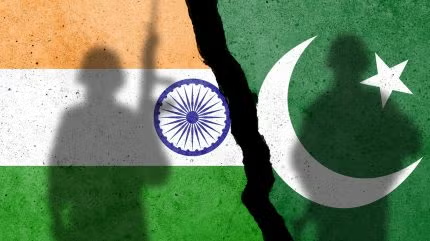
What Is Not India Is Pakistan

As Dave mentioned, there is a lively WhatsApp group of BP authors and editors, and it inevitably shapes the comment ecosystem. But one comment on the blog stood out:

ā€œThe very foundation of Pakistan is an anti-position. What is not India is Pakistan. So isn’t it obvious?ā€

It’s an extraordinarily crisp description of Pakistani identity-building. What is not India is Pakistan. That is not a slur; it is, in many ways, a psychologically accurate frame for how the state narrates itself.

What I increasingly find misplaced on this blog is the recurring assumption that Pakistanis are somehow ā€œIndians-in-waiting,ā€ or that Punjab is ā€œWest Punjab,ā€ Pakistan ā€œNorthwest India,ā€ or Bangladesh ā€œEast Bengal.ā€ These are irredentist projections that simply do not match lived identities. This is not ā€œNorth Koreaā€ or ā€œEast Germany,ā€ where both sides continue to imagine themselves as fragments of one common nation.

Yes, Pakistan consumes Bollywood and Hindi music, which themselves derive from Mughal and Indo-Persian syncretic traditions. Yes, Pakistan is culturally embedded in the greater Indo-Islamic civilizational sphere. But emotionally, Pakistan has severed itself from the Indian Subcontinent as a cohesive landscape. It has constructed a hybrid identity; part Turko-Persian, part Islamic internationalist, part anti-India.

I don’t personally agree with this move, and my own trajectory has been toward a strong Hinducised, Dharmic identification. But my view is irrelevant here. What matters is that Pakistani identity is defined negatively; as the commentator put it, ā€œWhat is not India is Pakistan.ā€

Whether that is healthy or sustainable is another matter. But identities can persist in unhealthy configurations for a very long time; the stock market can be irrational longer than your liquidity can survive.

Why we must talk about caste

Every few months (years?), Brown Pundits goes through its own small earthquake. A post lands wrong, a comment thread ignites, and the whole Commentariat erupts.

The latest rupture began with a mild jibe on caste. I pointed out, in passing, that caste shapes political instincts far more than many admit. The backlash was instant. A section of the readers declared a quiet boycott. The threads went cold. No one wanted to break ranks. The more one claims to have transcended caste, the clearer its caste blind-spots become. Silence itself becomes a shibboleth.

And when the silence hit, the blog froze. Continue reading Why we must talk about caste

Red Fort Attack and Aftermath: Initial Thoughts by Manav S.


Red Fort Attack and Aftermath: Initial Thoughts by Manav S.

Last evening’s devastating car-explosion near the Red Fort in Delhi is not only a cruel assault on innocent lives but an assault on the very symbolism of our nation. According to early reports, a vehicle detonated close to the busy metro zone at the historic Red Fort complex, killing at least eight people and injuring more than twenty. ļæ¼ The government has invoked anti-terror legislation and launched a full probe under the Unlawful Activities (Prevention) Act (UAPA). ļæ¼

First, we must recognise the human tragedy behind the headlines. Lives shattered, families devastated, fear spreading in a city already grappling with chronic insecurity. For those of us of South Asian heritage who carry memories of communal strife, of migration and displacement, this attack touches a deeper chord of vulnerability and of collective memory. Hospitals have reported frantic cries, missing persons, relatives screaming for loved ones. ļæ¼

Second, the choice of location amplifies the message. The Red Fort is not just another landmark: it is an emblem of India’s sovereignty, its layered history, its identity. To strike here is to strike at the heart of public confidence and to send a message of audacious defiance. As scholars writing on ā€œbrown diasporic publicsā€ know, our public spaces carry meaning not just for those inside India, but for those of us abroad who anchor our identity in ā€˜homeland’ narratives. This attack disrupts that anchor.

Third, we must resist both fear and simplistic narratives. The invocation of terror laws suggests the state is treating this as a planned act of violence, not an accident. ļæ¼ But let us guard against quick binaries: Us vs Them, Hindus vs Muslims, India vs Outsiders. In a plural society like ours, sweeping communal attributions too often deepen fault-lines rather than heal them. Our commentary must demand both justice and wisdom: meticulous investigation, transparent process, and safeguarding civil rights in the process.

Fourth, what does this mean for our shared public culture? For someone born in Punjab and now living across borders, the explosion challenges our sense of movement, of belonging, of normalcy. We think of carrying family across continents, of re-configuring identity in Washington–DC and Delhi , how do such apparently random acts of terror recalibrate the psychic cost of migration and the distance between home and homeland? The answer is: they make the cost higher, the emotional freight heavier.

Finally, the path forward must hold three imperatives: one, empathy – for all victims, irrespective of religion, class or residence; two, accountability – for whoever plotted, financed or enabled this attack; and three, renewal – of the public realm, the shouting panic, the fear-laden sighs, with something stronger: resilient civic culture, public institutions we trust, cross-community solidarity.

As a brown pundit, I urge our readership to see beyond the flashes of violence, beyond the political spin, and to ask the deeper questions: What kind of society are we building? What kind of public spaces do we imagine, and what cost are we willing to pay for them? For if we shrug now, the symbolic scar will grow — far after the immediate blast damage is repaired.

In that moment of stillness after the blast, we owe to our fellow citizens not just sorrow, but vigilant hope.

The Broken Compact

Why the India, and American, Dream No Longer Holds

It was Dr V’s birthday this weekend, and we found ourselves in the Great English countryside; those great undulating fields and hedgerows that still whisper of an older order. There’s something about England’s pastoral stillness that throws modern anxiety into relief. The calm of inherited hierarchy, the sense that everything has already been decided, makes you think of those of us who were told that nothing was fixed, that we could climb forever if we just kept studying, working and performing.

The Dreams Continue reading The Broken Compact

Caste, Civilisation, and the Courage to Own It

Kabir suggested that I apologise but for what, exactly? Why should Saffroniate be considered offensive? Own it. I don’t see anything inherently wrong with the idea of Akhand Bharat; the concept of a broader Dharmic civilisation makes eminent sense to me.

Likewise, I don’t understand why questioning caste identities provokes such sensitivity. Again, own it because the more caste is repressed, the more likely it is to resurface.

At heart, I’m a reformist, not a revolutionary. I believe in improving and refining what exists, not erasing it. Cultural features should only be abolished when they are truly harmful or deleterious, not simply because they make us uncomfortable.

Brown Pundits