A Pakistani Wedding That Refused Not to Be Indian

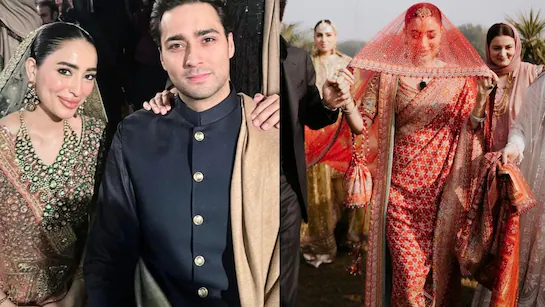
There is a tweet circulating of Nawaz Sharif’s grandson’s wedding. It is meant to be ordinary; the bride wore Indian designers, Sabyasachi and Tarun Tahiliani. Instead, it is revealing, the extent of Indic soft power. The colours are unmistakably Indian: red, gold, marigold. The symmetry is ritualistic rather than theological. The staging is ceremonial, not Quranic. The aesthetics are not Arab, Persian, or Turkic. They are Hindu-Indian; not in belief, but in form.

This is not a criticism. It is an observation. For seventy-five years, Pakistan has insisted that it is not India. That it broke away not only as a state but as a civilisation. That Islam did not merely replace Hinduism but erased it. Yet when Pakistan’s most powerful family marries its children, what appears is not a purified Islamic aesthetic but a recognisably Indic one.

Civilisation does not obey ideology.

Islam in Jambudvīpa did not enter an empty space. It arrived in a world already shaped by colour,  hierarchy, procession, music, and spectacle. It adapted to that world. It did not abolish ceremony; it repurposed it. Nikah replaced vivah, but the social grammar remained. Weddings stayed long, public, ornate, and familial. They did not become austere. They became Muslim in name and Indian in structure.

Continue reading A Pakistani Wedding That Refused Not to Be Indian

Who can speak for the “Muslim minority” of India?

Public debates on Indian Muslims often make one basic mistake: they collapse all minorities into a single category and then declare that “everyone is thriving because a few individuals have done well”. This flattens history, erases structure, and turns civilisational questions into census arithmetic.

1. Minorities Are Not Interchangeable

Jains, Sikhs, and Buddhists offer no meaningful analogy to Indian Muslims.

  • Jains were never politically central to the subcontinent.

  • Sikhs built a regional power, not a pan-subcontinental order.

  • Buddhists have been demographically marginal for a thousand years.

Indian Muslims were different. For centuries they formed the civilisational elite of North India; shaping courts, languages, music, etiquette, food, architecture, and the ways Indian states understood power. Delhi, Agra, Lucknow, Hyderabad were not enclaves. They were the centre of the political and aesthetic world of the Indo-Gangetic plain. A fall from centrality is not comparable to never having been central at all.

2. Individual Success Is Not Structural Health Continue reading Who can speak for the “Muslim minority” of India?

Brown Pundits