Reading the Reader: On Ammar Ali Qureshi’s Views and Reviews

By Furqan Ali

A review from Ink-e-Lab.
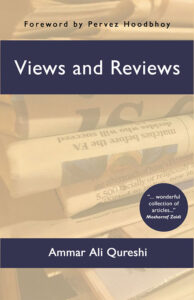

Publisher: Folio Books

Author: Ammar Ali Qureshi

Pages: 228


According to a Gallup survey, 75% of people claim not to read books at all. Mind you, this survey is from 2019 and by 2025, the figure has likely deteriorated even further; social media has drastically decimated our attention spans. A book, being a far more demanding form of engagement, often feels too formidable. People now struggle to read even a full 1,000 words op-ed, let alone something verbose. Many skim through posts on X, LinkedIn, or even long WhatsApp messages. And for those who do feel the urge to read, they’re often left perplexed: what should they read?

And that’s where book reviews come in: book reviews offer several valuable benefits for readers, writers, and the broader literary community. They help readers make informed decisions by summarizing a book’s content, style, and strengths or weaknesses, ultimately saving time and guiding personal preferences. Albeit, it is not a replacement of the whole corpus at all.

Reviews also deepen understanding by unpacking complex themes, symbolism, or context that casual readers might overlook. Additionally, they encourage critical thinking and discussion, as they often present arguments and interpretations that spark dialogue.

For writers, reviews provide constructive feedback and insight into how their work is being received, while also offering exposure, especially to lesser-known authors, by promoting diverse voices and hidden literary gems. Overall, reviews enrich the reading experience and foster a thoughtful culture of engagement with books. And the impending book under discussion does all of this and more.

Ammar Ali Qureshi’s Views and Reviews is a compilation of articles written across five cities spanning three continents over the past 15 years. One might call it a ‘labour of love’—a testament to his deep affection for books, inherited from his parents, both students of history, who allowed him to devour every book in their home. Even today, the library he has posted online reflects this passion, curated with care and brimming with crème de la crème titles.

The idea of writing these pieces draws inspiration from A.J.P. Taylor, the most popular and provocative British historian of the 20th century, who authored around 1,600 book reviews. This book, of course, is much slimmer compared to Taylor’s prolific output, yet it spans a wide range of subjects: history, politics, the economy and governance structures, nationalism, notable personalities, poetry, and more.

One striking piece, included in the first section, covers the exiled prince I had never heard of before, Maharaja Daleep Singh, son of Maharaja Ranjit Singh. The author’s review captures the deep melancholy of the story: the fall of one of the fiercest and most formidable reigns faced by the British, stretching from 1799 to 1849—from the southern districts of Punjab to Afghanistan and Kashmir. Ranjit Singh’s feat was a remarkable historical achievement.

The loss of this indigenous Punjabi kingdom, the confiscation of the Koh-i-Noor, Daleep’s dethronement at the age of ten, his coerced conversion to Christianity, his exile to England, and eventually his re-embrace of Sikhism, these form a profoundly tragic arc. He died penniless in a Paris hotel room, carrying the burdens of resentment and betrayal to the very end. The first section of the book, “Historical Perspectives on Punjab,” reads like a lament from a son mourning his lost mother, Punjab.

The second section turns to Pakistan. Among the essays, Pakistan and Iran: Neighbours of Many Surprises and Pakistan’s Middle Class and Islam particularly caught my attention. The former explores how Iran, under the Shah, was the first foreign head of state to visit Pakistan in 1950, became its largest bilateral donor—providing $800 million in loans and credit in the 1970s—supported Pakistan in the 1965 and 1971 wars, and yet, today, we face off against each other at a tense border.

The latter explores the rise of the new middle class, based on Dr Ammara Maqsood’s book The New Pakistani Middle Class. It focuses on how this class is more inclined toward a globalized form of Islam—seen as a legacy of Zia-ul-Haq and practiced by many Muslims in the West—rather than Wahhabism. However, Ammar points out the frequent conflation between the two, especially given the influence of Saudi funding. This stands in contrast to the older middle class, which projected a softer image of Pakistan.

In the third section, the article on Iqbal, “Iqbal — Love Letter to Persia,” reveals his (Iqbal’s) deep love for Persia: the language (of over 12,000 verses he composed, around 7,000 are in Persian), and Persian history especially the Persian conquest, which he considered most significant in the history of Islam, as reflected in his doctoral thesis. Iqbal’s admiration was reciprocated by prominent Persians, including Iran’s poet laureate Mohammad-Taqi Bahar, Prime Minister Mohammad Mossadegh, and influential figures like Ali Shariati (the ideologue of the Iranian Revolution) and Ali Khamenei (Supreme Leader of Iran).

Ammar quotes,

“Although the language of Hind is sweet as sugar / Yet sweeter is the fashion of Persian speech / My mind was enchanted by its loveliness / My pen became a twig of the Burning Bush / Because of the loftiness of my thoughts / Persian alone is suitable to them.”

The fourth section focuses on governance, particularly how corruption and the absence of a robust justice system fuel crony capitalism, weaken public service delivery, stifle economic growth, hinder innovation, crowd out investment, erode public trust, nudge religious extremism and reinforce elitism, among other consequences.

The fifth section, focused on personalities and memoirs, features intriguing pieces on figures such as Karl Marx—described as a “Prophet of Revolutions”—and Nur Jahan, the only Mughal queen to have her name inscribed on coins, who effectively ruled Jahangir’s empire for 15 of his 21 years on the throne. It explores the enduring influence of their legacies and the lessons they continue to offer, even after centuries. He quotes Robert Heilbroner from his book The Worldly Philosophers:

“We turn to Marx, therefore, not because he is infallible, but because he is inescapable.”

The sixth section shifts to global history, touching upon the rise and fall of Eastern and Western powers, the miscalculations of the Afghan war, Robert Fisk’s life amidst global upheavals, diplomatic failures, Obama’s failures, the rise of Trump, and much more. But I’ll stop here, I wouldn’t want to spoil it by revealing everything in it.

What elevates Ammar’s work is that his reviews are not mere summaries. He weaves history, politics, identity, and contemporary relevance into his analysis. He doesn’t shy away from highlighting contradictions or calling for critical engagement. His essays are not just about books, but about how to read, how to wrestle with ideas, how to cherish curiosity, and how to think.

In an age of vanishing attention spans, Views and Reviews is not only a literary respite, it is a call to return to depth, nuance, and the quiet joy of thoughtful reading.
War in the Sanskritopolis

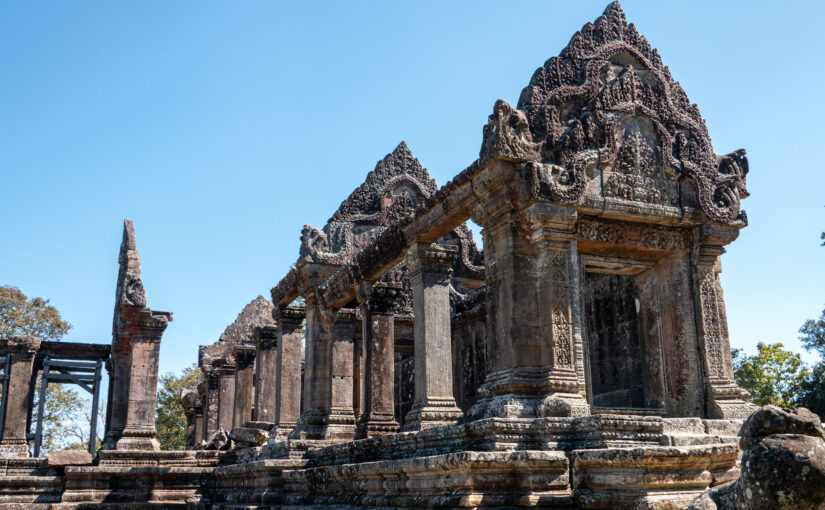
The long-running dispute between Thailand and Cambodia dates back more than a century, when the borders of the two nations were drawn after the French occupation of Cambodia.

Things officially became hostile in 2008, when Cambodia tried to register an 11th Century temple located in the disputed area as a Unesco World Heritage Site – a move that was met with heated protest from Thailand.

Why A Cluster Of Hindu Temples Is At Heart Of Thailand-Cambodia Conflict

It’s striking to see just how deeply Dharmic culture shaped Southeast Asia — not just as historical residue, but as a living civilizational layer. Buddhism, in many respects, prepared the civilizational terrain that Islam would later traverse.

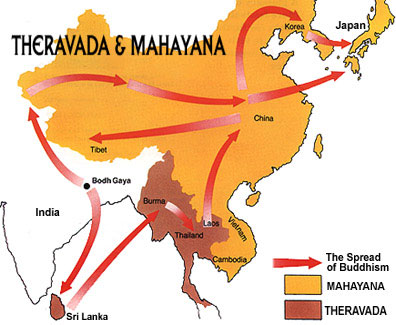
The Buddhist Studies: Theravada and Mahayana - buddhanet.net

Buddhism, too, was not monolithic. The Sri Lankan Theravāda tradition influenced the western flank of Indo-China, while Mahayana currents, traveling through Sumatra, appear to have looped back toward Guangzhou, feeding into the Sinosphere.

HISTORY OF MAHAYANA BUDDHISM | Facts and Details

The sectarian divergence between Thailand and Cambodia — Theravāda vs. Mahayana— adds nuance to territorial and cultural disputes like the Preah Vihear Temple, whose iconography and inheritance clearly align more with Cambodian history.

These are not just archaeological debates. They’re about cultural legitimacy, historical continuity, and civilizational memory.

In such moments, India, that is Bharat, must not remain a bystander. As the civilizational fountainhead, it should be playing a constructive role in cultural mediation and soft power diplomacy.

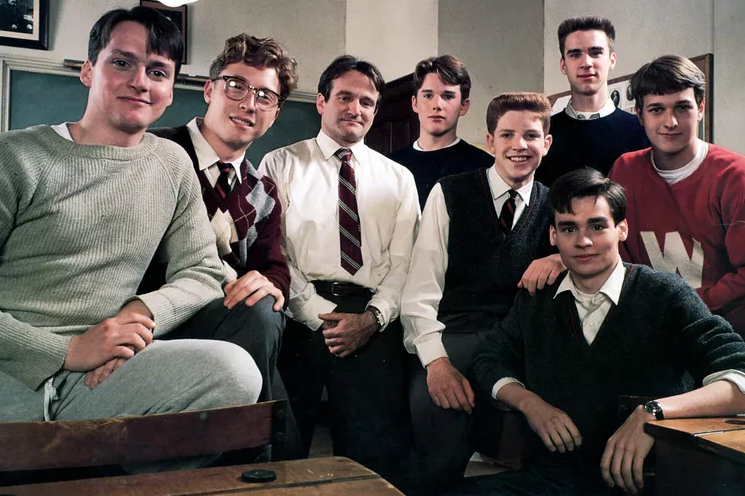
Dead Poets of Pakistan

After Kabir exited the WhatsApp group, the conversation between the Manavs and Furqan (who I have made Editor to encourage more DPPs) drifted, inevitably, to poetry and Punjabi. Furqan has already made two excellent contributions, A flying peacock and Lord Ganesh in a confectionary mill. Kabir did a great job in diversifying the Authorial voices on BP.

As we shape the future of Brown Pundits, I keep returning to one submerged voice in the Persianate world, particularly in Pakistan. A voice that is Westernised, undercapitalised, and culturally adrift. These are not the clerics, generals, or capitalists. These are the middle-gentry, the in-betweeners; fluent in English, wired to the internet, but uncoupled from patronage and power.

Like much of the Muslim world, Pakistan remains profoundly hierarchical. And I suspect its creative pulse, its latent genius, lies in that Westernised fringe of the lower elite: the zone between the bourgeoisie and the establishment. The boundary class. Half-in, half-out.

In a strange way, Pakistan’s obscurity may be its shield. Unlike India, an excavated society with every civilizational layer being rapidly monetised (Saiyaara is breaking records), Pakistan is a half-formed splinter. It doesn’t face the same pressures of internal reckoning. That may be a blessing.

Across the Persianate world, from Anatolia to Delhi, we are witnessing a civilizational scatter. The old cosmopolis of the Gunpowder Empires (Ottoman, Safavid, Mughal) has collapsed, leaving behind cultural debris. The Persianate polity, once a unified Empire of the Mind, is now a broken archipelago.

India, by contrast, benefits from its post-colonial majority. Like Israel, it is 80% one faith; with all the confidence and coherence that brings. It has the numbers, the market, and a dominant civilizational script. The Sanskrit world, if not unified, is at least centrally anchored.

In this context, Kabir represents one pole of the Pakistani elite: articulate, English-speaking, confidently liberal but also capable of drowning out the marginal voices he’s adjacent to. And yet sadly, I don’t think Pakistan is headed for any Hindufication. The trajectory is different.

Pakistan is not returning to India. It is, perhaps, becoming the lowlands of the Iranian plateau; a bridge nation once again, neither fully Arab nor Indic. Suspended between worlds, it may rediscover itself in that liminality.

Because sometimes, the dead poets are not gone. They’re just waiting for the right silence.

A commentary: Ganesh, in a confectionery mill

By Furqan Ali

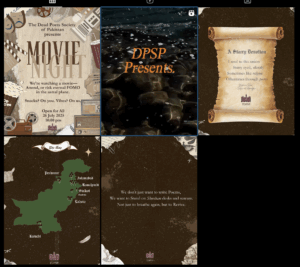
I’ve known Afshan Shafi for a while now as a mentor and a senior poet in the Pakistani Anglophone poetry scene (which is growing rapidly). Especially through the Dead Poets Society of Pakistan, a collective I founded, I’ve had the chance to learn from her presence and support. I still can’t believe we started just 2–3 months ago, and already we’ve grown to over 50 members, with nearly 30 actively contributing to our first anthology volume.

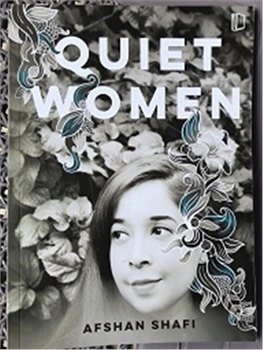
Anyway, I’ve tried here to annotate a poem from Afshan’s book Quiet Women, titled: Ganesh, in a confectionery mill.

Stanza I:
Last November’s basilica is crumbling,
The taffy foundry found to the char, the last scruff of meal
rotten.
still aerate masses dispense themselves
Onto the curd, and enter the extruder to be filled with
Shiny viscera,
Palm oil kidneys blossoming under the churn,
The winds percolating soft while
The clouds widen their tangerine irises,

This modernist-lyrical poem positions the Hindu deity Ganesh, traditionally a remover of obstacles and God of beginnings, in an absurdly industrial, even grotesque setting: a confectionary mill. It layers Hindu symbolism with post-industrial imagery, a surrealist aesthetic, and biting socioeconomic subtext.

The opening line juxtaposes Ganesh, a spiritual figure, with confectionary mill—a symbol of capitalist excess, mechanized desire, and sweetness-turned-sinister. The “basilica” references crumbling sacred spaces, showing how religion itself is industrialized or decaying in a consumerist age. The “taffy foundry” being burnt and the meal rotting suggest both spiritual and material entropy.

Further, it presents visceral industrial birth. A grotesque fusion of biology and production. “Palm oil kidneys” evoke cheap globalized ingredients, outsourced and mechanized labor. The clouds’ “tangerine irises” lend a psychedelic, possibly apocalyptic aura, where even nature gazes on in artificial hues.

Stanza II:
Ganesh wakes with a strawberry smile
his Styrofoam lips expunge bliss from leather jowls,
lashes and white hoarfrost of the eye
refract petroleum flora and
The textile of his palm, offers a hilltop of
Pink candy and glucose intaglio.
no satyr could have envisaged him thus, with
this clutch of winching blades and death ribbons
in rococo hands; he loosely wills to the green lotus.
a noose, hammer, axe, tusk, and garland,
a comely exhibition of rage.

Ganesh is now awakened, but with synthetic, sterile parts: “Styrofoam lips,” “leather jowls,” “petroleum flora.” This re-engineering of divinity underscores how capitalism and mass production cannibalize the divine, reconfiguring joy as pre-packaged euphoria. “Glucose intaglio” suggests even meaning is etched in sugar, brittle and saccharine.

We see an inversion of traditional religious iconography; Ganesh’s usual items (lotus, tusk) are now joined by industrial tools and “death ribbons.” Rococo—an ornate, decadent European aesthetic—is ironically placed in the deity’s hands, symbolizing colonial residues and grotesque excess. His rage becomes a beautiful but hollow spectacle.

Stanza III:
he, who galumphed through the century’s rain-carousel,
like a little girl
in his emerald playground, iliac metal suffused
with humectants, sacred sugars cohering his cross bones
and the toppling caul of an
ancestral-star, across his neck.
his delicate calf, frozen, in supplication to the woodbulb
of his throne,
for a being so strong
his gaze is weary, adolescent,
has no gunpowder to sustain the promise
of violence and eldritch-rosy,
He does not even possess the tranquilized regret
of the aesthete or the shaman
though one can see him across the
astral esplanades, chalking out his charkas,
hope scotching across the sediment, not even
alert to the cosmic sanguinity of his pleasure,
roaring beyond
the elongated shadows.

Ganesh is reimagined as childlike and vulnerable, “galumphing” playfully—an echo of Carrollian absurdity—but in a world of “iliac metal” and “sacred sugars.” This verse mourns the death of sacred innocence in a world overrun by commodified spirituality and mechanical ritual. The “ancestral-star” falling suggests cosmic disinheritance.

There’s a paralysis of divine strength. Ganesh kneels before an industrial “woodbulb,” a bastardization of enlightenment or throne. His adolescent gaze captures a mood of spiritual fatigue and confusion, as if divine power itself is exhausted in late capitalism.

Even violence is rendered inert, “no gunpowder” to fuel change. Neither divine fury nor aesthetic contemplation is viable anymore. The aesthete and shaman, both archetypes of deep feeling and mystical insight, are absent, replaced by a numb spectator god.

The poem ends on a note of withdrawal and loss of awareness. Ganesh remains, perhaps in form, but is disconnected from his own pleasure, joy, or purpose. His “chalked chakras” become meaningless diagrams. “Hope” is burning uselessly, never catching flame.

Much like:

    1. Since 2020, $42 trillion in new wealth was created, with 63% ($26 trillion) captured by the top 1%.
    2. From 1995–2021, the top 1% gained 38% of global wealth growth, while the bottom 50% got only 2%.
    3. In Pakistan, the richest 10% earning 16x the poorest, and landed aristocracy (nearly 52% of National Assembly members) exempting itself from tax.
    4. Land Ownership in Pakistan: 5% of large landowners hold 64% of farmland; 65% of small farmers own just 15% of land.
    5. Public neglect of social welfare: education spending slashed, health stagnant, and the HDI plunging.

CODA: The holy has decayed, not because gods have abandoned humans, but because humans have converted gods into icons of consumption. This poem is not just an abstract surrealist poem. It is a lament and a critique, a religious and political satire, invoking a plastic deity in a sugarcoated hell. It mourns the erosion of the divine, critiques structural injustice, and questions whether even the gods plasticized and commodified, can feel pleasure or rage anymore.

A flying peacock

By Furqan Ali

Today, I was travelling to Tarkha, a small village near Taru Jabba, all situated in KP (erstwhile NWFP), from Peshawar, which is considered the oldest living city of South Asia.

There, I saw a flying peacock. It was a once-in-a-lifetime experience. I had never seen one fly before, except in caged settings. A dog kept pestering her, making her dart from one place to another. And then, there was a donkey too, without reins! Perhaps the spectre of capitalism was absent. In that rural pocket, so close to the bustling and chaotic city of Peshawar, constantly a victim of radical urbanisation (over 45%), there was still something untamed.

Here’s the poem, inspired by the errand, along with the picture I took. Pardon my pathetic aesthetic, I’m learning this craft for my IG.


a flying peacock

“My mistress’ eyes are nothing like the sun…”

— Shakespeare

In Tarkha,

a flying peacock—

Simurgh,

aphrodisiac,

like a newly resurrected girl

in the dark night,

and the sin of being born.

Wandering,

hand in hand, eye to eye,

with Quratulain Tahira in the heavens.

Scène crème de la crème

landscape and portrait,

all green.

A darbar of some majzoob,

a Hindu majzoob

who lifted his hand—donning a ring of tourmaline—

and forgot,

like I forgot my birthday.

A free Jack—

a free, rapacious Jack

in the temporariness

of extraction,

with no reins

and obstruction.

Imbibed the aerodynamics

of the multicolored creature.

Everyone is colorblind

up to some extent—

too many hues.

Gobsmacked.

Kaleidoscope swaying

retina and brain.

And a thirsty dog

trying to bite—

for hemoglobin, and iron, and water.

The displacement angles

bottlenecked

between:

the dog must die.

It is ugly.

A brat with channa mewa,

wandering in the intricate ploy—

dusty and topsy-turvy roads.

A sheriff was maybe peeing somewhere.

I could not sense anyone.

Miscreant mist—

and resplendent.

Except

us.

I waited for a nimrod

who could bullet that beautiful ghoul.

A dragon scroll fell on my head,

with a sheesh mahal.

Every nook flummoxed

with those savage eyes.

I could see the song of the future—

Inconsequential.

How could I smoke and not puff?

The nicotine pouches in my jaw?

Pathetic!

Sweet coils of

paintings,

bureaus of linen—

I was painted

a zillion times

by the palette of that bird

that prowled through Tarru Jabba,

for the relief of my head,

and the reconstruction of

my senses—

and poems.

Open Thread; Trans in the Muslim World

Other Stories (thank you Nivedita):

🔗 India Today – Harshvardhan Jain Scam

A man posed as a diplomat, set up fake embassies, and ran a multi-crore loan fraud racket via fake companies. He even issued “official” visas.

🔗 Business Standard – Karnataka Vendor GST Nightmare

A vegetable vendor in Karnataka received a GST notice due to high UPI volume — triggering a cascade of tax bureaucracy.

🔗 Economic Times – Indian Man Stabbed in Ireland

An Indian man in Ireland issues a public warning after surviving a random stabbing in Dublin.

🔗 NDTV – Hyderabad Man Kills Wife

In Hyderabad, a man stabbed his estranged wife to death at a birthday party for a child.

Brown Pundits: Broad Church or Narrow Canon?

Brown Pundits Must Stay a Broad Church

Reading Kabir’s thoughtful post on the “soft Hindutva” bias at Brown Pundits, I found myself both agreeing with parts of his argument and diverging from its framing. My own journey with BP goes back to its inception. The blog was born in Twixmas December 2010; 10 days after I had met Dr. Lalchand, whose presence has profoundly shaped my civilizational views.

I say this not as a biographical aside but because BP, at its best, is where the personal and civilizational collide. We bring who we are; our marriages, our migrations, our contradictions, into this messy, brilliant conversation.

At the time, like many Pakistanis, I held a deep-seated assumption: that Hindus were fundamentally “other.” It wasn’t overt hatred; just a civilizational distance, internalized from birth. But Dr. V & Brown Pundits challenged that.

A Forum With Bias? Yes. But Which One?

The heart of BP is not neutrality; it’s the willingness to host contradiction. That is its genius, and it must be protected.

Continue reading Brown Pundits: Broad Church or Narrow Canon?

What Kind of Space Is Brown Pundits

A few of us authors have been actively discussing the future of Brown Pundits; the space, the tone, and the deeper ideas we’re engaging. It started informally on our WhatsApp group, but the questions are foundational: What kind of platform is BP becoming? What should it strive to be? And what kinds of ideas does it host best?

At its best, Brown Pundits is a bridge; across nations, faiths, ideologies, and lived experiences. It’s a space where one can be deeply Indian, wholly Pakistani, broadly Bangladeshi, or diasporic and disillusioned but still belong. But like any bridge, it needs conscious upkeep. If a conversation leans too far in one direction, it doesn’t stretch, it collapses inward.

Some contributors feel the platform has become overly shaped by one ideological current. Others argue that the real problem isn’t dominance, but disengagement ; those who want plurality must also show up. And both perspectives can be true.

Open Thread

Today will be a bit busy so I haven’t had time to attend to BP (running on 4-5hours sleep).

Talk about whatever you like; I’ll make this thread sticky a while. A good & engaged commentariat is the lifeblood of a platform.

I’m working on something that will be a bit interesting (my newsletter meets my work) but let’s hear from you w.r.t the wacky and the wonderful.

Bharat Needs No Validation

I’ve been following the usual commentary, the BP quadrant: Indosauras, Nivedita, Kabir. And I read Kabir’s offhand remark that the Ramayana “didn’t resonate” the way the Iliad or Odyssey did. That casual dismissal is telling.

The Ramayana is not just literature,  it is scripture, memory, and civilization encoded in verse. It has shaped the moral and cultural landscape of over a billion people for millennia. To compare it, then downplay it and to do so so glibly reveals less about the text and more about one’s own civilizational estrangement.

Let’s be honest: that kind of language would never be used for the Quran or Islamic texts. And the fact that it is used for Hindu epics by brown intellectuals raised in the shadows of colonial categories says everything about how deeply colonized the Pakistani mind remains. Pakistan is, in truth, an Urdufied Punjab insufficiently imagined, a fragment that lost its civilizational compass in the act of imagining itself apart. The fact that the Ramayan being Pakistani heritage is such a novelty speaks volumes.

Today I sat at Stratford Westfield, eating Dubai Hot Chocolate ice cream, and the man next to me clearly Pakistani asked me, in Urdu, “if I was in the queue?” His wife spoke Punjabi-inflected Urdu. It struck me how London has become the real unifying Punjab. Ten percent of Britain is now Desi. And outside of the subcontinent, the fractures of 1947 heal in ways that remain impossible back home.

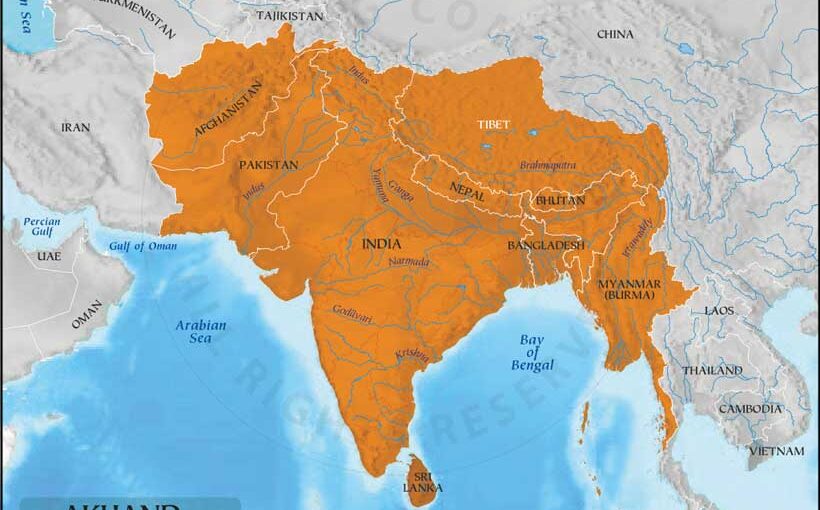
We speak of South Asia. But the term is bureaucratic; no one identifies with it. India is real. Bharat is civilizational. Aryavarta stretches from the Hindu Kush to the Indian Ocean — just as France is the Hexagon, Bharat is the Triangle. Partition clipped its wings, but its soul remains intact.

And look at the reality today: Indian Muslims are thriving in the mainstream. The title song of the upcoming film Sarai — written, composed, and directed by three Muslims: Ishaq, Fahim, and Arsalan. The leading lyricist is Javed Akhtar. This is a country that refused bitterness. A country whose largest minority chose Partition, and yet was never cast out, a unique precedent and testament the pluralism of Dharma.

Bharat needs no validation. It doesn’t need the approval of its neighbours or the heirs of partitioned imagination. It only needs to walk — and it is flying. Toward its own authenticity, on its own terms. And the world is watching.

Brown Pundits