
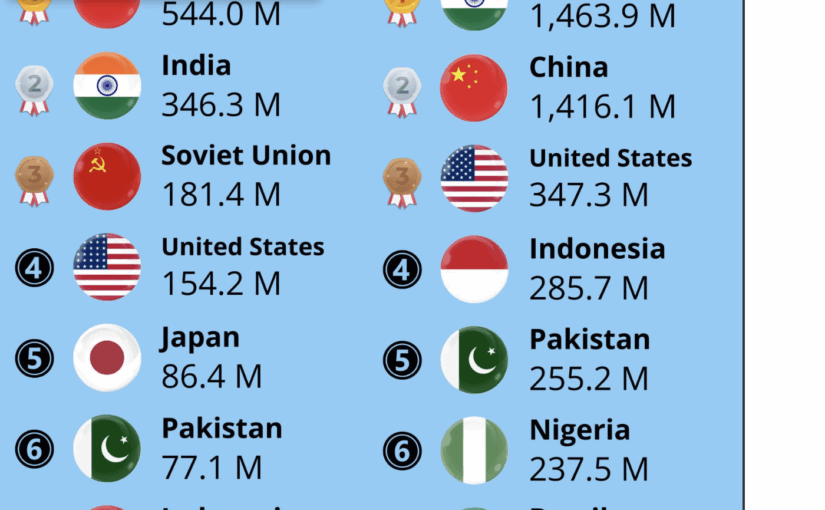
South Asia’s demography is one of the great untold stories of the modern world. Too often we look at the subcontinent through today’s partitions — India, Pakistan, Bangladesh — but the real insight comes when we view the region as a single whole. Across 125 years, the balance of populations has shifted dramatically.
📊 1900: A Baseline
At the turn of the twentieth century, Muslims made up about 20% of undivided India’s population. The rest were overwhelmingly Hindu, with significant Sikh, Christian, Jain, and other minorities.
📊 1950: Partition and Realignment
By 1950, just after Partition, Muslims had grown to around 23.5% of the undivided population.
- Total population: ~423M
- Muslims: ~100M (23.6%)
- Non-Muslims: ~323M (76.4%)
This was the backdrop to Partition — a subcontinent where one in four people identified as Muslim.
📊 2025: Today’s Landscape
Fast forward to 2025, and the combined population of India, Pakistan, and Bangladesh stands at nearly 1.9 billion.
- Muslims: ~618.5M (32.7%)
- Non-Muslims: ~1,276.3M (67.3%)
What was one-quarter is now closer to one-third.
- Pakistan: 14.2% non-Muslim in 1950 → just 3.9% today (however West Pakistan was 3.4% so in fact the non-Muslim.minority has grown relatively in West Pakistan as non-Muslim minorities tend to have higher TFRs).
- Bangladesh: about 9% non-Muslim, still home to ~16M Hindus (it was 23.20% in 1950).
- India: Muslim share rising modestly, from ~10% in 1950 → ~14.5% today; estimated to peak at 18-20% toward the latter half of the 21st century.
Why the Change?
- Differential fertility rates: Muslim communities historically had higher total fertility rates (TFRs), especially in rural areas.
- Migration & partition violence: Large Hindu and Sikh communities left Pakistan (and later Bangladesh), while many Muslims crossed into Pakistan.
- Minority attrition: Pakistan’s non-Muslim population has never been especially significant and Bangladesh’s has shrunk (owing most likely to the 1971 war) while India retained its fledgling Muslim minority.
📉 A Global Trend
Yet today, the real story is convergence. TFRs are dropping everywhere. The engine of this decline is not just economics or urbanisation; it is the mobile phone. In every village, every slum, every small town, the phone is a pathway to global culture and global norms. Families shrink when horizons expand.
Demography is destiny, but destiny itself is being rewritten by technology. What took centuries to shift in Spain or the Ottoman world now takes decades in South Asia.
✨ Closing Thought
From 20% in 1900, to 23.5% in 1950, to nearly 33% in 2025, the Muslim share of undivided India has grown consistently (it may peak at around 40% circa 2050). But the pace of change may slow, even reverse, as fertility collapses across the subcontinent. The smartphone may prove to be as powerful a force in shaping South Asia’s future as Partition was in shaping its past.
Addendum
This post was first inspired by a Twitter thread that visualised population growth between 1950 and 2025 across countries. It sparked me to look more closely at South Asia’s long-term numbers.
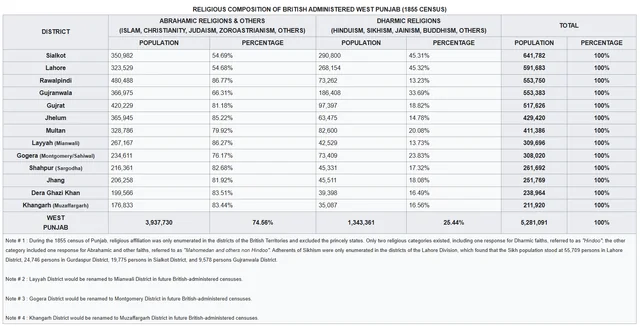
Another thread that caught my eye today, from @viprabuddhi, pointed to how different the region looked on the eve of British expansion. He argued that much of Bangladesh was still Hindu-majority, that Pakistan was relatively sparse (even compared to Arunachal), and that Hindus globally outnumbered Muslims until as late as 1872. The snapshots interspersed below are from the 1855 Punjab Survey.
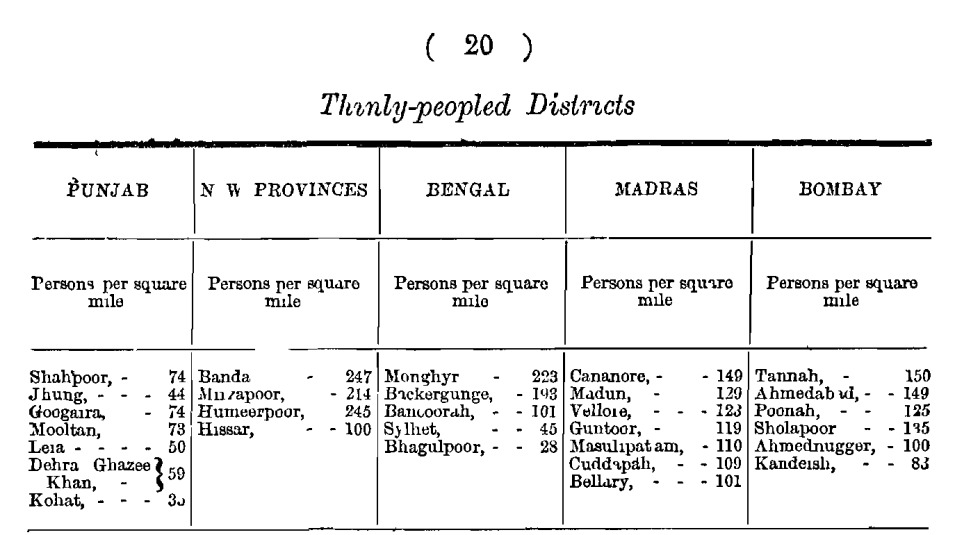
In fact, when we look closer, colonial and pre-colonial patterns of settlement are central to understanding why Pakistan and Bangladesh look the way they do today.
-
West Punjab and Sindh were transformed by the British canal colonies of the late 19th and early 20th centuries. Millions of acres of previously arid land were irrigated and resettled, creating the agricultural heartland of modern Pakistan. This was in stark contrast to East Punjab, which remained largely rain-fed. The 1911 Encyclopaedia Britannica even noted the dividing line between the “two Punjabs” running neatly between Lahore and Amritsar.
The eastern and western plains, which are divided from each other by a line passing through Lahore, are dissimilar in character. The eastern are arable plains of moderate rainfall and almost without rivers, except along their northern and eastern edges. They are inhabited by the Hindu races of India, and contain the great cities of Delhi, Amritsar and Lahore. They formed, until the recent spread of irrigation, the most fertile, wealthy and populous portion of the province. The western plains, except where canal irrigation has been introduced, consist of arid pastures with scanty rainfall, traversed by the five great rivers, of which the broad valleys alone are cultivable. They are inhabited largely by Mahommedan tribes, and it is in this tract that irrigation has worked such great changes.
A significant beneficiary of the colonisation was the city of Lyallpur, now Faisalabad, originally named after Sir James Broadwood Lyall who pioneered the Chenab colony. At the time of the British annexation in 1849 it was a barren wasteland, and by 1891 the region had a population density of mere 7 persons per square mile. It was characterised by nomadic tribes and notorious criminals, with the Sandal Bar area being named after the Chuhra bandit Sandal. By 1901, in just a decade, the population had reached 187 persons per square mile, was 301 in 1921 and 927 in 1998.[74] Lyallpur, renamed Faisalabad in the 1970s, is currently the third most prosperous city of Pakistan in terms of GDP per capita.[75]

-
East Bengal (today’s Bangladesh) followed a very different trajectory. Historian Richard M. Eaton has written extensively about the “agrarian frontier” in Bengal between the 13th and 18th centuries. As forests were cleared and the plough spread, new farming communities took root. Crucially, this process was tied to the spread of Islam, as Muslim pioneers, landlords, and Sufi networks spearheaded settlement in newly opened lands. Eaton’s “history of the plough” makes clear that Bengal’s Islamization was not primarily by conversion of existing Hindu villagers, but through the creation of new Muslim-majority villages on fresh agricultural frontiers.
Taken together, these patterns remind us that demography is not simply about fertility rates or census counts. It is about land, water, and agriculture — how empires and states open up land for cultivation, move populations, and redraw the map of settlement. In just 170 years, West Punjab’s population rose thirtyfold—from 4 million to 127 million. Pakistan may be seen as ordained by God, in some tellings of the national myth, but it was certainly engineered by the British
interesting read.
Thanks – demographcis is and isn’t Destiny
More trouble in India in one of their colonies
For the past six years, thousands of people in Ladakh, led by local civic bodies, have taken out peaceful marches and gone on hunger strikes demanding greater constitutional safeguards and statehood from India, which has governed the region federally since 2019. They want the power to elect a local government.
“This is the bloodiest day in the history of Ladakh. They martyred our young people – the general public who were on the streets to support the demands of the strike,” said Jigmat Paljor, the coordinator of the apex body behind the hunger strikes.
https://www.aljazeera.com/news/2025/9/25/bloodiest-day-how-gen-z-protest-wave-hit-indias-ladakh-killing-four
how is Ladakh a colony?
Watch out sbarrkum. Calling Ladakh a “colony” is going to make you public enemy number one over here.
Obviously, Ladakh is part of Occupied Kashmir (as in it was part of the Maharaja’s state) and in that sense it is a “colony” of India just as much as Kashmir is.
They are struggling for statehood (within the Indian union) just as Occupied Kashmir is.
ur back?
our not so loyal opposition droll
I think he couldn’t help himself. Got excited at seeing the rage bait and wanted to throw in some kerosene of his own.
Funny thing is he could have been on a Pak focused site but thing is Pakistan has much lower literacy and English proficiency so you don’t even have similar Pak focused sites.
Anything about India is a red rag for many
Then how is it a colony if they want to be a state in the Indian union lol.
2019 – Sonam Wangchuk, super happy that article 360 was abrogated and Ladakh was made UT
2025 – Sonam Wangchuk, – we need GenZ nepal – bangladesh style protest for Statehood
How many news media organizations report this accurately?
Ladakh is a region administered by India as a union territory[1] and constitutes an eastern portion of the larger Kashmir region that has been the subject of a dispute between India and Pakistan since 1947 and India and China since 1959. Ladakh is bordered by the Tibet Autonomous Region to the east,
Only colony in South Asia is Eelam, brother.
4 people dead and Ladakh is a colony, how many civilians did the Sinhalese army murder in annexing Jaffna?
Do you think India as a nation should not exist?
Moving this here. Seems more apt for some reason.
https://www.aljazeera.com/news/2025/9/23/calls-for-probe-after-killing-of-civilians-reported-in-northwest-pakistan
What happened here? Did the Pakistanis bomb their own people?
There are pictures of Tirah valley Pastuns holding up fragments of the Tail fins of Mk-80 series American bombs used on them.
Looks like non-surgical strike, dumb bombs killing women and children victims. (Some reports have more deaths than India’s surgical strikes in Muridke and Bhawalpur)
Yup.
Lots of insurgency in that area.
The fall of Kabul didn’t go as planned for Pakistan.
Also do not underestimate the exmuslim trend.