So it starts ..
Continuing on, X.T.M says that “India’s post-Independence settlement created structural ambiguity” and cites four factors in particular:
I think his key insight is this: “The constitution guaranteed rights. It could not guarantee renewed political consent.”
The issue as I see it is that the Indian state took the most half-hearted, wishy-washy approach towards the problem of integration. It allowed Muslims to construct bastions of political power while at the same time dividing Hindus along caste and linguistic lines. It allowed criminal elements, many from a Muslim background, to dominate perhaps its most significant sector — the arts — and spread messages of the innate goodness of Indian Muslims and Pakistanis (which is only being suppressed due to both governments’ actions) and the need for peace between Hindus and Muslims, thereby constructing an illusory palace to beguile secularized urban Hindus, while behind the silver screen they fund terrorist attacks in India. The murder of Gulshan Kumar comes to mind as (seemingly) among the least of these crimes, but that he was killed outside a temple is like having salt poured into the wound and mud slung at one’s face. What to speak of 26/11 which has already been talked about, especially recently.
Again, as I mentioned previously, I don’t think the overwhelming issue is that Muslims were allowed to maintain particular political fiefdoms — it’s that Hindus were stymied from establishing systems of political power based on traditional models. When talking about ‘independence’, Moldbug (2008) in chapter 2 of An Open Letter to Open-Minded Progressives suggests that:
“One test we can apply for independence, which should be pretty conclusive, is that the structures of government in a genuinely independent country should tend to resemble the structures that existed before it was subjugated—rather than the structures of some other country on which it may happen to be, um, dependent. These structures should be especially unlikely to resemble structures in other newly independent countries, with which it presumably has nothing in common.”
When I get to set a banner image I will post the article
The exchange (which has now been removed after mutual agreement) that just unfolded was not about architecture. It was about authority.
SD made factual errors, quietly corrected them, and apologised in private. That should have ended the matter. Instead, the loudest resistance came from Kabir: a reflex insistence that disagreement was illegitimate because the author was “credentialed,” “Oxford,” and therefore beyond challenge.
This is the residue of colonisation. Pakistanis were not only carved out of British India; they were produced by the collapse of a Muslim ruling class already broken by the British after the destruction of Mughal power. What followed was not confidence but deference. The habit of looking upward, to Western institutions, American accents, British titles, for permission to speak. That habit persists. Continue reading Why Pakistani Liberals Remain a Colonised Intellectual Class
I finally saw the movie in a theater in central California (almost houseful) and here are my thoughts:
4 out of 5 stars.
Genre: Inglorious Basterds. This is a revenge fantasy. The Indian state did not (publicly) take revenge for the Kandahar Hijack, the parliament attack or the Mumbai attack. This bothers “Nationalist Indians” and one of them decided to make a fantasy movie about revenge being taken.. And he did a good job.
Storyline: Fantasy about an Indian super-agent sent to infiltrate Pakistani terrorist networks, ends up in Lyari in the most notorious criminal gangs in Pakistan, who turn out to be tangentially involved in Pakistani-sponsored terrorism (none of this has any connection with reality). Mumbai attacks make an appearance and that is the part of the movie that is closest to reality; the attackers did train in Karachi, the attacks really happened and they really did get massacre instructions over the internet during their “mission”. Whether Khanani was involved or not, I have no clue, but someone like him probably was involved in the overall jihad efforts, so those parts are not just fantasy. The role assigned to the Lyari gangs is pure fantasy though.
The rest is of course ALL fantasy. But as a movie, it works very well, as long as you keep in mind that this is a revenge fantasy on the lines of Inglorious Basterds, not some kind of historical movie or documentary. The love angle is the silliest part of the story, but it IS a fantasy and it’s a bollywood movie, so hardly unexpected.
The movie itself works very well as a movie. The stars all deliver good performances, and Akshay Khanna definitely steals the show. His portrayal of Rahman Dakait will live long and prosper. And Akshay is now a legit superstar in Lyari (you can check out reels from there to confirm this) and will be mobbed and much loved if he shows up there. Sanjay Dutt as SP Choudhry Aslam is outstanding and Ranveer does a good job as the hero.
The music is simply outstanding. The background score worked VERY well in the theater (so see with good speakers if you can) and the songs are all excellent and fit in well with the movie.
It is very much an anti-Pakistan movie, so I dont think patriotic Pakistanis will enjoy it too much, but if you are a normal working class Pakistani you can enjoy it and if you are from Lyari you will likely watch it again. With direct attacks on Pakistan as the world center of terrorism and thinly disguised portrayals of Asif Zardari and Nabil Gabol, it is absolutely no surprise that this was banned in UAE as well. In fact, ISPR will surely make a revenge fantasy of their own now (it will be mostly AI slop, but some actors will get such over the top dialogs that they will be entertaining, and some music may be good, that is my prediction about the revenge movie, and I am very sure it will get funded, but it will not match Bollywood in tech or production; my confidence that it WILL be made comes from the simple fact that the Pakistani deep state is VERY obsessed with making sure we always have a tit for every tat.. in this we are somewhat different from India, but closer to the world average).
Why did Dhar mix Lyari up in this story? And was that a good idea? I think he mixed in lyari because Lyari gang wars are fantastic movie material and even if there was no real connection with the anti-Indian terrorism, for a movie it was a good element to fit into the story. Those gangsters mostly did die horrible deaths in real life and this too fits in well with the fantasy story, but it is worth keeping in mind that this connection is almost certainly fictional (if anything, some of them were working for foreign agencies, for example Uzair Baloch was formally accused of working with Iranian intelligence).
I will make a prediction about Dhurandhar part 2. I think they will get many or most of the figures shown in this movie to be killed in the next one as revenge by “unknown gunmen”, though in real life the unknown gunmen have not struck down any of the big fish till now.
That this revenge fantasy got a LOT Of pushback from Indian reviewers and critics (on the basis that it shows Pakistan too negatively and is too jingoistic) is a tribute to the naivete and innocence of the reviewers and the ecosystem they live in. We Pakistanis had no idea we have so many friends in India 🙂
Overall: well worth a watch. Three hours do fly past. It is very well made and most people will find it enjoyable, but patriotic Pakistanis may want to avoid it if such things raise their BP.
These are a couple of videos about the reality of the Lyari gangs and how this movie is playing there.
This growing tendency to treat every internal conflict in South Asia as if it were interchangeable with Kashmir (the “Sunni Valley“). This is a mistake, and in the case of Balochistan, a very serious one.
The distinction was once put very clearly to me by Benazir Bhutto herself. In the 1990s, while seeking international advocacy on Kashmir, she was asked by Saddam Hussein a blunt question: If we support Kashmir, why should the world not support Kurdistan? Her reply was immediate and precise. Kashmir, she said, is an international dispute. Kurdistan is not.
That distinction matters, and it still holds.
Kashmir is internationalized by design. It is anchored in UN resolutions, formal bilateral agreements, wars between recognized states, and sustained global diplomatic engagement. It belongs to the same narrow category as Palestine or Cyprus; flashpoints where sovereignty itself is contested between states and therefore cannot be reduced to a domestic matter. Continue reading Why Balochistan Is Not Kashmir
There is a persistent habit, especially among our soi-disant commentators, of predicting Pakistan’s imminent disintegration. The arguments are familiar: Baloch insurgency, Pashtun irredentism, low Kashmiri fertility, economic weakness, and analogies to 1971. They are also, taken together, wrong.
To begin with, most people discussing Pakistan do not understand its internal sociology. They begin with a conclusion, “Pakistan is artificial and unstable”, and then select facts to confirm it. This is confirmation bias dressed up as analysis.
Consider the Pashtuns. The claim that they are natural irredentists misunderstands who they are and how they live. Pashtuns in Pakistan are not a marginal population looking across the border for salvation. They are deeply integrated into the Pakistani state, economy, and military. They dominate transport, logistics, security, and large parts of urban informal commerce. Large numbers have moved permanently into Karachi, Lahore, and Islamabad. Assimilation is not failing; it is proceeding at scale. Continue reading Pakistan Is Not About to Break Apart
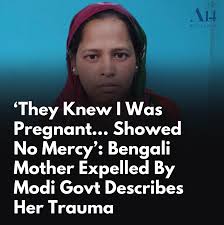
“We are not from Bangladesh. We are Indian. Why did they do this to us?”
That question should shame the Indian state. On the facts as currently established, Sunali Khatun, a pregnant Indian woman, her husband, and their child were detained in Delhi, deported across an international border without due process, imprisoned in a foreign country, separated, and left to survive on charity and court orders. Their crime was not illegal entry. It was speaking Bengali, being Muslim, and being poor. This was not a mistake or overreach. It was state violence carried out through paperwork and silence.
India has procedures for suspected illegal migrants
They exist to prevent this outcome. They were ignored. There was no verification with the home state, no due process, no public record, and no accountability. A family was pushed across a border, reportedly beaten when they tried to return, and abandoned. That is not law enforcement. It is expulsion by force. When a state confuses language with nationality and religion with foreignness, it stops governing and starts hunting.
Citizenship is not a favour
It is a legal fact. India is not meant to be a blood, language, or religious state. Citizenship is defined by law, not accent or poverty. When the weakest are forced to prove citizenship under duress while the powerful are never asked, law collapses into power. This is how republics rot: not through coups, but through habits.
This is not an isolated lapse of manners towards the Muslim minority
It is the same logic in a smaller, more public form. When a Chief Minister can pull down a Muslim woman’s veil at a government appointment ceremony, and senior ministers can defend it as “show your face” patriotism, the message is clear: Muslim dignity is conditional, and visibility is enforced, not consented to. The argument is always the same. It is dressed up as procedure, security, or “rule of law,” but it operates as dominance.
Muslim Identity is seen as a National Threat
Today it is a veil tugged down in a room of officials. Yesterday it was a Bengali-speaking family pushed across a border. In both cases, the state treats Muslim identity as an offence to be corrected in public, and citizenship as something that can be suspended by suspicion. This is how discrimination becomes policy: first through humiliation, then through paperwork, then through expulsion.
Bengal, like Kashmir, is not a border zone to be cleansed Continue reading A Republic Cannot Deport, Humiliate or “Outbreed” Its Own People
A Cold Comparison, Not a Romantic One
There is only one historical analogy worth using when discussing Pakistan “rejoining” India: the Act of Union of 1707 between Scotland and England. Not Rome and Greece. Not Yugoslavia. Not German reunification. And certainly not civilizational nostalgia. The reason is simple. The 1707 Union was not about love, memory, or reconciliation. It was about bankruptcy, security, elite survival, and managed loss of sovereignty without humiliation. That is the only way such a union could ever happen.
Union Is an Elite Exit, Not a Popular Dream
Scotland did not join England because it felt British. It joined because it was broke. The Darien Scheme collapsed. The Scottish state was insolvent. The elite faced personal ruin. England controlled capital, markets, and trade. The Act of Union absorbed Scottish debt, protected elite property, preserved law and church, dissolved sovereignty while preserving status. The public opposed it. It passed anyway. Unions are not plebiscites. They are elite exits under pressure.
Pakistan’s Position Is Structurally Similar
Pakistan today is not Scotland in 1707. But the resemblance is close enough to matter. Pakistan is chronically indebted, permanently IMF-dependent, over-militarised by design, economically capped by scale and FX limits. It is run by elites whose lives are already offshore, Like Scotland, the state is failing faster than rents can be extracted, sovereignty has become expensive, security dominates fiscal policy and there is no credible independent growth path. This is not ideology. It is arithmetic.
Why India Is England in This Analogy Continue reading Pakistan and the Act of Union
Excerpts from an Article on NakedCapitalism
Donald, you just wrote the most honest colonial confession of the 21st century. When you say Venezuela must “return” its oil, land, and assets to the United States, you are not talking about law. You are talking about ownership. You are saying, out loud, what empire has always believed in private: What lies under Venezuelan soil belongs to Washington.
The money quote: “you know the old days, when you had a war, it was ‘to the victor the spoils.’”
Venezuela has the largest proven reserves of heavy crude in the world, with an estimated 303 billion barrels, as well as the largest reserves of light crude oil in the Western Hemisphere. But it’s not just that Venezuela is home to the largest oil reserves on the planet, it’s that those reserves are sitting “right next door” to the US, as Trump himself said in 2023:
President Trump’s obsession with seizing other countries’ oil goes back a ways, to even before he entered politics. Here he is explaining in 2011 why the US should seize half or more of Libya’s oil after murdering its leader, Muammar Muhammad Abu Minyar al-Gaddafi, and plunging what was arguably the richest country in Africa (on a per-capita basis) into total chaos.
There are, of course, a plethora of other reasons for the US’ aggressive moves against Venezuela that we’ve discussed before, including the country’s large deposits of gold, rare earth minerals and freshwater; the opportunity to open up a mid-sized country’s market to rampant privatisation and liberalisation.
It is, after all, the US, mainly during Trump’s two presidencies, that has been stealing all kinds of Venezuelan assets, from the country’s gold reserves to the oil tanker seized in the Caribbean last week, to the president’s official plane, to Venezuelan oil company Citgo.
Exxon has a long, rich history in Venezuela dating back over a century. Its predecessor, Standard Oil, was one of the first companies to explore for oil in the South American country in the 1910s
But that all came to a halt in 2005, when Hugo Chávez ordered all existing “operating agreements” with foreign oil companies to be converted into joint ventures in which the state oil company, Petróleos de Venezuela (PDVSA), held a mandatory majority stake (over 50% ownership and operational control). Exxon refused to sign while most other companies, including BP, Total and Chevron, took the deal.
That high-intensity conflict is now closer than ever. But it needs to be packaged and sold to US lawmakers, media, members of the armed forces, and Trump’s war-weary MAGA base. And that is where CSIS’ “experts” come in. And they appear to be marketing this war on behalf of a company (Exxon) that has much to gain from a military intervention, and which bears the biggest grudge against Venezuela’s Bolivarian movement.