

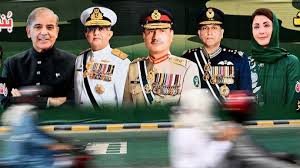
Pakistan, the Successor State to Islamistan
The settled view of Pakistan, is that it is the most ideologically Islamic state the world has ever produced, and that each decade carries it further into theocracy. We think the settled view is wrong.
The Pakistani elite has quietly secularised. And far from hollowing the state out, this is precisely how Pakistan became what it was always designed to be: the successor state to British India’s Muslims. Islam was the vehicle. Pakistan is the destination.
Islam remains the public language of legitimacy.
Privately, among the stakeholders who actually run the place, the operating priorities are entirely secular. The society on the ground is conservative and devout. The class at the top, the one that keeps the state alive, believes in Pakistan far more than it believes in Islam.
It helps to separate three things that we mean by Islam. There is Islam as faith, the private conviction of the believer. There is Islam as identity, the badge of who one is and whom one stands with. And there is Islam as state language, in which Pakistan explains itself to itself and to the world.
The elite has not surrendered the third, and it has not wholly shed the second. What it has let go of is the first as a terminal value: the notion that the purpose of the state is to realise Islam, rather than to deploy it.
Faith has gone from ultimate to instrumental.
This migration is what we mean by secularisation. This is not the familiar story of liberalisation. We are not saying Pakistan grew tolerant, or irreligious, or fond of gin. We are saying something narrower and stranger. Pakistan’s elite secularised the priorities of the state without secularising its language. Strip away the Islamic vocabulary and look at what the stakeholder class optimises for, and the list is unmistakable: state survival, strategic depth, military capability, sovereignty, national prestige, and the reproduction of the elite itself.
Continue reading Pakistan, the Successor State to Islamistan

High-Intensity Precedent
Brown Pundits runs on attention. When we put hours into the site, it hums; when work and travel pull us across three jurisdictions at once, it slows. We have a backlog of pieces we want to write and lives that keep getting in the way. The June survey took the wind out of the schedule. We do not want to run this place as full-time editors, and we should not have to.
First, a thing worth saying plainly. Brown Pundits is not a magazine. It is a discussion community with essays attached, and it always has been. The life of the site is the conversation, not the rate of publication. Everything below follows from taking that seriously.
The principle is high-intensity posts. A lot of writing is rewriting, and we want authors to work their pieces hard before they go up. We have noticed the same thing for years. A post that carries real thought and attention never dies at ten or fifteen comments. Fifty is our quiet benchmark. Past a hundred, the thread stops being ours at all and takes on its own life, because people come here to argue with each other and use the post as fodder. Signal pulls signal. Thin posts pull nothing.
The rules:
- Fresh original writing is the post. Work it hard, put it up on its own, and let the comments run. This is the essay, and it keeps standing where it always has.
- Reposts do not each get a post. Links, columns, reviews, the odd video, other people’s work: these stack into a single running thread, one per author or theme. The author upranks the newest entry to the top, refreshes the timestamp, and lets the curation gather in one place. One dense thread beats ten thin link-drops that die overnight.
- Open threads, where the general cross-talk lives, stay scarce. We open a new one only when the current thread crosses fifty to a hundred comments, or once a week, whichever comes first. Two or three live threads, not twenty.
The obvious worry is that a long thread walls out newcomers. It does not, because the newest entry always sits on top, and the open threads rotate weekly or at a hundred, so the live conversation is never buried under a year of history.
An example. A contributor who shares a steady stream of links, a column here, a book review there, the odd YouTube, keeps one running thread for the lot instead of a dozen one-line posts. Each new link goes to the top. The older ones stay underneath. The regulars know exactly where to find it and argue about it, and the thread grows heavier and more valuable every week instead of vanishing down the feed in a day.
That is the whole idea. Original essays worked harder, reposts gathered in one place, cross-talk kept to a few live threads. We stay a discussion community with essays attached. We are just building better rooms for the discussion to happen in. Less churn for us, more weight for you.
Open Thread: AfPak – Cocktail 2
We are busy but we found this comment amusing:
The origin and variation of ethnic violence in South Asia
It’s been a few days since I last appeared here, so I don’t know what’s going on here. Either way, I had previously mentioned in some of my past comments about a few useful sources for understanding communal and caste conflict. One of the books that I mentioned was “The Colonial Origins of ethnic violence in India” by Ajay Varghese. I have been meaning to make a post about the book, but I couldn’t really fully summarize everything in a meaningful manner until I remembered a summary the author wrote in the concluding chapter himself, which I am just going to fully quote below since I think it’s an interesting insight about violence in present-day South Asia.
Summary of the Book
This book has argued that patterns of ethnic violence in India stem from legacies of colonial rule that were reinforced over time through institutions. India is well known as having been the “jewel in the crown” of the British Empire; less well known is that the British never controlled the entire country. Most of the areas that were already British colonies prior to the conquest of India had been brought under direct rule, but the Rebellion of 1857 prevented the subcontinent from being entirely annexed. Afterward, roughly one-fourth of the Indian population lived in princely states ruled by largely autonomous native kings. This key historical divide forms the colonial origins of ethnic violence in contemporary India. Both the British administrators and the princely rulers governed heterogeneous populations, but they had very different conceptions of how to manage this ethnic diversity. In the provinces, British administrators emphasized the centrality of caste. Colonial officials chose this particular identity after the Rebellion of 1857, which they perceived as a religious(primarily Islamic) uprising, because they were intent on de-emphasizing religion. Caste (along with tribal identities) was promoted as the central organizing principle for a new, modern society. During the latter half of the nineteenth century, the caste system was divorced from its Hindu origins and became largely a system of social categories. It was subsequently viewed as scientific in character, bearing resemblance (depending on the administrator) either to race or to the class structure of Victorian England.
Continue reading The origin and variation of ethnic violence in South Asia
Is Pakistan primitive?
By new Precedent, ceasefires are lifted by default, and maintained only where a commenter requests one on Online Safety grounds, as K has (BB – RNJ – 0M).
We argued in “The Patriarchy Survives Everything” that has no religion.
Over the last month, in order not to be Islamophobic, a line was surreptiously moved. The proposition that women should be confined to the home and kept out of higher education stopped being an outrage to be dismantled in public and became a “perspective” to be weighed.
Silence on the right of a woman to leave her own house, and called the silence respect. A space loud for one liberty and mute on another has not been even-handed; it has been captured. That is the moment the emperor lost his clothes and the courtiers agreed not to mention it.
How a country starts eating halal
RNJ consistently brings up Nassim Taleb’s seminal piece on “The Most Intolerant Wins: The Dictatorship of the Small Minority.” Continue reading Is Pakistan primitive?
Indus Water Treaty: What lies in the future?
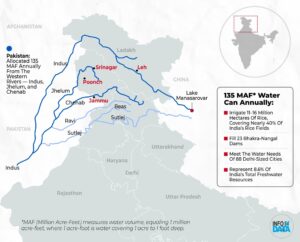
Indus Waters Treaty was signed in 19 Sept 1960 between India and Pakistan under mediation provided by the World Bank. As a political compromise between Pakistan and India seemed improbable the US and UK decided to pressure both into signing onto a technical treaty which could outline the claims and limits of both nations on the flow of the water. Over the years it was touted at the most successful and unequal water sharing agreement where the upper riparian nation only made claim to a minor portion of the river’s waters.
The Indus basin was categorized into two groups of rivers. With the Eastern Rivers (Beas, Ravi, and Sutlej) being controlled by India and the Western Rivers (Indus, Chenab and Jhelum) being controlled by Pakistan.
Many still blame Nehru for this treaty in India for only allowing India to control less than 20% of the Indus’ waters, while many in Pakistan still decry the unequal nature of the treaty in directly awarding a set of rivers to India as that may eventually cause droughts in the parts of Pakistan which are mainly fed by the Eastern rivers. However, the main calls for renegotiations of the treaty have originated in India which at this point has put it into ‘abeyance’. In this post we will go through the main areas of dispute in the treaty and what the possible solutions for the current impasse may be.
Continue reading Indus Water Treaty: What lies in the future?
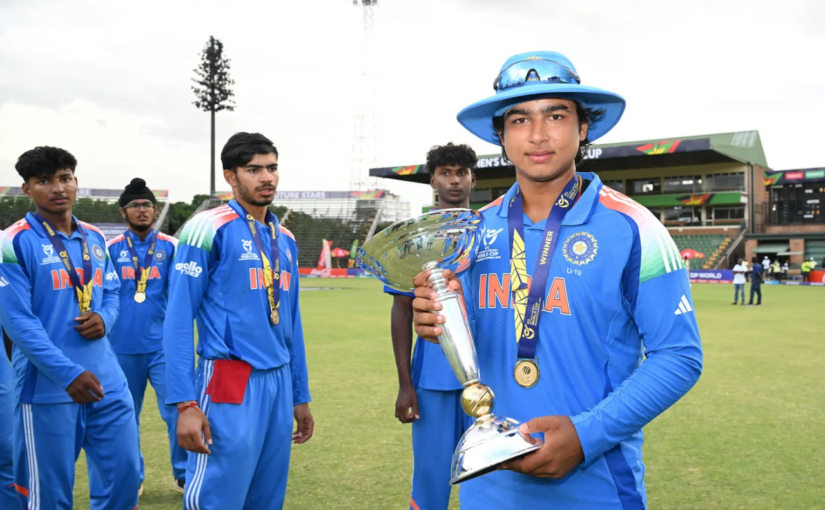
The joy of watching Vaibhav Sooryavanshi
After the twin pleasures of the Indian cricket team’s campaign in the T20 World Cup in February and early March and Dhurandhar: the Revenge in late March, the thing that has given me a lot of joy throughout the months of April and May is watching Vaibhav Sooryavanshi’s batting in the IPL.
As I write this, he has been selected for the Ireland and England tours in late June-July, becoming the youngest Indian to get an international callup ever, surpassing the great Sachin Tendulkar. He also won the IPL MVP award along with the Emerging Player Award (usually people win them years apart, not in the same year) along with a variety of other awards. This follows the U-19 World Cup in February where he was Man of the Match in the final as well as Man of the Tournament.
And it is not just me, but the entire cricketing world which has been set aflutter by his exploits. His extremely fast pace of play (even compared to some of the fastest players in the world) plus his insane shot making and bat swing have made him a fan favourite already.
Open Trade: Peace Deal Reached
Is Kabir Right?
Kabir’s claim, is that much of the Saffroniate comes to Brown Pundits for one purpose: to litigate Pakistan, and to litigate the Muslim. Take that fixture away and the room goes quiet. The post on Hindustani classical music sinks without a ripple. The translated short story draws three comments and dies. Only the threads that arm the two camps against each other run to hundred+.
Is he right?
“And who knows, in the distant future we can prop up Afghanistan like China does Pakistan.”
We are going to watch this in a few hours?