Five billionaires have as much wealth as half of humanity ~ Vandana Shiva
Prime Minister of Uzbekistan, Singing Raj Kapoor’s Song.
Seems LV also stole its TM design from India. Continue reading Open Thread: Bharat overawes France
Five billionaires have as much wealth as half of humanity ~ Vandana Shiva
Prime Minister of Uzbekistan, Singing Raj Kapoor’s Song.
Seems LV also stole its TM design from India. Continue reading Open Thread: Bharat overawes France
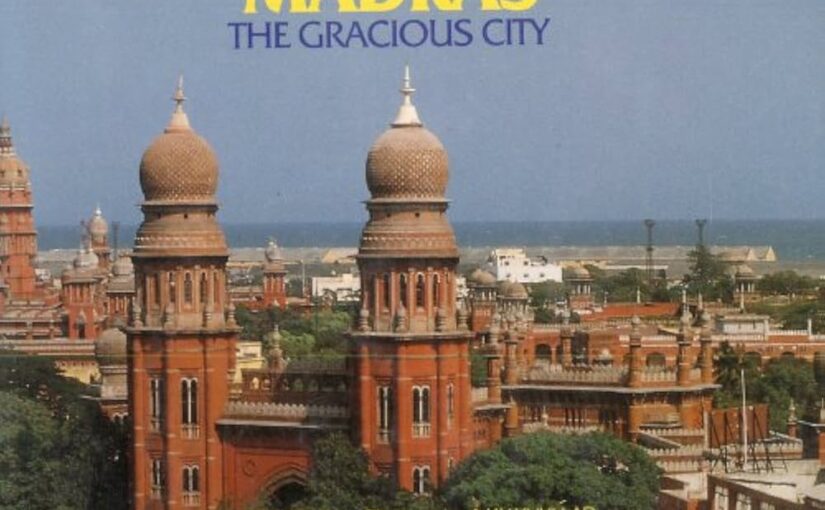
There are places in the world that do not behave the way theory predicts. Chennai is one of them. Tamil Nadu is among India’s richer states. It is urbanised. It is educated. It is globally connected. And yet it retains a form of social cohesion and human reflex that hyper-capitalism usually dissolves.
This is not nostalgia. It is observation.
A Different Social Reflex
In much of the world shaped by late-stage capitalism, interaction is transactional by default. Help is conditional. Suspicion precedes generosity. Risk is individualised. In Chennai, the reflex is still different. People intervene without being asked. Strangers stop when something is wrong. Assistance is offered before motives are assessed. Money is often refused. This is not charity. It is social instinct. That instinct survives even in moments that theory says it should not: late nights, urban settings, infrastructural failure, ambiguity. The absence of alcohol matters. The presence of peer groups matters.
But more than anything, the cultural baseline matters.
Why Tamil Nadu Resists Homogenisation Continue reading Chennai Is Not an Accident
Originally Published: February 03, 2025
The nirīśvaravādi ādi-accelerationists no doubt consider our usage of the word ‘God’ and countless references to ancient myths and texts a serious breach of the philosophy and a perversion of its ideas. Though we are not interested in soothing their fears, the objections they will raise must nevertheless be wrestled with, as Landian Accelerationism portrays itself a purely materialist philosophical system, which, although not often talked about at present, is properly referred to as ‘libidinal materialism’. Thus, we must descend into the ‘sublime basement’ of Land’s philosophy before we may return once more to the heady poetics of Meltdown. His system of thought is most comprehensively laid out in the opus The Thirst for Annihilation (Land, 1992b), which makes it clear that his philosophy follows in the wake of the Nietzschean ‘death of God’, something he explicitly states when he assembles a theoretical machine linking Kant, Schopenhauer, Nietzsche, Freud, and, most importantly, Bataille to himself. As Mackay and Brassier put it in the ‘Editors’ Introduction’ of Fanged Noumena (Land, 2012): “Land allied himself to a line of renegade thinkers – Schopenhauer, Nietzsche, Bataille – who mocked and disparaged academicism and wielded philosophy as an implement for exacerbating enigma, disrupting orthodoxy, and transforming existence” (p. 2-3). Continue reading Meltdown Bhāṣya: Verse 1.1.1 (Part 1.3)
This post is a continuation of my Introduction to Accelerationism. The goal of this project is to explore Accelerationist Philosophy (with an emphasis on the work of Nick Land) and explain it from a Hindu perspective with an exegetical and comparative focus on the Vedas, Itihāsas, and Tantras, among other traditional Hindu texts.
Originally Published: January 26, 2025
[1].[1].[1] The story goes like this: Earth is captured by a technocapital singularity as renaissance rationalitization and oceanic navigation lock into commoditization take-off.
“Machinic desire can seem a little inhuman, as it rips up political cultures, deletes traditions, dissolves subjectivities, and hacks through security apparatuses, tracking a soulless tropism to zero control. This is because what appears to humanity as the history of capitalism is an invasion from the future by an artificial intelligent space that must assemble itself entirely from its enemy’s resources. Digitocommodification is the index of a cyberpositively escalating technovirus, of the planetary technocapital singularity: a self-organizing insidious traumatism, virtually guiding the entire biological desiring-complex towards post-carbon replicator usurpation.”— Machinic Desire (Land, 1993)
While reading Brad DeLong’s fascinating newsletter on centi-billionaires and political power (I’m going to ignore Elon’s self-imploding stunt), I noticed something that jarred me more than it should have: Mukesh Ambani’s name was misspelled as “Mukash.” A minor slip, perhaps. But it was the only error in a list that included Bernard Arnault, Warren Buffett, and Michael Bloomberg—men whose names command a certain global familiarity.
What does it say that even after spending nearly half a billion dollars on a wedding for his son, India’s wealthiest man doesn’t merit a spellcheck? It says a lot.
🧠 The Chimera of Respect via Capital Continue reading 🪙 What’s in a Name? Mukesh, Not Mukash.
I’m writing this from a bakery-café in Concord, Massachusetts—the cradle of the American Revolution, where ideals like liberty and equality were born anew in the New World. The croissants are fresh, the espresso is bespoke (lavender), and the staff layout is eerily familiar.
At the front: white staff—stylish, aesthetic, articulate—handling (bossing sometimes but in general everyone is exceptionally lovely & calm) model minority clientele with curated ease. In the kitchen: Mexican workers—efficient, invisible, foundational. It’s the same setup across most of America’s cool, clean consumer spaces: the aesthetic and the labor silently segregated by race and language.
No one talks about it. You’re not supposed to notice the subtle “Americanisation” at play (the American dream and its attendant complexities). But once you do, as a twice-immigrant (East to Britain, old England to New England), it’s hard to unsee. The roles aren’t assigned by policy, but by a deeper algorithm—one that sorts people into place based on centuries of sedimented power: race, class, culture, even aesthetics. Continue reading Café Concord: A View from the Counter
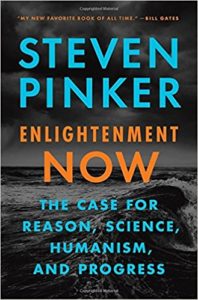
I have not so much read the book as scanned it. For most of the book he builds a case for his basic claim that life, for most people, has improved to an amazing extent in the last 200 years and we can thank science, reason and humanism for all this progress.
I assume he has to provide so much data because he knows this is an unfashionable opinion within the postmodern liberal intellectual elite and this bothers him. By listing all these facts and showing us all these graphs, he thinks he can convince even his most skeptical critics that progress is real, and that it is much more widely distributed than most people imagine. Is there something missing from his account of progress? I think there definitely is. I do not disagree with his claim that progress is real. Hunger, disease, violent death, these are not trivial concerns. The tremendous progress in these areas is real, and it is meaningful. Intellectuals who criticize Pinker by pointing to persistent or new forms of ill health, physical suffering or violence should take a break and actually read the book, they will find that he has the data and it is not bad data. Either argue about his data with better data of your own, or argue on some OTHER grounds. On THESE grounds, he is solid. Continue reading Review: Enlightenment Now. Steven Pinker.