Musings on & Answers to “The Partition of Elites: India, Pakistan, and the Unfinished Trauma of 1947” (Part 3)

Part 2

Continuing on, X.T.M says that “India’s post-Independence settlement created structural ambiguity” and cites four factors in particular:

  • Upper-caste Hindu political dominance at the center
  • Muslim demographic concentrations with limited elite integration
  • A constitutional secularism that promised equality while leaving communal structures intact
  • No acknowledgment that the Muslim League’s victory posed a legitimacy problem

I think his key insight is this: “The constitution guaranteed rights. It could not guarantee renewed political consent.”

The issue as I see it is that the Indian state took the most half-hearted, wishy-washy approach towards the problem of integration. It allowed Muslims to construct bastions of political power while at the same time dividing Hindus along caste and linguistic lines. It allowed criminal elements, many from a Muslim background, to dominate perhaps its most significant sector — the arts — and spread messages of the innate goodness of Indian Muslims and Pakistanis (which is only being suppressed due to both governments’ actions) and the need for peace between Hindus and Muslims, thereby constructing an illusory palace to beguile secularized urban Hindus, while behind the silver screen they fund terrorist attacks in India. The murder of Gulshan Kumar comes to mind as (seemingly) among the least of these crimes, but that he was killed outside a temple is like having salt poured into the wound and mud slung at one’s face. What to speak of 26/11 which has already been talked about, especially recently.

Again, as I mentioned previously, I don’t think the overwhelming issue is that Muslims were allowed to maintain particular political fiefdoms — it’s that Hindus were stymied from establishing systems of political power based on traditional models. When talking about ‘independence’, Moldbug (2008) in chapter 2 of An Open Letter to Open-Minded Progressives suggests that:

“One test we can apply for independence, which should be pretty conclusive, is that the structures of government in a genuinely independent country should tend to resemble the structures that existed before it was subjugated—rather than the structures of some other country on which it may happen to be, um, dependent. These structures should be especially unlikely to resemble structures in other newly independent countries, with which it presumably has nothing in common.”
Continue reading Musings on & Answers to “The Partition of Elites: India, Pakistan, and the Unfinished Trauma of 1947” (Part 3)

The Changing Demographics of Undivided India (1900–2025)

South Asia’s demography is one of the great untold stories of the modern world. Too often we look at the subcontinent through today’s partitions — India, Pakistan, Bangladesh — but the real insight comes when we view the region as a single whole. Across 125 years, the balance of populations has shifted dramatically.


📊 1900: A Baseline

At the turn of the twentieth century, Muslims made up about 20% of undivided India’s population. The rest were overwhelmingly Hindu, with significant Sikh, Christian, Jain, and other minorities.


📊 1950: Partition and Realignment Continue reading The Changing Demographics of Undivided India (1900–2025)

The once and future India

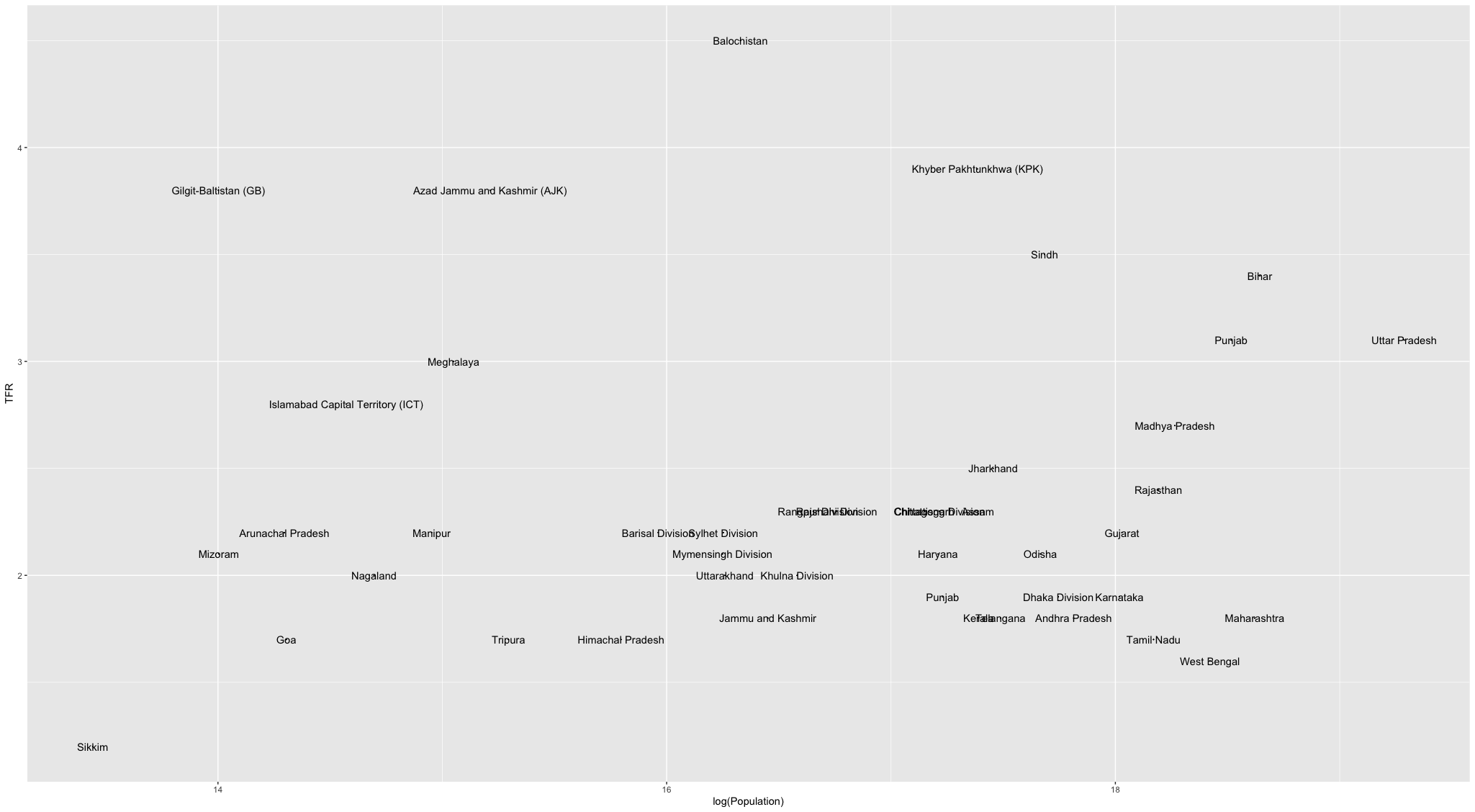
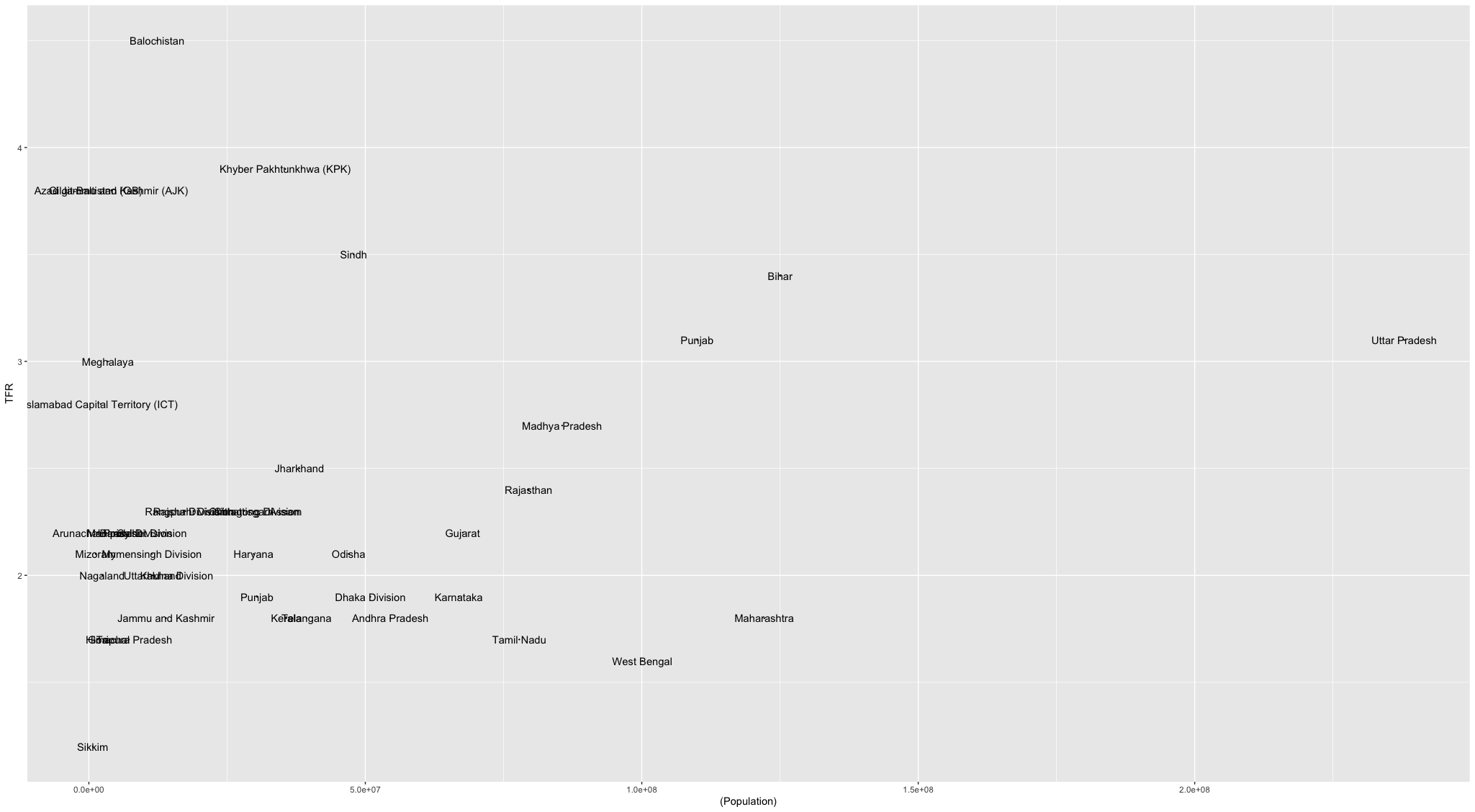
A lot of the media is writing about how India’s population is now, or will be any moment, bigger than China. The issue I always have with these narratives is India is a big country; UP has a total fertility rate of around 3, while West Bengal is closer to 1.5. I assembled data on TFR’s in administrative divisions across India, Pakistan and Bangladesh. I plotted by population and TFR (the second chart is log-transformed so you can see more of the labels). Click to enlarge.

Also attached the table below.

Continue reading The once and future India

White privilege, and how to get it

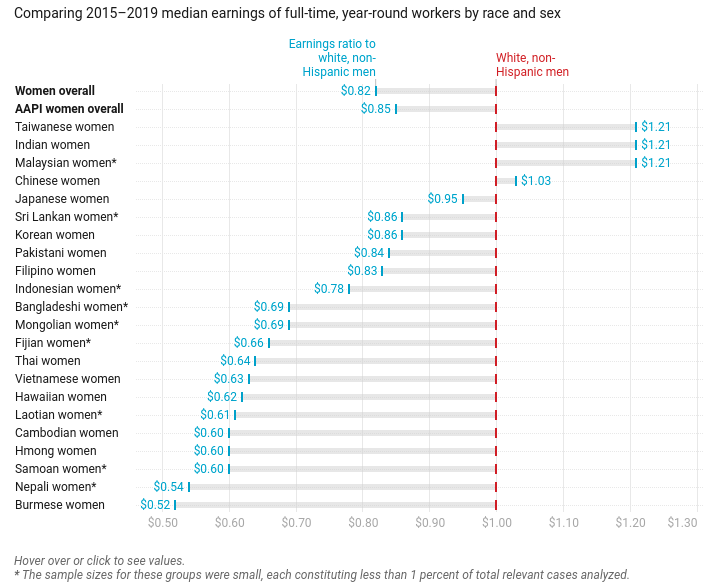
The figure above shows that Indian American women make $1.21 for every $1.00 that a white man makes. I knew this data, but the infographic was brought to my attention to illustrate that not all South Asians are privileged. Pakistani women make $0.84 and Bangladeshi women $0.69.

Here’s the “problem” – 84% of “South Asians” are Indian American.

The reason that Indian Americans do so well is pretty obvious: human capital. They’re educated, they’re entrepreneurial, etc. At least to me. What if you believed that all outcome differences between nonwhites are due to white supremacy?

What have you heard about this? How is it people who now accept The Narrative explain how brown-skinned Indian Americans do so well while brown-skinned Pakistanis don’t? What have you heard?

Hindu philosophy was mathematical, but Hindu nationalists are innumerate

In the early 2000s, there was a lot of demographic alarmism about Islam and European societies. Pundits such as Mark Steyn were predicting Islam would take over some European nation-states by 2020 as the majority religion. For a while, I credited that sort of thing. After all, Islam is an assimilation problem in most Western democratic societies.

This is the politically incorrect truth that the Left is even more vigorous in denying to this day than it was in the 2000s.

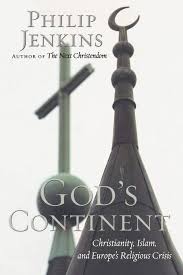
But I happened to change my views to be less pessimistic. One thing is that I read Philip Jenkin’s God’s Continent: Christianity, Islam, and Europe’s Religious Crisis. Jenkins is a thorough and objective scholar. An Episcopalian with moderate views on the whole, he reviewed the evidence of violence in the Koran and the Bible and came away surprised to note that the Bible was far more violent (in large part due to the Hebrew Bible). I recommend all his books but in particular The Lost History of Christianity: The Thousand-Year Golden Age of the Church in the Middle East, Africa, and Asia–and How It Died (Jenkins is neither a fundamentalist nor secular, so he operates in a good middle-ground).

In any case, Jenkins lays out the argument that Christian identity is far stronger in Europe than American skeptics presume. Islam will be a large minority religion in 2100, not the dominant religion. The numbers are with Jenkins here, though the demographics are concerning to me over the long-term.

I bring this up because too often Hindu nationalists and their fellow travelers undermine the credibility of their arguments by forwarding ridiculous numbers. Here is a comment on my other weblog:

Small number converted and demography did the rest.

Conversions really began after Shah Jahan & peaked with Aurangzeb in Panjab.

Christianity in Rome was similar.

You can look at old census of Bengal and Panjab to see the few% increase every decade till partition.

Turks (turkey) had numeric parity and lower tfr than Greek Armenia till ww1. Today 8x more,

http://yugaparivartan.com/2016/02/17/demographic-seize-of-al-hind/

Hindus were there from Indonesia to Armenia.

Probably by 2050ad will just be hated minority in India.

35% of newborns in India already Muslim. More in cities.. Only Hindu migration from countryside has prevented full slide to civil war with outside support by Abrahamic powers.

The comment piqued my interest because of the assertion of conversion in the period between 1650-1700. This seems interesting. I wanted to follow this up. But then the person claims that

1) 35% of newborns in India are Muslim
2) Muses that by 2050 Hindus will be a minority

This makes no sense. First, the TFR for Muslims is 2.6 vs. 2.1 for Hindus across India as of the late 2010s. Assuming that 70% of the reproductively active population are Hindus and 20% Muslims (being generous to the numbers above) I still only get 26% newborns Muslim. The point about this is that lots of people throw numbers around to add firmness and plausibility to their argument, but lying about numbers just makes you seem like a charlatan.

Second, even if 35% of the newborns in 2020 are Muslim, how is it that in 30 years the majority of the population will be Muslim??? It is theoretically possible, but very unlikely. Using current rates of differential fertility Muslims will overtake Hindus in 200 years, not 30 years.

The comment above isn’t actually atypical. Many of the Hindu nationalists on this weblog have left similar comments, while I have Hindu nationalist friends who have suggested to be widespread conversion to crypto-Christianity all across India.

I am very skeptical of this in a broad sense now for a simple reason: Narendra Modi is incredibly popular.  It could be that all of these hidden Christians and Muslims love Modi, but I don’t think that’s the case. I think the reality is Hindus are about ~80% of India’s population, and Hindus on the whole love Modi.

My logic is similar to the argument around Yezidi numbers. For decades there were arguments about Yezidi numbers in Iraq. The answer was clear when they voted en masse for a particular political party. It turns out the Yezidis were right that there were many of them, and the Muslims were wrong.

To be clear, when it comes to the Hindus vs. the Muslims, my own personal bias is probably with the Hindus because I am a murtad. The personal is political to some extent. But that does not mean that I will accept and promote lies, stupidity, and misrepresentations. The truth is strong enough to stand on its own.

Brown Pundits