
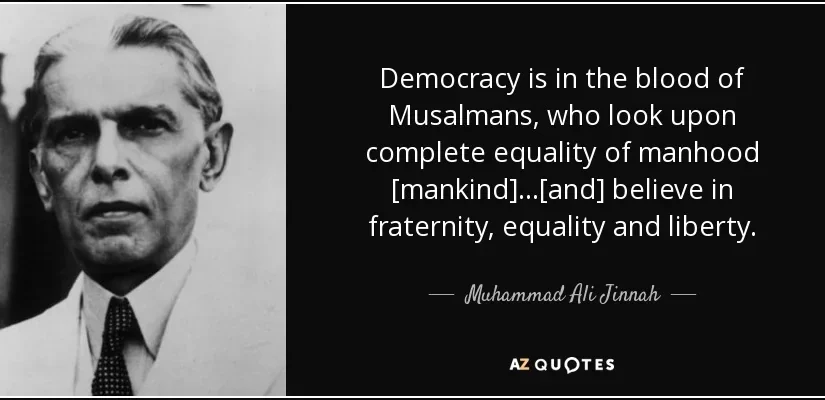
Similarly the core Hindu-Dharmic civilizational nature of India, that is Bharat, is for Indians to decide. Outsiders demanding secularism often mistake their own preferences for universal law.
Tag: South Asia
Pakistan’s dramatic drop in fertility
Meanwhile, Pakistan’s average number of children per woman has dropped sharply from 3.61 in 2023 to 3.19 in 2024, reflecting shifting fertility patterns. By comparison, India’s rate declined more modestly from 2.14 to 2.12.
Why women in South Asia are aging faster than in Europe, US
Those are not marginal adjustments. That is acceleration. For decades, Pakistan was treated as a demographic outlier. India fell below replacement. Bangladesh stabilised. Iran collapsed to European levels. Turkey dropped. The Gulf states hollowed out. Pakistan remained “young.” That youth dividend now looks fragile.
Economic Pressures
The fertility transition is no longer creeping. It is sprinting. The familiar explanation is economic pressure. Urban housing costs more. Education lasts longer. Children are expensive. Women delay marriage. This is all true but incomplete. The deeper shift is cultural. Modernity changes how individuals see time.
Rural Norms
In agrarian societies, children are labour, security, and continuity. In urban societies, children are choice. Once children become a choice rather than a necessity, fertility becomes elastic. It bends downward.
Social Media Continue reading Pakistan’s dramatic drop in fertility
On Breakup Fantasies and Basic Geopolitical Decency
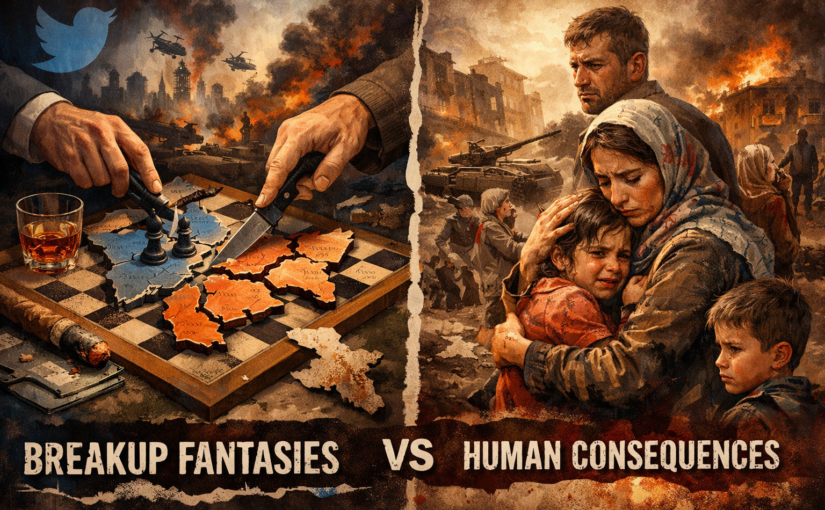
Following my conversation with Kabir; I mulled on the difference between criticising a state and fantasising about its dismemberment.
What should be the type of Critique?
Criticising a political party, a military institution, or a government’s failures is normal. It is necessary. Democracies depend on it. Even flawed democracies depend on it. Pakistan’s military can be criticised. India’s ruling party can be criticised. Iran’s clerical establishment can be criticised. No state is beyond scrutiny. But imagining the territorial breakup of a country, and doing so with visible satisfaction, is something else entirely.
Sacred States?
States are not debating societies. They are containers of memory, trauma, and blood. They are “almost” sacred spaces. For Pakistanis, 1971 is not an abstract lesson in federalism. It is a civilisational rupture. It was war, humiliation, loss of half the country, and a wound that still shapes the national psyche. For Indians, similar fantasies about Tamil Nadu, Punjab, or Kashmir breaking away would be equally triggering. Every nation has red lines embedded in its historical trauma.
Ex-USSR Continue reading On Breakup Fantasies and Basic Geopolitical Decency
After the Begums: Bangladesh searches for a new order
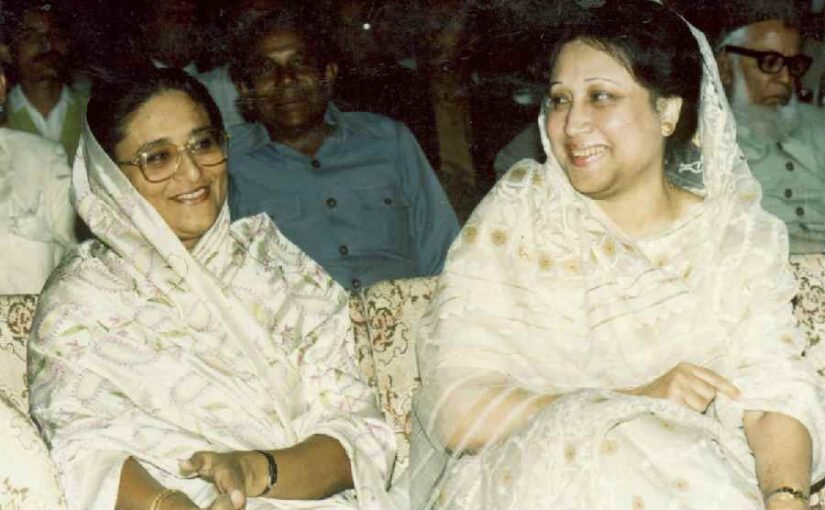
In the tea stalls of Bangladesh, where politics is consumed with the same sugary intensity as the cha, the mood is one of jittery anticipation. For 18 months the country has been a state in parenthesis.
On 12 February that parenthesis would close. Voters will go to the polls in a unique double act: casting one ballot for a new parliament and another in a referendum on the “July Charter,” a package of constitutional reforms designed to prevent the rise of another autocrat.
The election is framed as the culmination of a “Second Liberation,” born of the student-led uprising that ousted Awami League in August 2024 after 15 consecutive years in power.
Observers from the Commonwealth, the EU and other nations are in place; the ballot boxes are ready.
Continue reading After the Begums: Bangladesh searches for a new order
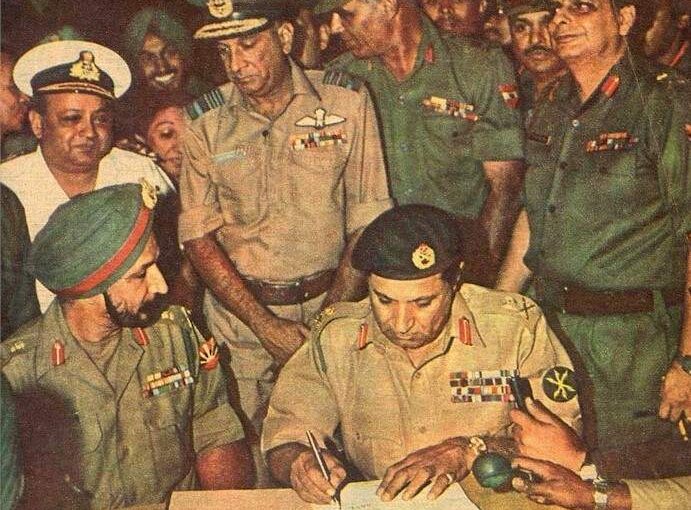
Pakistan, 1971, and the Misuse of the Holocaust Analogy
“Pakistan army remains the only one after WW2 to have carried out a large scale genocide. The comparison to the Nazis is a fact-based one. Mentioning this simple historical fact isn’t “anti-Pakistan”. RNJ
The events of 1971 in East Pakistan involved large-scale violence, mass civilian deaths, displacement, and grave violations of humanitarian norms. These facts are not contested. What remains contested is classification. Continue reading Pakistan, 1971, and the Misuse of the Holocaust Analogy
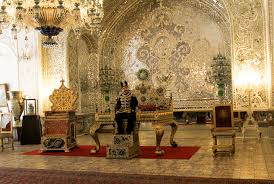
Pakistan’s Civilisational Orphanhood
The argument over Balochistan exposed something deeper than maps or borders. It revealed a confusion about what Pakistan is supposed to belong to.
Formally, Pakistan is one of the most nationalistic states on earth. Its red lines are absolute. Its territorial language is uncompromising. Its founding trauma has hardened into doctrine. And yet, beneath this rigidity sits a quieter truth: Pakistan’s elite does not actually live inside a closed nation-state imagination. They live in English.
They think in Western legal categories, read Western literature, speak the language of international institutions, and send their children into global circuits of education and finance. At the same time, their social world remains unmistakably South Asian; family-centred, hierarchical, ritualised, and deeply embedded in subcontinental habit. They are neither fully Western nor comfortably Indic. This produces a tension that Pakistan has never resolved.
The Nation-State After 1945: A Container That No Longer Holds
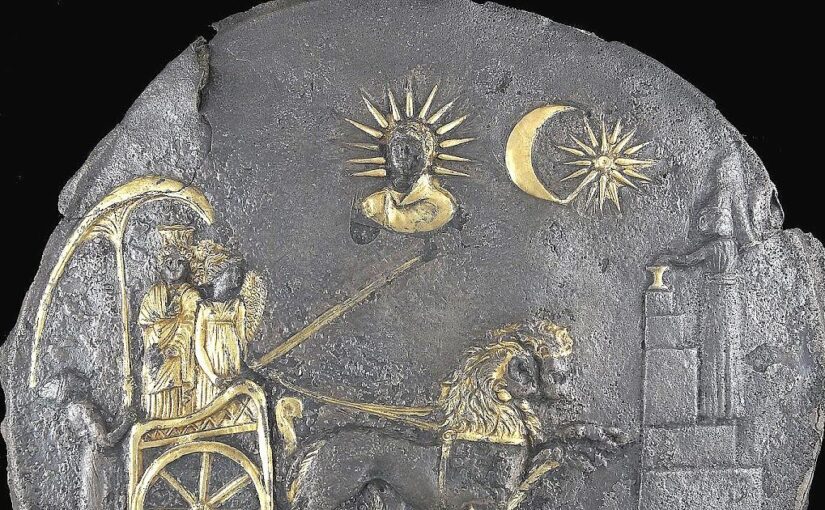
Iran and Pakistan Are Not the Same Kind of State
Iran cannot be analysed using the same political categories as Pakistan or most modern states. The difference is not whether a regime is monarchical, clerical, or military. It is the age of the civilisation being governed. Pakistan is a young state. Its borders, institutions, and political language were assembled in the twentieth century. In such states, power fills a vacuum directly.
Power in Young States, Authority in Old Ones
A military dictatorship governs by force, hierarchy, and command. Its legitimacy is procedural and immediate: order, security, survival. This form works where political memory is thin and inherited meaning is limited. Pakistan’s army did not overthrow an old order. It stepped into an empty one. Iran is structured differently. It is a civilisational state that has existed in recognisable form for roughly three thousand years. Power there has never been exercised through force alone. Authority has always been tied to ideas that predate any single regime.
Monarchy as Civilisation, Not Administration Continue reading Iran and Pakistan Are Not the Same Kind of State

Why It Is Still Acceptable to Insult India
This happened on an ordinary Cambridge street. Dr. V and I ran into acquaintances, who in turn had friends (from medical school; a grandmother & granddaughter) visiting from Australia. Polite introductions. Small talk. The weather. Then, inevitably, India.
One of the women mentioned that her husband was “half Indian.” She smiled and added that he had told her she would definitely not like India. This was offered casually, as if it were neutral information, not an insult delivered in front of two Indians.
Trying to keep the exchange courteous, I mentioned Sri Lanka; not as a deflection, but as a bellwether. Our mutual acquaintances had already mentioned enjoying seeing my birthday pictures from there so I thought it a natural segue.
It is often how people test their appetite for the subcontinent: more contained, more legible, still culturally rich. If one enjoys that, India follows naturally; if not, India can feel overwhelming. This was not a provocation. Yet the suggestion was met with laughter, as though I had committed a social error. It was after this, not before, that the tone hardened and the remark about her granddaughter emerged, delivered with surprising persistence, as if the earlier politeness had licensed open disdain.
Continue reading Why It Is Still Acceptable to Insult India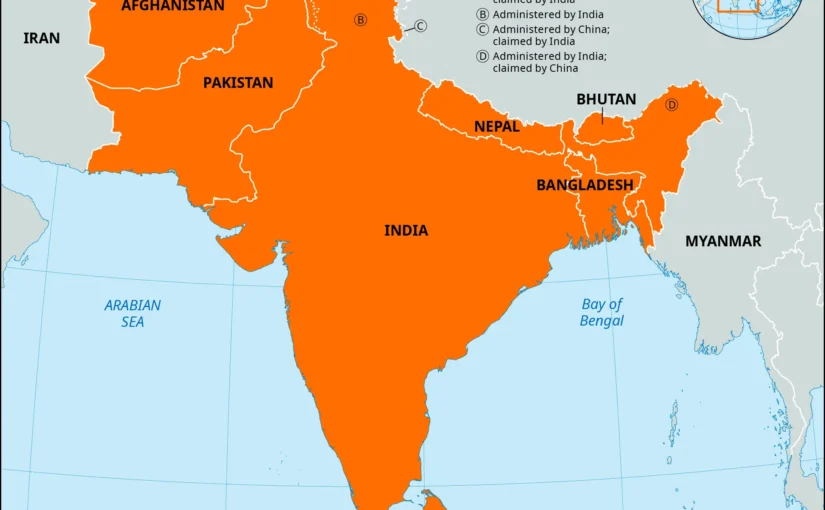
South Asia Is an Ugly Postcolonial Euphemism
There is something faintly ridiculous about how often educated people insist on using the term South Asia as if it were a neutral, hygienic improvement on an older and supposedly “problematic” word. It is neither neutral nor an improvement. It is a bureaucratic euphemism invented to manage post-Partition discomfort, and it collapses the civilizational reality of the region rather than clarifying it.
The Indian subcontinent has had a name for millennia. It was called India because it lay beyond the Indus. Greeks used it. Persians used it. Arabs used it. Medieval Muslims, early modern Europeans, and the British all used it. The word survived because it described a geographic and civilizational unit, not because it flattered any modern state. The fact that the Republic of India later adopted the name does not retroactively invalidate its older meaning. Belgium did not abolish the word “Europe,” and Serbia’s existence does not make “European” offensive.
South Asia, by contrast, is not an ancient term misused by a nation-state. It is a late–Cold War academic construction, popularised by American area studies departments that were uncomfortable saying “India” once India no longer meant a single polity. It is a word designed to avoid an argument, not to resolve one. Like “Middle East,” it describes nothing from within the region itself. No one historically lived in “South Asia.” No one spoke “South Asian.” No one cooked “South Asian food.” Continue reading South Asia Is an Ugly Postcolonial Euphemism
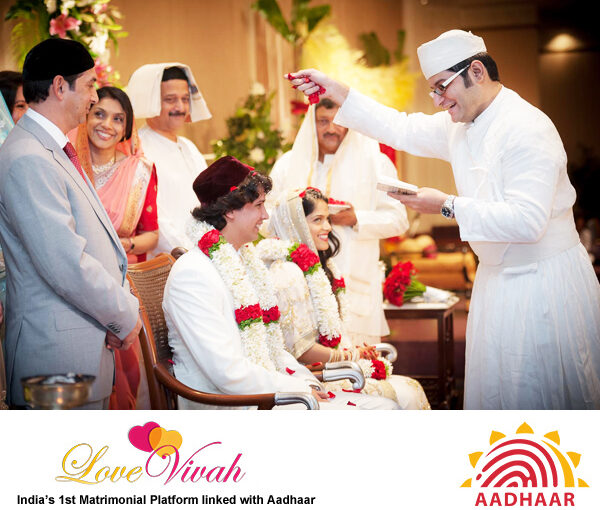
Bollywood, Brahmins, Parsis & WASPs:
Endogamy Is Optional When You Own the Institutions
Gaurav’s excellent piece on “progressive Dravidianism” pushed me to re-examine a related elite anxiety: the melodrama around intermarriage. I am happy to be corrected on any of the specifics below, especially where a claim could be tightened with better data.
The standard story goes like this. Elites marry out. Boundaries dissolve. The group dies. This story is intuitively appealing because it treats identity as if it were a biological substance. But elites are not reproduced primarily by blood. They are reproduced by property, institutions, credentials, and networks. In that world, intermarriage is rarely a solvent. It is more often a merger.
The English aristocracy understood this early, and acted accordingly. When the old landed families were cash-poor but title-rich, they did not preserve themselves by sealing the gates. They did the opposite. They married in money. The late nineteenth and early twentieth centuries produced a whole genre of “dollar princesses,” wealthy American heiresses who married British aristocrats, trading capital for rank. By one commonly cited compilation, between 1870 and 1914, over a hundred British aristocrats, including multiple dukes, married American women; and in the broader European set, hundreds of such transatlantic matches were recorded. This was not cultural dilution. It was institutional self-preservation by acquisition. The class survived because it treated marriage as capital strategy. Continue reading Bollywood, Brahmins, Parsis & WASPs: