Hijab: Between Revelation and Regulation

When Bahá’u’lláh wrote that every word of the Qur’ān bears meaning and intention, he was reminding us that revelation, properly read, resists reduction.  Scripture, like language itself, is alive; it breathes, it hesitates, it renews.  Yet somewhere between the living word and the legislated code, the hijab became a symbol, of modesty, of defiance, of cultural siege, of theological purity, until its nuance was lost to politics.

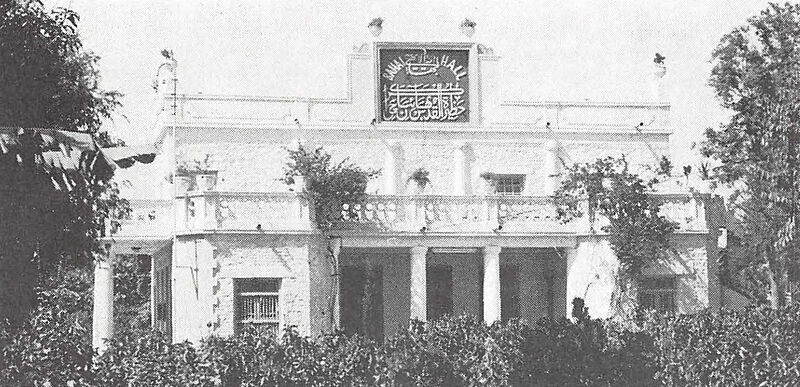
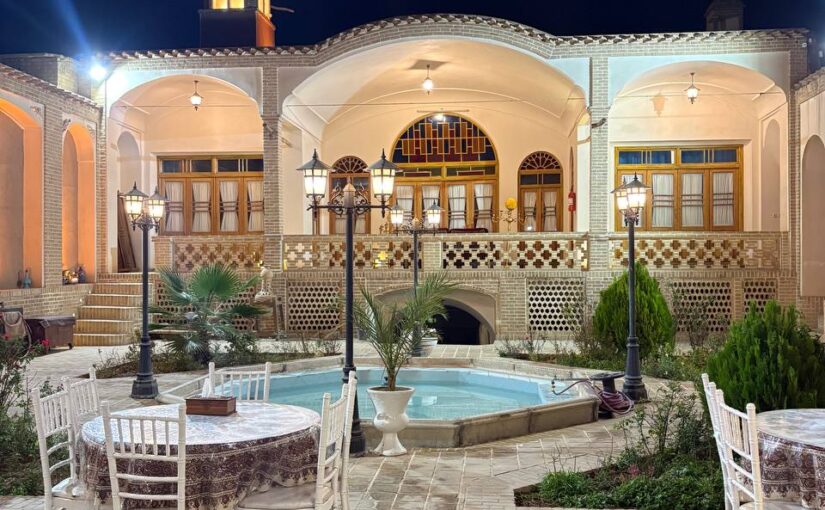
My friend is in Kashan, a city of gardens and scholars, and perhaps among the most traditional pockets of Iran.  She forgot her hijab back in her home city and now cannot step out of her hotel.  The irony is sharp: the veil that once signified spiritual privacy has become an enclosure of space.  Kashan’s cobbled lanes whisper poetry, but they also enforce silence.

Meanwhile, the liberal axis of Iran, Shiraz, Tehran, Gilan, Mazandaran, Semnan, walks the tightrope between revelation and rebellion.  The North dresses as Europe, the Centre prays as Qom.  Mahsa Amini’s martyrdom was Kurdish, and therefore doubly liminal: ethnically marginal, religiously symbolic (the Kurds are very secular as a rule of thumb; more Zoroastrian than the Persians).  Her death reopened a question the Qur’ān itself leaves open — what, after all, does ḥijāb mean?

1. The Qur’ānic Vocabulary of Modesty Continue reading Hijab: Between Revelation and Regulation

On Islamism, the Oneness of Mankind, and the Burden of Public Bahá’ís

For too long, the term Islamism has functioned as a lazy shorthand in Western discourse; one that often sanitizes the dehumanization and securitization of Muslim bodies. And when it’s used by those claiming spiritual insight, especially from within a global Faith like the Bahá’í Faith, it becomes more than just a rhetorical misstep. It becomes a betrayal.

This week, a prominent British Bahá’í comedian made such a misstep.

A Moment of Caution — Dismissed

When Omid Djalili posted a news clip, which gently reframed the Bahá’í concept of the Oneness of Mankind, I appreciated the gesture. In fact, I said so. The “toe-stubbing” analogy was clever, and there was something moving in seeing profound principles gently repackaged for a wider audience.
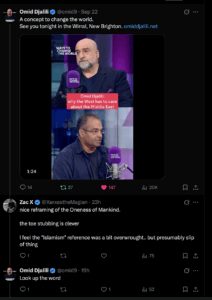
But I raised one concern: the reference to Islamism. It was, I suggested, overwrought, unnecessary, and ultimately unwise. I proposed an alternative: perhaps rephrasing the same concern as “security anxieties around mass migration” or similar language that doesn’t dog-whistle. This wasn’t a condemnation. It was, as any Bahá’í should recognize, consultation. An invitation to reflection.

Instead, I was told: “Look up the word.”

The Burden of Bahá’ís in Public

It’s not about semantics. It’s about responsibility. And especially so when one is invoking sacred teachings, teachings that thousands upon thousands have died for; on public platforms. The Bahá’í Faith is not a marketing device to win over a Western liberal audience by soft-launching its principles in the language of border panic and counter-terrorism.
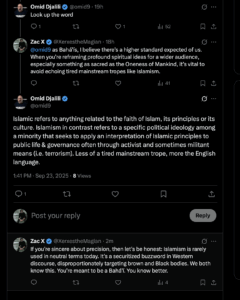
To reduce Islamism to a “technical English-language distinction” is disingenuous. The term has never been neutral. In nearly all Western contexts, it has become a floating signifier for violence, extremism, and “dangerous Muslims.” It serves to other, to isolate, and to justify state and vigilante violence often against entirely innocent people (Afghanistan, Iraq & Palestine).

And when Bahá’ís, of all people, repeat that language without self-awareness, without contrition, and without consultation, we should all be worried.

The Problem Isn’t the Joke. It’s the Response.

I understand the pressures of performance. I’ve done media. I know how easy it is to slip. What matters is what happens next. When another Bahá’í, someone you know, someone with many mutual connects, raises a concern gently and in good faith, the correct response isn’t smugness. It isn’t defensiveness. It certainly isn’t “learn English.”

That response is hurtful, racist, and deeply contrary to the values we both claim to serve. And that’s what cut. Not the line in the show but the refusal to listen afterwards. The arrogance of elite Bahá’ís who believe proximity to celebrity, applause, or power gives them carte blanche to reframe revelation in their own image.

This Is Why We Need to Talk

As Brown Pundits reshapes itself, I’m re-examining my own priors, too. What voices we platform. What values we uphold. Who gets to speak for our communities and under what banner.

So I say this plainly: The oneness of mankind cannot be proclaimed by marginalizing Muslims. And Bahá’ís, especially public ones, must hold themselves to the standard of humility, consultation, and truthfulness we profess to believe in. We cannot serve justice while echoing injustice. We cannot preach unity while casually reinscribing division. The world is watching. Let’s be worthy of what we claim.

When the Commentariat lies

I’ve updated this post (Brown Pundits is not an echo chamber) after realising something important.

What began as a spirited disagreement veered into something darker. It turns out that bombay_badshah, a voice I initially assumed to be new, may not be who he claims to be (I had a hunch but so did Kabir, that BB was HS reincarnated). The posting style, the fixations, the timing; all too familiar. My suspicion is that BB may be a derivative or proxy of HS, previously banned. If true, this was not a genuine disagreement; it was entrapment, bait-and-switch.

In that light, I owe Kabir an apology. He was provoked in bad faith by someone who may be operating behind a mask. And that matters, because here on Brown Pundits, identity isn’t incidental; it shapes perspective, and we respect that. We excavate worldviews, not just opinions.

While I cannot definitively prove that BB is HS, the circumstantial evidence is strong. I will allow BB to remain but if the commentary returns obsessively to Kabir or Pakistan, I will intervene. Everyone is welcome to engage on substance. But this space will not be hijacked.

The original post remains below the jump, unedited but its context has now changed.

Continue reading When the Commentariat lies

Pakistaniat & Urdu from Qasim to Quaid

UP’s very long shadow:

As I board my flight back to the UK after a brief but productive trip, I find myself reflecting on a language that continues to haunt and inspire me: Urdu.

It is a tongue caught between paradoxes. The language of courtesans and qawwals, of sacred supplication and sly seduction. It carries within it the scent of jasmine and blood, of Delhi’s dusk and Lahore’s lingering grief.

The Beloved Guardian of the Baha’i Faith once noted that while most Baha’i texts should be translated from English, Urdu alone is trusted for direct translation from Persian and Arabic. That proximity, that spiritual siblinghood with Persian, the language of kings, and Arabic, the language of God, renders Urdu magical.

Sanskrit, of course, is the language of gods, but Urdu, its stepdaughter of sorts, captures the longing of poet to partisan.

There’s a reason the Bahá’í prayer I share below is so piercing in Urdu. So here, before I cross back into another timezone, I offer this prayer—without commentary, without translation. Just Urdu, as it was meant to be heard.

And I wonder: perhaps this is what Pakistan truly is—a project in transcending the local. Not rooted in soil, but in sentiment. A place where Punjabis, Pathans, and Muhajirs are asked to shed skin and commune in Urdu. Where Pakistaniyat, for all its fractures, has succeeded in producing a common idiom: of piety, pride, and pain. Continue reading Pakistaniat & Urdu from Qasim to Quaid

Brown Pundits