On Moderation, Minoritization, and the Elite

Pulse: The Threads We Weave —

Lately I’ve wondered whether I over-curated the threads. Things feel quieter. Maybe too quiet. But perhaps that’s the cost of raising the bar—of asking for dialogue instead of dopamine. Still, this lull has me reflecting not just on moderation but on why some arguments no longer move me.

Take the Indo-Pak conflict: once electric, now strangely inert. That shift reflects my own evolution over two decades. I no longer inhabit that binary. I carry a layered identity—a South Asian Bahá’í sensibility shaped by Persian aesthetics, grounded in British institutions, and fluently navigated through English. That complexity is my compass. It’s why I care less about flags and more about forces.

And the real force that shapes our lives? The elite. Not as a pejorative, but as a structural reality. I see it as nested tiers: Continue reading On Moderation, Minoritization, and the Elite

The Elder Race and the English-Speaking Heat

As I write this from Dublin, waiting to board my connecting flight—I’d nearly missed it in Newark, too absorbed in writing to hear the gate call—I’m struck by how a Euro sign or EU flag can alter one’s sense of place. Technically, I’m still in the British Isles. But culturally—unmistakably—I’m on the Continent. A sensation I never quite feel in England.

It’s a strange feeling, this flicker of European belonging. In the early millennium, I was a passionate Brexiteer—young, angry, seeking change. By the time of the referendum, a decade later, I found myself morally conflicted. I knew the EU was not a good fit but as a Bahá’í, I knew I could never advocate for disunity, of any sort. I abstained. Ironically, Commonwealth citizens could vote, but EU nationals couldn’t—a bit of imperial gatekeeping that deeply irritated my liberal British-Irish friend. (“Why can Indians vote, but not the French?” he asked.)

Today, standing in Europe, I feel the contrast sharply. The Continent is genteel, even decadent, locked into postwar consensus. Meanwhile, the English-speaking world feels like it’s on fire—politically, culturally, psychologically. It’s not just the UK or the US. India, too, belongs to this hot zone of rhetoric and reinvention. Pakistan, by contrast, while elite-driven in English, remains emotionally and socially an Urdu republic. Continue reading The Elder Race and the English-Speaking Heat

Merit, Class, and the Ossified Dream

Dispatch from Newark Airport

By X.T.M | Acting Editor, Brown Pundits

I lost my train of thought earlier, but I’m back now, writing this from Newark Airport, awaiting a flight back to the United Kingdom—then onward, as they say, to the old, old world.

What I’d begun to reflect on was social mobility—and how drastically it’s shifted over the past few decades. In much of the Global South, the idea of a working-class avant-garde—those who rose through grit, communal aspiration, and sacrifice—still retains cultural force. But in the Global North, that current has largely dissipated. Class structures have ossified. The ladder still exists, but the rungs are brittle.

I’ve been mapping that reality onto the commentariat, especially the highly educated, striving upper-middle-class Hindus who have, for the most part, embraced the system—IITs, IIMs, Oxbridge, the Ivies. These are not just institutions; they’re rites of passage. For many, the peak came at the point of entry. Twenty years on, what remains is not expansion, but a formula—one track, one ceiling. Continue reading Merit, Class, and the Ossified Dream

Is It Indian Culture or Hindu (Brahmin) Culture that creates excellence?

On Faizan Zaki, Spelling Bees, and Civilizational Osmosis

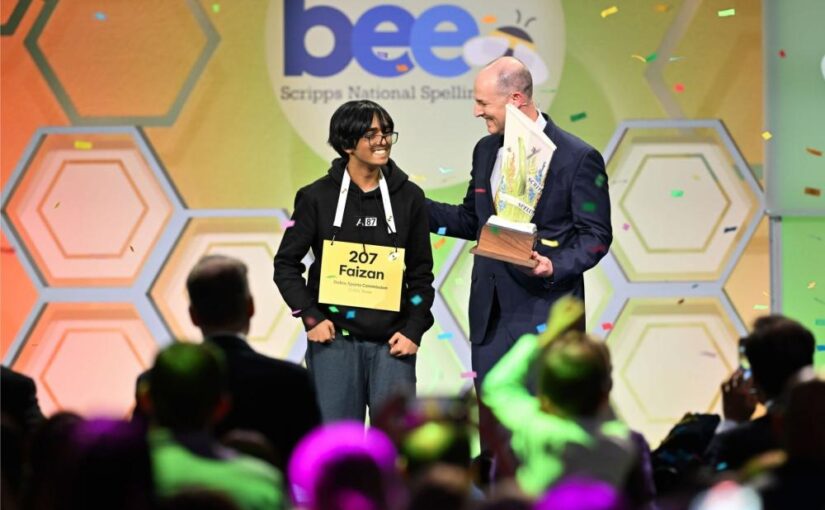
Another year, another Spelling Bee crown for an Indian American. But this one, the 100th Scripps tournament,  is different.

Faizan Zaki—young, brilliant, and by name Muslim—just became the latest in a long line of Indian-origin champions of America’s most idiosyncratic intellectual ritual. Faizan is the 32nd Indian American to win—meaning they’ve claimed 32 out of the last 40 Spelling Bees. But he is very likely the first Muslim American to do so.

Which raises an old but essential question: Continue reading Is It Indian Culture or Hindu (Brahmin) Culture that creates excellence?

“A Foreign Class of Servants” — JD Vance and the Great American Amnesia

Vice President JD Vance recently declared that America doesn’t need to “import a foreign class of servants” to remain competitive. “We did it in the ’50s and ’60s,” he said. “We put a man on the moon with American talent. Some German and Jewish scientists who had come over during World War two, but mostly by American citizens.”

The line is memorable—not for its nationalism, but for its breathtaking amnesia.

The moon landing was not the product of some closed, white-bread meritocracy. It was powered by German engineers, Jewish refugees, and immigrant scientists—many quite literally “imported.” Wernher von Braun, the face of NASA’s rocket program, was a former Nazi, repurposed by America for its Cold War dreams.

Today, the immigrant pipeline Vance sneers at includes his own in-laws—his wife’s parents, Indian-born academics. I’ve highlighted this problematic tendency before. They weren’t servants. They were scholars. Like hundreds of thousands who have powered this country’s universities, tech firms, hospitals, and labs. America doesn’t run on pedigree. It runs on brains. And yes, those brains often have accents.

America First doesn’t mean America stays first Continue reading “A Foreign Class of Servants” — JD Vance and the Great American Amnesia

Café Concord: A View from the Counter

I’m writing this from a bakery-cafĂ© in Concord, Massachusetts—the cradle of the American Revolution, where ideals like liberty and equality were born anew in the New World. The croissants are fresh, the espresso is bespoke (lavender), and the staff layout is eerily familiar.

At the front: white staff—stylish, aesthetic, articulate—handling (bossing sometimes but in general everyone is exceptionally lovely & calm) model minority clientele with curated ease. In the kitchen: Mexican workers—efficient, invisible, foundational. It’s the same setup across most of America’s cool, clean consumer spaces: the aesthetic and the labor silently segregated by race and language.

No one talks about it. You’re not supposed to notice the subtle “Americanisation” at play (the American dream and its attendant complexities). But once you do, as a twice-immigrant (East to Britain, old England to New England), it’s hard to unsee. The roles aren’t assigned by policy, but by a deeper algorithm—one that sorts people into place based on centuries of sedimented power: race, class, culture, even aesthetics. Continue reading CafĂ© Concord: A View from the Counter

The once and future “Brown Pundits”

Country Users Rank % Rank
 China 746,662,194 1 53.20% 109
 India 391,292,631 2 29.55% 143
 United States 245,436,423 3 76.18% 54
 Brazil 123,927,230 4 59.68% 90
 Japan 117,528,631 5 92.00% 15
 Russia 110,003,284 6 76.41% 53

The “Brown Pundits” blog was formed on a lark about 7 years ago. The Sepia Munity weblog was clearly winding down, and people like Zach and I didn’t feel too well represented. What I mean is that weblog in its latter years reflected a certain activist Left-wing South Asian American perspective which naturally didn’t include all Diaspora South Asians. In some ways this was a shift away from its original years, when it was more politically eclectic, with some center-Right and libertarian voices, to go along with conventional center-Left viewpoints.

Two of the co-founders I knew personally before the blog was founded, and we had a small e-list where we discussed cultural and social issues. To a great extent, I think the Sepia Mutiny blog reflected a decade in transition for South Asian brown Americans. Most of the contributors were of an age where they would be routinely asked where “they were really from,” and all of us understood that we were seen to be a novel and exotic contribution to the American landscape.

Things have changed a lot since then. Most particularly in 2008, Barack Hussein Obama was elected president of the United States. Where black Americans rejoined in the election of a black man, I suspect many Americans of Asian background noted his exotic background and name. If a man with such a foreign name could become head of state of the United States could we be such aliens after all?

I do understand that some people feel that the election of Donald J. Trump has rendered us aliens in our own land again. Overall, I disagree. In a Spenglerian sense, I see the election of Trump as a crying in the wilderness of an old America which is feeling less at the center of our culture, as well as the more general atavisms triggered by globalization.

South Asian Americans, which mostly means Indian Americans, have a place and a role in American culture that can’t be denied. Most Indian Americans have followed a “Jewish model”, aligning with the political and social Left, especially a small activist class.

A framework to understand the trajectory of young 2nd and later generation South Asian Americans that I outlined over 10 years ago I think is a useful model. Roughly, there are three broad classes of South Asian Americans (with overlap):

  • Assimilators. Unlike some groups, South Asian Americans are physically distinct enough that assimilation doesn’t involve “passing” into another identity. Rather, assimilation involves intermarriage and socialization with a broad set of Americans and a very loose attachment to distinctively South Asian cultural markers ad community institutions. Most of the children of assimilators will be mixed, and so will not have a singular South Asian identity in an authentic way.
  • South Asian Americans. This group is perhaps equivalent to Indian identities in the West Indies, which have become distinct from Old World self-conceptions while retaining a sense of South Asianness. In some ways, I think this was a core group for the Sepia Mutiny blog. These are the sort of people who might marry other Indian Americans, but these marriages are often cross-regional, cross-caste, and even cross-religion. To give a concrete example, I know that two of the original Sepia Mutiny bloggers married and had children with someone whose family was from a different ethnoreligious tradition from their own. The sort of marriage which would raise eyebrows in South Asia, but wouldn’t be viewed that strange in the American context.
  • Finally, traditionalists. There are American-born and raised Patels who marry other Patels. There are Dawoodi Bohra Muslims who marry other Dawoodi Bohra Muslims. This group would be most recognizable to people from South Asia.

But to me, that’s the past. I think it’s done. I don’t see Brown Pundits contributing to that discussion or cultural space, for various reasons (the primary one being most that none of the contributors are of the second class). Rather, I’ve started to get interested in Brown Pundits in large part because it seems that Asia, including South Asia, is getting to be a bigger and bigger part of the discussion. There are now more Indians browsing the internet than Americans!

Yes, it’s mostly on mobile phones, but most Americans were on dial-up until the mid-2000s.

BP’s new home

So it seems that we are exiled from our old home where more than 3yrs of memories (and arguments, discussions, opinions) reside.

I of course have always been more comfortable with blogger than Word after all my first blog has always managed to eke out a home here.

I’ve never known whether BP still has a space despite an exploding twitter conversation on the Sub-continent. Are we marked out for extinction or does there exist a hazy middle ground between snap 140 character opinions and prestige journalism.

I guess it’s up to us to find out. Welcome back world..

Brown Pundits